


 09/05/2026
  1305 views
Handing over documents – whether they are project files, accounting contracts, HR records, or legal papers – is always a crucial moment to ensure work continuity, prevent the loss of important information, and protect the interests of all parties. A document handover record serves as a “living document” that details the list, quantity, and condition of documents, as well as the time of responsibility transfer. It helps make the process transparent, prevents disputes, and provides a solid legal basis for audits, inspections, or future conflicts. In this article, we will clearly explain what a document handover record is, its purpose, practical importance, legal value under Vietnamese regulations, and common situations where it is needed – helping you fully understand and apply it professionally in internal management and transactions in 2026!
Mục lục
- 1. What is a Document Handover Record?
- 2. General Structure of a Standard Handover Record
- 3. Detailed Guide on How to Write an Effective Handover Record
- 4. Collection of 10+ Handover Record Templates for Documents and Files
- Template 1: General Document and File Handover Record x
- Template 2: Work Handover Record for Resignation/Transfer
- Template 3: Accounting Document and File Handover Record
- Template 4: Asset, Tool, and Equipment Handover Record x
- Template 5: Project/Contract File Handover Record x
- Template 6: Customer File Handover Record
- Template 7: Confidential Document Handover Record
- Template 8: Recruitment Application File Handover Record
- Template 9: Handover Record for Legally Required Documents
- Mẫu 10: Biên bản bàn giao hồ sơ, tài liệu song ngữ (Việt – Anh)
- 5. Quy Trình Bàn Giao Hồ Sơ Chuyên Nghiệp, Hiệu Quả
- 6. Câu Hỏi Thường Gặp Về Biên Bản Bàn Giao Hồ Sơ
1. What is a Document Handover Record?
A document handover record is an administrative document (or a written agreement) created between relevant parties to officially record the transfer of all or part of records and documents from the handing-over party (owner, managing unit, former person in charge) to the receiving party (new person in charge, receiving unit, partner, state agency, etc.).
This document describes in detail the list of documents, quantity, condition (original, copy, complete or incomplete), main content (contracts, meeting minutes, reports, accounting vouchers, legal papers, etc.), the handover time, and the responsibilities of the parties after receipt.
Simply put: It is a “confirmation slip” stating that all documents have been transferred completely and clearly, and the receiving party has accepted the responsibility for their management, use, and preservation.
Purpose and role of a document handover record
- To confirm that the document handover is transparent, with the correct quantity and content.
- To clearly define the moment of responsibility transfer (who is responsible if the documents are lost, damaged, or misplaced after the handover).
- To serve as a basis for uninterrupted work continuity (projects, contracts, internal management).
- To act as legal evidence in case of disputes related to the content of the documents (contracts, rights, obligations).

The importance of a document handover record
- Legal Evidence – Protecting the interests of all parties, avoiding disputes. The record is crucial evidence in court or before state agencies in case of disputes over contracts, intellectual property rights, or the fulfillment of obligations. If documents are lost or missing after the handover, the receiving party may be held responsible if there is no record to prove they received everything in full.
- Process Transparency – Ensuring clarity on responsibilities and assets/documents. Recording a detailed list and condition helps avoid verbal agreements, “forgetting,” or “omissions” that could lead to misunderstandings and arguments later. This is the best way to ensure transparency of responsibility between parties.
- Internal Management – Maintaining work continuity, managing documents effectively. In businesses and state agencies, when there is a change in personnel (resignation, transfer), handing over documents helps the new person quickly grasp information and continue work without interruption. It also supports long-term inventory, storage, and retrieval of documents.
Relevant Legal Basis in Vietnam
Although Vietnamese law does not have a specific regulation requiring a document handover record in all cases, this record is supported and encouraged by many legal documents:
- Civil Code 2015:
- Article 117: Civil transactions must be voluntary and transparent.
- Articles 280–281: Responsibility for compensation for damages if documents are lost or damaged due to the fault of the receiving party after handover.
- Law on Accounting 2015:
- Articles 16, 41: Require the complete and accurate storage and management of accounting vouchers and financial records. A handover record for accounting documents is an important original document when transferring accounting responsibilities.
- Law on Archives 2011 (amended and supplemented):
- Articles 13, 14: Regulate the handover and receipt of archival documents between agencies and units. A handover record for archival documents is mandatory when transferring between units.
- Law on Enterprises 2020:
- During mergers, divisions, or dissolutions of enterprises, the handover of records and documents must be clearly recorded (Articles 68–70).
- Decree 30/2020/ND-CP (on clerical work): Regulates the format of administrative documents, including the document handover record.
In summary: A document handover record is an important, almost mandatory tool in the internal management of businesses, state agencies, and transactions involving legal documents. Creating a detailed, objective record with full signatures will help all parties protect their interests, maintain work continuity, and minimize legal risks.
2. General Structure of a Standard Handover Record
A handover record (for documents, assets, work, files, etc.) should be prepared according to the standard administrative document format in Vietnam (as per Decree 30/2020/ND-CP on clerical work) to ensure clarity, completeness of information, and the highest legal validity. Below is the general structure applicable to most types of handover records (project documents, fixed assets, work upon resignation, transfer of responsibility, etc.), along with detailed presentation instructions and practical notes.
- Opening Section
- National Emblem and Motto Presented at the top of the page, centered, in bold:
- Record Title, Reference Number (if any)
- Place and Time of Record Creation Record the exact minute to establish the legal time:
- Information of Participating Parties
- Handover Content
- Detailed List of Documents, Files, Work, and Assets
- Commitments and Confirmation
- Signatures and Full Names
3. Detailed Guide on How to Write an Effective Handover Record
Writing a handover record for documents, files, or assets requires care, accuracy, and adherence to professional principles to ensure the record has high legal value, is easy to reference, and avoids any future disputes. An effective record not only documents the transfer but also serves as a “shield” to protect the rights of all parties. Below is a detailed guide on how to write a standard handover record, updated with practical applications in Vietnam for 2026.

General Principles for Writing a Handover Record
- Clear: Use simple, easy-to-understand language; avoid ambiguous terms.
- Specific: All information must be as detailed as possible (document name, page count, condition, deadline, etc.).
- Complete: Do not omit any items; list the entire handover inventory.
- Accurate: Double-check 2–3 times before signing; do not use correction fluid (if there’s an error, create a new record).
- Objective: Only record facts, not personal opinions or feelings (e.g., instead of “good” or “badly damaged,” describe specifically “the screen has a 3cm scratch in the right corner”).
Important Notes When Filling in Information
- Title
- Clearly state the type of record and its specific purpose for easy reference.
- Example: PROJECT DOCUMENT HANDOVER RECORD (Re: Handover of documents for construction project No. 01/2025 upon transfer of responsibility)
- Avoid generic titles like “Handover Record” – be specific about the content.
- Time and Place
- Record the exact minute: Time: 09:30 AM, January 01, 2026 At: Meeting Room, 3rd Floor, XYZ Co., Ltd., 123 Le Loi Street, District 1, Ho Chi Minh City
- This is the legal moment that defines the transfer of responsibility.
- Personal/Organizational Information
- Ensure absolute accuracy: Full name, position, department, ID/Citizen ID/Tax ID number, phone number/email.
- If authorized: Clearly state “Authorized representative under Power of Attorney No. … dated …” and attach a copy of the power of attorney.
- Example: Handing-over Party: Mr. Nguyen Van A – Position: Head of Planning Department – ID Card No.: 0123456789
- Handover checklist
- List in as much detail as possible, use a table for easy tracking:
| No. | Profile/Document/Asset Name | Quantity | Status (original/copy, complete/missing, damaged…) | Notes (validity period, password, appendix…) |
| 1 | Service Provision Contract No. 01/HĐDV | 01 original copy | Original copy, complete with 15 pages, not damaged | Valid until 31/12/2026, with appendix 01 |
| 2 | Financial Report Q4/2025 | 03 copies | Notarized copy, complete | Signed and approved by the Director |
Describe the specific condition:- Document: “Original, complete 20 pages, not torn, with a red seal”.
- Digital document: “Scanned PDF file, 15MB size, password: ABC123”.
- Asset: “Dell computer, Serial: 7X9Y0Z1A2B3C, screen has no scratches, battery at 85%”.
- Notes
- Note special terms:
- “The receiving party commits to information security in accordance with the Cybersecurity Law”.
- “The delivering party will supplement missing documents within 07 days”.
- “Digital documents are stored on Google Drive at the link: … with restricted access”.
- Note special terms:
- Number of copies made
- Clearly specify: “The handover record is made in 03 copies of equal legal validity, each party keeps 01 copy, and the remaining copy is stored at the Administration/Accounting department”.
- For important documents: Make additional copies for archival or submission to regulatory agencies if necessary.
Avoid common mistakes
- Information errors: Double-check 2–3 times (name, ID card number, serial number).
- Lack of detail: Don’t just write “complete”; list the number of pages and specific condition.
- Unclear language: Avoid words like “good” or “ok” → use specific descriptions.
- Missing signatures: Ensure all relevant parties sign and stamp (if a legal entity). If someone refuses to sign: Record the reason and invite a witness.
- No appendices: Always attach photos of documents, scanned files, or inspection videos to increase credibility.
An effective handover record must be clear – specific – complete – accurate, with a detailed inventory, clear commitments of responsibility, and full signatures. By following the notes above, the record will become solid legal evidence, helping all parties feel secure in managing and transferring documents.
4. Collection of 10+ Handover Record Templates for Documents and Files
Handing over documents and files—whether they are project files, accounting contracts, HR documents, legal papers, or digital data—is always a crucial final step to ensure work continuity, prevent information loss, and protect the rights of all parties. A standard handover record not only details the list, quantity, and condition of items but also serves as solid legal evidence for resolving disputes, internal audits, or future inspections. In this article, we have compiled over 10 of the most common handover record templates for documents and files, from handovers upon resignation, project transfers, accounting file handovers, and HR document handovers to archival document handovers. All are structured professionally, easily editable in Word, and come with detailed instructions and legal notes for immediate, transparent, professional, and maximally secure application!
Template 1: General Document and File Handover Record x
A general document and file handover is a fundamental process in every business and organization, helping to transparently record a complete list of documents, their condition, and transfer responsibilities. This template is flexible for internal handovers, transfers between departments or individuals, ensuring work continuity, preventing loss, and serving as solid legal evidence for future inventories or dispute resolutions.
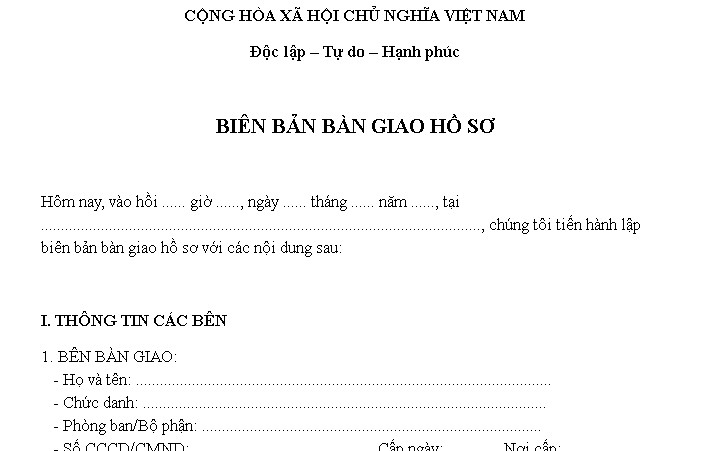
Download the General Document and File Handover Record Template Now
Template 2: Work Handover Record for Resignation/Transfer
When an employee resigns or transfers, a work handover record is a mandatory document to record all ongoing tasks, related files, progress, and handover instructions. This template helps the business maintain uninterrupted operations, clearly define the responsibilities of the former and new employee, avoid disputes over unfinished work, and comply with labor regulations when finalizing salary and bonuses.
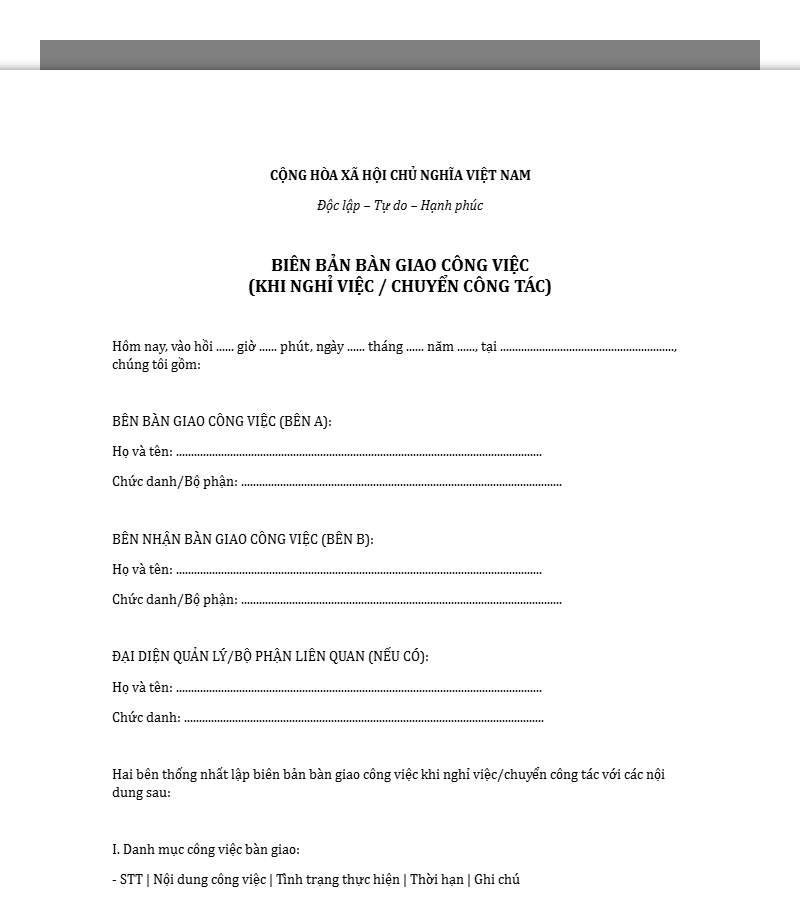
Download the Work Handover Record Template for Resignation/Transfer Now
Template 3: Accounting Document and File Handover Record
Handing over accounting files (ledgers, receipts and payment vouchers, financial statements, VAT invoices, etc.) requires high accuracy to ensure data integrity and compliance with the 2015 Law on Accounting. This template details the list of documents, quantities, accounting periods, and confidentiality commitments, helping the new accountant take over smoothly, supporting internal audits, and avoiding legal risks during tax inspections.
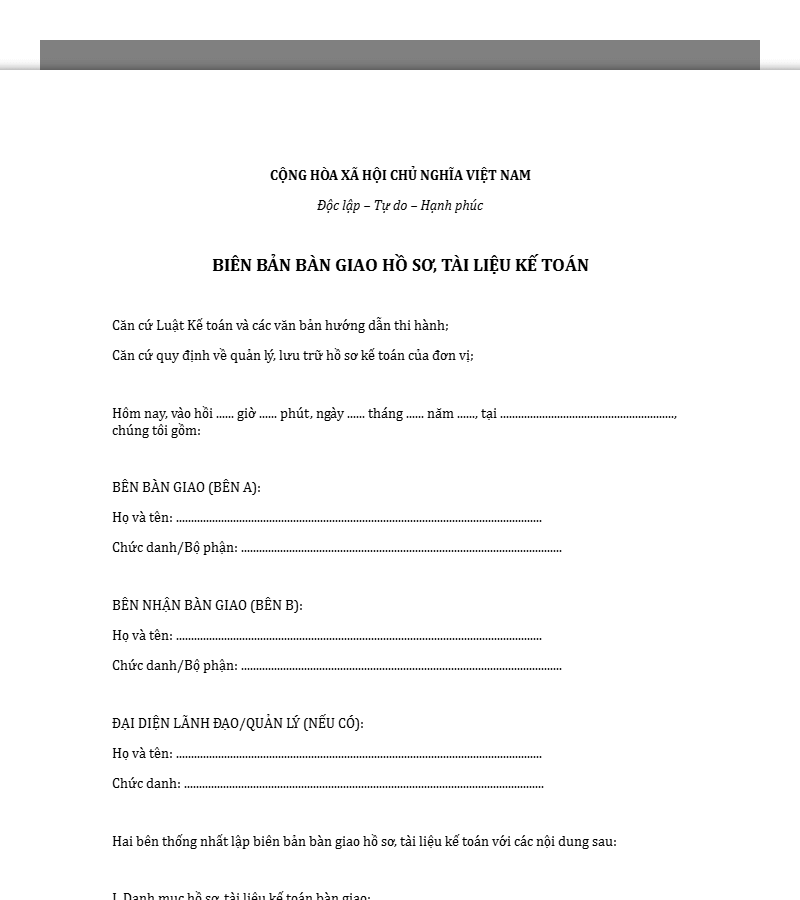
Download the Accounting Document and File Handover Record Template Now
Template 4: Asset, Tool, and Equipment Handover Record x
Handing over assets, tools, and equipment (computers, desks, chairs, work tools, office equipment, etc.) is a crucial step for controlling fixed assets and preventing loss during personnel or departmental changes. This template, with its detailed inventory of serial numbers, conditions, and book values, helps businesses manage assets tightly, determine compensation liability, and meet inventory requirements according to Circular 200/2014/TT-BTC.
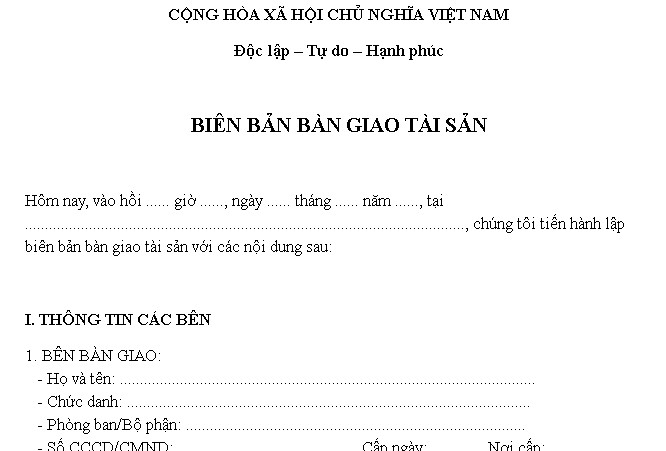
Download the Asset Handover Record Template Now
Template 5: Project/Contract File Handover Record x
At the end of a project or during a contract transfer, the project/contract file handover record documents all materials (drawings, progress reports, acceptance records, appendices, etc.) for the new party to continue implementation. This specialized template ensures project continuity, protects the rights of all parties under the 2015 Civil Code, and serves as a crucial legal basis in case of disputes over progress or payment.

Download the Project Document and File Handover Record Template Now
Template 6: Customer File Handover Record
Handing over customer files (contact information, transaction history, personalized contracts, etc.) requires strict adherence to data security regulations under the 2018 Cybersecurity Law. This template details the list of files, includes a commitment not to disclose information, and outlines data protection responsibilities, helping the business maintain customer relationships, avoid the risk of information leaks, and prevent lawsuits from customers.
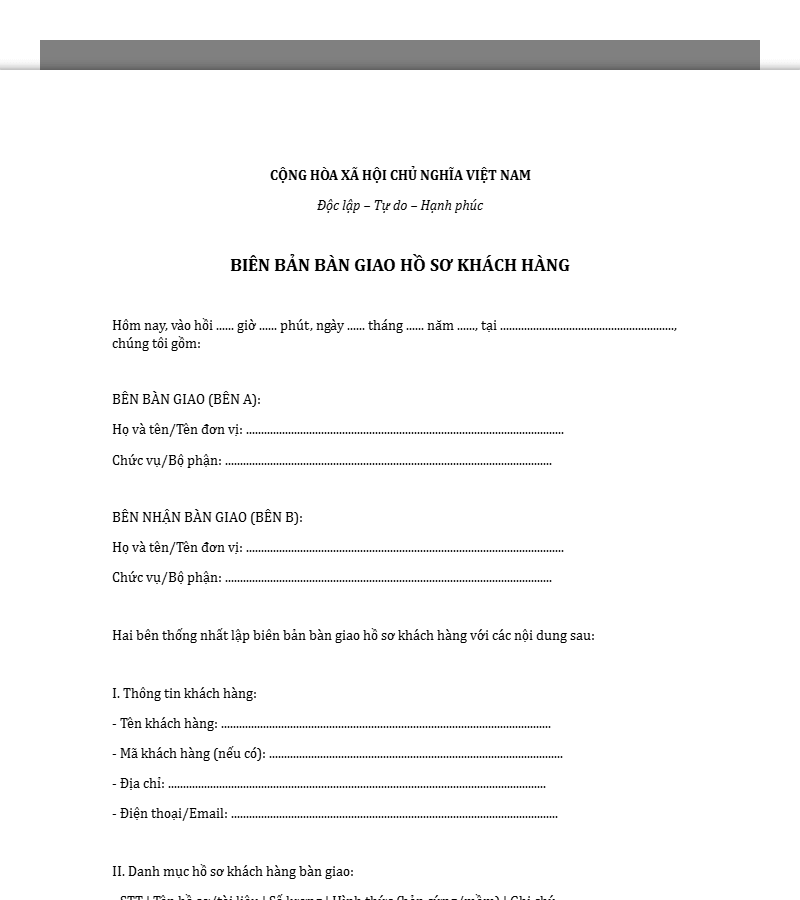
Download the Customer File Handover Record Template Now
Template 7: Confidential Document Handover Record
Confidential documents (business strategies, internal data, secret formulas, sensitive financial information, etc.) require a handover record with strict confidentiality commitments in accordance with the Law on Protection of State Secrets and the Law on Enterprises. This template records the list of documents, security measures (passwords, access rights), and legal consequences for violations, ensuring information security and protecting the company’s competitive advantage.
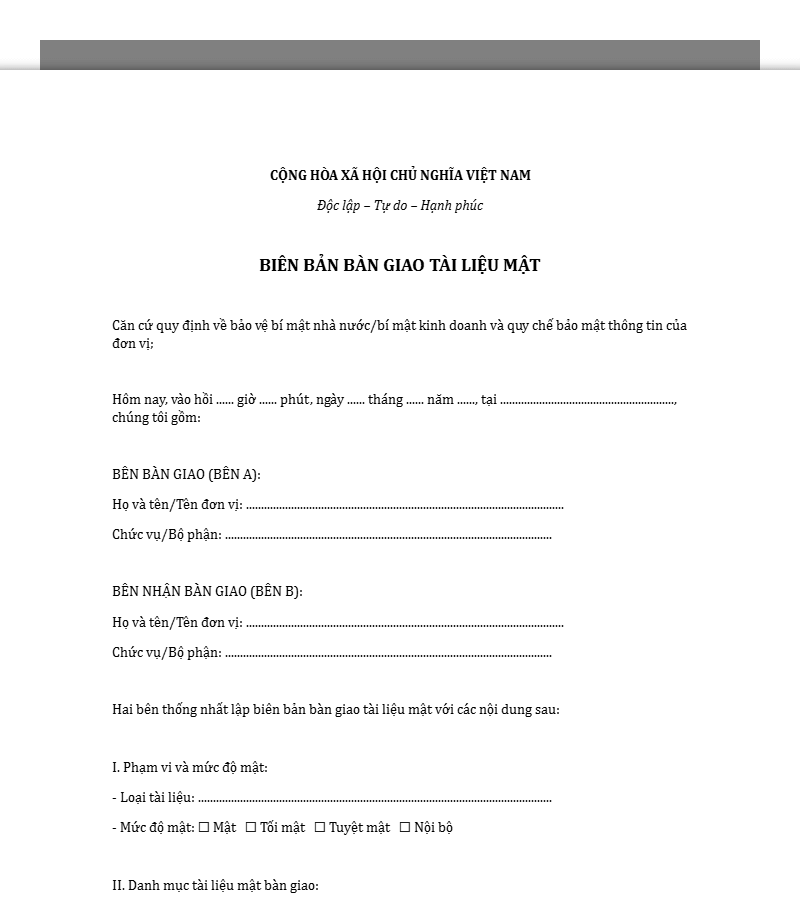
Download the Confidential Document Handover Record Template Now
Template 8: Recruitment Application File Handover Record
When transferring recruitment applicant files (CVs, cover letters, interview results, health certificates, etc.), a handover record helps the new HR department take over the process without missing any information. This template complies with the 2013 Law on Employment, details the list of files, personal data security status, and responsibilities for handling applicant data, avoiding the risk of labor disputes or privacy violations.

Download the Recruitment Application File Handover Record Template Now
Template 9: Handover Record for Legally Required Documents
Đối với hồ sơ pháp lý bắt buộc (hồ sơ lưu trữ quốc gia, hồ sơ hành chính sự nghiệp, tài liệu thuế…), biên bản bàn giao phải tuân thủ Luật Lưu trữ 2011 và Luật Kế toán. Mẫu chuẩn này đảm bảo đầy đủ thông tin pháp lý, chữ ký chứng kiến và lưu trữ vĩnh viễn, giúp cơ quan nhà nước, doanh nghiệp tránh sai sót khi thanh tra, kiểm toán và đáp ứng yêu cầu pháp luật về quản lý hồ sơ.
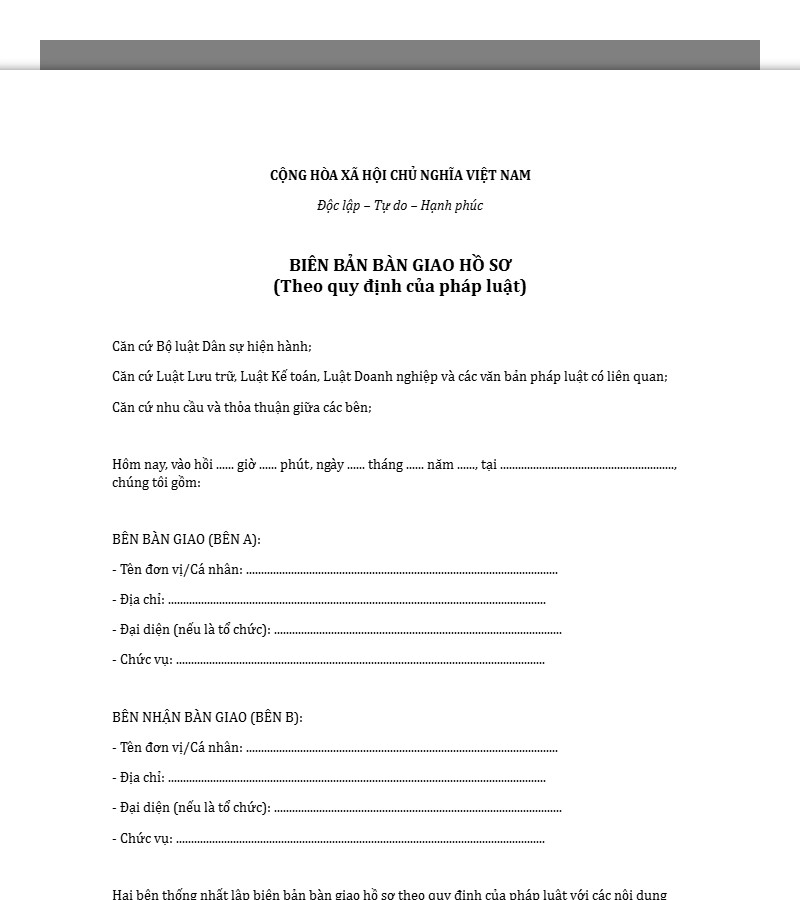
Tải Ngay Mẫu Biên Bản Bàn Giao Hồ Sơ Theo Quy Định Của Pháp Luật
Mẫu 10: Biên bản bàn giao hồ sơ, tài liệu song ngữ (Việt – Anh)
Trong doanh nghiệp quốc tế hoặc dự án có đối tác nước ngoài, biên bản bàn giao hồ sơ song ngữ (Việt – Anh) giúp tránh hiểu lầm ngôn ngữ, đảm bảo tính chính xác nội dung. Mẫu này trình bày song song hai ngôn ngữ, ghi chi tiết danh mục tài liệu, thuật ngữ chuyên ngành và cam kết dịch thuật chính xác, phù hợp cho bàn giao hợp đồng quốc tế, hồ sơ dự án FDI theo quy định thương mại quốc tế và pháp luật Việt Nam.
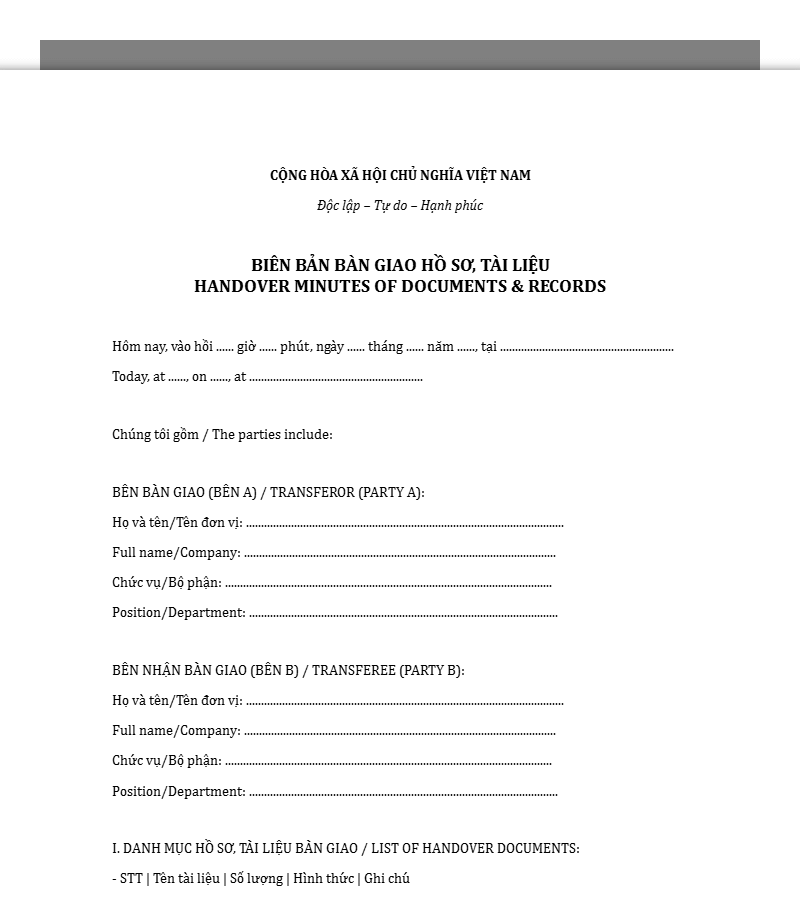
Tải Ngay Mẫu Biên Bản Bàn Giao Hồ Sơ, Tài Liệu Song Ngữ
5. Quy Trình Bàn Giao Hồ Sơ Chuyên Nghiệp, Hiệu Quả
Bàn giao hồ sơ (dự án, kế toán, nhân sự, hợp đồng…) là quy trình quan trọng để đảm bảo tính liên tục công việc, tránh thất lạc tài liệu và giảm thiểu tranh chấp pháp lý sau này. Một quy trình chuyên nghiệp không chỉ giúp bên giao “thoát trách nhiệm” mà còn hỗ trợ bên nhận nhanh chóng nắm bắt, tiếp tục xử lý. Dưới đây là quy trình bàn giao hồ sơ chuẩn 3 bước (chuẩn bị – thực hiện – theo dõi), được áp dụng rộng rãi trong doanh nghiệp, cơ quan nhà nước tại Việt Nam năm 2026, giúp tối ưu hóa thời gian, minh bạch hóa trách nhiệm và tuân thủ quy định pháp luật (Luật Lưu trữ 2011, Luật Kế toán 2015).
Bước 1: Chuẩn bị trước bàn giao
Chuẩn bị kỹ lưỡng là yếu tố quyết định thành công 80% quy trình, giúp tránh thiếu sót và tranh cãi sau này.
- Kiểm kê, sắp xếp, phân loại hồ sơ, tài liệu:
- Liệt kê toàn bộ hồ sơ theo danh mục (hợp đồng gốc, biên bản họp, báo cáo tài chính, tài liệu số/USB…).
- Phân loại: Bản gốc (giữ nguyên), bản sao công chứng, file điện tử (scan PDF, Google Drive/OneDrive).
- Kiểm tra tình trạng: Không rách nát, đầy đủ trang, không thiếu phụ lục. Sử dụng checklist Excel để đánh dấu (Đầy đủ/Thiếu/Khác).
- Thời gian: Hoàn thành ít nhất 3–5 ngày trước bàn giao.
- Lập danh mục chi tiết các hạng mục cần bàn giao:
- Sử dụng bảng Excel/Word với cột: STT, Tên hồ sơ, Số lượng, Tình trạng, Nội dung chính, Ghi chú (thời hạn hiệu lực, mật khẩu file…).
- Ví dụ: “Hợp đồng số 01/HĐDV-2025 (01 bản gốc + 02 bản sao, đầy đủ, hiệu lực đến 31/12/2026)”.
- Đính kèm ảnh chụp bìa hồ sơ hoặc file scan làm phụ lục.
- Thông báo và thống nhất thời gian, địa điểm với bên nhận:
- Gửi thông báo chính thức (email, văn bản nội bộ) ít nhất 3–7 ngày trước, nêu rõ thời gian (ví dụ: 9h sáng ngày 10/01/2026), địa điểm (phòng họp/zoom nếu trực tuyến).
- Mời thêm người chứng kiến (trưởng phòng, kế toán trưởng) để tăng tính khách quan.
Bước 2: Thực hiện bàn giao
Thực hiện trực tiếp, kiểm tra chéo để đảm bảo không sai sót.
- Kiểm tra chéo nội dung theo danh mục:
- Hai bên cùng mở hồ sơ, kiểm tra từng mục (đọc lướt nội dung chính, đếm số trang/bản).
- Với tài liệu số: Cùng mở file, kiểm tra mật khẩu, dung lượng, không bị lỗi.
- Phát hiện thiếu sót/hư hỏng: Ghi ngay vào danh mục và thỏa thuận khắc phục (bổ sung/bồi thường).
- Lập biên bản với đầy đủ thông tin:
- Sử dụng mẫu chuẩn (quốc hiệu, thông tin các bên, bảng danh mục, cam kết).
- Đọc to biên bản trước khi ký, ghi “Không có ý kiến khác” hoặc bổ sung nếu cần.
- Đính kèm danh mục checklist và ảnh/video kiểm tra làm phụ lục.
- Ký xác nhận của các bên:
- Tất cả ký tay (bên giao, bên nhận, chứng kiến), ghi rõ họ tên, chức danh.
- Doanh nghiệp đóng dấu công ty. Lập 03 bản (mỗi bên giữ 01, bản lưu hồ sơ).
- Nếu trực tuyến: Sử dụng chữ ký số (VNPT-CA, Viettel-CA) theo Nghị định 130/2018/NĐ-CP.
Bước 3: Sau bàn giao
Theo dõi để đảm bảo quy trình hoàn tất và giải quyết kịp thời vấn đề.
- Lưu trữ biên bản cẩn thận:
- Bản cứng: Lưu tủ hồ sơ (phòng hành chính/kế toán), phân loại theo năm/tháng.
- Bản mềm: Scan màu (PDF), lưu Google Drive/OneDrive với quyền truy cập hạn chế, backup định kỳ.
- Thời hạn: Ít nhất 10 năm (Luật Kế toán) hoặc vĩnh viễn nếu hồ sơ lưu trữ quốc gia (Luật Lưu trữ).
- Hướng dẫn, hỗ trợ bên nhận (nếu cần):
- Hướng dẫn sử dụng hồ sơ (cách tra cứu, mật khẩu file, phần mềm liên quan).
- Lên lịch hỗ trợ 1–2 tuần đầu (họp trực tuyến, Q&A) để bên nhận làm quen.
- Theo dõi và giải quyết các vấn đề phát sinh:
- Cập nhật tiến độ sử dụng hồ sơ (email hàng tuần nếu dự án lớn).
- Nếu phát hiện thiếu sót: Lập biên bản bổ sung, bên giao bồi thường (scan lại, cung cấp bản sao).
- Báo cáo lãnh đạo nếu có tranh chấp, hòa giải nội bộ trước khi kiện tụng (thời hiệu 3 năm theo BLDS 2015).
Lưu ý chung cho toàn quy trình:
- Thời gian toàn bộ: 5–10 ngày (chuẩn bị 3 ngày, bàn giao 1 ngày, theo dõi 3–5 ngày).
- Công cụ hỗ trợ: Checklist Excel, phần mềm quản lý tài liệu (Base.vn, 1Office, MISA).
- Rủi ro phổ biến: Thiếu chữ ký bên nhận → Không ký nếu chưa kiểm tra kỹ; hồ sơ số bị xóa → Backup 3 bản (cloud, USB, ổ cứng).
Quy trình này đảm bảo bàn giao hồ sơ chuyên nghiệp, không gián đoạn công việc và an toàn pháp lý.

6. Câu Hỏi Thường Gặp Về Biên Bản Bàn Giao Hồ Sơ
Dưới đây là các câu trả lời ngắn gọn, thực tiễn dựa trên quy định pháp luật Việt Nam hiện hành (tính đến ngày 01/01/2026), kết hợp kinh nghiệm áp dụng trong doanh nghiệp, cơ quan nhà nước và giao dịch dân sự.
Biên bản bàn giao hồ sơ có cần công chứng không?
Không bắt buộc.
Biên bản bàn giao hồ sơ là văn bản thỏa thuận nội bộ hoặc giữa các bên, không thuộc danh mục văn bản bắt buộc phải công chứng theo Luật Công chứng 2014 (sửa đổi, bổ sung). Chỉ cần chữ ký tay đầy đủ của các bên (bên giao, bên nhận, người chứng kiến nếu có) và đóng dấu (nếu là pháp nhân/doanh nghiệp) là biên bản đã có giá trị pháp lý đủ để làm chứng cứ trước tòa án hoặc cơ quan nhà nước.
Tuy nhiên nên công chứng trong các trường hợp:
- Hồ sơ liên quan đến tài sản giá trị lớn (hợp đồng bất động sản, quyền sở hữu trí tuệ).
- Bàn giao giữa các cá nhân không quen biết hoặc có yếu tố tranh chấp tiềm ẩn.
- Hồ sơ lưu trữ quốc gia hoặc tài liệu quan trọng theo Luật Lưu trữ.
Nếu bên nhận không đồng ý ký biên bản thì sao?
Không thể ép buộc ký, vì biên bản dựa trên sự tự nguyện (Điều 117 Bộ luật Dân sự 2015).
Cách xử lý chuẩn và được công nhận pháp lý:
- Ghi rõ lý do không ký vào biên bản (ví dụ: “Bên nhận từ chối ký vì cho rằng thiếu hồ sơ X”).
- Mời thêm người chứng kiến thứ ba (trưởng phòng, kế toán trưởng, đại diện công đoàn) hoặc đại diện UBND phường/xã (nếu nhạy cảm) để chứng kiến việc lập biên bản và từ chối ký.
- Lập biên bản một phía ghi nhận sự việc, kèm chữ ký người chứng kiến.
- Bên giao gửi biên bản cho bên nhận qua văn bản (email có xác nhận, thư bảo đảm) để yêu cầu xác nhận lại trong thời hạn hợp lý (7–15 ngày).
- Nếu vẫn không ký, lưu biên bản làm chứng cứ và báo cáo lãnh đạo để xử lý nội bộ hoặc khởi kiện nếu cần (thời hiệu 3 năm).
Recommendation: Always take photos/videos of the handover and document inspection process to increase persuasiveness.
How to ensure the legal validity of an electronic handover record?
Electronic records can be created and have legal validity equivalent to paper versions if they meet the regulations.
According to the 2005 Law on Electronic Transactions (amended 2023) and Decree 130/2018/ND-CP (on digital signatures):
- Use a valid digital signature (issued by a public Certificate Authority: VNPT-CA, Viettel-CA, BKAV-CA…).
- The record file must be in PDF/A format and remain unmodified (to ensure integrity).
- Attach a list of documents (scanned files, Google Drive link with access permissions).
- Store electronically on a secure system with regular backups.
Note: For important documents (accounting, legal), it is still advisable to print them out for a wet signature alongside the digital signature to increase persuasiveness before state authorities. Large enterprises often use document management software (Base.vn, 1Office) to automate digital signing.
How long should handover records be stored?
The storage period depends on the type of document:
- Accounting and financial records: At least 10 years (2015 Law on Accounting, Article 41).
- National archives (state project files, important documents): Permanently or for at least 70 years (2011 Law on Archives).
- General internal records (personnel files, civil projects): Recommended for at least 5–10 years (the statute of limitations for civil lawsuits is 3 years according to Article 429 of the 2015 Civil Code).
Storage methods:
- Hard copies: Store in filing cabinets, sorted by year/month.
- Soft copies: Scan in color to PDF, save to secure cloud storage (Google Drive, OneDrive with passwords).
- Prioritize dual storage (hard copy + electronic copy) to prevent loss.
Is a witness required for the handover?
Not mandatory in all cases, but highly recommended when:
- Handing over important, high-value documents (contracts worth hundreds of millions, legal documents).
- Handing over upon resignation or job transfer (where liability disputes are likely to arise).
- There are sensitive elements involved (confidential files, customer data).
Role of the witness:
- Confirm that the handover process was objective and complete.
- Act as a witness in court or before inspection agencies in case of a dispute.
- Sign the record to confirm (clearly stating full name, title, and ID card number).
Practical recommendation: Always invite 1–2 witnesses (e.g., department head, chief accountant, union representative) to increase persuasiveness and reduce risks.
















