


 09/05/2026
  162 views
Contract liquidation minutes – the ‘key’ to terminating a contract without legal repercussions. From sales, construction, and lease agreements to loan contracts, a standard record will help you confirm the fulfillment of obligations, commit to no disputes, and protect your rights to the fullest. Let’s explore a detailed guide, the legally compliant process for creating these minutes, and the latest set of contract liquidation templates, available for free download and immediate use!
Mục lục
- 1. What Are Contract Liquidation Minutes?
- 2. What is the Legal Basis for Creating Contract Liquidation Minutes?
- 3. Basic Structure & Content of a Contract Liquidation Record
- 4. Common Contract Liquidation Record Templates
- 5. Process for Contract Liquidation Records
- 6. Câu Hỏi Thường Gặp Về Biên Bản Thanh Lý Hợp Đồng
1. What Are Contract Liquidation Minutes?
Contract liquidation minutes are a legal document (often in the form of a memorandum of agreement) created by the contracting parties to confirm the completion (or termination) of the rights and obligations arising from a previously signed contract.
Simply put: This is the “final confirmation” that both parties have completed (or agreed to stop) what they committed to, and are no longer bound to each other (except for certain special obligations that remain in effect, such as warranties, confidentiality, etc.).
Clear Distinction from Contract Termination and Contract Cancellation
- Contract Liquidation → Usually applied when the contract has been successfully completed (or the parties voluntarily agree to terminate without serious fault). The liquidation minutes record an amicable conclusion, confirming no further disputes and that obligations are fulfilled.
- Contract Termination (under Article 422 of the 2015 Civil Code) → This is when a contract ceases to be effective for various reasons: expiration of the term, achievement of the purpose, mutual agreement, death/loss of legal capacity of a party, or a fundamental change in circumstances… Fault is not necessarily involved.
- Contract Cancellation (Articles 423, 424 of the 2015 Civil Code) → Occurs only when one party seriously breaches its obligations (or violates a pre-agreed cancellation condition). Consequence: the contract becomes invalid from the time of its conclusion, parties must return what they have received, and compensate for damages (if any).
Liquidation is a “happy ending, confirming the job is done,” termination is “expiring or stopping according to general rules,” and cancellation is a “penalty” for a serious breach.

Role and Legal Significance of Contract Liquidation Minutes
- Officially terminates rights and obligations: After signing the minutes, the parties are no longer bound by the contract (except for clauses that remain in effect, such as warranties, confidentiality, dispute resolution, etc.). This provides a basis for the parties to release their responsibilities, close their books, and finalize financial settlements.
- Serves as important legal evidence: The minutes have the value of a supplementary agreement (termination agreement) and are recognized by courts and state agencies if created through the proper process (voluntary, not contrary to law).
- Prevents future disputes: The minutes clearly state that the parties have fulfilled all obligations and have no further claims → helping to avoid unnecessary future disputes (e.g., one party suddenly demanding more money or compensation…).
The Importance of Creating Liquidation Minutes to Avoid Disputes
In Vietnamese business practice, many disputes arise precisely because liquidation minutes are not created or are drafted poorly:
- One party claims that obligations have not been fulfilled (even though they have been).
- Disputes over final payment, quality of work, or handed-over assets.
- Difficulty in providing proof during audits, tax finalization, or when there are changes in personnel/leadership.
Creating standard liquidation minutes (with complete information of the parties, basis for termination, confirmation of completion, commitment to no disputes, signatures, and seals) helps to:
- Protect the interests of both parties.
- Minimize future legal risks.
- Serve as solid evidence if litigation occurs later.
In summary, although Vietnamese law (the 2015 Civil Code) does not mandate the creation of liquidation minutes, it is a professional practice and the most effective measure to prevent disputes in reality. Parties should always create these minutes when a contract ends to ensure a “clean and safe conclusion.”
2. What is the Legal Basis for Creating Contract Liquidation Minutes?
According to the 2015 Civil Code (which remains the primary legal document for civil contracts as of 2025), a contract terminates in the cases clearly specified in Article 422:
Cases of Contract Termination under the 2015 Civil Code (Article 422)
A contract terminates in the following cases:
- The contract has been completed (the parties have fulfilled all obligations).
- By agreement of the parties (the parties can voluntarily terminate at any time, unless prohibited by law).
- The individual entering into the contract dies or the legal entity ceases to exist (if the contract must be performed by that specific individual/entity).
- The contract is cancelled or unilaterally terminated.
- The contract cannot be performed because its subject matter no longer exists.
- The contract terminates as prescribed in Article 420 (fundamental change in circumstances).
- Other cases as prescribed by law.
Note: Contract cancellation (Article 423) is one of the grounds for termination, occurring when one party seriously breaches its obligations, violates a pre-agreed cancellation condition, or in other cases prescribed by law (delay in performance, inability to perform, loss of/damage to the subject asset…).
Are Contract Liquidation Minutes Mandatory?
Not mandatory according to legal regulations.
The 2015 Civil Code does not contain any provision requiring parties to create contract liquidation minutes. The creation of these minutes is voluntary, based on the agreement of the parties.
However, in business and judicial practice in Vietnam, liquidation minutes are strongly encouraged because:
- They clearly confirm the fulfillment of obligations, financial settlement, and asset handover.
- They prevent future disputes (one party cannot demand more money, complain about quality, etc.).
- They serve as solid legal evidence during audits, tax finalization, or in the event of litigation.
Liquidation minutes should be created in the following cases:
- High-value contracts (construction, sale of goods, services, asset leases, etc.).
- Involving multiple payments, or the handover of assets and equipment.
- The parties want a “clean break” to avoid the risk of disputes.
- Contracts involving state agencies or state-owned enterprises (which often require strict procedures).
They are not necessary if:
- The contract is simple, of low value, and the parties have absolute trust in each other.
- The contract already specifies “automatic liquidation upon fulfillment of obligations” and no disputes have arisen.
Clearly Distinguishing the Concepts
| Concept | Main Definition | Legal Basis | Main Legal Consequences | Who Decides? | Damages? |
| Contract Liquidation | Confirmation of completion/amicable termination agreement, parties are no longer bound (usually accompanied by minutes/a record). | Agreement of the parties (usually under Article 422, Clause 2) | The contract ends, no further obligations (except for warranty, confidentiality…). No disputes. | Both parties voluntarily agree | Usually not (if amicable) |
| Contract Termination | The contract becomes invalid due to general grounds (completion, agreement, death of a party, fundamental change…). | Article 422 of the 2015 Civil Code | The contract becomes invalid from a certain point in time, the parties do not continue to perform. | As prescribed by law or by agreement | Depends on the case |
| Contract Cancellation | One party (or both) cancels due to a serious breach, defeating the purpose of the contract. | Article 423 of the 2015 Civil Code | The contract is void from the time of its conclusion, the parties return to each other what they have received, and compensate for damages. | Usually one party (conditional) | Yes (if the other party is in breach) |
| Unilateral Termination of Contract Performance | One party unilaterally terminates performance due to a serious breach by the other party. | Article 428 of the 2015 Civil Code | The contract is terminated from the time the other party receives notice, no further obligations (except for penalties, damages, dispute resolution). The performing party is paid for the work done. | One party (conditional) | Yes (if there is a breach) |
In summary:
- Liquidation is an “amicable termination” procedure (creating a record is recommended).
- Termination is a general concept.
- Cancellation and unilateral termination are penalties for serious breaches, often leading to compensation and more severe consequences.

3. Basic Structure & Content of a Contract Liquidation Record
A complete contract liquidation record must comply with the common administrative document format in Vietnam, while also ensuring it contains all necessary legal information to have the highest evidentiary value. Below is the standard structure and basic content:
- National Emblem, Motto, and Title
SOCIALIST REPUBLIC OF VIETNAM
Independence – Freedom – Happiness
CONTRACT LIQUIDATION RECORD
(Re: Liquidation of contract ………………… No. ………………… dated … / … / …)
- Detailed Information of the Participating Parties
- Party A (usually the main contracting party or the provider): Company/Individual Name: ……………………………………………………………… Head Office/Permanent Address: ……………………………………………… Tax ID (if any): ……………………………………………………………… Legal/Authorized Representative: Mr./Ms. …………………………………… Position: …………………………………………………………………………… ID Card/Citizen ID No.: ……………………………………………………………
- Party B (the other party): Same as above.
- Legal Basis
- Pursuant to the 2015 Civil Code (Article 422, 428…);
- Pursuant to Contract No. ……… dated … / … / … (and its appendices, if any);
- Pursuant to the parties’ agreement on contract liquidation;
- Pursuant to related documents and records (if any, e.g., acceptance record, handover record…).
- Reason for Contract Liquidation
- The parties have fully completed their obligations under the contract.
- Or: The parties voluntarily agree to terminate the contract (not due to a breach).
- Or: One of the grounds for termination under Article 422 of the Civil Code (specify the reason).
- Scope of Work Performed Under the Contract
Briefly and clearly describe the main tasks performed:
- Scope of work/services/goods provided.
- Performance period.
- Contract value and completed payments (amount, payment date, method).
Example:
“Party A has fully supplied and installed the equipment system as per contract No. … dated …; Party B has accepted and paid 100% of the contract value.”
- Status of Obligation Fulfillment by Each Party
- Party A: Has completed all obligations of supply, handover, and warranty (if any).
- Party B: Has made full payment and received the assets/documents as agreed.
- No outstanding obligations remain (or list them if any).
- Remaining Obligations (if any)
- Warranty obligation still in effect: … months from the handover date.
- Confidentiality obligation.
- Outstanding debt (if any): … VND, payment deadline …
- Handover of remaining documents, records, and assets.
- Confirmation of No Further Claims or Disputes
The parties agree to confirm that:
- All rights and obligations arising from the contract have been fulfilled.
- There are no further claims, disputes, demands for compensation, or any other obligations related to this contract after signing this liquidation record.
- This record serves as the basis for the complete release of responsibilities for all parties.
- General Provisions & Validity of the Record
- This record is made in … copies of equal legal validity, with each party keeping … copy/copies.
- This record is effective from the date of signing.
- Any amendments or supplements must be made in writing and signed by the parties.
- Signatures, Full Names, Titles, and Seals (if any)
REPRESENTATIVE OF PARTY A REPRESENTATIVE OF PARTY B
(Sign, print full name, and affix seal if any) (Sign, print full name, and affix seal if any)
Hanoi, date … / … / 2025
Notes on Drafting
- Use clear, objective language, avoiding commentary.
- Attach appendices if necessary (acceptance record, invoices, handover record…).
- If there are minor disputes, they should be resolved before signing the liquidation record.
- For businesses, the company seal should be affixed to enhance legal validity.
4. Common Contract Liquidation Record Templates
Below is a set of 6 of the most common contract liquidation record templates in Vietnam, drafted in the correct administrative format and easily editable in Word. Each template comes with detailed filling instructions and a free download link (from reputable legal sources). Simply download, fill in your actual information, print, sign, and affix a seal (if necessary).
4.1. General Contract Liquidation Record Template (Applicable to all contract types)
When a civil, commercial, or service contract concludes without any disputes, a general liquidation record is the most crucial document for the parties to officially confirm the completion of obligations, release responsibilities, and avoid future legal risks. This flexible template applies to most contract types, helping you ‘close the books’ quickly, professionally, and safely in accordance with the 2015 Civil Code.
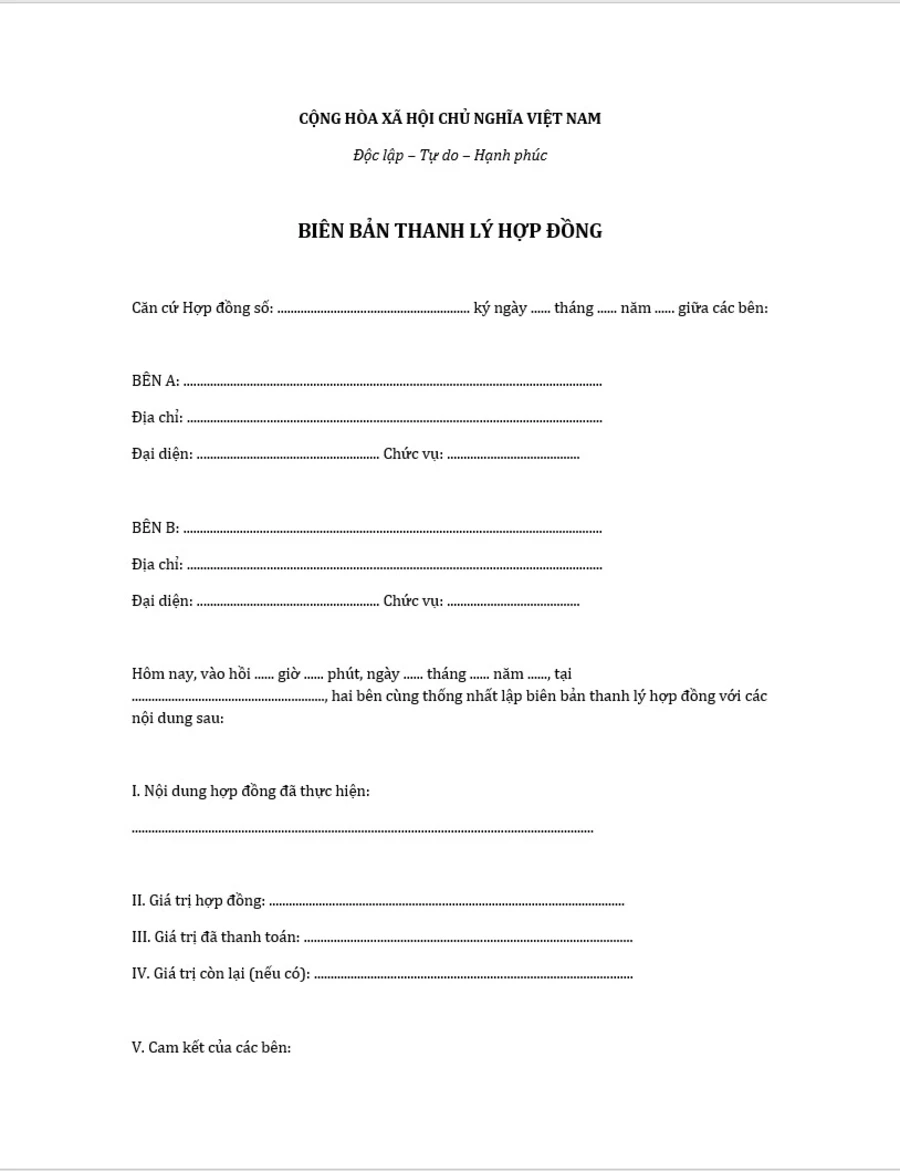
Download the Contract Liquidation Record Template
4.2. House/Warehouse Lease Contract Liquidation Record Template (Most Detailed)
At the end of a lease term for a house, warehouse, or business premises, the lease contract liquidation record is the final, essential step to hand over the premises in its original condition, return the security deposit, and settle utility bills and other incurred fees. This standard template helps landlords and tenants avoid disputes over the property’s condition, ensuring everything concludes clearly and transparently.
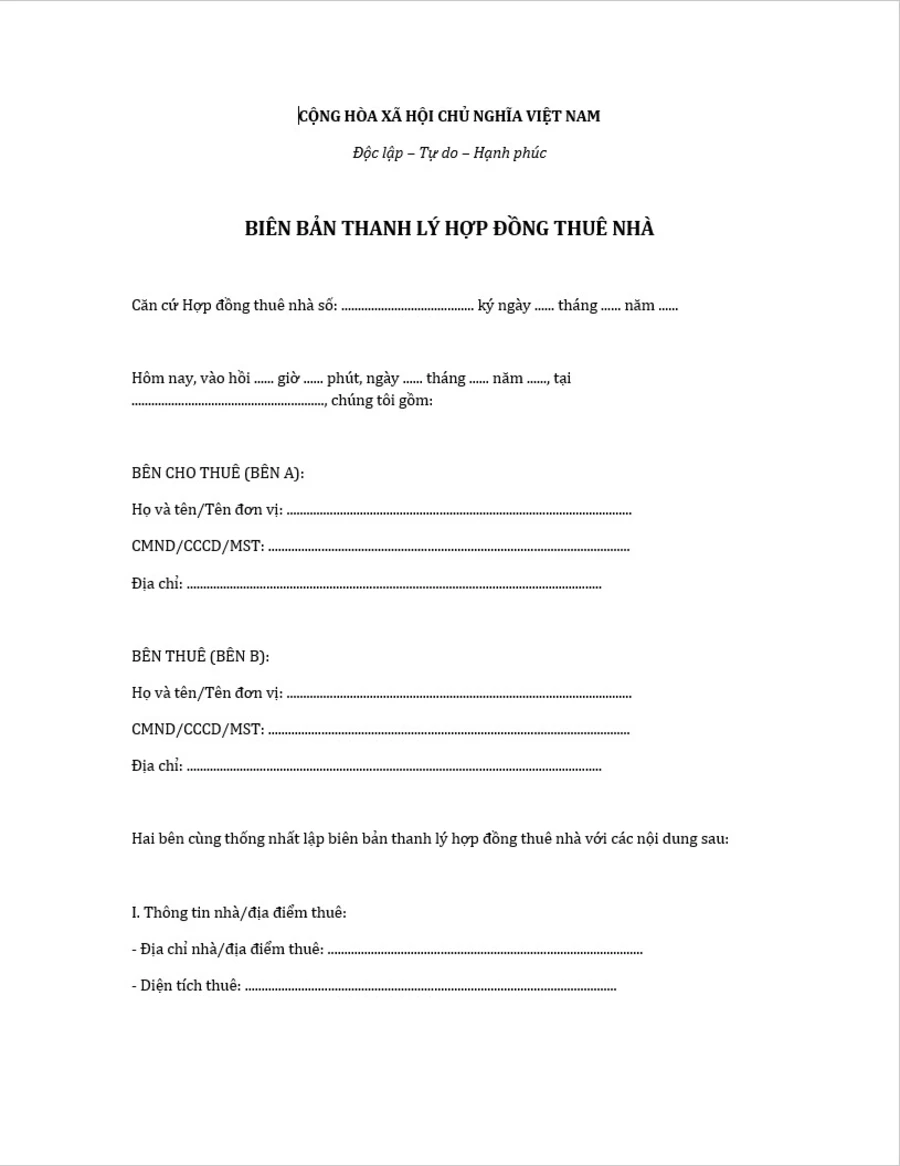
Download the House/Warehouse Lease Contract Liquidation Record Template
4.3. Goods and Services Purchase Contract Liquidation Record Template
After goods have been delivered, accepted, and paid for in full, the goods purchase contract liquidation record serves as the final ‘confirmation’ of quantity, quality, invoices, and the absence of outstanding debt. This template is particularly useful in commercial transactions, helping businesses finalize accounts quickly, archive accounting records, and protect their interests for future reference.
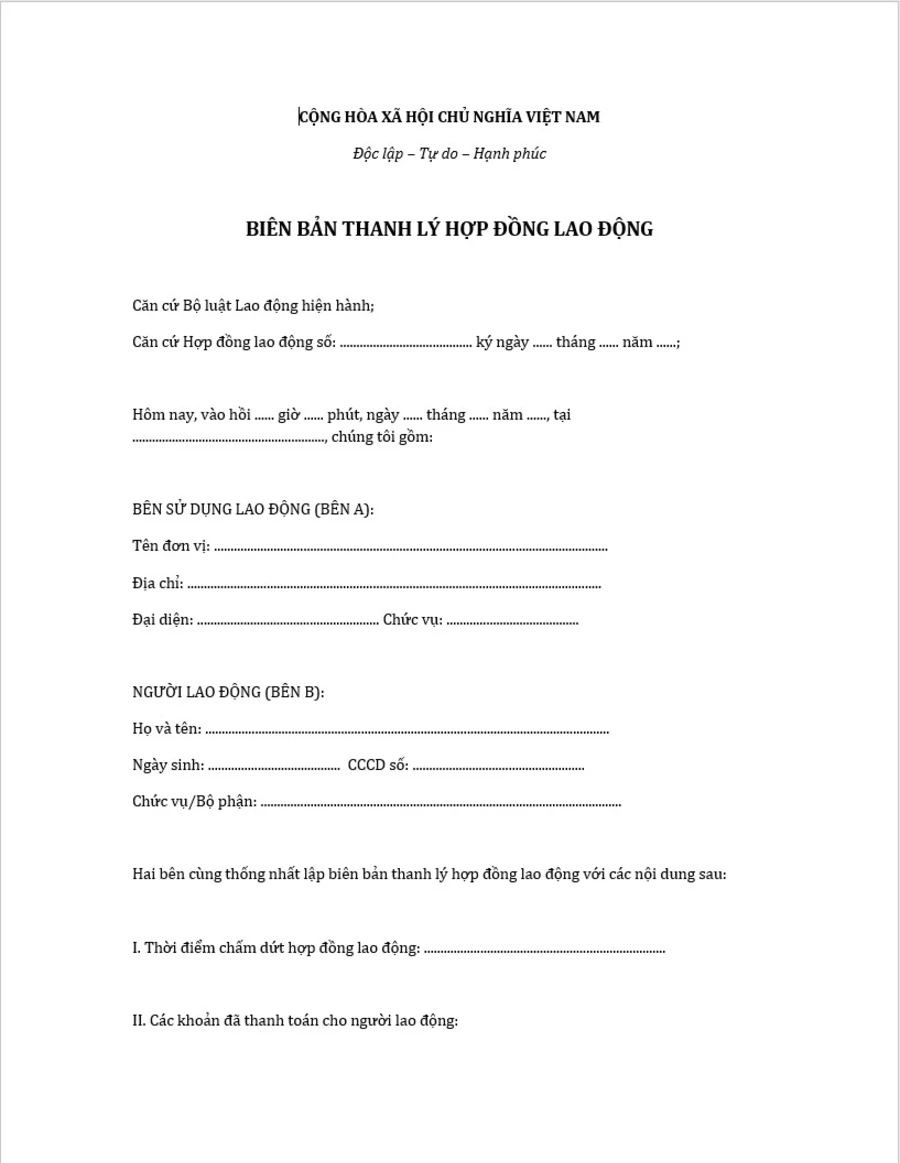
Download Labor Contract Liquidation Record Template
4.6. Construction/Execution Contract Liquidation Record Template
-
After the project is completed, accepted, and 100% settled, the construction contract liquidation record is a mandatory document to record the project’s quality, warranty, final payment, and confirm that there are no further claims. This detailed template helps the investor and contractor achieve a “clean break,” minimizing the risk of disputes over quality, volume, or incurred costs.
General notes when using the templates:
- Fill in information accurately, avoid erasures.
- Prepare 02–03 copies, with each party keeping one.
- Sign by hand and affix a seal (if it’s a business).
- Attach appendices (invoices, acceptance records, handover photos, etc.) to increase evidentiary value.
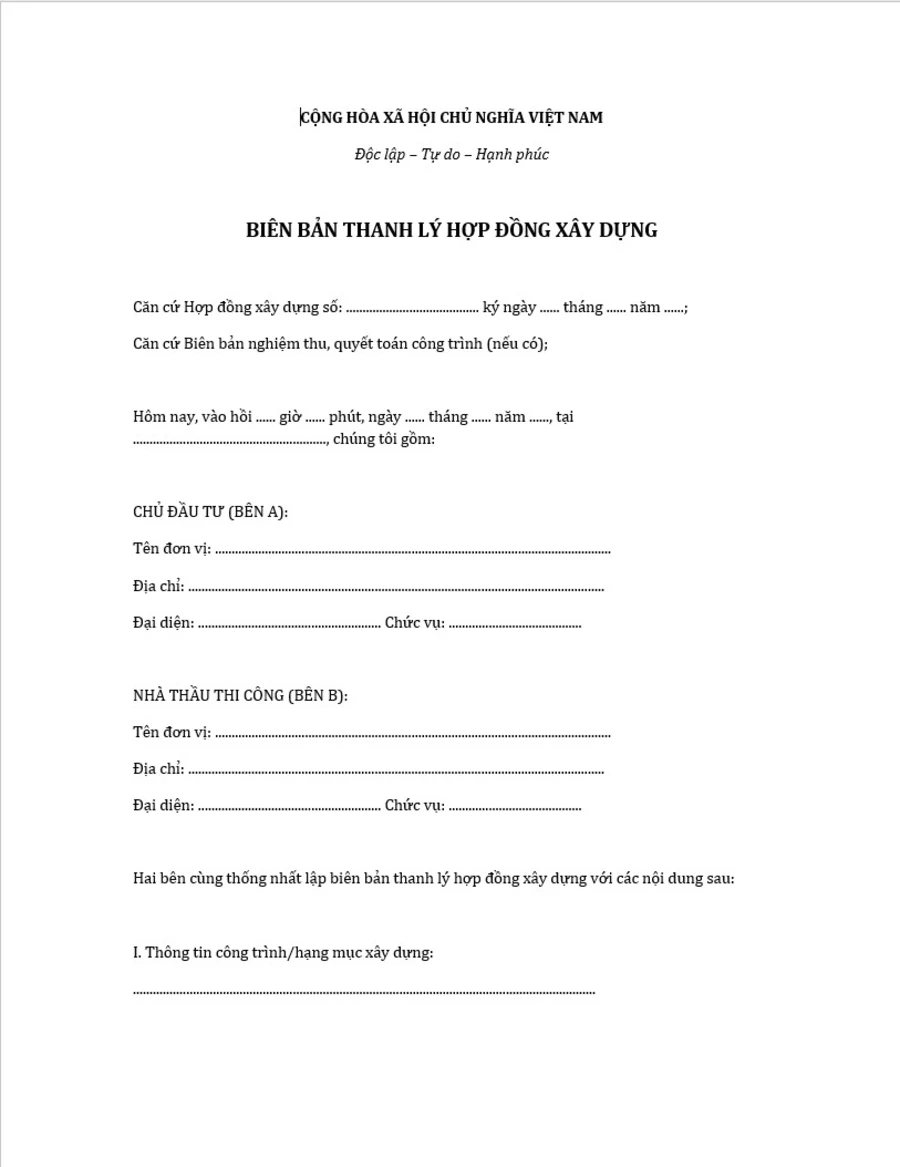
Download Construction Contract Liquidation Record Template
5. Process for Contract Liquidation Records
The creation and signing of a contract liquidation record must be done carefully and according to the correct procedure to ensure legal validity and avoid future disputes. Below is a detailed guide, updated according to Vietnamese legal practices as of December 31, 2025.
5.1. Step-by-step process
- Review the original contract and its appendices
- Check the entire contract, appendices, acceptance records, payment invoices, and asset handover records (if any).
- Clearly identify obligations that have been completed, are incomplete, or remain in effect (warranty, confidentiality, post-handover support).
- Note: Cross-reference with the actual execution to avoid missing any payments or handovers.
- List completed and remaining obligations
- Create a detailed settlement statement: amount paid, outstanding debt, assets handed over, quality status.
- Record any penalties or bonuses (if any) that have been deducted or added.
- Both parties review and agree on the final figures.
- Agree on the liquidation terms with the partner
- Organize a meeting or discussion (in-person/online) to agree on:
- The reason for liquidation (completion, termination by agreement).
- Confirmation of no further claims or disputes.
- Remaining obligations (warranty, confidentiality).
- Record audio/video if necessary (as supplementary evidence).
- Organize a meeting or discussion (in-person/online) to agree on:
- Draft and review the record
- Use a standard template (like the ones provided in section 4).
- Fill in all information: parties, basis, completed content, commitment of no disputes.
- Check carefully: objective language, no contradictions, no erasures.
- Attach appendices if needed (invoices, acceptance records, handover photos, etc.).
- Sign and seal
- The signatory must be a legal representative (with a power of attorney if authorized).
- Sign by hand (full name, title), and affix the company seal (if a legal entity).
- Prepare 02–03 copies of equal legal validity.
- Archive the records
- Each party keeps at least one original copy.
- Scan in color, save as a digital file (PDF with a digital signature if applicable).
- Store for at least 10 years (or longer depending on the contract’s value – according to the Law on Accounting, Law on Archives).
5.2. Important legal considerations
- Ensure voluntariness, no coercion: The record is only valid when the parties sign voluntarily, without being threatened or deceived (Article 117 of the 2015 Civil Code).
- Verify the legal capacity of the signatory:
- Legal representative (Director, Chairman of the Members’ Council).
- If authorized: There must be a valid, effective power of attorney.
- Clearly define the termination date of the original contract:
- Usually stated as: “The contract is terminated effective from the date of signing this liquidation record.”
- Avoid ambiguous wording to prevent disputes about the timing.
- Clauses on confidentiality and dispute resolution after liquidation:
- Remain in effect (often explicitly stated: “The confidentiality and dispute resolution clauses of the original contract shall remain in effect”).
- Ensure a sufficient number of copies with equal legal validity: Clearly state “This record is made in 03 copies of equal legal validity, with each party keeping one copy.”
5.3. Common mistakes and how to fix them
| Common Mistakes | Potential Consequences | How to Fix |
| Not attaching evidence appendices (invoices, acceptance records) | Difficult to prove in case of a dispute | Always list and attach appendices, clearly stating “See Appendix 01, 02…” |
| Vague wording regarding debts or handover status | One party may demand more money later | Specify the exact amount, payment date, “as-is” condition, or describe any damages |
| The signatory lacks representative authority | The record becomes invalid | Check the power of attorney and job title before signing |
| Not clearly stating the “no further claims” commitment | Prolonged disputes after liquidation | Add a standard clause: “The parties have no further claims or disputes related to the contract” |
| Corrections or erasures on the original document | Loss of evidentiary value | Create a new record or a supplementary appendix, and have all parties re-sign for confirmation |
5.4. Ký kết Biên bản thanh lý hợp đồng điện tử: Căn cứ pháp lý và lợi ích
Căn cứ pháp lý (tính đến 31/12/2025):
- Luật Giao dịch điện tử 2005 (sửa đổi, bổ sung 2023).
- Nghị định 130/2018/NĐ-CP (hướng dẫn chữ ký số).
- Nghị định 52/2024/NĐ-CP (về giao dịch điện tử trong hoạt động thương mại – cập nhật mới).
- Chữ ký số được chứng thực bởi tổ chức cung cấp dịch vụ chứng thực chữ ký số công cộng (CA công cộng như VNPT-CA, BKAV-CA, Viettel-CA…) có giá trị pháp lý tương đương chữ ký tay.
Lợi ích của biên bản thanh lý điện tử:
- Tiết kiệm thời gian, không cần gặp mặt (rất tiện cho hợp đồng giữa các tỉnh/thành phố hoặc quốc tế).
- Tăng tính bảo mật, chống làm giả (chữ ký số có thời hạn, không thể sửa đổi).
- Dễ lưu trữ, tra cứu (file PDF ký số, lưu trên hệ thống đám mây hoặc phần mềm quản lý hợp đồng).
- Được cơ quan nhà nước, tòa án công nhận đầy đủ (đã áp dụng rộng rãi trong doanh nghiệp lớn từ 2023–2025).
Lưu ý khi ký điện tử:
- Sử dụng chữ ký số hợp lệ, còn thời hạn.
- Đảm bảo các bên đều có chữ ký số.
- File cuối cùng phải ở định dạng PDF/A hoặc PDF có chữ ký số nhúng.
- Lưu trữ bản gốc điện tử kèm chứng thư số.
Tóm lại, quy trình lập biên bản thanh lý hợp đồng không phức tạp nhưng đòi hỏi cẩn thận, đầy đủ chứng cứ và tự nguyện. Làm đúng sẽ giúp các bên “kết thúc sạch sẽ”, giảm thiểu rủi ro pháp lý tối đa.

6. Câu Hỏi Thường Gặp Về Biên Bản Thanh Lý Hợp Đồng
Dưới đây là các câu trả lời ngắn gọn, dựa trên quy định pháp luật Việt Nam hiện hành (Bộ luật Dân sự 2015, các văn bản hướng dẫn liên quan, cập nhật đến ngày 31/12/2025), cùng thực tiễn áp dụng phổ biến trong kinh doanh và tố tụng.
Biên bản thanh lý hợp đồng có cần công chứng không?
Không bắt buộc.
Biên bản thanh lý hợp đồng là văn bản thỏa thuận giữa các bên (hợp đồng phụ), không thuộc danh mục văn bản bắt buộc phải công chứng/chứng thực theo Luật Công chứng 2014 (sửa đổi, bổ sung).
Tuy nhiên, nếu hợp đồng gốc yêu cầu công chứng (ví dụ: hợp đồng chuyển nhượng bất động sản, hợp đồng tặng cho tài sản giá trị lớn…), thì biên bản thanh lý cũng nên được công chứng để tăng tính pháp lý và dễ dàng thực hiện các thủ tục sau này (như xóa đăng ký thế chấp, chuyển quyền sở hữu).
Trong hầu hết các hợp đồng dân sự, thương mại thông thường (mua bán hàng hóa, dịch vụ, xây dựng…), chỉ cần chữ ký tay + đóng dấu (nếu có) là đủ giá trị chứng cứ trước tòa.
Có thể thanh lý hợp đồng khi nghĩa vụ chưa hoàn thành không?
Có thể, nếu cả hai bên tự nguyện thỏa thuận.
Theo Điều 422 Bộ luật Dân sự 2015, hợp đồng có thể chấm dứt theo thỏa thuận của các bên bất cứ lúc nào (khoản 2).
Khi nghĩa vụ chưa hoàn thành, biên bản thanh lý sẽ ghi rõ:
- Các bên đồng ý chấm dứt hợp đồng trước thời hạn.
- Xử lý các nghĩa vụ đã thực hiện một phần (thanh toán phần đã làm, hoàn trả tài sản, bồi thường nếu có thiệt hại).
- Cam kết không khiếu nại về phần chưa thực hiện. Ví dụ: Hợp đồng xây dựng đang thi công 60%, hai bên thỏa thuận dừng → lập biên bản thanh lý, quyết toán 60% giá trị, bên chủ đầu tư không đòi tiến độ, nhà thầu không đòi thêm chi phí.
Biên bản thanh lý có làm chấm dứt mọi trách nhiệm pháp lý?
Không hoàn toàn.
Biên bản thanh lý làm chấm dứt phần lớn quyền và nghĩa vụ phát sinh từ hợp đồng gốc (cung cấp hàng hóa/dịch vụ, thanh toán, bàn giao…).
Tuy nhiên, một số trách nhiệm pháp lý vẫn tiếp tục có hiệu lực, thường được ghi rõ trong biên bản:
- Nghĩa vụ bảo hành, bảo trì (thường 12–24 tháng).
- Nghĩa vụ bảo mật thông tin.
- Nghĩa vụ giải quyết tranh chấp (tòa án trọng tài đã thỏa thuận).
- Trách nhiệm bồi thường thiệt hại nếu phát hiện sai sót, gian lận sau này (thời hiệu khởi kiện vẫn áp dụng). Do đó, trong biên bản nên ghi cụ thể: “Các điều khoản bảo hành, bảo mật, giải quyết tranh chấp theo hợp đồng gốc vẫn tiếp tục có hiệu lực”.
Thời hiệu khởi kiện sau khi thanh lý hợp đồng?
Thời hiệu khởi kiện vẫn tính theo thời hiệu chung của Bộ luật Dân sự 2015, không bị biên bản thanh lý làm thay đổi (trừ khi các bên thỏa thuận khác):
- Thời hiệu khởi kiện về hợp đồng dân sự: 3 năm kể từ ngày quyền và lợi ích hợp pháp bị xâm phạm (Điều 429 BLDS 2015).
- Thời hiệu khởi kiện về hợp đồng thương mại: 2 năm kể từ ngày quyền lợi bị xâm phạm (Luật Thương mại 2005).
- Thời hiệu khởi kiện về hợp đồng lao động: 1 năm (Bộ luật Lao động 2019). Nếu sau thanh lý phát hiện gian lận, sai sót → thời hiệu bắt đầu từ ngày phát hiện (không quá 10 năm kể từ ngày giao kết hợp đồng – thời hiệu tối đa). Lưu ý: Biên bản thanh lý có cam kết “không còn khiếu nại” sẽ là chứng cứ mạnh để bác bỏ yêu cầu khởi kiện sau này nếu không có căn cứ mới.
Trường hợp một bên không chịu ký biên bản thanh lý thì sao?
Không thể ép buộc ký, vì biên bản thanh lý dựa trên sự tự nguyện (Điều 117 BLDS 2015).
Cách xử lý thực tiễn phổ biến:
- Gửi thông báo đơn phương: Bên muốn thanh lý gửi văn bản thông báo (thư yêu cầu, email có xác nhận) nêu rõ lý do thanh lý, đề nghị ký biên bản trong thời hạn nhất định (thường 7–15 ngày).
- Lập biên bản xác nhận việc từ chối: Nếu bên kia vẫn không ký, bên đề nghị lập biên bản một phía ghi rõ: “Bên B đã được mời ký nhưng từ chối với lý do …”. Có thể mời người thứ ba chứng kiến (công chứng viên, đại diện phòng công chứng, hoặc nhân chứng).
- Đơn phương chấm dứt nếu có căn cứ: Nếu bên kia vi phạm nghiêm trọng → áp dụng Điều 428 BLDS (đơn phương chấm dứt thực hiện hợp đồng), gửi thông báo chấm dứt và yêu cầu bồi thường.
- Khởi kiện nếu cần: Yêu cầu tòa án xác nhận hợp đồng đã chấm dứt do hoàn thành/thỏa thuận (nếu có chứng cứ rõ ràng). Khuyến nghị: Luôn giữ đầy đủ chứng cứ (biên bản nghiệm thu, hóa đơn, email trao đổi) để bảo vệ quyền lợi nếu phải giải quyết tranh chấp.
Nếu bạn đang gặp một trong các tình huống trên hoặc cần mẫu văn bản thông báo/thông báo từ chối ký, hãy cung cấp thêm chi tiết để mình hỗ trợ cụ thể hơn nhé!
















