


 10/05/2026
  172 views
With the “Think Different” campaign, Apple rose from failure and achieved resounding success on its path to winning over customers. Join 1Office as we decode this famous advertising campaign to see what was new about it and why it was so successful!
Mục lục
- 1. Introduction to Apple’s “Think Different” Campaign
- 2. Decoding the “Think Different” Campaign
- 3. Marketing lessons from Apple’s “Think Different” mindset
- 4. The long-term impact of “Think Different” on Apple’s culture and products
- 5. Lessons for Businesses from “Think Different”
- 6. What role did Steve Jobs play in the “Think Different” campaign?
- 7. Comparing “Think Different” with other legendary campaigns
- 8. Frequently Asked Questions about the “Think Different” campaign
- 9. Conclusion
1. Introduction to Apple’s “Think Different” Campaign
Apple’s “Think Different” campaign was launched in the late 90s. At that time, Apple was facing numerous difficulties, even standing on the brink of bankruptcy.
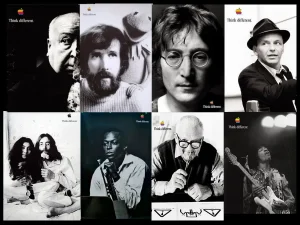
Under the direct leadership of Steve Jobs, Apple’s creative team used black and white images of famous figures like Albert Einstein, John Lennon, Martin Luther King, Jr., Pablo Picasso, and others to honor those who changed the world in their own way. The “Think Different” advertising campaign helped Apple overcome its difficult period and pioneered many other successful campaigns for the company.
The “Think Different” campaign conveyed the message that Apple is an innovative company that always encourages people to think differently. This advertising campaign not only reshaped Apple’s brand image but also became a symbol of distinctiveness, creativity, and breakthrough in reaching users and enhancing brand recognition.
2. Decoding the “Think Different” Campaign
2.1. A Unique Advertising Strategy
Apple’s strategy was to focus on spiritual values rather than the technical features of its products. The media images did not talk about the products but aimed to honor the individuals and famous figures who changed the world through creativity and breakthrough thinking.
Apple wanted to base its message on the philosophy and values of those who dared to think differently. This created a spiritual connection that users could feel, while also fostering a spirit of inspiration and innovation.
2.2. The Birth of the “Think Different” Slogan
Steve Jobs invited three advertising agencies to present ideas to revive Apple’s public image. One of them, Lee Clow, the Creative Director of Chiat/Day, presented the idea of Think Different.
Through the name “Think Different,” Lee Clow wanted to convey to technology users worldwide that Apple was the brand that could create new, different trends, unlike any competitor. Lee Clow’s message was aimed at respecting breakthrough thinking, even if it went against traditional mindsets.
2.3. Campaign Implementation
The “Think Different” campaign was implemented through various forms, from television commercials to community support projects. Each ad made a strong impression thanks to the harmonious combination of images and messages, creating inspiring stories about people who had a great impact on the world.
The campaign began with a commercial called “The Crazy Ones,” directed by Jennifer Golub. The one-minute film, in black and white, featured people and events that changed the world, such as: Albert Einstein, John Lennon, Bob Dylan, Muhammad Ali, Martin Luther King, Jr., Martha Graham, and more, along with the inspiring message “Think Different.”
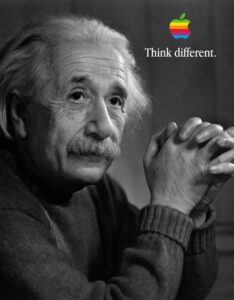
The rule of the campaign was that no products would appear in the ads. Therefore, the ads focused solely on portraying the characters’ portraits along with a small Apple logo and the “Think Different” slogan. The bitten apple logo with its 7 rainbow colors was used to create a contrast with the black and white tone of the pictures, and for Apple’s CEO, it seemed to be a very powerful statement, creating the attraction and thought-provoking stimulation that Apple needed.
Steve Jobs and his team launched ads in many major newspapers like Newsweek, Times, and others, and broadcast them during prime time on TV. In addition, Apple sent posters and promotional photos containing the “Think Different” message to schools nationwide, featuring images of many great stars like Pablo Picasso, Jane Goodall, Ron Howard, and more, to maintain the campaign until 2002.
2.4. The Campaign’s Impact and Success
After the “Think Different” campaign was launched, Apple quickly became a topic of discussion. There were quite a few negative comments for the “bitten apple” company, such as: “Apple used images of deceased people, so the brand will soon be gone too.” However, the campaign also brought Apple a large number of loyal “fans” – people who now fully support Apple. Objectively, whether negative or positive, Apple – a brand that seemed destined to be forgotten – succeeded in creating a buzz and attracting public attention.
After 12 months, the results of the campaign for Apple became more apparent as sales soared and the stock price tripled. A year later, Apple introduced the iMac computer – one of the best-selling products in the company’s history. It could be said that without “Think Different,” the iMac might have just been Apple’s “colorful toy.”
The campaign also brought many awards to Apple, including:
- The 1998 Emmy Award for Best Commercial
- The 2000 Grand Effie Award for the most effective campaign in the US.
Why was the “Think Different” campaign so successful? The campaign was successful because it wasn’t just a simple call to action, but a call for the community to change together. Moreover, Apple’s “Think Different” message had a powerful impact because of the emotion and attitude it conveyed: No product images, no feature boasts, no talk about devices, no selling. It was simply a pure and simple brand campaign.
3. Marketing lessons from Apple’s “Think Different” mindset
3.1. Compete on quality and service, not on price
For its products, Apple fully leveraged its Unique Selling Proposition (USP) – its exclusive IOS operating system – to send a strong competitive message that its products were far superior to its competitors. Not only that, but Apple also differentiated its products through design, leading the market at the time.
>>> Read more: What is a USP? How to define and establish a successful USP
Apple’s pricing strategy also went against the grain. Although Apple’s products are priced quite high compared to competitors, many customers are still willing to open their wallets to own products with high quality and an excellent user experience. This pricing strategy can be said to be in direct opposition to other laptop, tablet, and mobile phone manufacturers, most of whom want to offer competitive prices.
3.2. Optimizing the customer experience

Apple’s success is also attributed to its ability to create unique experiences for customers, turning them into brand ambassadors. Apple buyers receive more benefits in purchasing policies, warranty issues, returns, and other after-sales matters.
Understanding the importance of providing a positive and profound customer experience, Apple also boldly implemented free product trial programs to collect feedback and reviews from consumers. These programs provide valuable reviews and opinions that offer significant guidance for future product improvements.
3.3. Developing a user community
The distinctiveness of Apple’s products has created a large user community that includes loyal users. With the message of connecting users, owning and using an Apple device becomes a bridge that helps people easily connect, exchange ideas, and become close friends. In addition, Apple’s business strategy for the future will focus on developing a vast product ecosystem that is synchronized and effectively connects users. Anyone using Apple’s Mac or iOS operating system can easily share information, photos, or videos with others.
4. The long-term impact of “Think Different” on Apple’s culture and products
More than just an advertising campaign, “Think Different” became the guiding spirit for all of Apple’s activities — from how they develop products to how they inspire employees and customers. The “think different” philosophy not only appeared in TV commercials but was also deeply embedded in every product line, every design decision, and the company’s internal culture.
4.1. “Think Different” became the DNA in every Apple product
From the iMac and iPod to the iPhone and Apple Watch, the “Think Different” philosophy is always clearly present: a focus on user experience, simplicity in design, and emotion in technology. Apple doesn’t just create useful products — they create technological icons that make users proud to own them.
Each product embodies a spirit of creativity and differentiation: the iPod changed how we listen to music, the iPhone redefined the smartphone, and the MacBook demonstrates sophistication in every design detail. This is precisely the product development strategy Apple aims for.
4.2. Influence on internal creative culture
Inside Apple, “Think Different” is not just a slogan on the wall, but a guiding principle for work. Steve Jobs always encouraged employees to “think different,” dare to experiment, and accept risks to create what no one had ever done before.
Apple built an environment that is open yet strict about mediocrity: employees are free to be creative, but every idea must reach the level of “simple yet perfect.” It is this culture of “dare to try – dare to fail – dare to innovate” that helps Apple’s corporate communications always lead in creativity and continuously drive global technology trends.
4.3. Shaping Apple’s image in the consumer’s mind
“Think Different” helped Apple transcend the category of a technology company to become a cultural icon for those who dare to dream and dare to do things differently.
The brand represents those who break boundaries, from artists and creators to young entrepreneurs — all of whom find a reflection of themselves in Apple.
As a result, Apple’s marketing strategy was centered on this: Apple doesn’t just sell products — they sell the feeling of belonging to a creative class. And that is what helped Apple become the brand with the strongest loyal fanbase in the world.
5. Lessons for Businesses from “Think Different”
Not every business has the resources to create a campaign on the scale of Apple’s, but the thinking behind “Think Different” is a valuable lesson for every brand — big or small.
5.1. A Strong Brand Starts with a Clear Vision
What sets Apple apart is a consistent vision throughout all its activities. They don’t just sell products; they sell a philosophy: “We do things differently to change the world.”
This is something many businesses can learn from — when you have a clear vision, all marketing, product, and communication activities will be unified and have a natural reach.
5.2. Emotion is the Key to Building Loyalty
A campaign can change purchasing behavior, but only emotion can retain customers in the long run. Apple understood this better than anyone — they made users not just “buy” but “love” their products.
Other businesses need to learn how to connect emotionally at every customer touchpoint: from brand language and design to after-sales service.
5.3. Don’t Say “We’re Different” — Let Others Feel It
The success of “Think Different” lies in the fact that Apple didn’t declare its own difference, but let others feel it through stories, images, and experiences.
The most powerful message is always the one that doesn’t need to be spoken — when a brand creates genuine inspiration in the hearts of consumers.
6. What role did Steve Jobs play in the “Think Different” campaign?
Steve Jobs was the main leader of the campaign. He personally approved the ideas, selected the representative figures, and narrated the commercial to reaffirm Apple’s spirit of creative difference upon his return.
When Steve Jobs returned to Apple in 1997, the company was in its most difficult period: sales were declining, the brand was fading, and its products lacked appeal. “Think Different” was born at that exact moment — and it was Steve Jobs who was behind the spirit, message, and emotion of the entire campaign.
Interestingly, he didn’t personally create every word or every image, but he was the one who guided the soul of the campaign. Without Jobs’ mindset, “Think Different” could not have become the timeless brand manifesto it is today.
6.1. The Brand Vision Steve Jobs Pursued
Steve Jobs always believed that Apple was not just a technology company, but a brand for those who dared to be different. Apple users — according to him — were the creators, the rebels, those who refused to accept limits. And Apple needed to celebrate that very spirit.
In meetings with the TBWAChiatDay creative team, Jobs emphasized 3 points:
-
Apple had to return to its DNA: simple, bold, and profound.
-
Don’t talk about the product. At that time, Apple computers were not superior in terms of specs. Therefore, he demanded a 100% focus on spiritual value.
-
The brand needed a “soul.” Something that, according to Jobs, Apple had lost in the years prior.
Thanks to this vision, “Think Different” became a philosophical message, not a sales campaign.
6.2. How Steve Jobs Inspired and Led the Creative Team
Many people involved in the project said they had never met a leader like Steve Jobs: demanding and emotional, yet incredibly inspiring. His role in the project was clearly demonstrated in 3 aspects:
• Setting extremely high standards
Jobs always wanted everything to reach a level of “absolute excellence.” When he saw the first concepts, he shook his head and said:
“We can do much better.”
This pushed the creative team not just to find new ideas, but to find the right idea.
• Evoking a strong creative spirit
Jobs often asked the team simple but “heart-piercing” questions:
-
“Are you proud of this?”
-
“Does it inspire you?”
-
“If this were the last campaign you ever created, would you be okay with it?”
These questions pushed the team to live up to the “Think Different” spirit during the creative process.
• Keep everything as simple as possible
Jobs was famous for his philosophy: “Simplicity is the ultimate sophistication.”
Therefore, he demanded that all superfluous elements be removed, retaining only the essentials.
The result was a minimalist yet powerful campaign: black and white images, a concise tagline, no mention of features, and no talk about the product.
6.3. Steve Jobs’s Signature Aesthetic and Storytelling
Jobs’s personality and style were clearly reflected in every detail of the campaign.
• Minimalist – but inspiring
No color, no complex effects, no product appearance.
Everything was designed to focus 100% of the attention on the “Think Different” message and the extraordinary people.
• Putting people above technology
Jobs chose figures like Einstein, Picasso, Gandhi, John Lennon… — people who dared to break the rules and change the world.
He wanted the audience to feel that Apple belonged with those people.
• Emotionally resonant storytelling
The “Here’s to the Crazy Ones” speech is a prime example of Jobs’s storytelling style: short, concise, and powerfully inspiring.
7. Comparing “Think Different” with other legendary campaigns
Apple was not alone on its journey of inspiration. During the same era, many other brands also created classic campaigns, each representing a unique marketing philosophy.
7.1. “Just Do It” – Nike
If Nike encourages action, Apple encourages thought.
Nike says “Just do it,” Apple says “Think different.” One evokes physical energy, the other evokes intellect and creativity. Both aim for personal freedom and the aspiration to overcome limits.
7.2. “Impossible is Nothing” – Adidas
Adidas celebrates the human spirit of conquering the impossible, while Apple chooses to honor the “crazy ones” – those who believe they can change the world.
Both campaigns put people at the center, but Apple did it with profound storytelling and cultural symbolism.
7.3. “Because You’re Worth It” – L’Oréal
If L’Oréal makes customers feel “I’m worth the best,” Apple makes them believe “I belong to the world of different creators.”
Both brands succeeded by personalizing their message, making customers feel respected and proud to choose their products.

> See more: A compilation of the best business slogans
8. Frequently Asked Questions about the “Think Different” campaign
Why did Apple choose a black and white color scheme for all the campaign’s images?
To create a classic, timeless look and to focus maximum attention on the portraits of the figures rather than on distracting elements.
How did Apple handle the image rights for the famous figures?
By working directly with and obtaining permission from the relatives or estates of the figures to ensure legality and agreement on the message of honor.
Did the “Think Different” campaign cause any controversy at the time of its launch?
Yes, there was some criticism regarding the use of deceased people’s images for advertising, but it was quickly overshadowed by the support for its creative message.
The slogan “Think Different” was considered grammatically incorrect. How did Apple explain it?
Steve Jobs intentionally used the phrase as a noun (“think about difference”) to create a strong, concise impression that sounded more impactful than the grammatically correct version.
Besides branding, did this campaign have any direct impact on Apple’s internal staff?
It served as a revolution in thinking, helping to filter out old personnel and attract new talent who shared the same ideals of breakthrough and creativity.
9. Conclusion
Apple’s “Think Different” campaign succeeded in establishing a unique message, focusing on the importance of different thinking and the impact of bold initiatives. The success of the “Think Different” campaign helped revive the Apple brand and initiated its journey to becoming the tech giant the world admires today.
This has been 1Office’s detailed breakdown of Apple’s Think Different campaign. We hope the marketing lessons from this campaign will be beneficial to your business. We wish you success!
















