


 10/05/2026
  156 views
In business, understanding and investing in the Sales Pipeline is an effective method to increase sales. The better you understand your potential customers, the higher your chances of closing a deal. So, what is a Sales Pipeline and how can you apply it to your business? 1Office will reveal everything in the article below.
-

Sales Pipeline – An indispensable sales tool for businesses
Mục lục
- 1. What is a Sales Pipeline?
- 2. Benefits of a Sales Pipeline for Businesses
- 3. The 5-Step Process to Build a Sales Pipeline for Your Business
- 4. How to build a Sales Pipeline for your business
- 5. Common mistakes when implementing a Sales Pipeline
- Not clearly defining the potential customer profile from the start
- Scattered and outdated customer data
- Lack of a standardized process among sales staff
- Not updating the pipeline regularly to reflect business reality
- Prioritizing quantity over lead quality
- Lack of a continuous monitoring and feedback mechanism
- 6. How to optimize and measure Sales Pipeline effectiveness
- 7. Tools to support building an effective Sales Pipeline for businesses
1. What is a Sales Pipeline?
A Sales Pipeline is simply understood as a “sales pipeline.” It is the journey a salesperson takes to accompany and nurture a prospect, converting them from a potential customer (lead) into a customer.
2. Benefits of a Sales Pipeline for Businesses
If business managers understand and effectively apply the Sales Pipeline model to their business operations, there will be many benefits for everyone in the company, from employees and managers to the business itself.
Benefits for Employees
- Have a professional sales process to base their work on
- Assess the priority level for nurturing each customer to create a suitable work plan
- Track the status of sales opportunities to take action to close the sale at the right time
- Easily share information with colleagues and create reports for management
Benefits for Management
- Monitor sales staff activities to ensure they follow the steps in the sales process flowchart, thereby accurately evaluating each person’s work efficiency
- Forecast future revenue based on current data
- Quickly build marketing, cross-sell/up-sell strategies
- Quickly identify and resolve “bottlenecks” in the sales process
Benefits for the Business
- Standardize the sales process within the business
- Increase potential customers and revenue
- Optimize the time and quality of the staff
3. The 5-Step Process to Build a Sales Pipeline for Your Business
Depending on the nature and scale of the business, the 5 steps to build the process will vary. Some businesses will use a 5-step process to build their Sales Pipeline.
Below are the 5 most basic steps in a Sales Pipeline to give you the clearest view of what it entails.
-

5 steps to build a Sales Pipeline for your business
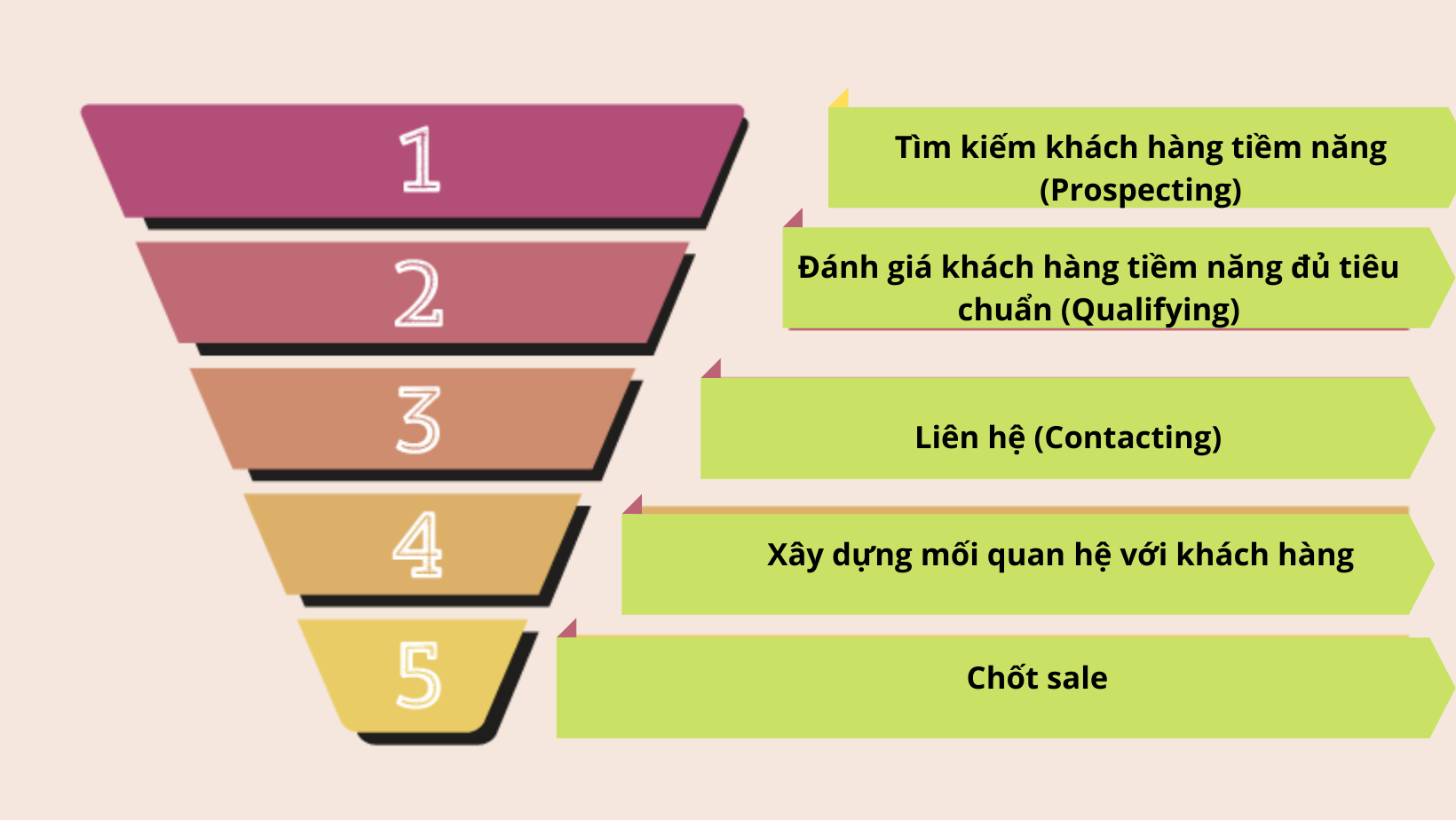
Step 1: Prospecting for Potential Customers
The first step in any sales process is the same: prospecting for potential customers. This source of customers can come from content marketing activities on social media, Google, events, email, etc. During this stage, the most important thing is to record as much customer information as possible. This includes demographic information: Name, age, gender, as well as information about their location and the type of interaction they have had with your company.
Step 2: Connecting (Telesales)
In step 1, the collected potential customer data may include junk leads who have no purchasing ability. Therefore, this is a crucial step to filter out potential customers who genuinely have a need for the business’s product.
In many businesses, a Telesales department connects with customers by contacting them via phone to determine their needs before transferring them to the Sales department.
This is also a step that is just as important as step 1, because the business does not want to waste too much time on customers who do not have a real need.
So how do you filter customers from that data file? During a conversation with a potential lead, try to gather information to answer the following questions:
- Can the potential lead afford the company’s product?
- Is the potential lead the decision-maker, or do they need to convince someone else to make the purchase and close the deal?
- Does the potential lead have a real need for the product?
- Is the potential lead ready to buy?
If all the answers are yes, then the prospect is a hot lead and should be immediately transferred to a salesperson for nurturing and closing.
What about the prospects who answer no? Don’t delete that data just yet. Save this customer information in your CRM software to add them to nurturing campaigns. These prospects may not want to buy the product right now, but they could become potential customers for the business in the future.
Step 3: Contact
This is the step where the salesperson contacts the potential customer (hot lead) who was filtered out in step 2.
This stage will vary depending on your product or service and your sales model. It can take the form of a face-to-face meeting, a phone call, or a video call. The salesperson explains the product or service in detail, the advantages of purchasing it, and tries to overcome any objections or doubts the potential customer may have.
Step 4: Building a Relationship with the Customer
For B2B businesses, it’s not easy to sell a product immediately. Customers need time to research and consider.
Typically, the sales cycle for B2B customers lasts from 15 to 30 days. Therefore, sales staff need to nurture customers and build good relationships with them.
Sales staff don’t need to call or email constantly. Instead, they should call and email at an appropriate frequency. Don’t make customers feel bothered and annoyed.
Additionally, sales staff can use more subtle ways to remind customers, such as connecting with them on social media to answer their questions as quickly as possible.
Step 5: Closing the deal
At this stage, the sales staff needs to confirm the customer’s exact needs, provide a quote, and proceed with the payment request.
However, this doesn’t mean the Sales Pipeline is complete. In theory, closing the sale is the final step of a sales process, but to encourage repeat purchases, sales staff must continue to guide customers into a post-sale nurturing process to ensure they have the best possible experience.
Additionally, businesses can refer to the 7-step B2B sales process to help achieve business goals quickly and easily.
4. How to build a Sales Pipeline for your business
Above is information on the importance and the 5-step process for building a Sales Pipeline for a business.
This will be the way to build an effective Sales Pipeline for your business.
Have a list of potential customers
Before you have a Sales Pipeline, you must first build a list of potential customers who have a need for your business’s products.
If your business has a long list, you should have a tool to manage it. Some tools businesses can consider are Google Sheets, Excel, or a CRM management tool.
Google Sheets or Excel can be used, but they are only suitable when a business has a small number of employees or is newly established and wants to organize a sales pipeline before implementing management software.
CRM software, on the other hand, is more effective and is highly recommended when a business has many transactions or customers. With CRM software, managers can proactively monitor and track the progress and performance of their sales staff to see if they are meeting set targets.
Build the sales stages
Sometimes, the goals set by sales staff are too ambitious, which can easily lead to discouragement and frustration. One method managers can use to help their team achieve sales targets is to break down the main goal into daily activities that sales staff need to complete to close deals.
By managing and focusing on sales activities, your team will be more likely to achieve the set sales targets. And that is the role of the Sales Pipeline: to measure and manage sales activities.
Adjust the stages in the Sales Pipeline
Once you have established the stages in your sales pipeline, measure the results to see if the sales staff’s activities align with the defined stages, whether the pipeline is suitable for the business, and if any adjustments or additions are needed.
Managers shouldn’t worry about building a perfect Sales Pipeline on the first try. This journey may take a lot of time and effort for the business to define and build a pipeline that fits its operations. The important thing is for managers to continuously evaluate and analyze data from the sales team’s activities to build a suitable Sales Pipeline.
5. Common mistakes when implementing a Sales Pipeline
Although the Sales Pipeline is a core tool for managing and forecasting revenue, in reality, many businesses fail to achieve the expected results. The problem isn’t the tool itself, but rather its improper implementation and operation. Below are the most common mistakes that prevent a Sales Pipeline from delivering real value.
Not clearly defining the potential customer profile from the start
One of the root causes is that the sales team doesn’t truly understand who their target customers are. They collect leads from various sources without proper filtering, leading to a “noisy” pipeline filled with unsuitable prospects. As a result, the sales team wastes effort on nurturing leads that don’t convert, leading to extremely low conversion rates in later stages.
- Solution: Businesses need to build a clear customer persona and classify leads based on behavior, geographic location, actual needs, etc., before adding them to the pipeline.
Scattered and outdated customer data
Many businesses still manage customers using Excel or store data scattered across emails, Zalo, or personal files. This not only leads to unsynchronized data but also risks data loss when an employee leaves. More importantly, management cannot get a holistic view of the “pipeline health” to forecast revenue or adjust strategies in a timely manner.
- Solution: Use a centralized CRM system to automatically update data, ensuring the pipeline is always accurate and easily accessible.
Lack of a standardized process among sales staff
Each sales representative has their own way of working, recording, and updating information. One person might consider a “called lead” as qualified, while another waits until a meeting is scheduled to mark that step. This inconsistency makes the pipeline data unreliable and impossible to use for comparing or measuring team performance.
- Solution: Businesses need to standardize each stage of the pipeline, clearly define the “completion criteria” for each step, and train employees for consistent execution.
Not updating the pipeline regularly to reflect business reality
A Sales Pipeline is not something you design once and forget. The market changes, customer behavior fluctuates, and the sales process needs to be adjusted accordingly. However, many businesses let their pipeline “die” – it’s not updated, causing data to become outdated and misaligned with reality.
- Solution: Establish a regular monthly or quarterly review schedule, re-evaluating the conversion rate at each stage for timely optimization.
Prioritizing quantity over lead quality
A “full” pipeline is not necessarily a good one. Focusing too much on the number of leads can overload the sales team, leaving them with insufficient time to nurture truly potential opportunities. This leads to a “bloated but empty” pipeline, giving management the illusion of impending revenue growth, while the actual closing rate is very low.
- Solution: Prioritize lead quality over quantity, and establish a lead scoring mechanism to assess potential before adding them to the pipeline.
Lack of a continuous monitoring and feedback mechanism
A subtle but common mistake is when a business has no one responsible for comprehensive pipeline tracking. No one monitors data updates, and there are no regular performance reports, leading to the pipeline gradually getting “out of control.”
- Solution: Clearly assign a person in charge of pipeline management (a Pipeline Owner), and set up a visual dashboard for leadership and sales leaders to easily track progress.

6. How to optimize and measure Sales Pipeline effectiveness
An effective Sales Pipeline isn’t just about “drawing out” the process; it must be continuously optimized and measured with real data.
First, businesses need to define core key performance indicators (KPIs) to evaluate pipeline performance, such as:
-
Conversion Rate between stages
-
Average Deal Size
-
Average Sales Cycle Length
-
Drop-off Rate
Based on these metrics, managers can identify which stages are “bottlenecks” and implement improvements such as streamlining the telesales step, optimizing care scripts, or shortening the approval process.
To ensure the pipeline operates smoothly, build a continuous improvement mechanism (following the PDCA cycle or Kaizen). Every month or quarter, the sales team should hold a meeting to review the pipeline, analyze bottlenecks, and update the lead strategy or closing process accordingly.
7. Tools to support building an effective Sales Pipeline for businesses
To manage Sales Pipeline activities, managers can use applications like notes, Excel, or Google Sheets. However, these tools are only suitable for small-scale businesses with a limited number of customers.
For larger businesses, seeking out CRM solutions is entirely appropriate.
A comprehensive CRM software will help businesses establish a sales process, manage customer data, store all interactions between sales staff and customers, integrate email and call systems, and track all employee activities and progress toward sales targets. This allows for the measurement of revenue goals that sales staff can achieve.
-

What is CRM software? Benefits of CRM for businesses
Customer care software from 1Office is a solution that helps boost revenue for B2B sales activities. The solution helps businesses manage and optimize all pre-sales, sales, and post-sales activities, thereby enhancing the efficiency of their business operations.
Notably, the 1Office CRM solution is very easy to operate and use, so managers can easily persuade their teams to adopt it for daily work management. It fully meets all the needs of a business’s operations.
The above is all the essential information about the Sales Pipeline. We hope this knowledge has clarified any questions you may have. Continue to follow 1Office for more useful insights.
For more detailed information, please visit:
Fanpage: https://www.facebook.com/1officevn/
Youtube: https://www.youtube.com/channel/UCeTIRNqxaTwk0_kcTw6SxmA
















