


 11/05/2026
  141 views
For production and business activities to run effectively, a business needs a sufficiently large source of investment capital. Among them, fixed capital is an important source of capital that determines the success or failure of the business. Therefore, let’s join 1Office to clarify the concept, characteristics, role, and formula for calculating fixed capital in the article below.
Mục lục
- 1. What is fixed capital?
- 2. What types of fixed capital are there?
- 3. Characteristics of fixed capital
- 4. The role of fixed capital for businesses
- 5. How to Calculate Fixed Capital on the Balance Sheet
- 6. Distinguishing between Fixed Capital and Working Capital
- 7. Criteria for evaluating the efficiency of fixed capital
- 8. Strategies for Optimizing Fixed Capital Usage in a Business
- 9. Common Risks in Fixed Capital Management
- 10. Effective Fixed Capital Management Methods for Businesses
- Frequently Asked Questions about Fixed Capital
- Conclusion
1. What is fixed capital?
Fixed capital is the amount of money invested in high-value assets such as land, factories, machinery, equipment, etc., to serve the production and business activities of the enterprise. This type of asset has reusable value and is not consumed or destroyed during the production of goods and services, and is called a fixed asset.
In other words: Fixed capital is the amount of money invested in advance for the purchase, construction, and installation of tangible or intangible fixed assets during the production and business process. This is the source of capital that forms fixed assets and is part of the total capital of the business.
2. What types of fixed capital are there?
Fixed capital is divided into two main groups based on physical characteristics and economic value: tangible fixed assets (physical entities serving production) and intangible fixed assets (non-physical values that bring long-term benefits to the business).
Below are the detailed components that make up fixed capital:
Tangible fixed assets are fixed assets that have a physical form, can be seen and touched, such as:
- Land: includes residential land, production land, business land, etc.
- Buildings and structures: includes factories, offices, warehouses, etc.
- Machinery and equipment: includes production machinery and equipment, office machinery and equipment, etc.
- Vehicles: includes cars, motorcycles, ships, etc.
- Equipment, tools, and furniture: includes tables, chairs, cabinets, beds, etc.
Intangible fixed assets are fixed assets that do not have a physical form but have value and can bring benefits to the business over many business cycles, such as:
- Land use rights: includes land use rights assigned, leased, or subleased by the State.
- Intellectual property rights: includes copyrights, industrial property rights, rights to plant varieties, etc.
- Brands and trademarks: includes signs used to distinguish the goods and services of one business from those of another.
- Goodwill: includes advantages that a business has due to its geographical location, reputation, etc.
3. Characteristics of fixed capital
Fixed capital is a long-term investment capital source used to purchase, construct, or install fixed assets for the production and business activities of an enterprise.
3.1. Durability: Fixed capital has a long-term useful life of 1 year or more. Therefore, this capital source can be used over many business cycles to create products, goods, and services, generating profit for the business.
3.2. Historical cost: The value of fixed capital is determined by its historical cost, which includes the purchase price, installation costs, and other costs directly related to putting the asset into operation. The historical cost of fixed capital is the basis for calculating depreciation and determining the remaining value of the fixed asset.
3.3. Value transfer: The value of fixed capital is gradually transferred to the value of the product over many business cycles. During that process, a portion of the fixed capital becomes a production cost corresponding to the depreciation of the fixed asset.
The three characteristics of fixed capital mentioned above affect a business’s capital management. Businesses need to have a reasonable fixed capital investment plan to ensure the effective use of capital and avoid waste.
4. The role of fixed capital for businesses
Fixed capital plays an important role in the production and business activities of an enterprise, specifically as follows:
- Ensures the continuous operation of the production process and business activities within the enterprise. Thanks to necessary physical and technical facilities such as factories, machinery, equipment, vehicles, etc., the business can carry out its activities and create goods.
- Enhances labor productivity, reduces production costs, and improves product/service quality by investing in advanced, modern technologies. This promotes the sustainable development of the business.
- Increases the competitiveness of the business in the market, thereby limiting potential business risks such as market fluctuations or future financial crises.
- Creates a foundation for the sustainable development of the business because fixed capital is a durable asset that can be used over many business cycles. A business with strong fixed capital will have a solid foundation for long-term future development.
5. How to Calculate Fixed Capital on the Balance Sheet
Fixed capital is an important asset for a business. Managers need to closely monitor and manage fixed capital to ensure the effective use of capital resources.
Below is the formula to calculate fixed capital at the beginning and end of a business period:
| Fixed capital at the beginning/end of the period = Original cost of fixed assets – Accumulated depreciation at the beginning/end of the period |
Where:
- The original cost of a fixed asset is its value when first acquired, including the purchase price, installation costs, trial run costs, and other expenses directly related to putting the asset into use.
- Accumulated depreciation is the total amount of depreciation that the business has allocated to production costs for the fixed asset over various periods up to the time of calculation.
Illustrative example: Suppose company 1Office has an original cost of fixed assets at the beginning of the period of 100 billion VND. During the business period, company 1Office purchases additional fixed assets with an original cost of 50 billion VND and also depreciates fixed assets by an amount of 20 billion VND. Therefore, the fixed capital at the end of the business period for company 1Office is 130 billion VND.
Businesses need to calculate fixed capital in various situations. Accurately determining fixed capital helps businesses manage their finances effectively, meet the requirements of regulatory agencies, and implement their business plans.
6. Distinguishing between Fixed Capital and Working Capital
The biggest difference between fixed capital and working capital is their usage period and turnover nature. Fixed capital gradually transfers its value to the product through depreciation, while working capital transfers its entire value into the product’s value within a business cycle.
| Criteria | Fixed Capital | Working Capital |
| Concept | The investment in high-value assets used over multiple business periods, with its value gradually allocated to products and services. | The monetary value of short-term assets that are fully converted or used up within one business cycle. |
| Characteristics | Durable, with value transferred gradually. | Highly liquid, fully circulated within one business cycle. |
| Usage Period | 1 year or more | Less than 1 year |
| Unit | Currency | Currency |
| Classification | Tangible fixed assets, intangible fixed assets | Cash, bank deposits, inventory, accounts receivable, short-term investments |
| Role | Ensures the operation of the production and business process. | Meets the payment and investment needs of the business. |
Comparison of fixed and working capital in a business
7. Criteria for evaluating the efficiency of fixed capital
The efficiency of fixed capital usage is the ability to generate revenue and profit from this type of capital. High efficiency in fixed capital usage indicates that the business is using its capital rationally, yielding high economic benefits. There are many criteria to evaluate this efficiency, with the most common ones being:
7.1. Efficiency of fixed capital utilization
This is an indicator that reflects the ability to convert fixed capital into revenue. The higher the capital utilization efficiency, the more effectively the business is using its fixed capital.
| Fixed asset turnover ratio = Revenue / Fixed assets |
7.2. Return on Fixed Capital
Return on fixed capital is an indicator reflecting the ability to generate profit from capital. The higher this return rate, the more effectively the business utilizes its fixed capital.
| Return on Fixed Assets = Earnings Before Interest and Taxes / Fixed Assets |
7.3. Fixed capital intensity
This indicator reflects the amount of fixed capital required to produce one unit of product. The lower the fixed capital intensity, the more effectively the business utilizes its fixed capital.
| Fixed Capital Ratio = Fixed Capital / Revenue |
7.4. Fixed Asset Equipment Ratio
The Fixed Asset Equipment Ratio is an indicator that reflects the level of fixed asset equipment per direct laborer. This ratio is calculated using the following formula:
| Fixed Asset Provision Ratio = Original cost of fixed assets / Number of direct production workers |
7.5. Fixed Asset Investment Ratio
This metric reflects the level of investment in fixed assets as a proportion of the company’s total asset value. A higher fixed asset investment ratio indicates that the company invests heavily in fixed assets, and they constitute a large proportion of the company’s total assets.
| Fixed Asset Ratio = Net book value of fixed assets / Total assets |
8. Strategies for Optimizing Fixed Capital Usage in a Business
Fixed capital is the foundation for all long-term business operations. Without strict management, a business can face asset waste, low efficiency, and affected profits. Therefore, building a strategy to optimize fixed capital is crucial for ensuring sustainable growth.
- Selectively reinvest in fixed assets: Businesses should regularly assess the use value and depreciation level of assets. Instead of investing massively, focus on reinvesting in items that truly bring long-term benefits, such as upgrading production lines rather than purchasing unnecessary equipment.
- Consider buying new vs. financial leasing: It’s not always necessary to purchase fixed assets. For assets with a short lifecycle or high depreciation costs, financial or operating leases can help businesses save capital, reduce risks, and be more flexible in their use.
- Apply technology for effective capital management: Asset management software helps businesses track the status, depreciation, and performance of each type of fixed capital. This allows managers to easily make timely decisions about investing, replacing, or liquidating assets.
- Optimize maintenance and upgrade costs: Regular maintenance helps extend the lifespan of fixed assets, minimizing unexpected breakdowns that disrupt operations. Businesses can apply a Predictive Maintenance strategy to save costs.
Real-world example: Many large manufacturing companies like Samsung or Vinamilk have adopted a model of outsourcing equipment combined with reinvesting in core technology lines. This helps them optimize fixed capital costs while maintaining operational flexibility.
9. Common Risks in Fixed Capital Management
In practice, fixed capital accounts for a large proportion of a company’s total assets. If mismanaged, it can become a “bottleneck” affecting cash flow, competitiveness, and even the company’s reputation. Below are common risks that require special attention:
9.1. Unreasonable Asset Depreciation
Depreciation is a decisive factor in a company’s costs and profits. If the depreciation period is miscalculated or an unsuitable method is chosen, financial reports will lose their accuracy, leading to poor management decisions.
For example, a manufacturing company applies accelerated depreciation to a production line that is still in good working condition. The result: costs increase sharply, profits decline, making it difficult for the business to raise capital from investors.
9.2. Scattered, Unstrategic Investment
Many businesses expand their investment in fixed assets without basing it on actual needs. Holding too much machinery, warehousing, or real estate ties up capital, while short-term cash flow becomes insufficient.
Typically, a trading company invests in building a warehouse larger than its needs, leading to high maintenance and depreciation costs but low utilization efficiency.
9.3. Lack of Monitoring and Maintenance for Fixed Assets
If fixed assets are not regularly maintained, they will quickly deteriorate, causing production disruptions and repair costs that are many times higher.
For example, a logistics company neglects regular maintenance of its vehicle fleet → vehicles break down unexpectedly, causing delivery delays and loss of customer trust.
9.4. Failure to Update the Actual Value of Assets
Fixed assets often have a significant discrepancy between their book value and market value. If a business does not revalue them regularly, it will be difficult to accurately assess the efficiency of capital use, affecting the process of raising capital and financial planning.
A real estate company records the value of its land based on figures from 5 years ago, which is much lower than the current market price → it misses opportunities to leverage capital when needing a bank loan or to raise investment.
9.5. Errors in Asset Liquidation or Replacement
Liquidating assets too early when they are still usable or purchasing new ones at the wrong time both lead to wasted capital. Businesses need a specific plan for each stage of an asset’s lifecycle to avoid losses.
For example, a factory liquidates all its machinery just because new technology has emerged, while the old production line can still meet production needs → this causes capital loss and reduces business efficiency.
10. Effective Fixed Capital Management Methods for Businesses
Fixed capital is one of the most important capital sources for a business, ensuring that production and business activities run continuously. Therefore, effective capital management is a critical requirement for leaders.
So how can a business manage its capital intelligently and effectively? The most effective solution to this problem is the application of technology, specifically an income and expense management system. Among them, the 1Office CRM income and expense management software is a comprehensive toolset that helps businesses manage fixed capital easily and effectively.
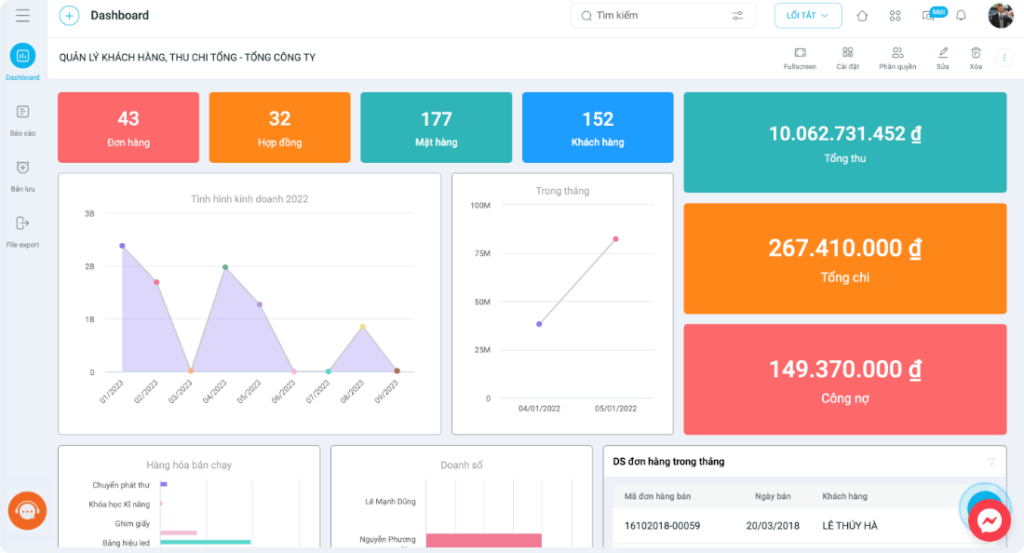
Key features of the 1Office CRM income and expense management software include:
- Track the entire process of fixed capital usage, from investment planning and execution to fixed asset liquidation.
- Evaluate the efficiency of fixed capital usage through intuitive, clear, and transparent real-time reporting Dashboards.
- Support managers in making business decisions and easily controlling risks related to fixed capital.
These features help businesses easily track, manage, calculate fixed asset depreciation, and report on capital utilization efficiency. This allows businesses to make more effective investment decisions and use fixed capital more efficiently.
Frequently Asked Questions about Fixed Capital
In what ways does fixed capital depreciate?
It includes tangible depreciation (loss of value due to use/natural wear and tear) and intangible depreciation (loss of value due to technological obsolescence).
How is fixed capital different from fixed assets?
Fixed assets are specific tangible/intangible items, while fixed capital is the amount of money advanced to form those assets.
Can the depreciation method be changed?
Yes, but consistency must be ensured throughout the fiscal year, and the reason must be clearly explained in the tax report.
Does fixed capital include long-term securities investments?
No. Fixed capital is only invested in assets that directly serve business production; securities belong to the financial investment portfolio.
What is the fastest way to recover fixed capital?
Apply accelerated depreciation methods to speed up the accumulation of capital for reinvestment, especially for assets prone to technological obsolescence.
Conclusion
Effective management of fixed capital is extremely necessary to ensure the business’s production and business activities run efficiently. Businesses can use the revenue and expenditure management software 1Office CRM to assist in analyzing fixed capital. We wish your business success
















