


 11/05/2026
  694 views
In any transaction, a three-party contract always requires careful consideration and a deep understanding of its content, policies, and legal regulations before signing. In this article, let’s explore with 1Office some important regulations and principles that businesses must know when entering into a three-party contract. What are the key points to ensure the contract is drafted accurately and protects the interests of each party? Let’s dive into the article right away!
Mục lục
- 1. What is a 3-party contract?
- 2. Advantages and disadvantages of a 3-party contract
- 3. What content should a 3-party contract include?
- 4. Process & Legal Validity of a Three-Party Contract Template
- 5. What are the regulations for signing a three-party contract?
- 6. Principles of signing a 3-party contract for Leaders
- 7. Classification of 5 Common Three-Party Contract Templates (Free Download)
- 8. Common Mistakes When Signing a Three-Party Contract
- 9. 7-Step Checklist for Securely Signing a Three-Party Contract
- 10. Frequently Asked Questions about Tripartite Contracts (FAQs)
- 11. Conclusion
1. What is a 3-party contract?
A three-party contract is a type of civil contract involving the equal participation of three parties instead of just two, as in a traditional contract. The parties involved in this contract each have distinct rights and obligations they aim to achieve through signing it. The signatures of all three parties on the contract certify that each party has read and agreed to the stipulated terms and conditions.
Three-party contracts are often used in complex situations involving multiple related relationships where rights and responsibilities must be clearly defined. These can be agreements related to product or service distribution, project management collaboration, business partnerships, or other complex commercial transactions.
-

What is a 3-party contract? Types of three-party contracts

Below are some common three-party contracts used by individuals, organizations, and businesses:
- Three-party capital contribution contract,
- Three-party cooperation contract,
- Three-party sales contract,
- Three-party asset mortgage contract,
- Two-party contract for the benefit of a third party.
(Learn about and download templates for these 5 types of three-party contracts in Section 6)
Before signing a three-party contract, the participating parties should consult with a lawyer or legal expert to ensure the contract is drafted accurately and aligns with the purpose and interests of each party. This also helps avoid potential disputes and legal risks that may arise during the contract’s execution.
2. Advantages and disadvantages of a 3-party contract
Three-party contracts are increasingly used by businesses in cooperation, investment, sales, or mortgage transactions. However, this type of contract has both clear advantages and potential disadvantages that businesses should carefully consider before signing.
Advantages:
- Clear binding responsibilities: Each party has specific obligations and rights recorded in the contract, preventing the “third party” from being overlooked.
- Minimizes disputes: When all terms are transparent, the likelihood of overlapping disputes between parties is significantly reduced.
- Protects business interests: Especially in financial transactions, a three-party contract helps businesses ensure payment obligations, capital contributions, or profit sharing are carried out as agreed.
- Increases legal validity: A notarized/certified contract becomes valuable legal evidence in the event of a dispute.
Disadvantages:
- More complex procedures: With three parties involved, drafting, reviewing, and agreeing on the content takes more time than with a two-party contract.
- Risk of conflicting interests: When multiple parties are involved, conflicts of interest can easily arise, especially if the terms are not tightly defined.
- Higher drafting and consultation costs: Due to its complexity, businesses often need to hire lawyers or legal experts, leading to additional costs.
- Difficult to amend or terminate: Changing terms or terminating the contract requires the consent of all three parties, which can easily lead to a deadlock if one party disagrees.
3. What content should a 3-party contract include?
A three-party contract requires detailed content specifying the role of each party to ensure transparency and minimize conflicts of interest throughout its execution.
According to Article 398 of the 2015 Civil Code, the basic contents a three-party contract should have to ensure clarity and transparency in the relationship between the parties include:
- Description of the participating parties (organization or individual)
- Subject and scope of the contract
- Payment conditions
- Time and validity of the contract
- Contract term
- Place of signing
- Rights and obligations of each party
- Termination clause
- Dispute resolution
- Additional clauses
- …
The contents above are just some of the basic sections that should be in a three-party contract. Depending on the type of contract and industry, other clauses may be added to suit the specific situation and requirements of the participating parties.

4. Process & Legal Validity of a Three-Party Contract Template
4.1 Tripartite contract signing process within a business
Currently, there are 2 types of written contracts legally recognized by Vietnamese law: Traditional Contracts & Electronic Contracts. Individuals and businesses can refer to the comparison table below to choose the most suitable signing method:
| Process | Traditional 3-Party Contract | 3-Party Electronic Contract |
| Step 1 | Contract Preparation: The contracting parties agree on the purpose, scope, and terms of the transaction. Clearly define the roles, rights, and obligations of each party in the contract. | Contract Preparation: Same as a traditional 3-party contract |
| Step 2 | Contract Drafting: Draft the contract based on the agreements and requirements of the parties, clearly stating important clauses such as transaction value, execution time, commitments and penalties, and information security and protection policies. | Electronic Contract Drafting: Use information technology to draft the contract in an electronic environment. Ensure the terms and conditions are presented clearly and are easy to understand. |
| Step 3 | Contract Review and Discussion: The contracting parties review and evaluate the terms and conditions, while also discussing to adjust and agree on any unclear or disputed clauses. | Contract Review and Discussion: Same as a traditional three-party contract |
| Step 4 | Legal and Content Check: The parties should conduct a legal check of the contract to ensure compliance with legal regulations and review the contract content to ensure accuracy and avoid errors. | Legal and Content Check: Same as a traditional three-party contract |
| Step 5 | Prepare Signing Documents: Prepare the final contract for signing, including copies and related documents. The participating parties need to verify personal information and legal representation (A minimum of 6 copies of the three-party contract are printed, with each party keeping 2 copies). | Electronic Contract Signing: Use electronic signing methods for parties to affix digital signatures, OTP codes, or use similar authentication methods to enhance security and prevent content changes after signing. |
| Step 6 | Contract Signing: Organize a contract signing ceremony with the participation of all parties or send the contract copies by courier to each company for signing. | Electronic Contract Storage and Management: The participating parties store and manage the electronic contract on software, making it convenient for lookup and tracking. |
| Step 7 | Contract Storage and Management: The signed contract should be stored securely and be easily accessible.
The participating parties should have a contract storage and management system for convenient lookup and tracking. |
Comparison table of traditional & electronic three-party contracts
In summary, both types of three-party contracts are legally valid and recognized in the contract signing or dispute process. However, electronic contracts are always more convenient as they save time and effort while providing higher security and authentication than traditional paper contracts.
See more: TOP 10 best electronic contract (eContract) software today
4.2 What does the legal validity of a three-party contract include?
According to Article 401 of the 2015 Civil Code, the legal validity of a three-party contract is regulated as follows:
1. A legally concluded contract takes effect from the time of its conclusion, unless otherwise agreed or otherwise provided by relevant laws.
2. From the effective date of the contract, the parties must perform their rights and obligations to each other as committed. The contract can only be amended or canceled by agreement of the parties or as prescribed by law.
In addition, the legal validity of a 3-party contract includes protecting rights and interests, proving consent and commitment, defining rights and obligations, providing a means for dispute resolution between the parties, and complying with legal regulations.
-

What does the legal validity of a 3-party contract include?

- Protecting the rights and interests of the participating parties: To ensure fairness and consideration among the parties during the contract execution process.
- Proving the consent and commitment of the parties: A three-party contract is a document that clearly proves the parties have agreed to the terms and conditions of the contract. It provides evidence of the commitment and agreement between the parties.
- Clearly defining the rights and obligations of the parties: A three-party contract clearly defines the role, rights, and obligations of each party during the contract execution process. This helps ensure clarity and transparency in the working process and avoid disputes.
- Means of dispute resolution: A three-party contract often contains clauses related to dispute resolution methods (such as arbitration or court). This aims to have an effective and fair dispute resolution mechanism if any conflicts arise.
- Defining legal conditions and regulations: A three-party contract must comply with current legal regulations and clearly define the legal conditions and regulations related to the transaction. This helps ensure the legality and legal compliance of the contract.
-

Some regulations businesses must know when signing a 3-party contract

5. What are the regulations for signing a three-party contract?
The signing of a 3-party contract is governed by the principle of freedom of agreement in the Civil Code, requiring the voluntary consent of all three parties to establish an intertwined system of rights and obligations, ensuring that the interests of any party are not infringed upon.
Below are some important regulations that businesses need to know when signing a 3-party contract:
- Clearly define the roles and responsibilities of each participating party: The contract needs to clearly define the role and responsibilities of each party to ensure clarity and transparency during the execution process.
- Define the objectives and scope of the contract: The contract needs to set specific objectives and clearly define the scope of activities that the parties commit to perform to ensure clear and consistent understanding.
- Regulations on payment methods: The contract needs to detail the payment method, including the time, method, and conditions of payment to ensure fairness and transparency in the payment process.
- Clauses on information security and trade secrets: The contract needs to have clauses on information security and trade secrets to ensure the protection of important information and prevent leakage of important information to third parties.
- Regulations on dispute resolution: The contract needs to have clauses related to dispute resolution methods, such as arbitration or court, to ensure an effective and fair dispute resolution mechanism if conflicts arise.
- Clauses on contract termination: The contract needs to clearly stipulate the conditions and methods for terminating the contract, including legal and financial consequences, to ensure fairness and transparency in the termination of the contract.
6. Principles of signing a 3-party contract for Leaders
When participating in the contract signing process, the parties need to grasp the following important principles:
-

Principles of signing a 3-party contract that Leaders must know

6.1 Principle of Content
The business must ensure that the contract’s content is clearly defined, detailed, and transparent. All objectives, scope, conditions, and rights of each party must be clearly specified to avoid misunderstandings or future disputes.
6.2 Principle of Form
The contract can be executed in traditional paper form or using electronic means, depending on legal regulations and the nature of the contract.
6.3 Principle of Legal Validity
Leaders must ensure that the contract is legally valid and complies with current regulations and laws. Legal compliance helps ensure the contract’s effectiveness and enforceability when necessary.
6.4 Principle of Information Security
Important and sensitive information should not be disclosed or used for improper purposes, in order to protect the interests of all three parties to the contract.
6.5 Principle of Dispute Resolution
The administrator must ensure that the contract includes a clause for fair and effective dispute resolution. This helps avoid conflicts and supports a smoother contract execution process.
6.6 Principle of Contract Termination
The organization needs to clearly define the conditions and mechanisms for terminating the contract when necessary. This ensures flexibility and protects the business’s interests when changes or irresolvable issues arise.
7. Classification of 5 Common Three-Party Contract Templates (Free Download)
7.1 Three-Party Capital Contribution Agreement
-

Three-Party Capital Contribution Agreement
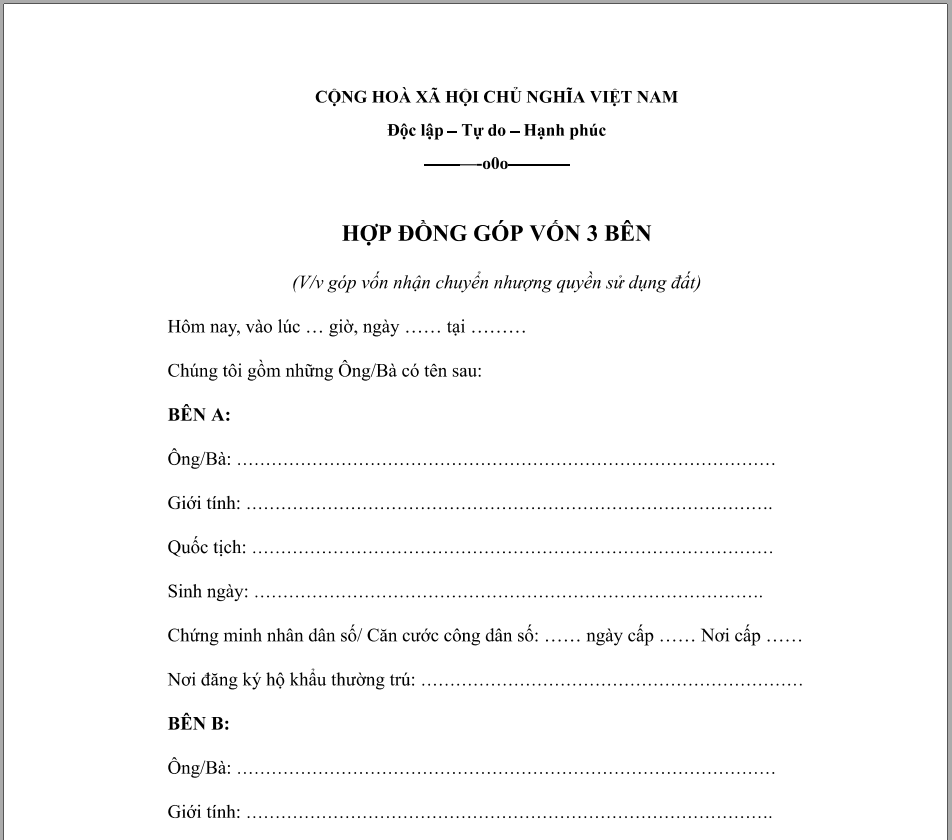
This is a contract used when three parties jointly contribute capital to a project, company, or organization. This contract defines the rights and obligations of each party regarding capital contribution and management.
DOWNLOAD: [1OFFICE] Hợp đồng góp vốn 3 bên.docx
7.2 Three-Party Cooperation Agreement
-

Three-Party Cooperation Agreement
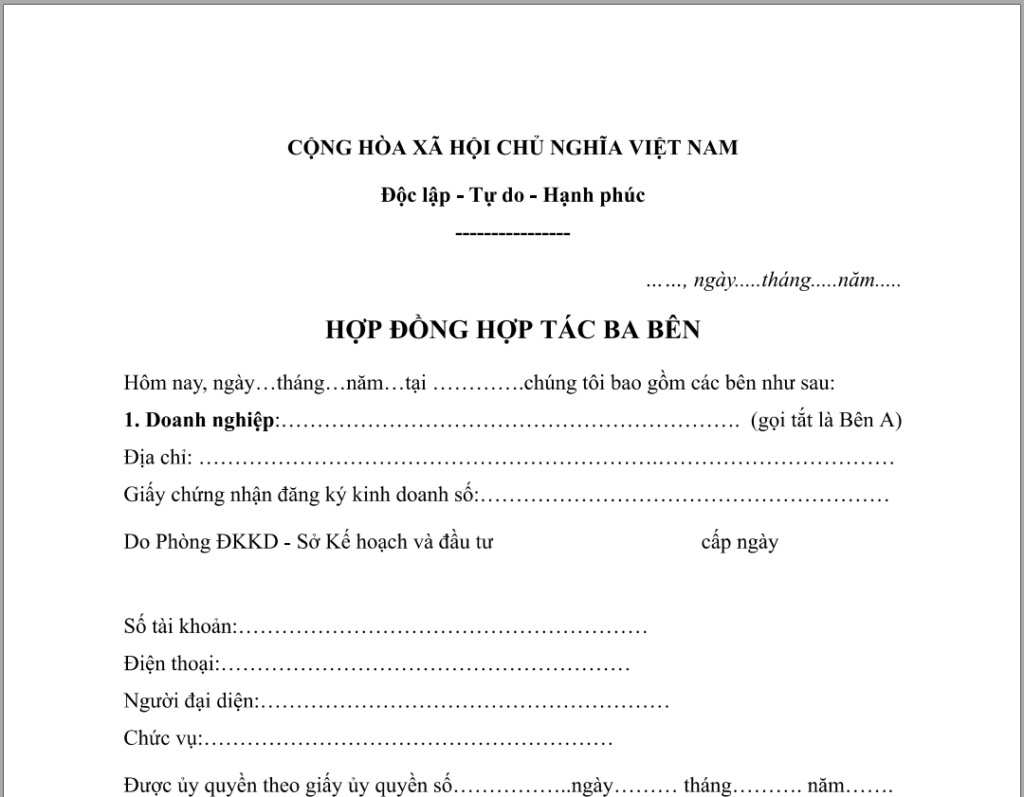
This is a type of contract signed between three parties to carry out a project, produce a product, or provide a service. This contract defines the rights and responsibilities of each party during the cooperation process.
DOWNLOAD: [1OFFICE] Hợp đồng hợp tác 3 bên.docx
7.3 Three-Party Sales Agreement
-

Three-Party Sales Agreement
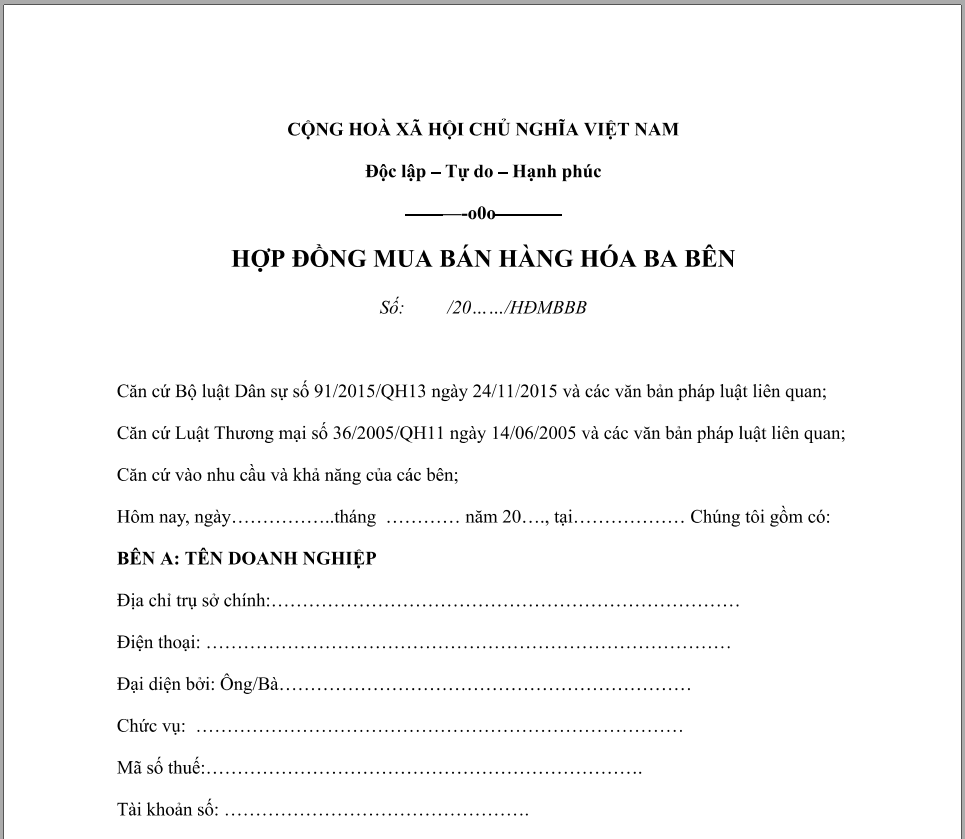
This type of contract occurs when three parties are involved in a sales transaction. This contract defines the terms regarding the sale of products or services, value, payment conditions, and the rights and obligations of each party.
DOWNLOAD: [1OFFICE] Hợp đồng mua bán 3 bên.docx
7.4 Three-Party Asset Mortgage Agreement
-

Three-Party Asset Mortgage Agreement
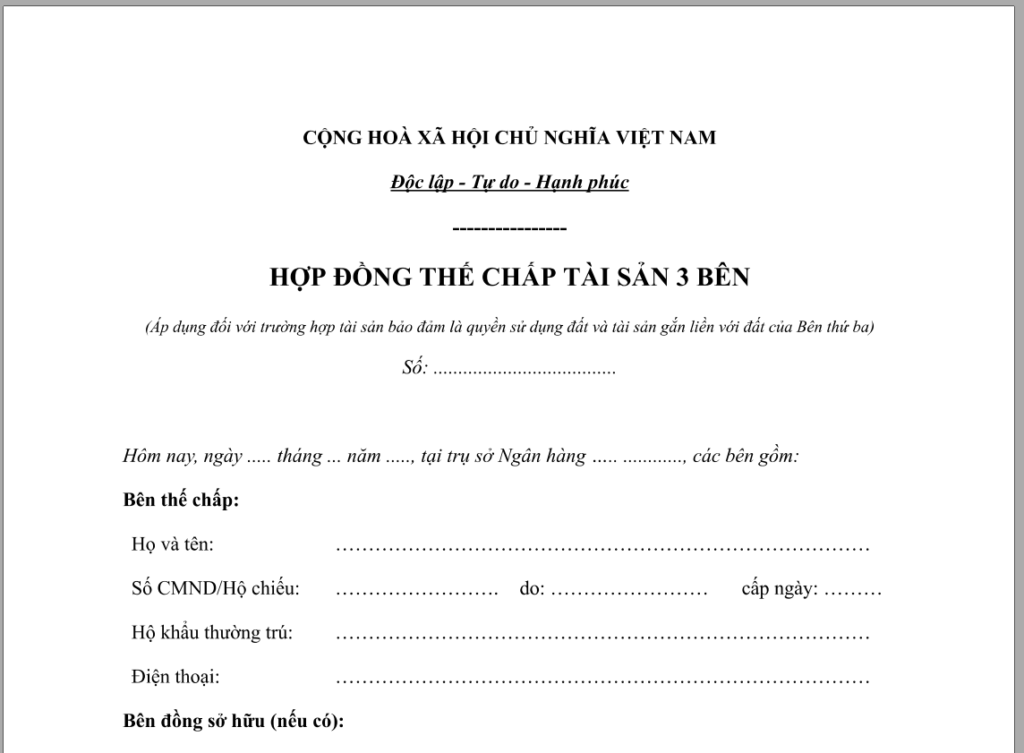
This is a type of contract used when three parties are involved in mortgaging an asset to secure a loan or other financial obligation. This contract defines the terms regarding the mortgaged asset, and the responsibilities and rights of each party.
DOWNLOAD: [1OFFICE] Hợp đồng thuế chấp tài sản 3 bên.docx
7.5 Two-Party Contract for the Benefit of a Third Party
-

Two-Party Contract for the Benefit of a Third Party
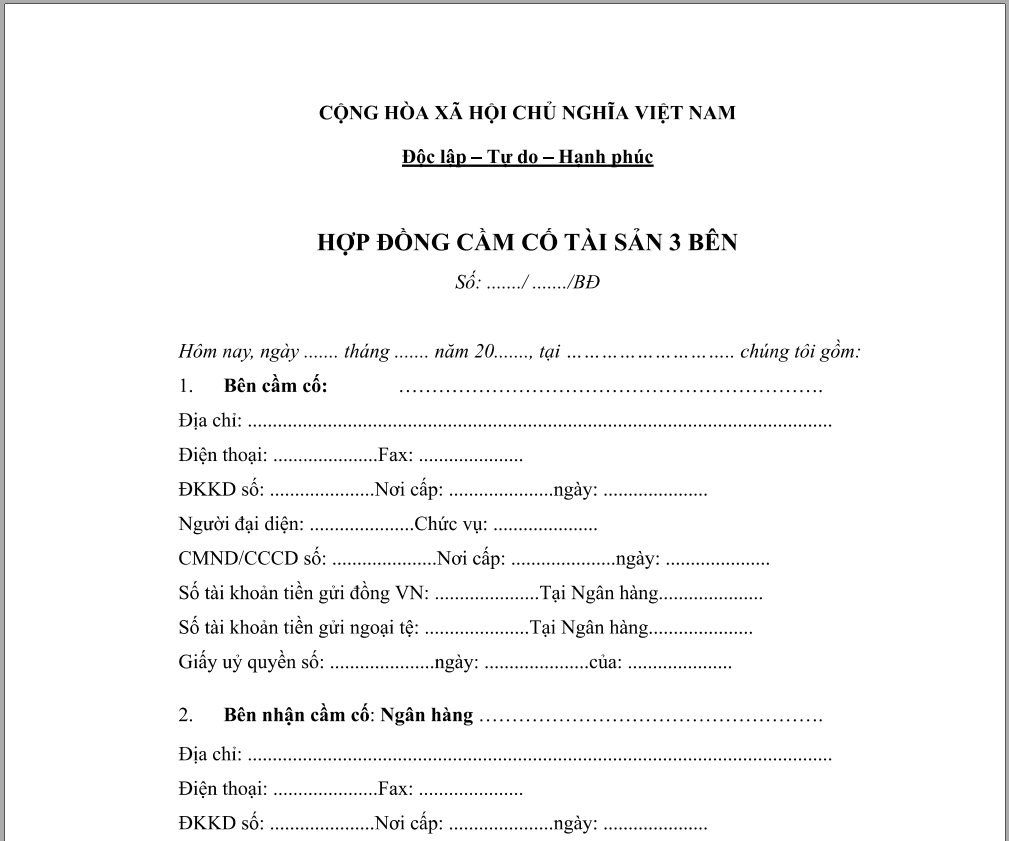
This is a type of contract signed between two parties to protect the interests of a third party. This contract defines the rights and obligations of the two parties in protecting and realizing the interests of the third party.
DOWNLOAD: [1OFFICE] Hợp đồng 2 bên vì lợi ích của bên thứ 3.docx
8. Common Mistakes When Signing a Three-Party Contract
Although a three-party contract helps ensure rights and bind responsibilities, many businesses still make mistakes that can invalidate the contract or lead to legal disputes.
Not clearly defining the rights and obligations of each party: Businesses often include general clauses, leading to parties not knowing their specific responsibilities. This is the main cause of disputes when incidents occur.
Lacking a dispute resolution clause: Many contracts do not specify a clear method for handling conflicts (negotiation, arbitration, court). This makes the resolution process lengthy and costly.
Ignoring relevant legal regulations: Some businesses draft contracts based on “verbal agreements” without referencing the Civil Code, Law on Enterprises, or Commercial Law. As a result, the contract is easily invalidated when disputes go to court.
Failing to notarize or certify the contract: In mandatory cases (asset mortgages, real estate transfers, etc.), failing to notarize the contract renders the document legally invalid.
Vague terms on payment and benefits: If payment methods, profit-sharing ratios, or disbursement conditions are not detailed, businesses are at risk of partners delaying or refusing to fulfill their obligations.
Lack of information security: Many contracts do not clearly define the scope and responsibility for confidentiality, leading to leaks of business or financial information that can harm the company.
9. 7-Step Checklist for Securely Signing a Three-Party Contract
To ensure a tripartite contract is both legal and provides maximum protection of rights, businesses should follow these 7 steps:
- Define the purpose and scope of cooperation: Before drafting, all three parties must clearly agree on the cooperation objectives, desired benefits, and scope of work to avoid future conflicts.
- Draft a detailed contract: The content must fully include: information of the parties, rights and obligations, payment terms, confidentiality, legal liability, and termination clauses.
- Review relevant legal clauses: Cross-reference with the Civil Code, Law on Enterprises, Commercial Law, and specialized regulations to ensure legality and prevent the contract from being invalidated.
- Consult a lawyer or legal expert: Have an expert review the draft to amend any weak points, especially clauses regarding disputes, payment, and rights and obligations.
- Finalize and sign the contract: All three parties should carefully read each clause, agree in writing, and then proceed to sign. Signing in person is preferred to avoid misunderstandings.
- Notarize or certify when necessary: For transactions such as mortgages, asset transfers, capital contributions, etc., the contract must be notarized to be legally valid.
- Store and monitor contract execution: Each party should keep an original copy of the contract and monitor its implementation, updating with supplementary appendices if there are any changes during the cooperation.
10. Frequently Asked Questions about Tripartite Contracts (FAQs)
Are tripartite contracts legally valid?
Yes. Tripartite contracts are fully legally valid based on the principle of freedom of agreement in the Civil Code. As long as all parties have full civil act capacity, the content does not violate prohibited regulations, and it has the signatures and seals of all three entities, this document is as legally binding as a bilateral contract.
When is it necessary to sign a tripartite contract?
Businesses should sign this type of contract when the parties have intertwined rights and obligations that cannot be separated. The most common scenarios are: Party A buys goods from Party B but has Party C pay on their behalf; or Party A sells goods to Party B but delivers them directly to Party B’s customer, who is Party C. A tripartite agreement helps clarify cash flow and delivery responsibilities.
Is notarization mandatory for tripartite contracts?
It is not mandatory for standard commercial and service transactions. However, if the contract’s content involves the transfer of real estate, land use rights, or other assets requiring ownership registration by law, it must be notarized or certified to ensure its enforceability.
What is the biggest risk when signing a tripartite contract?
The main risk is a break in the chain of responsibility. If one party fails to fulfill its obligation (e.g., Party C does not pay Party B on behalf of Party A), it will be difficult to determine fault and collect the debt. Additionally, dispute resolution procedures are often more complex as they require summoning and cross-checking obligations from all three sides.
Can two parties unilaterally amend a tripartite contract?
No. Any changes to the content, term, or termination of the contract must be agreed upon and confirmed in writing by all three parties. If only two parties unilaterally agree to changes without the consent of the third, the amended clauses will be void and may lead to legal disputes.
11. Conclusion
Managing tripartite contracts requires not only accuracy but also a robust real-time control system. In reality, however, many businesses still handle this through manual Word files, Excel spreadsheets, or emails. With AI in 1Office, this problem can be completely solved: the system automatically sends reminders for contract deadlines, suggests clauses based on partner type, alerts for missing signatures, and tracks the entire process – ensuring both transparency and operational efficiency. The CEO no longer needs to ask, “Has this contract been signed yet?”, because the system always knows.
If you are looking for a type of digital signature software or electronic contract software with excellent features that meet the advantages mentioned above, then our 1Office is the most suitable solution. Please leave your information in the form below, and we will contact you with support as quickly as possible:
- Hotline: 083 483 8888
- Facebook: https://www.facebook.com/1officevn/
- Youtube: https://www.youtube.com/@1office-chuyendoisodn
















