


 11/05/2026
  167 views
In a rapidly changing and complex market, a cash flow plan is a useful tool to ensure the stability and sustainability of a business. A cash flow plan can help business owners manage financial processes effectively and improve cash flow management efficiency. In this article, 1Office will guide you on how to create a comprehensive and easy-to-understand cash flow plan.
Mục lục
1. What is a cash flow plan?
A cash flow plan is a forecast of a business’s cash inflows (all money the business earns) and cash outflows (including all expenses) that will occur at a specific time in the future.
It helps businesses understand their financial situation, enabling them to allocate cash flow reasonably, implement measures to balance income and expenses, and deploy suitable investment and business plans. A cash flow plan plays a crucial role in ensuring the financial stability and sustainability of a business or organization.
2. The role of a cash flow plan for businesses
Creating a cash flow plan is a crucial task for any business. It helps businesses understand their financial situation, allowing them to make appropriate investment, business, and development plans. Specifically, a cash flow plan has the following roles:
Forecast and control cash flow
Through a cash flow plan, business owners can more easily grasp the company’s cash flow trends by focusing on every inflow and outflow of money. This is very important as it helps the CEO anticipate risks for timely adjustments, minimizing obstacles that could affect the cash flow and the business’s operations.
Mitigate the risk of cash shortages
A cash shortage is a major financial risk for a business. A cash flow plan helps businesses predict periods when they might face a cash shortage. From there, the business can implement measures to mitigate this risk, such as accelerating debt collection, delaying non-essential expenses, or seeking additional funding.
Enhance solvency
A cash flow plan helps a business determine the amount of money needed to pay debts as they come due. This allows the business to be proactive in paying its debts, avoiding late payment penalties or loss of credibility with partners.
Provide a basis for business decisions
A cash flow plan helps a business assess its financial capacity to make appropriate business decisions. For example, if a business plans to expand, the cash flow plan will help determine whether it has sufficient funds to execute this plan.
3. Guide to creating a cash flow plan for businesses
Step 1: Forecast cash inflows
To make forecasting and planning more convenient, a business’s cash inflows are typically divided into 3 types:
Cash inflows from operating activities
This is cash received from revenue-generating activities such as cash from sales of goods and services to customers, collection of accounts receivable from customers, etc.
To forecast cash flow from operating activities, you can base it on sales patterns, payment methods and timing of buyers, credit sales policies, and discount policies for early collection of payments from customers.
Cash inflows from investing activities
This includes proceeds from the sale of investments, interest earned from investing activities in other companies or projects, proceeds from the sale or disposal of fixed assets, collection of loans, and recovery of investments or capital contributions to other businesses.
The basis for forecasting this cash flow is based on planned disposals of fixed assets, policies for recovering financial investments, etc.
Cash inflows from financing activities
This includes cash from owners’ additional capital contributions, funds raised from loans, issuance of stocks, bonds, etc.
To forecast this cash flow, you need to base it on the potential for new borrowing, strategies for issuing securities to raise capital, investment attraction activities, etc.
Step 2: Forecast cash outflows
Simply put, cash outflow is all cash expenditures and payments arising from a business’s operating and business activities over a period of time. Cash outflow is usually classified into 3 types:
Cash outflows from operating activities
These are expenditures for the business’s revenue-generating activities, such as payments to suppliers of materials and services, salaries, payments to the state budget for financial obligations, expenses for marketing and sales activities, expenses related to business management, and interest payments on business loans.
The basis for a business to forecast cash outflows from operating activities is based on purchasing and debt payment patterns, estimated payroll, insurance, interest expenses, and projected tax liabilities. Additionally, you should also consider inventory reserve policies, credit purchase policies, etc., for more accurate calculations.
Cash outflows from investing activities
This includes cash expenditures for the construction and purchase of fixed assets, capital contributions to other entities, loans made to others, etc.
The basis for forecasting this cash flow stems from the need to invest in fixed assets for the business’s activities, capital contribution strategies, strategies for purchasing stocks and bonds, etc.
Cash outflows from financing activities
This includes payments of loan principal due, financial lease payments, interest paid to investors in the business through forms such as dividends, stock buybacks, bond interest, etc.
The basis for forecasting cash outflows from this activity is based on the need to repay debts according to existing credit agreements and the company’s profit distribution policy.
Step 3: Determine net cash flow
To calculate net cash flow, you need to calculate the difference between the business’s cash inflows and cash outflows over the same period.
For example:
Cash inflow: 500 million
Cash outflow: 300 million
⇒ Net cash flow = 500 million – 300 million = 200 million
Step 4: Determine the ending cash balance
The ending cash balance is determined by the following formula:
Ending cash balance = Beginning cash balance + Net cash flow for the period
Where:
- Net cash flow for the period: The difference between cash inflows and cash outflows.
- Beginning cash balance: The existing cash balance at the start of the period.
Step 5: Handle the cash balance
In case of a capital shortage
The business needs to immediately consider, find, and apply appropriate solutions to balance cash flow, such as considering loans, accelerating debt collection, and tightening expenditures. Based on this, evaluate the new balance of revenue and expenses.
In case of a capital surplus
The solution for the business in this case is to analyze and re-evaluate how money is used and allocate investments appropriately to increase the profitability of the capital.
Note that when applying solutions for surplus or shortage of capital, it is necessary to calculate cash flow accurately because changing the amount in one period will affect the surplus or shortage in subsequent periods.
4. Important Cash Flow KPIs to Monitor
To manage cash flow effectively, businesses should not just record income and expenses, but also monitor financial indicators (KPIs) that directly reflect liquidity, capital management efficiency, and financial security. Some important KPIs include:
-
Working Capital Cycle
-
Days Sales Outstanding (DSO): the average number of days to collect receivables from customers.
-
Days Payable Outstanding (DPO): the average number of days for the business to pay its suppliers.
-
Days Inventory Outstanding (DIO): the average number of days for inventory to be sold.
-
This indicator helps businesses assess the speed of capital turnover. The shorter the cycle, the healthier the cash flow.
-
Free Cash Flow (FCF)
-
Formula: FCF = Cash flow from operating activities – Capital expenditures (CAPEX).
-
This is the cash remaining after paying for operating expenses and investments. A positive FCF indicates the business can reinvest or pay dividends, while a consistently negative FCF warns of liquidity risks.
-
Current Ratio
-
Formula: Current Ratio = Current Assets / Current Liabilities.
-
A ratio > 1 indicates the business has good short-term solvency. If it is < 1 for several consecutive periods, the risk of a cash flow imbalance is very high.
-
Margins & Profit Margins
-
Includes: Gross Margin, Operating Margin, and Net Margin.
-
Although they do not directly reflect cash, profit margins show whether the business is generating enough cash flow from its operations. The higher the margin, the greater the ability to accumulate cash.
In summary, cash flow KPIs are an “early warning system” that helps businesses understand their actual financial situation, detect unusual signs, and make timely decisions to avoid working capital shortages.
5. Strategies for Optimizing Cash Flow
After monitoring and analyzing KPIs, the next step is to design management strategies to improve and optimize cash flow. This is the “key to survival” for every business, especially for SMEs where pressure on capital and liquidity is always high. Optimizing cash flow not only helps businesses operate in the short term but also ensures long-term sustainability.
Accelerate Debt Collection
One of the fastest ways to improve cash flow is to shorten the collection cycle from customers.
-
Establish a strict payment policy: require a partial deposit in advance, reduce credit terms from 60 days to 30 days.
-
Apply early payment incentives: for example, a 2–3% discount for customers who pay before the due date.
-
Use debt management tools: CRM/ERP software with automatic payment reminders and payment history tracking.
Collecting cash early helps businesses reduce the pressure of short-term loans and provides cash flow for reinvestment.
Negotiate Payment Terms with Suppliers
In addition to collecting money quickly, businesses also need to hold onto cash for as long as possible by managing payments.
-
Extend payment terms reasonably: from 30 days to 60 days if possible.
-
Arrange flexible payment terms: pay in installments or according to project progress instead of paying the full amount at once.
-
Build long-term relationships: with a good reputation, businesses can more easily negotiate debt extensions during difficult periods.
This is a “leveraging” method that helps businesses utilize supplier capital without affecting the partnership.
Control Inventory at a Reasonable Level
Large inventories can tie up capital, while too little inventory can easily disrupt the supply chain.
-
Avoid excess inventory: regularly check slow-moving items to handle them promptly.
-
Apply the Just-In-Time (JIT) model: import goods based on demand instead of overstocking.
-
Analyze inventory turnover: evaluate the speed of import-export-inventory to make more accurate purchasing decisions.
A reasonable inventory system helps optimize storage costs, free up cash flow, and reduce the risk of goods damage.
Postpone Non-Essential Expenses
It’s not always necessary to spend money immediately on every project. Businesses need to know how to prioritize.
-
Prioritize spending on core activities: production, sales, and direct marketing that generate revenue.
-
Delay non-urgent projects: for example, office upgrades or equipment purchases that do not affect production.
-
Plan quarterly spending: forecast cash outflows to avoid misalignment with cash inflows.
Smart spending management helps businesses maintain a “financial cushion” to respond to unexpected events.
Effective cash flow management is not just about cutting costs, but about a smart balance between income and expenses. When businesses know how to collect debts quickly, extend payments, control inventory, and postpone unnecessary spending, they will maintain financial flexibility, creating a solid foundation to both overcome difficulties and seize growth opportunities.

6. Free Download: Sample Cash Flow Plan Excel File
1Office would like to share the following basic Cash Flow Plan File with you. Readers can download and customize the figures according to their business model and characteristics.
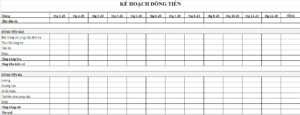
[Download] Cash Flow Plan Excel File
Additionally, for accurate reports on revenues and expenditures, businesses can use 1Office CRM with its highly precise Expense Management feature. With this feature, businesses can get an overview report of their cash flow status. The expense management feature allows you to easily monitor and calculate the operating costs of each department and employee. All cash inflows and outflows are clearly and fully updated on the system, and detailed reports can be easily exported, replacing the sample cash flow plan file above.
1Office is an effective business financial management support tool with a friendly, easy-to-use interface. The software helps you manage all revenues and expenditures on a single system, with real-time updates on all cash flow activities. Moreover, 1Office ensures complete transparency for every revenue and expense, provides absolute information security, and maximizes savings on creation and approval time, as well as costs for paperwork, ink, and storage devices. The Expense Management feature of the 1Office software will help business owners get a comprehensive view of their cash flow, thereby helping them build more accurate future cash flow plans.
Above is a detailed guide on how to create a basic and easy-to-understand cash flow plan. We hope it will be useful for your business in managing cash flow and allocating budgets reasonably. We wish you success!
















