What is Accounts Receivable Turnover? Significance & Formula


In business operations, accounts receivable from customers are considered a crucial item in a company’s working capital. Leaders need to collect these receivables effectively to ensure cash flow and solvency. To better understand the accounts receivable turnover ratio, let’s explore it with 1Office in the article below.
Mục lục
- 1.What is Accounts Receivable Turnover?
- 2. The Significance of Accounts Receivable Turnover
- 3. Formula for Calculating Accounts Receivable Turnover
- 4. Example of accounts receivable turnover
- 5. What are the limitations of accounts receivable turnover?
- 6. What factors affect accounts receivable turnover?
- 7. Important notes about the accounts receivable turnover ratio
- 8. How to Improve Accounts Receivable Turnover?
- 9. Frequently Asked Questions
- 10. Conclusion
1.What is Accounts Receivable Turnover?

Accounts receivable turnover is a ratio used to measure the number of times a company’s accounts receivable are converted into cash within a specific period. This is a crucial indicator that helps businesses evaluate the effectiveness of their debt collection activities from customers.
Typically, businesses will calculate their accounts receivable turnover on a monthly or quarterly basis to promptly assess the customer debt collection situation. Additionally, calculating it annually helps businesses get a broader overview of their debt collection performance over a year and make appropriate adjustments for the following years.
2. The Significance of Accounts Receivable Turnover
Accounts receivable turnover is used to evaluate a company’s credit policy. The credit policy is one of the key factors affecting a company’s revenue, profit, and solvency. A company with a suitable credit policy will attract more potential customers, thereby helping to boost revenue and profit.

The higher the accounts receivable turnover ratio, the better the company’s debt collection efficiency. This indicates that the company is effectively collecting cash from customers, which helps ensure it has enough money to pay off short-term debts, invest in business, and grow.
Furthermore, this ratio can also be used to monitor the company’s bad debt situation. A low accounts receivable turnover may be due to the company allowing customers to pay late, meaning cash flow is not being optimally utilized. This can easily lead to an increase in bad debt and affect the company’s solvency.
3. Formula for Calculating Accounts Receivable Turnover
Accounts receivable turnover is determined by the following formula:
| Accounts Receivable Turnover = Net Credit Sales / Average Accounts Receivable |
Where:
- Accounts receivable turnover: Is the number of times a company’s accounts receivable are converted into cash within a specific period (month/quarter/year)
- Net credit sales: Refers to sales where cash is collected at a later date. This metric is determined as follows: Net credit sales = Total credit sales – Sales returns – Sales allowances.
- Average accounts receivable: Is the average of the beginning and ending accounts receivable over a specific period. This metric is determined by the formula: Average accounts receivable = (Beginning accounts receivable + Ending accounts receivable) / 2
Thus, the formula for calculating accounts receivable turnover is:
| Accounts Receivable Turnover | = | Credit Sales – Sales Returns – Sales Allowances |
| (Beginning Accounts Receivable + Ending Accounts Receivable) / 2 |
From the formula above, it can be seen that net credit sales and average accounts receivable are two important factors in the formula for calculating accounts receivable turnover. These figures are taken from the company’s balance sheet. Therefore, leaders need to regularly monitor and control them closely to ensure the accounts receivable turnover is at a reasonable level.
4. Example of accounts receivable turnover
In 2023, Company A, operating in the electronics sector, had total credit sales of 300 million VND, of which the profit was 70 million VND. Company A’s beginning accounts receivable was 120 million VND, and by the end of 2023, the ending accounts receivable was 80 million VND. Determine the accounts receivable turnover for Company A in 2023.
Calculation:
- Company A’s net credit sales in 2023 are: 300 – 70 = 230 million VND
- The average value of accounts receivable in 2023 will be: (120 + 80) / 2 = 100 million VND
- Company A’s accounts receivable turnover in 2023 is: 230 / 100 = 2.3 times
Thus, Company A’s accounts receivable turnover in 2023 is 2.3 times/year.
5. What are the limitations of accounts receivable turnover?

Accounts receivable turnover is an important financial ratio, but it also has some limitations that businesses should be aware of:
It cannot reflect the entire debt collection situation of the business: This ratio measures the number of times accounts receivable are converted into cash within a specific period. However, the effectiveness of a company’s debt collection also depends on many other factors such as credit policy, customer quality, etc.
This ratio can be influenced by other factors: Such as sales volume, credit policy, customer quality, etc. Therefore, businesses need to consider these factors when evaluating accounts receivable turnover.
It cannot be directly compared between different companies: The accounts receivable turnover of different companies can vary due to size, industry, credit policy, etc. Therefore, businesses should compare their accounts receivable turnover with that of other companies in the same industry to get a more accurate assessment.
6. What factors affect accounts receivable turnover?
The accounts receivable turnover ratio not only reflects the speed of debt collection but is also affected by various other factors in business operations. Understanding these factors will help businesses identify the reasons for a slowdown in turnover and find suitable improvement solutions. Below are the three most important groups of factors.
6.1 Credit policy and payment terms
The credit policy provides the “open conditions” for customers to buy now and pay later. If a business applies excessively long payment terms, customers will have more time to tie up capital, thus extending the accounts receivable turnover period. Conversely, if the policy is too strict, customers may be hesitant and reduce their purchasing demand.
Therefore, businesses need to balance market competitiveness with the ability to control cash flow. For example, stipulating a payment term of 15–30 days with an early payment discount is more reasonable than allowing debt for 60–90 days without any constraints.
6.2 Customer quality and bad debt risk
Not all customers have the same financial capacity and creditworthiness. If a business chooses the wrong customer segment (e.g., small customers, those with weak financial capacity, or a history of late payments), it will likely face overdue debts or bad debts, which will seriously affect the accounts receivable turnover.
How to mitigate risk:
-
Check credit and transaction history before signing a contract.
-
Diversify customers to avoid depending on a few “large debtors.”
-
Build a customer evaluation and rating mechanism for a flexible credit policy.
6.3 The business’s debt management capacity
Even with a reasonable credit policy and reputable customers, if the business’s debt management is poor, the turnover ratio will still be low. Common issues include: lack of an invoice tracking process, no automatic debt reminder system, and manual processing by accounting staff causing delays.
Therefore, debt management capacity is the “lever” to improve the turnover ratio. Businesses need to:
-
Use debt management software for real-time tracking.
-
Establish a clear, polite, but firm debt reminder process.
-
Train accounting and finance personnel in risk analysis and quick decision-making skills.

7. Important notes about the accounts receivable turnover ratio

7.1. What is a good accounts receivable turnover ratio?
What constitutes a good accounts receivable turnover ratio depends on many factors such as business size, industry, credit policy, etc. However, the higher the accounts receivable turnover, the better the company’s debt collection efficiency.
According to a study by the American Institute of Certified Public Accountants (AICPA), the average accounts receivable turnover for businesses in the United States is 7.1 times. However, this number can vary by industry. For example, the accounts receivable turnover for retail businesses is often higher than the accounts receivable turnover of manufacturing businesses.
7.2.What does a decreasing accounts receivable turnover mean?
A decreasing accounts receivable turnover means the business is collecting its debts more slowly. This could be due to several reasons, such as:
- A credit policy that is too lenient, allowing customers to pay late.
- Poor customer quality, with many customers likely to pay late.
- Ineffective debt collection efforts.
A decreasing accounts receivable turnover can lead to an increase in bad debt, affecting the business’s solvency.
7.3.What does an increasing accounts receivable turnover mean?
An increase in accounts receivable turnover means the business is collecting its debts faster, which could be due to several reasons such as:
- Strengthening debt collection efforts.
- Applying stricter credit policies, reducing payment terms, requiring customers to make advance deposits, etc.
- Improved customer quality, with more customers having good payment ability.
An increase in accounts receivable turnover can help businesses improve cash flow, reduce bad debt, and enhance operational efficiency.
8. How to Improve Accounts Receivable Turnover?
Effective debt management not only helps businesses maintain a stable cash flow but also reflects their financial capacity and credibility with partners. When the accounts receivable turnover ratio is low, capital gets “frozen” in uncollected receivables, causing difficulties for the business in paying operational costs or investing in expansion. Therefore, finding solutions to improve accounts receivable turnover is essential to accelerate debt collection, minimize risks, and enhance capital utilization efficiency.
8.1 Discount Policies and Early Payment Incentives
One of the most effective measures to shorten the debt collection period is to apply discount policies or early payment incentives. For example, a business can offer a 1–2% discount on the invoice value if customers pay within 7 days instead of waiting for 30 days.
-
Benefits: Motivates customers to pay faster, reduces the risk of bad debt, and helps the business improve cash flow.
-
Note: The discount rate needs to be calculated reasonably to both encourage customers and avoid significantly reducing the profit margin.
8.2 Automate the Debt Reminder and Management Process
Many businesses still handle debt collection manually, leading to missed invoices or poorly timed reminders. This prolongs the accounts receivable turnover and increases the risk of bad debt.
-
Solution: Set up an automated reminder system via email, SMS, or in-app notifications. This helps customers remember payment deadlines and reduces forgetfulness or delays.
-
Benefits: Optimizes resources, reduces the manual workload for accounting staff, and maintains professionalism and transparency with customers.
8.3 Use Financial and Accounting Management Software
When a business has to process hundreds to thousands of transactions each month, managing receivables with Excel or manually becomes inefficient. In this situation, financial and accounting management software is an indispensable tool.
- Supporting features:
- Automatically record invoices and track receivables for each customer.
- Generate reports analyzing accounts receivable turnover and Days Sales Outstanding (DSO).
- Provide alerts for due and overdue invoices directly on the system.
-
Benefits: Provides managers with real-time data to make quick decisions, minimizes manual errors, and enhances cash flow control efficiency.

Solutions to improve accounts receivable turnover
9. Frequently Asked Questions
10. Conclusion
The above is all the information that 1Office wants to share with businesses about the accounts receivable turnover ratio. As you can see, calculating the accounts receivable turnover is not too complicated. We hope your business will gain the right perspective to effectively control customer receivables and thereby optimize cash flow.
In summary, managing customer debt is one of the crucial activities for a business. The efficiency of debt collection will directly affect cash flow, solvency, and the operational performance of the business.
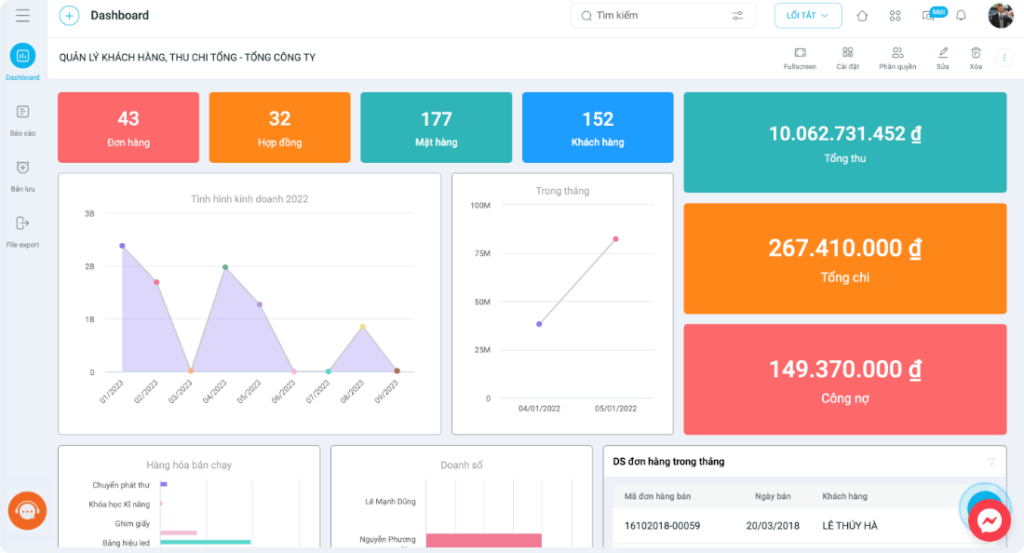
1Office’s revenue and expenditure management software is a comprehensive solution that helps businesses efficiently manage revenue and expenditure operations, including the collection of customer debts.
- Create financial plans, forecast and control the business’s cash flow
- Track and manage all revenues and expenditures within the business, from sales and purchasing costs to customer collections, etc.
- Automatically send alerts and reminders for contract expiration dates, payment deadlines, etc., to avoid omissions.
- Provide an intuitive reporting dashboard to give businesses a detailed view of accounts receivable from customers
Experience all the features of the 1Office CRM sales management software for free today!