


 11/05/2026
  924 views
The ROS ratio is an important tool for evaluating a company’s financial performance and provides basic information on how the organization manages profits from its business operations. Join 1Office in this article to learn what the ROS ratio is, what it reflects about a company’s financial situation, and how to calculate and apply it in practice.
Mục lục
- 1. What is the ROS ratio? Why is it important?
- 2. The significance of the ROS ratio in financial statements
- 3. How to accurately calculate ROS in financial analysis
- 4. What is a good ROS?
- 5. Comparing ROS by Industry: Understanding Correctly to Evaluate Effectiveness
- 6. The Correlation Between ROS and ROA, ROE, ROI
- 7. Frequently Asked Questions (FAQs) about the ROS metric
- 8. Manage Revenue and Expenditures Effectively with 1Office CRM
- 9. Conclusion
1. What is the ROS ratio? Why is it important?
The ROS (Return on Sales) ratio is an indicator that reflects a company’s profitability, showing how much profit is generated for every dollar of revenue after costs. Tracking ROS helps assess cost management efficiency and competitiveness; a higher and more stable ROS indicates that the company operates efficiently and is attractive to investors.

Characteristics and practical value of ROS:
- Representation: ROS is calculated as a percentage (%). This ratio is directly proportional to financial health: the higher the ROS, the stronger the growth potential and the ability to pay dividends to investors.Example: If a company has an ROS of 20%, it means that for every 10 dollars of net revenue, the company makes a real profit of 2 dollars.
- A measure of cost management: ROS is the most vivid evidence of a company’s ability to optimize operations. A company with a high ROS demonstrates that it is effectively controlling input costs and administrative expenses, thereby widening its actual profit margin.
- A tool for forecasting and comparison: The value of ROS is maximized when analyzed over time (monthly/quarterly/annually). Comparing ROS between periods or with industry competitors helps managers identify early signs of performance decline to make timely adjustments.
2. The significance of the ROS ratio in financial statements
The ROS ratio is significant in financial statements because it provides crucial information about a company’s financial performance. The ROS ratio in a company’s financial statements serves to:
- Measure profit performance: ROS indicates the level of profit a company can generate from each unit of revenue. It helps determine whether the company can generate enough profit to sustain and grow its business operations.
- Compare with the industry: ROS allows for a performance comparison of the company with its competitors in the same industry. This helps determine whether the company is more or less competitive than others.
- Predict the future: A high ROS can predict positive future growth. It can make the company more attractive to investors or external capital sources.
- Measure management performance: The ROS level reflects the ability of the company’s leadership and management to optimize resources and business processes.
- Basis for adjusting strategy and optimizing business/operational costs: ROS is a powerful tool for adjusting business strategy. When ROS is low, the company can consider adjusting product prices or cutting unnecessary costs.
3. How to accurately calculate ROS in financial analysis
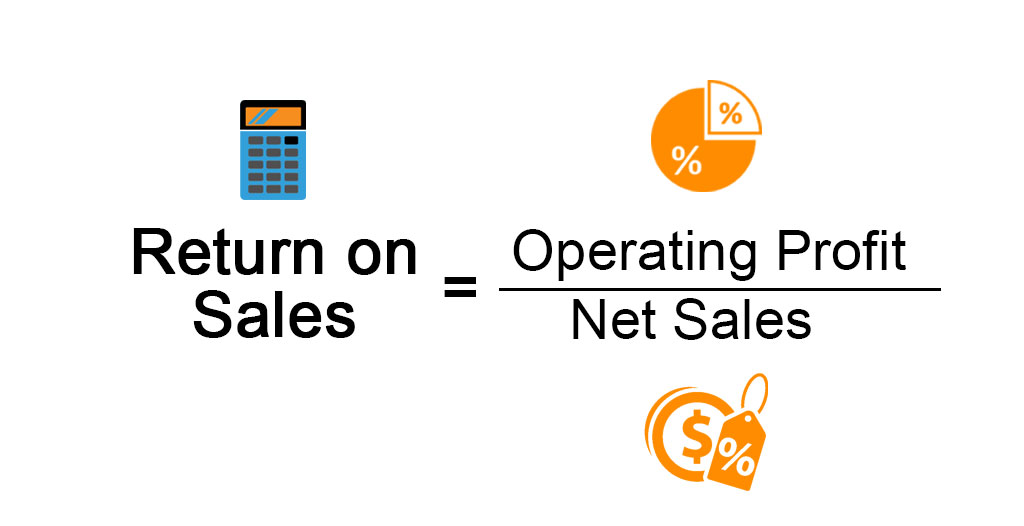
To calculate the ROS ratio, you need to take the net profit (profit after tax) and divide it by sales revenue. The specific formula is as follows:
ROS = (Profit After Tax / Net Revenue) x 100% (unit: %)
Where:
- Net Revenue: The actual revenue after deducting reductions (discounts, returned goods).
- Profit After Tax: The actual profit the company retains after fulfilling its tax obligations to the state.
Analyzing the meaning of the ROS ratio
How to interpret the ROS ratio to assess a company’s health:
- Case of negative ROS (ROS < 0): The company is operating at a loss. The cause is usually that operating costs (cost of goods sold, administrative, selling expenses) are too high, or revenue is insufficient to cover fixed costs. If this situation persists, the company risks insolvency.
- Case of positive ROS (ROS > 0): The company is profitable. A higher ROS demonstrates a better ability to optimize costs and effective management.
Note: The fluctuation of ROS is more important than a single figure. You should track ROS for at least 5 consecutive periods:
- Increasing ROS: A positive signal, indicating that cost management is becoming more effective.
- Decreasing ROS (even if revenue increases): A warning that the business is overspending or that profit margins are shrinking due to price competition.
4. What is a good ROS?
There is no fixed ROS level that is universally “good,” as it depends on the industry and business strategy. An ideal ROS is one that is higher than the industry average, stable or growing over 3–5 years, and aligned with the business goals for each stage.
The criteria for evaluating the ROS include:
- Comparison with the industry average: The profit margin for each sector is completely different (e.g., the service industry typically has a much higher ROS than retail). A business with an ROS higher than the industry average is clear evidence of optimal cost management capabilities and a strong brand position.
- Compatibility with business strategy:
- Market expansion phase: ROS may be low, or even negative (like e-commerce platforms), as the business prioritizes “burning money” to capture market share.
- Optimization phase: Once a position is established, ROS needs to be pushed to the highest possible level to demonstrate profitability and increase shareholder value.
- Stability and growth trend: An efficiently operated business typically maintains an ROS above 10% and shows a stable growth trend. Managers should analyze ROS over a 3-7 year cycle to eliminate temporary fluctuations or unusual income, thereby accurately assessing the nature of the operational apparatus.
- Identifying sudden signals: Special attention is needed when ROS fluctuates too rapidly (spikes or sharp drops). At this point, the business needs to break down the data to determine if the cause is a change in core operations or just one-time revenue/expenses.
5. Comparing ROS by Industry: Understanding Correctly to Evaluate Effectiveness
The ROS cannot be evaluated by a single standard for all businesses; it must be placed in the context of the industry. This is because each industry has different characteristics regarding operating costs, gross profit margins, and business models. Comparing ROS by industry helps a business “self-reflect” within the bigger picture, thereby adjusting its strategy accordingly.
F&B (Food & Beverage) Industry
-
Characteristics: Costs for fresh ingredients, operations (personnel, rent), and brand marketing account for a large proportion.
-
Average ROS: typically ranges from 3–7%.
-
Significance: An ROS at this level is still considered “healthy” because the industry has a fast capital turnover and high daily revenue. F&B businesses looking to improve ROS need to optimize their supply chain and reduce inventory loss.
E-commerce Industry
-
Characteristics: Fierce competition, with very high logistics and promotion costs.
-
Average ROS: only 1–5%, and many startups even accept a negative ROS in the initial phase to capture market share.
-
Significance: A low ROS does not mean failure; it reflects a “burn money” strategy to expand the market. Investors often look at ROS in conjunction with the GMV (Gross Merchandise Value) growth rate.
Technology & Software Industry (SaaS, IT)
-
Characteristics: Low marginal costs, digital products with nearly unlimited scalability.
-
Average ROS: significantly higher, from 15–30%.
-
Significance: A high ROS indicates a sustainable “scalable” model. SaaS businesses can maintain a high ROS if they invest effectively in R&D and retain a high customer renewal rate.
Real Estate Industry
-
Characteristics: Large capital investment, long business cycles (1–3 years/project).
-
Average ROS: around 8–12%/year.
-
Meaning: Although the percentage may seem lower than in the technology sector, in absolute terms, the profit is still very large. Investors consider ROS along with IRR (Internal Rate of Return) to assess project feasibility.
Retail – Supermarket – Chain Store Industry
-
Characteristics: Thin gross profit margins, dependent on scale and operational efficiency.
-
Average ROS: only 2–4%.
-
Meaning: ROS is low, but this is compensated by a high inventory turnover rate. Retail corporations often optimize using a “scale up” strategy – increasing store size and purchasing power to offset the profit on each individual order.
Thus, it’s clear that the ROS indicator cannot be evaluated uniformly for all businesses but must be considered within the context of each specific industry. An ROS of 5% in the F&B sector is considered stable, but in the software technology industry, it would be seen as low. Conversely, a 10% ROS in real estate can yield enormous profits due to high transaction values. Therefore, when conducting financial analysis, businesses should not look at ROS in isolation but should compare it with the industry “benchmark” and combine it with other indicators like ROA, ROE, or ROI to get a comprehensive picture of operational efficiency. This is how managers can make accurate decisions and clearly identify the strengths and weaknesses of their business model.
To better understand the practical significance of the ROS indicator, we can look at some major listed companies in Vietnam.
Vinamilk (VNM) in 2024 recorded a consolidated revenue of about 61.8 trillion VND and a post-tax profit of over 9.45 trillion VND, bringing its ROS to 15.3%. This is a very impressive rate in the FMCG industry, demonstrating its ability to control input costs, optimize its product portfolio, and maintain high profit margins – according to Theinvestor report
Meanwhile, in the retail sector, Thế Giới Di Động (MWG), after a difficult period, improved its ROS to about 2.8% in 2024 (up from 0.1% the previous year), thanks to restructuring, reducing operating costs, and Bách Hóa Xanh becoming profitable. Although this rate is lower than in other industries, with a revenue scale of hundreds of trillions of VND, even a few percentage points of improvement can lead to a significant change in absolute profit – according to VNDirect
6. The Correlation Between ROS and ROA, ROE, ROI
Besides ROS, we also use the ROA, ROI, and ROE indicators to evaluate a company’s operational efficiency. All three of these indicators relate to the company’s profit (R – Return). However, ROA, ROE, and ROI are calculated based on the company’s assets, while ROS evaluates performance based on business results.
Correlation between ROS and ROA
ROA stands for “Return On Asset,” which measures a company’s ability to generate profit from each unit of its assets. This indicator shows how much profit a company earns for every dollar of assets it invests.
If this ratio is high, it indicates that post-tax profit is increasing and the company is managing costs effectively. Conversely, if this ratio decreases, it means post-tax profit is falling, and there might even be a deficit compared to the capital invested.
ROA formula:
ROA = Post-tax Profit / Total Assets
The ROA indicator is always directly proportional to ROS, meaning they increase or decrease together. For example, consider businesses in the banking and finance industry. Their main assets are typically cash, and cash is the primary source of revenue generation. For instance, a bank generates profit by lending money. In this situation, a high ROA ratio often leads to a high ROS ratio.
Correlation between ROS and ROE
ROE, which stands for Return on Equity, is the ratio of profit to the company’s equity. ROE shows how effectively a company uses its capital and also reflects its competitiveness against rivals in the same industry.
ROE formula:
ROE = Post-tax Profit / Total Equity
If ROS increases, it can lead to an increase in ROE, provided there is no significant increase in the equity structure. When a company generates more profit from sales without changing its capital structure, ROE will improve.
However, if ROS increases while the company significantly expands its equity to invest in expansion or development, ROE may remain unchanged or decrease. An increase in equity can lower the ROE ratio as profits are shared among more shareholders.
Correlation between ROS and ROI
ROI, short for Return On Investment, measures the rate of return on the total invested capital. This metric is often used to evaluate the efficiency of an investment.
For example, in 2022, company A invested 100 million VND in company B by purchasing shares at a price of 20,000 VND/share. After 5 years, the share price of company B increased to 30,000 VND/share. When company A sold all its shares, it received 150 million VND. Thus, company A’s ROI is 50/100 = 50%.
From a business perspective, business operations and financial investment activities are two independent aspects, but many people easily confuse the analysis of these two metrics. ROI reflects the profit efficiency from investment activities, while ROS reflects the profit efficiency from core business operations. Therefore, a high ROS does not necessarily mean a high ROI, and vice versa.
7. Frequently Asked Questions (FAQs) about the ROS metric
What is the best ROS ratio?
There is no standard number for all businesses because ROS depends on the specifics of the industry. However, an ROS is considered good when it is higher than the industry average and maintains stable growth momentum for 3–5 years. Typically, an ROS > 10% is considered a sign of a strongly operating business.
Why does revenue increase while the ROS ratio decreases?
This is a warning sign that the business has uncontrolled spending or that profit margins are narrowing due to price competition. When operating costs (cost of goods sold, management, advertising) increase faster than revenue growth, the profitability per unit of sales will be pulled down.
Is a negative ROS a sign of impending bankruptcy?
Not necessarily. A negative ROS can be a short-term strategy (burning cash) for startups to capture market share or due to large investments in R&D. However, if a negative ROS persists for many consecutive years, it is a red flag regarding the erosion of owner’s equity and the risk of insolvency.
Are ROS and net profit margin different?
In terms of calculation, these two metrics are similar. The difference lies in the context: ROS is often used in sales management to measure the efficiency of revenue conversion; while Net Profit Margin is a standard financial term used in reports to evaluate overall business performance.
What is the most effective way to improve the ROS ratio?
There are two main levers:
- Increase the average order value: Focus on product lines with high profit margins.
- Optimize operating costs: Use technology like 1Office CRM to digitize revenue and expenditure management, minimize waste and data loss, thereby widening the actual profit margin.
8. Manage Revenue and Expenditures Effectively with 1Office CRM
To manage revenue cash flow effectively, businesses can use supporting software with a full range of smart features, such as 1Office CRM – a tool that integrates detailed revenue and expenditure management, advanced reporting, invoice extraction, and more, helping businesses manage sales revenue easily, accurately, and quickly.
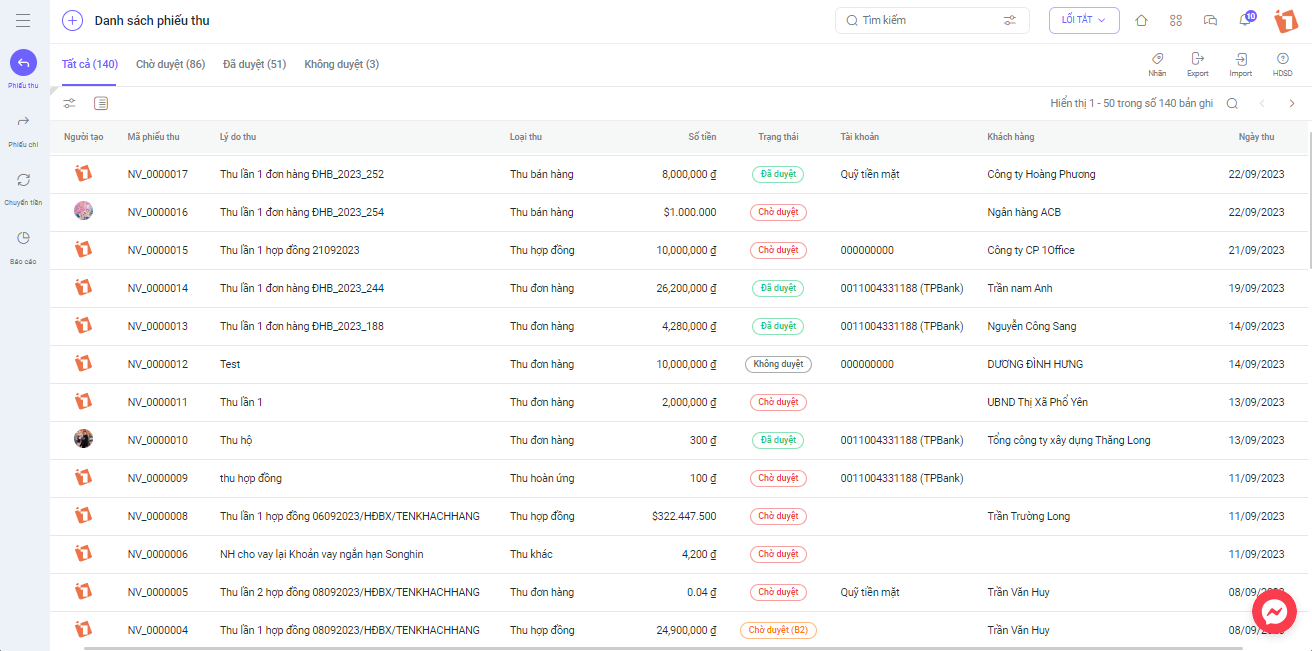
Manage revenue and expenditures effectively with 1Office CRM
With a friendly and easy-to-use interface, 1Office helps you manage all revenue and expenditure transactions on a single system. You can instantly update all activities related to cash flow. Notably, 1Office ensures the transparency of each revenue and expenditure transaction while providing absolute information security. This helps you save time when creating and approving transactions, while also minimizing costs related to paperwork, ink, and storage devices.
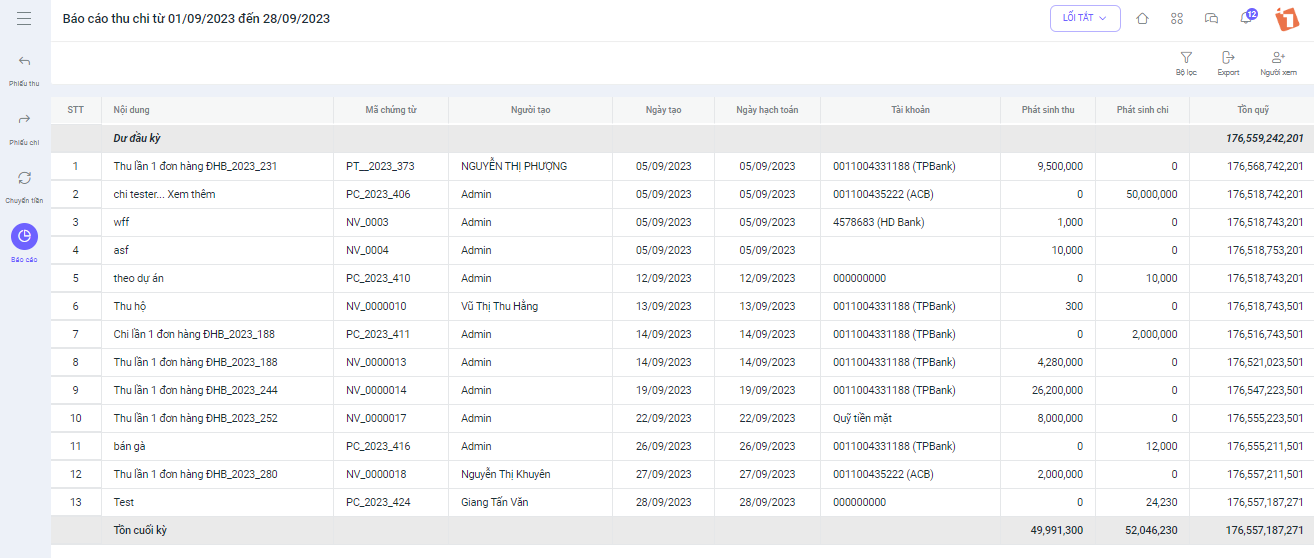
A tool that integrates detailed revenue and expenditure management features
A comprehensive overview of the spending status for the month, quarter, and year is automatically updated on the 1Office software. Business owners can now closely monitor all business and purchasing activities, making it easy to know by how much the budget has been exceeded and to accurately calculate metrics like ROS, ROA, ROE, and ROI.
9. Conclusion
Above is all the information about the ROS metric that 1Office has compiled through research, synthesis, and summarization. We hope this article will provide you with valuable insights for analyzing the ROS metric as well as the financial situation of your business. We wish you success!
















