


 11/05/2026
  760 views
A Job Description is a crucial document that helps businesses clearly define the tasks, responsibilities, and requirements for each position. A standard JD not only helps attract the right candidates but also supports performance management and evaluation. In this article, 1Office will guide you on how to write a standard job description in 5 detailed steps, with easy-to-apply templates.
Mục lục
- 1. What is a Job Description?
- 2. What should a job description include?
- 3. Steps to build a standard and detailed job description
- 4. Job Description Templates for Company Positions and Departments
- 5. Principles for Creating a Job Description
- 6. Guide to Creating Job Descriptions for Positions in the Company
- Guide to Creating a Job Description for a Sales Executive Position
- Guide to Creating a Job Description for the Human Resources – HR Position
- Guide to Creating a Job Description for an Accountant Position
- Guide to Creating a Job Description for a Marketing Position
- Guide to Creating a Job Description for a Manager/Team Leader Position
- 7. Automated HR Management Solution with 1Office HRM
- 8. Frequently Asked Questions
1. What is a Job Description?
A job description is a document that summarizes the necessary tasks, responsibilities, and requirements for a specific job position, aimed at supporting effective recruitment and human resource management.
The purpose of creating a job description is to provide specific guidance for employees and managers in the company’s human resource management activities.
The Importance of a Job Description
- Job descriptions are most commonly used in recruitment, helping candidates clearly understand the evaluation and selection criteria for the position. They also provide guidance for candidates to determine if they are a good fit for the job.
- In personnel orientation, a job description helps employees understand the organization’s expectations for them and be clearly aware of their duties and responsibilities, thereby striving to complete their assigned tasks well.
- In performance management, a job description serves as a reference framework for managers to have clear criteria for evaluating employee performance and as a basis for building a fair compensation system.
- A job description is especially important and mandatory for newly established businesses or when a new job role is created.
2. What should a job description include?
Each business will have its own way of creating a job description; however, every job description must include the following basic content:
- General job information: Includes information about the job title, department, work location, and reporting relationships (supervisor/subordinates)
- Job purpose: A general description of the main requirements and functions of the job.
Example: The purpose of an HR Officer’s job is: To assist the Head of HR & Admin in organizing and managing the apparatus, labor management, labor relations; recruitment; training; salary and benefits policies to ensure the company has sufficient human resources to achieve its strategic business goals.
- Key responsibilities: These are the main activities that the employee will perform with a certain frequency/cycle to achieve the job’s outputs.
Example: The main responsibilities of an HR Officer are: (1) Labor and personnel records management, (2) Recruitment and training, (3) Administering salaries and benefits policies, etc.
- Authority: The employee’s rights during the work process, for example, the right to receive full benefits and insurance, the right to use machinery and equipment necessary for the job, etc.
- Working conditions: The context in which the employee performs the job, including factors such as working hours, work environment, or transportation.
- Job specifications: The minimum competency criteria required for the employee to perform the job (knowledge, skills, attitude, etc.)
| Reference: Head of Human Resources Job Description Template |
3. Steps to build a standard and detailed job description
-

Process for building a standard job description
Step 1: Gather information about the job
Gathering necessary information about the job position is the first step in creating a standard job description. This will provide the writer with accurate data on the requirements and standards necessary for performing the job.
Information should be collected from both internal and external sources to ensure the job description is suitable for the company and competitive in the human resources market.
Here are some common information-gathering methods that businesses can apply:
| Method | Implementation | Advantages | Limitations |
| Using questionnaires/surveys | Develop a questionnaire with prepared questions for each job position and distribute it to the employees performing the work.
Collect and synthesize the information from the responses. |
Quickly collects a large amount of information. | Time-consuming and costly to design the questionnaire.
Job requirements may be overlooked due to excessive focus on task analysis. |
| Observation | Directly observe employees performing their work from the beginning to the end of the process. | Allows for observation of the actual process and actions of employees while performing the job. | Time-consuming.
Only observes behavior, does not delve deep into the nature of the work. |
| Using existing information | Use readily available information from the internet, job description templates, etc. | Fast, saves collection time.
Leverages existing information sources. |
May not address specific needs.
Information can be too generic. |
Step 2: Define the Work Context
The next step in the process of creating a job description is to define the work context, which includes the following factors:
- Reporting relationships: Positioned within the organizational structure, defining accountability to superiors
- Supervisory relationships: Positioned within the organizational structure, defining who will supervise the employee’s work process
- Relationships with others: Relationships between different departments for mutual support
- Working conditions: Pay attention to environmental factors that may be hazardous or interrupt the work process, such as extremely high/low temperatures, noisy/vibrating work environments, etc.
Step 3: Define the Job Content
Job content includes the functional activities that an employee must perform to achieve job objectives. Job content consists of 3 levels, from general to detailed:
- Level 1 (General) – Refers to general functions/duties
- Level 2 (Specific) – Explains tasks in detail, which are what the employee must do when performing a job function or creating a specific product/service
- Level 3 (Detailed) – The detailed steps that need to be implemented to complete a task
Step 4: Define the Job Requirements
Defining the requirements for the person performing the job is one of the most important steps in creating a job description. The requirements for an employee include the following aspects:
- Knowledge: The professional knowledge and understanding necessary to perform the tasks
- Skills: The ability to perform a specific task (operational in nature, can be acquired through training)
- Abilities: The capacity to perform non-operational tasks, including: intellectual, physical, psychological, and cognitive abilities, etc.
- Other requirements: Certain legal requirements (degrees, certificates), personality requirements (work ethic, professional ethics), or availability requirements (start date)
The final step to complete the job description creation process is to define the authority of the person performing the job. These are the legitimate benefits that the employee is entitled to, as mentioned in the content above. Note that all authorities must be listed in full to ensure the benefits for the person performing the job.
See more: Important HR policies according to corporate standards – how to build them effectively
4. Job Description Templates for Company Positions and Departments
-

Standard job description template form
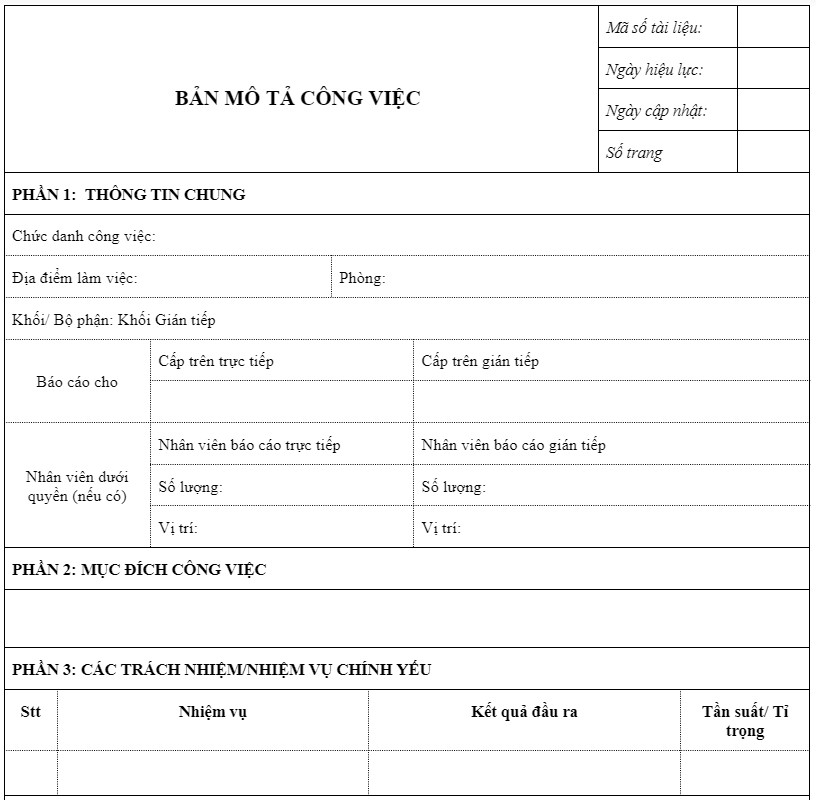
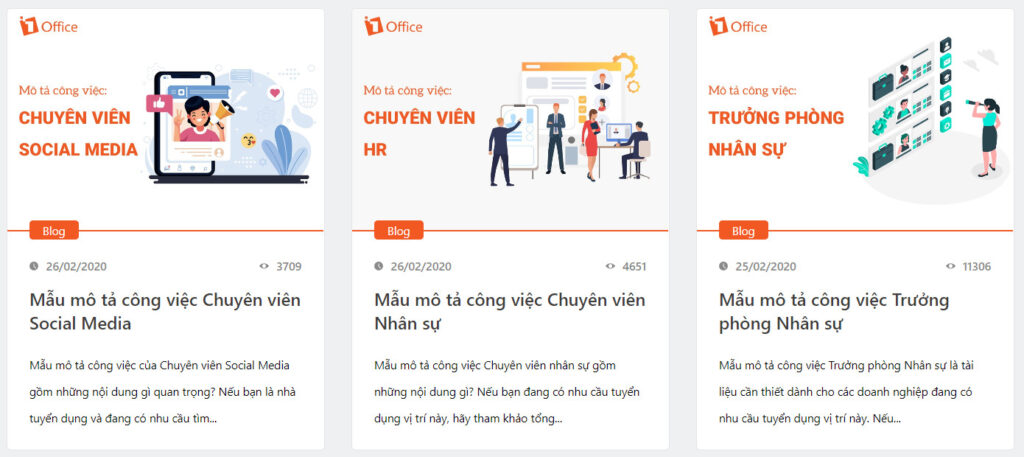
In addition, we provide the most complete and detailed job description templates for various positions in the following link:
-

Job description templates for various positions and roles
5. Principles for Creating a Job Description
To create a standard job description, you need to ensure the following principles:
Focus Only on the Job
The person writing the job description needs to focus on factors related to job functions and duties instead of creating a “wish list” of skills or personal qualities for the employee
Use Clear and Understandable Language
- Prioritize using action verbs
- Clearly define terms such as “may,” “periodically,” and “occasionally”
- Avoid vague and general interpretations
Arrange Tasks in Order of Priority
Emphasize the importance of priority tasks to the employee by listing them at the beginning of the duties description section.
Set Reasonable Expectations
Define requirements that are appropriate for the abilities and job position. Setting a “benchmark” that is too high or too low can easily affect the number of applicants and the morale of the staff.
6. Guide to Creating Job Descriptions for Positions in the Company
Guide to Creating a Job Description for a Sales Executive Position
The job description for a sales executive needs to clearly define sales targets, customer scope, and work processes. Additionally, the company should specify requirements for sales and customer relationship management skills.
Examples of main tasks:
- Find and develop new customers.
- Maintain and care for existing customers.
- Introduce and advise customers on products/services.
- Negotiate and sign business contracts.
- Track and expedite customer payment progress.
- Prepare periodic sales performance reports.
Guide to Creating a Job Description for the Human Resources – HR Position
For an HR position, the job description needs to clearly state the role in recruiting, training, and managing employees. This helps standardize HR processes and avoid overlapping functions.
Examples of main responsibilities:
- Plan and implement recruitment activities.
- Manage employee records and labor contracts.
- Organize training and orientation for new employees.
- Monitor and evaluate employee performance.
- Handle termination, reward, and disciplinary procedures.
- Implement employee engagement activities.
Guide to Creating a Job Description for an Accountant Position
The job description for an accountant should clarify areas such as bookkeeping, debt management, financial reporting, and legal compliance. Depending on the type of accountant (cash, accounts payable/receivable, general), responsibilities should be detailed to avoid overlap.
Examples of main responsibilities:
- Record and account for arising accounting transactions.
- Manage cash and bank receipts and expenditures.
- Track accounts receivable and payable.
- Prepare periodic financial reports.
- Check, store, and reconcile accounting documents.
- Assist with tax finalization as required by regulations.
Guide to Creating a Job Description for a Marketing Position
In the job description for a marketing employee, tasks related to market research, implementing communication campaigns, managing advertising channels, and measuring results should be clearly stated. Necessary skills such as content creation and data analysis should also be specified.
Examples of main responsibilities:
-
Conduct market and customer behavior research.
-
Plan and implement marketing campaigns.
-
Manage communication channels: Facebook, Google, TikTok, etc.
-
Write and edit communication content.
-
Monitor, analyze, and report on campaign effectiveness.
-
Coordinate with the sales department to implement sales programs.
Guide to Creating a Job Description for a Manager/Team Leader Position
For a manager or team leader position, the job description should focus on the roles of coordinating, assigning tasks, monitoring work efficiency, and training staff. Additionally, the reporting mechanism and responsibility for coordinating with other departments should be clearly defined.
Examples of main responsibilities:
-
Plan and assign tasks to the team.
-
Monitor the progress and quality of employees’ work.
-
Train, support, and mentor new employees.
-
Evaluate the performance of the team and individual members.
-
Report on operational status to superiors.
-
Coordinate collaboration between the team and other departments.
7. Automated HR Management Solution with 1Office HRM
To manage human resources effectively and increase productivity, it’s not enough to just have a job description; you also need to apply software to optimize management processes. With 1Office HRM software, businesses will be supported by the most advanced features inherited from digital transformation achievements:
- Smart recruitment process, automated progress reporting for recruitment campaigns
- Store labor contracts and employee records on the system, freeing businesses from traditional paperwork and procedures
- Automated timekeeping and payroll system with salary formulas tailored to each business
- Performance evaluation reports for personnel based on the ASK competency framework, KPIs, etc.
This article from 1Office has provided readers with essential information on how to create a job description and standard job description templates for various positions. For a free consultation and a trial of the 1Office sales management software, please contact us using the information below.
8. Frequently Asked Questions
For more details, please find us at:
- Hotline: 083 483 8888
- Fanpage: https://www.facebook.com/1officevn/
- Youtube: https://www.youtube.com/channel/UCeTIRNqxaTwk0_kcTw6SxmA
















