


What is ROE? Its Role, Formula, and Limitations


The ROE ratio is one of the key financial indicators used to assess a company’s profitability on its shareholders’ equity. But what is ROE, how is it calculated, and what does this ratio reveal about a company’s operational efficiency? This article will help you understand everything from the concept and significance to how to analyze ROE in practice.
Mục lục
- I. What is the ROE ratio?
- II. What is the significance of the ROE ratio?
- III. How to accurately calculate and analyze the ROE ratio
- IV. What factors affect the ROE index?
- V. How to apply the ROE index in business
- VI. What are the limitations of the ROE index?
- Frequently Asked Questions about the ROE (Return On Equity) Ratio
- VIII. Conclusion
I. What is the ROE ratio?
ROE stands for “Return on Equity”. The ROE ratio is an indicator used to evaluate how effectively a company uses its shareholders’ equity to generate profits.
Simply put, the ROE ratio shows a company’s level of profitability and efficiency in using its shareholders’ equity. ROE not only indicates a company’s attractiveness to investors but also reflects its financial health and growth potential.
>> See more: What is Profit Margin? Formula, Meaning, and Role
II. What is the significance of the ROE ratio?
The ROE ratio is a measure of the efficiency of using shareholders’ equity, indicating how much profit is generated for each dollar of equity invested by shareholders. This helps investors and managers assess the company’s actual profitability.
The ROE ratio plays a crucial role in evaluating a company’s financial performance:
- Assessing financial performance: ROE reflects a company’s ability to generate profits from its shareholders’ equity. A high ROE indicates that the company is using its capital effectively.
- Comparing with industry competitors: ROE partly reflects a company’s financial performance against its peers in the same industry. This helps managers determine the company’s market position.
- Demonstrating financial strength: A high ROE often reflects a company’s financial strength and its ability to attract investment or financing at low interest rates.
- Evaluating growth: Analyzing ROE can help assess a company’s growth potential. If ROE increases steadily over time, it shows that the company is managing its shareholders’ equity effectively and generating sustainable profits.
III. How to accurately calculate and analyze the ROE ratio
1. What is the ROE formula?
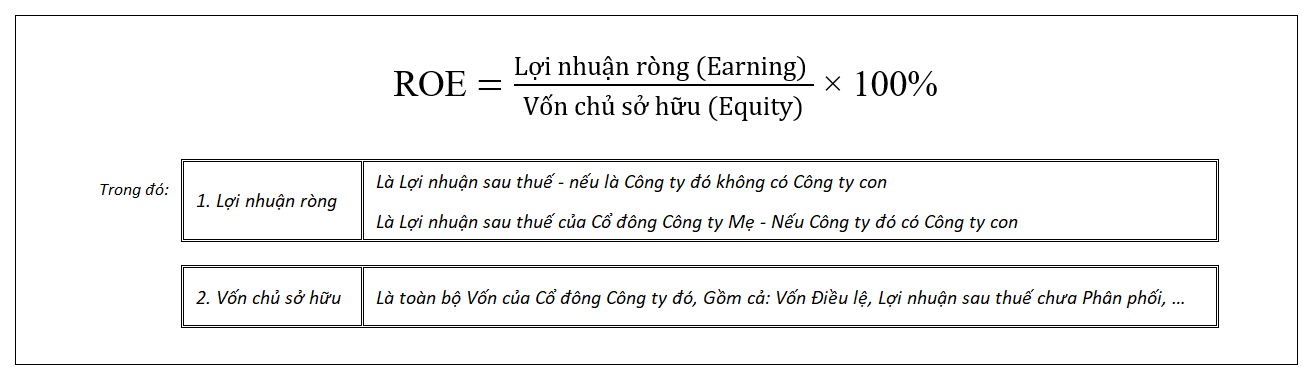
You can use the following formula to calculate the ROE ratio for any company:
2. Guide to analyzing the ROE ratio
Based on ROE, investors can understand the level of profitability that each dollar of shareholders’ equity generates.
- If ROE is positive, it indicates that the company is operating profitably.
- If ROE is negative, the company is operating inefficiently and recording a loss.
When a company’s ROE is high, it can be seen that the company has growth potential, and investors may consider investing in it. The return on equity depends on many factors such as the company’s size, business sector, seasonality, and risk level.
For a business, a high ROE – Return On Equity indicates that the company is performing well, and the management can continue with the current business strategy. Conversely, if ROE is low, the management needs to review and adjust the business strategy to achieve better results.
>>> See more: A guide to reading & analyzing basic financial statements
A general rule when comparing companies is that the ROE ratio should be at or above the industry average.
For example: Company A has maintained a stable ROE of 20% over the past few years, compared to the industry average of 15%. From this, you can conclude that Company A has effectively used its shareholders’ equity to generate profits that exceed the average.
Therefore, you should evaluate ROE from the following specific perspectives:
- If ROE is less than or equal to the bank’s lending rate, it means the profit generated is mainly used to pay loan interest. If the company has bank loans equivalent to or greater than its shareholders’ equity, the profit may only be sufficient to cover interest payments.
- If ROE is higher than the bank’s lending rate, it is necessary to assess whether the company has fully utilized its competitive potential in the market to ensure it can increase ROE in the future.
IV. What factors affect the ROE index?
The ROE index is directly influenced by three main factors: profitability per dollar of revenue, asset utilization speed, and the level of debt used to increase capital, which are clearly analyzed through the Dupont financial model.

1. Net Profit Margin
Net profit margin is calculated using the following formula:
Net Profit Margin = Net Income / Revenue
The net profit margin shows the profit generated from each dollar of revenue. When this index increases, it is a sign that the business is operating effectively and has a competitive advantage. Therefore, it can either increase selling prices or find ways to reduce costs per product unit.
2. Asset Turnover
The second factor that can change the ROE index is asset turnover, with the calculation formula as follows:
Asset Turnover = (Revenue / Total Assets)
Asset turnover evaluates the efficiency of a company’s asset utilization. When this index increases, the company is generating more revenue from its existing assets.
3. Financial Leverage
Financial leverage is an index that reflects the relationship between a company’s total assets and its available capital, calculated by the formula:
Financial Leverage = (Total Assets / Equity).
When the financial leverage index increases, it indicates that the company is using more external borrowed capital for its production and business operations.
V. How to apply the ROE index in business
1. Calculate the company’s growth rate
A company’s growth rate depends heavily on its profitability:
Growth Rate (g) = ROE x Reinvestment Rate
Each year, the company pays a portion of its profits as dividends to shareholders. The remaining profit is reinvested into production and business activities.
Reinvestment Rate (%) = (1 – Dividend Payout Ratio)
The future growth rate of the company can be calculated by multiplying ROE by the reinvestment rate.
Example: Company X and Company Y both have an ROE of 15%. Company X pays an annual dividend at a rate of 25%. Meanwhile, Company Y only pays a dividend at a rate of 10%. The results are:
- Growth rate of X = 15% x (1 – 25%) = 11.25%
- Growth rate of Y = 15% x (1 – 10%) = 13.5%
Although Company X has a higher dividend payout ratio than Company Y, based on the calculation, Company Y is predicted to have a higher growth rate in the future. In the long term, Company Y’s stock may become more attractive than Company X’s.
Assessing the ability to create value for shareholders based on capital efficiency is a crucial part of determining the value shareholders can receive. Typically, to assess this ability, the ROE index is compared with the expected rate of return when purchasing the company’s shares (i.e., the cost of equity). This can be interpreted through the following cases:
- ROE is less than the cost of equity: This is a sign that the company is operating inefficiently and its profits are gradually decreasing compared to initial expectations.
- ROE is greater than the cost of equity: This indicates that the company is performing well, knows how to reinvest earnings, and creates value that exceeds initial expectations.
3. Assess competitive capacity
Businesses with competitive advantages in brand, technology, and other factors often outperform their competitors. Thanks to this, these businesses can achieve high profits and an ROE that exceeds the industry average. This also reflects the sustainable competitive capacity of the businesses in the market.
VI. What are the limitations of the ROE index?
Mặc dù là thước đo quan trọng, chỉ số ROE vẫn tồn tại những hạn chế khi dễ bị nhiễu bởi các khoản lợi nhuận đột biến hoặc các kỹ thuật nghiệp vụ kế toán, dẫn đến việc phản ánh không đầy đủ giá trị thực của tài sản vô hình và tiềm năng nội tại của doanh nghiệp.
1. The ROE index is unstable with unusual profits
Uneven fluctuations in a company’s profits are one of the causes of instability in the ROE ratio. This particularly creates difficulties for management in evaluating operational efficiency and making decisions.
2. Affected by accounting policies
Some businesses often adjust or change accounting policies, for example, by extending project lifespans or reducing depreciation rates to increase competitiveness or attract investment capital. This will affect the net profit and ROE ratio of the business. Additionally, the ROE formula does not account for intangible assets such as patents, intellectual property rights, etc. This causes errors in calculation and does not fully reflect the advantages of each company.
Frequently Asked Questions about the ROE (Return On Equity) Ratio
Why does a company’s ROE decrease even when its profits increase?
This occurs when the growth rate of shareholder equity (due to retaining too much profit or issuing additional shares) is faster than the growth rate of net profit. This indicates that the business is accumulating capital but has not yet found an effective channel for reinvestment.
Is an extremely high ROE (over 50%) always a good sign for a business?
Not necessarily. An extremely high ROE can be the result of a business using excessive debt (high financial leverage) or having its shareholder equity eroded by accumulated losses. Investors need to check the debt ratio to assess the risk of bankruptcy.
What does a negative ROE mean for investors?
A negative ROE occurs when a business has a negative net profit (a loss). This is a warning sign of poor management or a severe crisis in the industry, causing shareholder equity to deplete over time.
What is the core difference between the ROE and ROA ratios?
While ROE measures the efficiency of shareholder equity, ROA (Return on Assets) measures the profitability on total capital (including both debt and equity). A larger gap between ROE and ROA indicates that the business is using more financial leverage.
How can you compare the ROE of two businesses from different industries?
You should not directly compare ROE across different industries due to their varying capital intensity characteristics (e.g., Technology typically has a higher ROE than Real Estate). You should use the industry average ROE as a benchmark to assess the relative performance of each business.
VIII. Conclusion
Hopefully, through this article, you have gained a clear understanding of what the ROE ratio is, its significance, and how to calculate it to analyze a company’s business situation most effectively. If you want to get the fastest updates on useful knowledge and receive free weekly templates, please follow the 1Office Zalo OA page now!




