11/05/2026
  399 views
In the ever-changing business world, organizational goals play a key role in guiding all activities and decisions. For business leaders, especially CEOs and new startup founders, setting clear, achievable goals is one of the most critical skills for leading an organization to sustainable growth.
Join 1Office in exploring a comprehensive overview of organizational goals, from their definition, significance, and classification to the process of setting them effectively for businesses of all sizes, from startups to large corporations.
Mục lục
- 1. What are organizational goals?
- 2. Benefits of clearly defining organizational goals
- 4. Principles for setting organizational goals
- 5. Examples of common organizational goals
- 6. The 10-Step Process for Setting Organizational Goals
- Step 1: Analyze the Current Context
- Step 2: Discuss and Align on Strategic Goals
- Step 3: Communicate the Overall Goals to the Entire Organization
- Step 4: Provide Specific Guidance for Each Department
- Step 5: Develop Departmental and Individual Goals
- Step 6: Conduct Effective 1-on-1 Dialogues
- Step 7: Create Connections Between Individual Goals
- Step 8: Finalize and Confirm Goals
- Step 9: Develop a Detailed Action Plan
- Step 10: Establish a System for Evaluation and Adjustment
- 7. Set and Manage Organizational Goals Effectively with 1Office
- 8. Conclusion
1. What are organizational goals?
Organizational goals (Organizational Goals) are the specific outcomes a business aims to achieve within a defined period. They are the clear destination that all members of the organization work towards.

By professional definition, organizational goals are desired future states that an organization strives to achieve through the allocation of resources and strategic activities. These goals must be designed to align with the company’s vision, mission, and core values.
An effective organizational goal must meet the SMART criteria:
- Specific
- Measurable
- Achievable
- Relevant
- Time-bound
>>> Read more: What is the SMART model? Principles & how to apply SMART goals
2. Benefits of clearly defining organizational goals
In the process of building and developing a business, organizational goals offer many significant benefits:
2.1. Clear Direction
Clearly defining organizational goals gives a business a “compass” for precise direction in all decisions.
When everyone clearly understands the destination, daily activities will be carried out with a unified purpose, avoiding situations where people pull in different directions or lack focus.
2.2. Resource Optimization
Clear goals allow a business to allocate resources strategically and effectively. Instead of spreading investments across various activities, the organization can focus its resources on projects and initiatives that have the greatest impact on achieving its stated goals.
This provides a dual benefit: saving costs, time, and manpower, while also enhancing return on investment (ROI).
Research from Harvard Business Review indicates that businesses with clear goals are typically 23% better at cost optimization than those without specific goals.
For startups with limited resources, this is a crucial advantage for ensuring survival and growth.
2.3. Boosting Motivation and Engagement
When employees clearly understand the organization’s goals and their role in achieving them, their motivation and engagement increase significantly.
<img class="size-full wp-image-48956 aligncenter" src="https://1office.vn/wp-content/uploads/2025/03/Loi-
Organizational goals are classified according to various criteria. Here are the most common classifications:
By timeframe
- Short-term goals: Usually set for less than 1 year, helping to create motivation and achieve quick results.
- Mid-term goals: Lasting from 1-3 years, these are often tactical goals to realize the strategy.
- Long-term goals: From 3-5 years or more, often linked to the company’s overall vision and strategy.
By nature
- Strategic goals: Related to the overall development direction of the organization, usually set by senior leadership.
- Tactical goals: Goals that specify strategic goals, often set at the departmental level.
- Operational goals: Related to daily activities, often set at the team and individual level.
By area
- Financial goals: Revenue, profit, cost optimization, ROI…
- Customer goals: Customer satisfaction, market share expansion, increased customer retention rate…
- Internal process goals: Improving efficiency, optimizing processes, minimizing errors…
- Learning and development goals: Enhancing employee capabilities, developing new products, fostering innovation…
4. Principles for setting organizational goals
To set effective organizational goals, leaders need to adhere to the following important principles:
- Aligned with vision and mission: Goals must be consistent with the organization’s vision and mission. Without this alignment, goals will create dispersion and conflict in the development direction.
- Ensure they are SMART: As mentioned, goals need to meet SMART criteria to ensure they are feasible and trackable.
- Balance ambition and reality: Goals should be challenging enough to drive growth, but also realistic enough not to create excessive pressure on the organization.
- Flexible and adjustable: The business environment is always changing, so goals need to be flexible to adapt to unforeseen changes.
- Ensure stakeholder involvement: The involvement of stakeholders in the goal-setting process will increase commitment and the likelihood of successful implementation.
5. Examples of common organizational goals

To better illustrate organizational goals, here are some specific examples in different areas:
5.1. Financial goals
- Increase revenue by 20% in the 2025 fiscal year compared to 2024
- Reduce operating costs by 15% in the next 6 months
- Achieve a net profit margin of 25% by the end of 2026
5.2. Customer goals
- Increase the customer satisfaction score (CSAT) from 75% to 90% within 12 months
- Increase the customer retention rate to 85% in 2025
- Expand market share in the Southern market from 20% to 35% in the next 2 years
5.3. Product development goals
- Launch 3 new features for the flagship product in Q2/2025
- Reduce product development time by 20% in the next year
- Acquire 1,000 paying users for the new product within 6 months of launch
5.4. HR Objectives
- Reduce employee turnover rate to below 10% in 2025
- Train 100% of employees in leadership skills within the next 9 months
- Increase the employee Net Promoter Score (eNPS) from +15 to +40 within 12 months
6. The 10-Step Process for Setting Organizational Goals
Here is a detailed 10-step process to help leaders set effective goals within their organization:
Step 1: Analyze the Current Context
Before setting goals, conduct a comprehensive assessment of the company’s situation. Analyze its strengths, weaknesses, opportunities, and threats (SWOT). Consider market factors, competitors, and industry trends to gain an objective view of the business’s current position.
Step 2: Discuss and Align on Strategic Goals
Organize a meeting with the senior leadership team to discuss and agree on strategic goals. Ensure these goals align with the organization’s vision, mission, and core values. Use brainstorming methods and listen to diverse perspectives to arrive at the optimal goals.
Step 3: Communicate the Overall Goals to the Entire Organization
Communicate the strategic goals to every member of the organization clearly and transparently. Use multiple internal communication channels and ensure a consistent message. Organize sharing sessions and Q&As to ensure everyone understands the overall direction and common goals.
Step 4: Provide Specific Guidance for Each Department
Provide specific direction to each department and unit on how to contribute to the common goals. Clarify expectations, responsibilities, and specific key performance indicators (KPIs). Ensure every unit understands its role in the bigger picture.
Step 5: Develop Departmental and Individual Goals
Encourage each employee to set personal goals that contribute to the common objectives. Apply the OKR (Objectives and Key Results) principle to ensure goals are challenging and measurable. Guide them in creating SMART goals that are closely linked to departmental and organizational goals.
Step 6: Conduct Effective 1-on-1 Dialogues
Organize 1-on-1 meetings between managers and employees to discuss individual goals. This is an opportunity to calibrate, clarify, and ensure goals are both aligned with individual capabilities and contribute to the common objectives. Create a safe space for employees to express concerns and propose ideas.
Step 7: Create Connections Between Individual Goals
Organize team meetings for members to share their individual goals, fostering connection and synergy. Identify intersections, interdependencies, and opportunities for collaboration. Adjust goals as necessary to avoid overlap or conflict.
Step 8: Finalize and Confirm Goals
Senior management reviews and approves employee goals, ensuring consistency and contribution to the common objectives. Assess the feasibility, level of challenge, and measurability of each goal. Provide constructive feedback and suggest adjustments when necessary.
Step 9: Develop a Detailed Action Plan
Guide each individual and unit in creating a specific action plan to achieve their goals. Identify key milestones, necessary resources, and potential risks. Apply appropriate project management methods to track progress and ensure effective implementation.
Step 10: Establish a System for Evaluation and Adjustment
Establish a mechanism to monitor, evaluate progress, and adjust goals if necessary. Organize regular review meetings (weekly, monthly, quarterly) to check progress. Recognize and reward achievements, and work together to overcome difficulties and challenges.
7. Set and Manage Organizational Goals Effectively with 1Office
1Office with its 1HRM module is one of the comprehensive and effective organizational goal management solutions suitable for today’s Business 4.0 management ecosystem. As a total enterprise management solution suite, 1Office software helps businesses digitize their entire work processes and manage them centrally on one system. This makes it easy for managers to allocate, track, and evaluate goals.
Unlike traditional goal management methods, the 1HRM module integrates the modern OKR model and KPIs, which have been proven effective at leading global technology corporations like Google, Intel, and LinkedIn. This allows businesses to adopt advanced goal management methods without significant investment in time and resources.
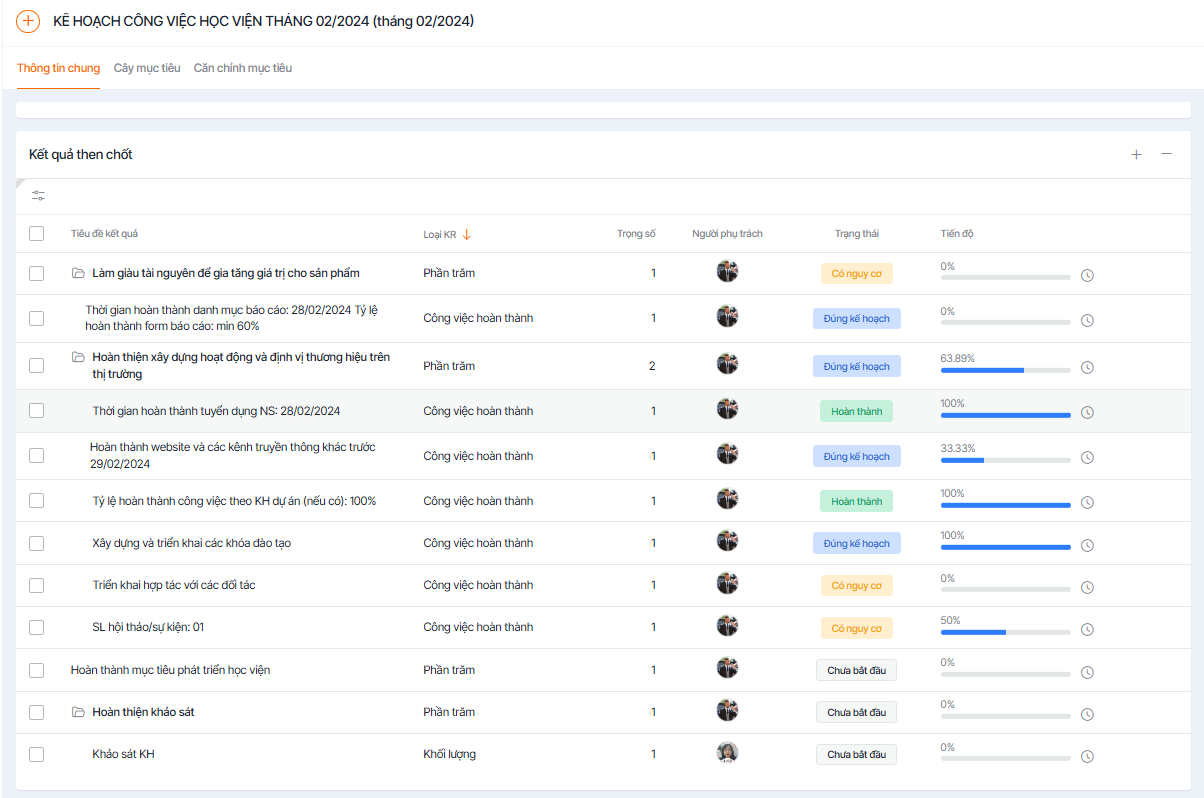
Manage organizational goals effectively with 1Office!
The 1Office goal management software provides many advanced features to support businesses throughout the entire process, from setting to evaluating goals:
- Create and manage Objectives: Set company, department, and individual goals on a monthly, quarterly, or yearly cycle, and allow linking between individual and departmental goals.
- Create and measure Key Results (KRs): Allows customization of the OKR measurement board for each employee, department, and position, automatically updates completion percentage in real-time, and helps easily identify areas for improvement.
- Track plans and report on key results: Supports multiple methods of aggregation and reporting, including reports by workload completion rate, reports by work completion percentage, reports by work items performed, and more.
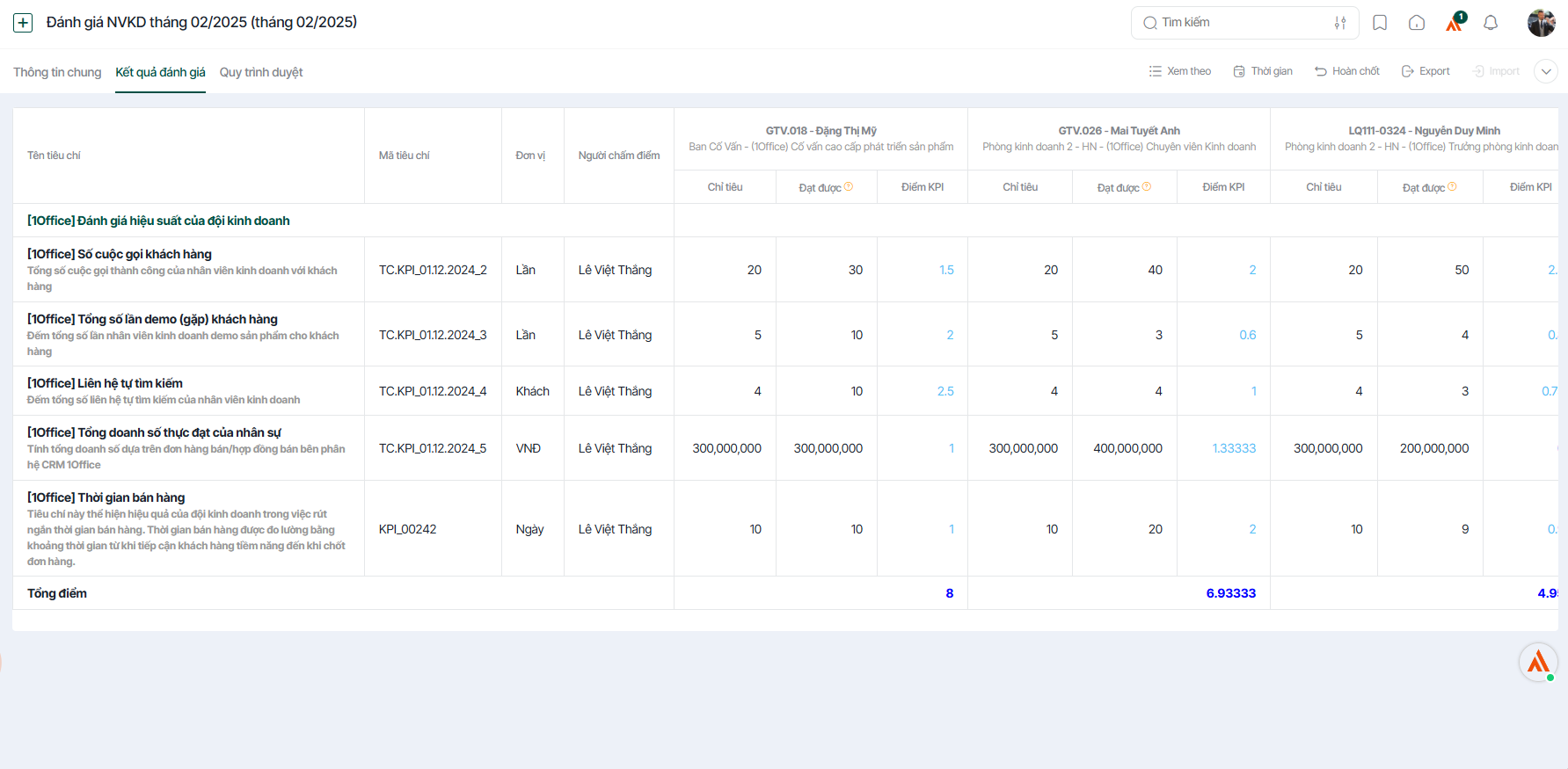
Manage organizational goals effectively with 1Office!
Currently, 1Office offers 3 service packages suitable for the scale and field of operation of each business. Therefore, customers only pay for what they use.
Service pricing is as follows:
- STANDARD Package: 40,000 VND/user/month
- PROFESSIONAL Package: 60,000 VND/user/month
- ENTERPRISE Package: 100,000 VND/user/month
8. Conclusion
Establishing organizational goals effectively is one of the key factors determining a business’s success. By setting clear, feasible, and interconnected goals, leaders not only direct the organization’s activities but also create motivation and cohesion for all employees.
As a leader, you need to take the lead in establishing and communicating goals, while also creating an environment where everyone can contribute to this process. When the entire organization works towards a clear common destination, collective strength will be maximized, helping the business overcome all challenges and achieve outstanding success.