


 12/05/2026
  317 views
In today’s volatile business landscape, success comes not just from adapting but also from the ability to lead change and create new value. Transformational leadership is the key that helps CEOs and managers unlock creative potential, build cohesive teams, and propel their organizations forward. It is not merely a leadership style; it is a process of inspiring, motivating, and turning challenges into opportunities.
In the following article, 1Office will help you better understand the concept, benefits, and how to effectively apply transformational leadership to turn challenges into opportunities, thereby elevating your business on its journey of sustainable development.
Mục lục
- 1. What is Transformational Leadership?
- 2. The Impact of Transformational Leadership
- 3. The Elements of Transformational Leadership
- 4. Characteristics of a Transformational Leader
- 5. Pros and cons of transformational leadership
- 6. How to Become a Transformational Leader
- 7. Applying the Transformational Leadership Style in Business
- 8. Examples of Transformational Leadership
- 9. Comparison of popular leadership styles
1. What is Transformational Leadership?

The concept of Transformational Leadership was first introduced in 1978 by James MacGregor Burns in his book, *Leadership*. He described this leadership style as a process where leaders focus on creating positive and lasting change within an organization by inspiring, promoting innovation, and encouraging the personal development of team members.
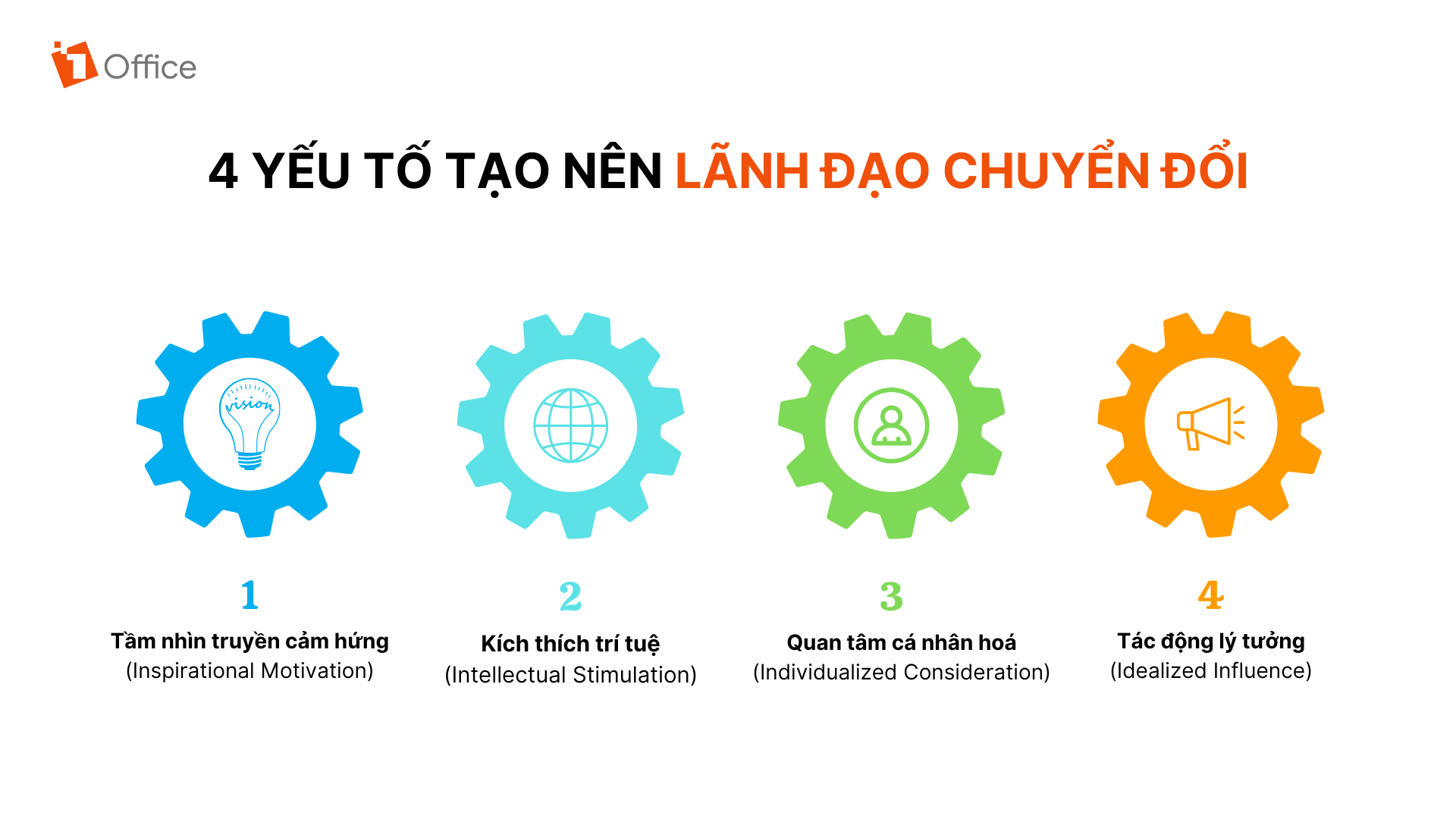
Later, in 1985, researcher Bernard M. Bass further developed this theory and identified four core components of transformational leadership:
- Inspirational Motivation
- Intellectual Stimulation
- Individualized Consideration
- Idealized Influence
Since then, the theory of transformational leadership has become a crucial foundation in the study of management and business development.
2. The Impact of Transformational Leadership
Enhances Motivation and Work Performance
An appropriate leadership style plays a crucial role in helping employees maximize their potential while performing tasks within the organization. This is reflected in the manager’s perspective, attitude, and support, creating an environment where employees can overcome obstacles and work effectively.
With its strong ability to inspire and motivate, the transformational leadership style helps teams understand the meaning of their work and the organization’s common goals. When employees feel encouraged and connected to a larger purpose, they are willing to give their all, thereby increasing work performance.
Promotes a Culture of Innovation and Creativity
The transformational leadership style encourages new thinking, innovation, improving work methods, and seeking more creative solutions. Organizations with transformational leaders often adapt easily to change, foster a strong creative culture, and produce groundbreaking products.
Develops Talent and Builds Strong Teams
Transformational leadership focuses on the development of each individual, helping employees unlock their potential and enhance their capabilities.
When given proper attention, employees feel valued, which increases their loyalty and commitment to the organization.
Builds Trust and Improves Internal Relationships
Transformational leadership encourages managers to build relationships based on trust and respect. A positive work culture not only enhances collaboration but also helps the organization reduce internal conflicts, improve communication, and increase team effectiveness.
Increases Adaptability and Maintains a Competitive Edge
In today’s volatile and competitive business environment, the ability to anticipate and lead change is a critical survival factor. Transformational leadership enables an organization to quickly adapt to market changes and maintain its position in the industry.
>>> Read more: The 8 Most Popular Leadership Styles Today
3. The Elements of Transformational Leadership
Bernard M. Bass’s model of transformational leadership focuses on driving significant change within an organization and building a foundation for sustainable development. By harmoniously combining the four elements (the 4 I’s): Inspirational Motivation, Idealized Influence, Intellectual Stimulation, and Individualized Consideration, a leader can create strong engagement, foster innovation, and guide the business to the forefront.
3.1. Inspirational Motivation
With an inspirational vision, a leader creates a big picture and a grand goal, inspiring the team to believe in and work together to achieve it. The manager uses powerful messages to ignite motivation and faith in the common objective.
- Articulate a clear and persuasive message about future goals.
- Encourage the team to believe in their ability to succeed.
- Build confidence in the growth of individuals and the organization.
Example: Steve Jobs at Apple inspired his staff by positioning the company not just as a creator of tech products, but as a force to “change the world” through innovation. This motivated Apple employees to push beyond conventional limits to create groundbreaking products like the iPhone.
3.2. Idealized Influence
Leaders need to be ideal role models whom employees can trust and follow. They consistently act in alignment with the core values and goals of the organization, prioritizing the collective interest.
- Act with transparency and integrity, building long-term trust.
- Place the interests of the organization and the team above personal gain.
- Always take the lead in solving difficult problems.
Example: A CEO who takes responsibility for the organization’s failures and praises the team for its successes will create a work environment of mutual respect, minimizing conflict and increasing internal cohesion.
3.3. Intellectual Stimulation
Intellectual stimulation is the leader’s ability to encourage employees to think creatively, express their opinions freely, ask questions, and seek new solutions. This style helps the organization constantly innovate and adapt to the rapid changes in the market.
- Challenge old working methods and encourage improvement.
- Stimulate critical thinking to find optimal solutions.
- Create an open environment where all ideas are respected.
Example: Elon Musk often asks questions like, “How can we make this 10 times better?” This not only motivates but also forces the team to think disruptively, leading to outstanding products like Tesla’s electric cars or SpaceX’s reusable rockets.
3.4. Individualized Consideration
Transformational leaders must always pay attention to the individual needs and potential of each team member. They are not just leaders but also mentors and coaches who help employees develop their skills and careers.
- Clearly understand the personal goals and direction of each employee.
- Provide constructive feedback to guide development.
- Provide opportunities for employees to maximize their potential.
Example: A leader who knows how to listen to employees’ personal difficulties and helps resolve them will create a positive work environment where everyone feels valued and contributes.
4. Characteristics of a Transformational Leader
Encourages innovation, creativity, and continuous learning
One of the standout characteristics of a transformational leader is the ability to drive innovation, creativity, and a spirit of continuous effort within the organization. They always seek to break free from traditional frameworks, challenging old methods to find more effective and groundbreaking solutions.
Transformational leaders not only inspire employees to come up with new ideas but also create a positive work environment where all employees are allowed to experiment and learn from their mistakes. This helps the organization adapt better to market fluctuations and build a creative team ready to embrace new opportunities.
Proactively solve problems and take responsibility
Transformational leaders always take the lead in facing and handling challenges. They don’t wait for problems to arise but proactively anticipate and prepare feasible solutions. A key characteristic is their willingness to take responsibility for mistakes instead of shifting blame to others.
This transparency and accountability help leaders build trust with their team, affirm their leadership role, and guide the organization through difficulties. For example, in crisis situations, transformational leaders often make decisive yet humane decisions to ensure the long-term interests of both the organization and its employees.
Inspire positive development
A transformational leader not only manages but also acts as an inspirer. They foster a positive work spirit and motivate the team to surpass personal limits.
This is achieved through real stories, a clear vision, and practical actions. When employees understand the value their work brings, they not only work for personal goals but are also willing to contribute to the organization’s collective success.
Build a corporate culture focused on the common good
Transformational leaders understand that for sustainable organizational development, all members must work towards a common goal. They build a corporate culture that values and encourages collaboration, placing collective interests above individual ones.
This not only promotes a spirit of unity but also encourages everyone to contribute to overall development. By honoring the organization’s core values, transformational leaders help build a healthy and effective work environment where everyone feels they are an important part of the team.
Fairness, integrity, and ethical role modeling
Fairness and integrity are core elements of the transformational leadership style. They maintain transparency in decision-making. Notably, transformational leaders act as role models, motivating employees to learn and follow their example.
Support, coach, and empower

A transformational leader doesn’t just assign tasks but also accompanies and supports employees throughout the implementation process. They provide all the necessary tools, knowledge, resources, and guidance, while also empowering employees to make their own decisions within the scope of their work.
As a result, employees are supported in improving their skills, increasing their confidence, and fostering a sense of responsibility for their work.
Listen and communicate openly
Effective communication is the key to the transformational leadership style. Leaders and managers always encourage the exchange of ideas, ensuring every team member is heard and understood.
By listening, transformational leaders not only understand the needs and perspectives of each employee but can also make more suitable and insightful decisions.
Adapt quickly to change
Another prominent characteristic of transformational leaders is their ability to adapt flexibly to fluctuations in the business environment. Instead of being bound by fixed plans, they are always ready to adjust strategies to fit the actual situation.
This open and flexible mindset helps the organization not only survive but also thrive during volatile periods, enhancing its competitiveness and creativity.
5. Pros and cons of transformational leadership
The transformational leadership style is seen as a powerful tool for driving innovation and development within an organization. However, every leadership style has two sides. Understanding the pros and cons of transformational leadership will help managers apply it more effectively and avoid potential pitfalls.

Advantages of the transformational leadership style:
- Inspire and motivate employees: Transformational leaders often create a clear vision for the organization, thereby inspiring and motivating employees. They help employees understand the meaning and value of their work, encouraging them to give their all to achieve goals.
- Enhance creativity and innovation: By encouraging open-mindedness and innovation, transformational leaders encourage their teams to experiment with new ideas, breaking down barriers in traditional thinking and work methods.
- Build a strong corporate culture: Beyond focusing on results, transformational leaders also concentrate on the organization’s culture and values. They create a cohesive work environment where employees are guided and supported to achieve common goals.
- Increase engagement and reduce turnover: Care and support from superiors help employees feel like an important part of the organization. This not only increases satisfaction but also reduces turnover rates.
Disadvantages of the transformational leadership style
- Highly dependent on the leader’s capabilities: The effectiveness of this style largely depends on the leader’s abilities. If the leader lacks skills or vision, the organization can easily lose direction.
- Time-consuming and effort-intensive in the initial phase: The transformational leadership style requires a significant investment of time and effort to build relationships, inspire, and gain the team’s trust.
- Potential to pressure employees: Transformational leaders often set high expectations and continuously encourage innovation, which can inadvertently create significant pressure on employees.
- Not suitable for all organizations and stages: This style may not be effective in rigid, change-resistant organizations, or during phases that require stability rather than innovation.
6. How to Become a Transformational Leader
6.1. Build and communicate a clear vision
A transformational leader needs a strategic vision and the ability to communicate it clearly and compellingly to the team. This vision is not just a long-term goal but also the driving force that motivates employees to strive and dedicate themselves. By specifically and clearly describing what can be achieved and the role of each individual, the leader can create alignment between individual and collective goals.
6.2. Inspire and motivate
A transformational leader must know how to awaken the intrinsic motivation of employees. They can do this by recognizing achievements, listening to opinions, and ensuring everyone feels their efforts are valued. This approach not only creates a positive environment but also increases work performance. Some methods you can apply include:
- Publicly praise employees when they achieve good results.
- Share inspiring stories of change and success within the organization.
6.3. Build trust and strong relationships
A transformational leader understands that trust is the foundation of all relationships. The manager needs to practice sincere listening, keep promises, and always act fairly and transparently. This builds respect and consensus from employees, helping the organization operate more effectively.
6.4. Continuously learn and develop yourself
An effective transformational leader always needs to cultivate their knowledge and skills. They are not afraid to learn from failure and always seek new opportunities to improve themselves by:
- Participating in management courses or professional seminars
- Learning from other leaders through books, podcasts, or networking.
7. Applying the Transformational Leadership Style in Business
Transformational leadership is not just a management style but also a strategic method that helps businesses thrive in times of change. Below are some methods for applying the transformational leadership style in business organizations, from shaping culture to improving processes:
7.1. Build a culture of innovation and continuous learning
To promote transformational leadership, businesses need to encourage and build a culture where employees continuously innovate and learn. This helps the business maintain its competitiveness and adapt to the market.
Application:
- Organize regular brainstorming sessions, encouraging employees to propose new ideas
- Invest in training programs for new skills and technologies for the team
- Create a safe environment for employees to experiment without fear of criticism for failure or mistakes
7.2. Enhancing management effectiveness through empowerment
Transformational leadership not only focuses on control but also empowers employees, creating conditions for them to be autonomous and maximize their potential.
Application:
- Delegate authority clearly, allowing middle managers and employees to make their own decisions within the scope of their work.
- Provide the necessary tools and data to make employees feel confident in performing their tasks.
>>>> See more: 10 Effective Employee Empowerment Tips & Specific Examples
7.3. Improving and innovating work processes
By focusing on improving work and production processes, businesses can foster innovation, creativity, enhance productivity, and create breakthrough products/services.
- Apply new technologies in management, production, and business to enhance operational efficiency.
- Establish innovation project teams focused on finding new solutions to solve problems or capitalize on opportunities.
In today’s market, innovating and improving work processes is not just a competitive advantage but a survival requirement for businesses. To support transformational leaders in enhancing operational efficiency and fostering innovation, technology solutions have become powerful tools. Prominent among them is 1Office – a comprehensive process automation and work management software platform with outstanding features such as:

Register for a free feature Demo
Workflow Automation
- Automate processes from approvals and document management to task handling, helping to minimize errors and optimize time.
- Create flexible workflows tailored to the specific needs of each business, ensuring optimization of all operational stages.
Centralized Task Management
- Assign tasks, track progress, and evaluate work performance on a single platform.
- Assist leaders in project planning, allocating resources reasonably, and comprehensively monitoring and controlling all activities within the business.
Enhanced Team Collaboration and Communication
- Internal communication features, document sharing, and task-specific discussions help promote interaction and creativity within the team.
- Build an effective team that is ready to innovate to solve challenges.
Consolidate, Analyze, and Evaluate Operational Efficiency
- Real-time automated reports provide detailed information on work performance and business operations.
- Support leaders in making data-driven decisions, thereby guiding appropriate innovation and improvement.
7.4. Developing a succession team
By focusing on developing a succession team of future transformational leaders, businesses can ensure their long-term stability and growth.
- Identify potential personnel and build individual development plans through training, coaching, and mentoring programs.
- Encourage employees to participate in strategic projects to learn management skills.
7.5. Readiness for Crisis and Change
During difficult periods, the role of transformational leadership is maximized by guiding the organization to overcome challenges and seize opportunities.
- Proactively listen to opinions and feedback from employees and customers to adjust strategies accordingly
- Enhance transparent internal communication to build trust and a spirit of unity
8. Examples of Transformational Leadership
Transformational leadership has become a source of inspiration for many managers in various fields, from business to technology, education, and politics. Below are prominent examples of transformational leaders and how they have applied this style to bring about revolutionary changes.
8.1. Steve Jobs (Apple)

Steve Jobs is considered one of the quintessential symbols of transformational leadership, especially in the technology sector. He not only revived Apple from the brink of bankruptcy in the late 1990s but also turned the company into one of the most valuable corporations in the world.
- Inspiration: Steve Jobs created a grand vision for Apple: “Think Different” – This was not just a slogan but also a guiding principle for the entire product and brand strategy.
- Continuous Innovation: He led the team to create revolutionary products through different eras, such as the iPhone, iPad, iPod, and MacBook,…
- Promoting Creativity: Jobs encouraged employees to surpass their own limits by always asking the question, “How can we make it better?”.
Impact: Under the leadership of Steve Jobs, Apple not only changed the technology industry but also had a profound influence on many other fields such as music, film, and product design.
8.2. Elon Musk (Tesla, SpaceX, and other projects)

Elon Musk is the embodiment of a modern transformational leader, with a vision that extends beyond current limits. He has driven breakthroughs in industries such as renewable energy, aerospace, and transportation.
- Open and Creative Mindset: Musk is not afraid to pursue seemingly impossible goals, such as sending humans to Mars or developing the electric car company Tesla to reduce environmental pollution.
- Ability to Inspire: Musk’s grand vision—such as building a sustainable future for humanity—has attracted thousands of talented individuals worldwide to join his projects.
- Proactive Problem-Solving: Musk is willing to get involved in technical and operational details to ensure the product achieves the highest quality.
Impact: The electric car company Tesla has revolutionized the automotive industry with its premium electric vehicles, while SpaceX has pioneered the field of private space transportation, opening a new era for the aerospace industry.
8.3. Satya Nadella (Microsoft)

In 2014, when Microsoft was facing difficulties in innovation and competing with major rivals like Google and Apple, Satya Nadella officially became the CEO of Microsoft. By applying a transformational leadership style, Nadella brought Microsoft back to a leading position.
- Building a collaborative culture: Nadella shifted the mindset from “us against the world” to “let’s collaborate,” encouraging the team to increase collaboration with partners and competitors.
- Focusing on innovation: He directed Microsoft to develop cloud services like Azure and Office 365, transitioning from a traditional software business model to a subscription-based service.
- Caring for people: Nadella created an environment where employees feel heard and are encouraged to develop both professionally and personally.
Impact: Under Nadella’s leadership, Microsoft’s market capitalization tripled, making the company one of the largest technology corporations in the world.
9. Comparison of popular leadership styles
| Criteria | Transformational Leadership | Autocratic Leadership | Democratic Leadership | Laissez-faire Leadership |
| Main Goal | Promote innovation, creativity, and achieve long-term goals | Ensure strict control and process compliance | Enhance participation, collaboration, and contribution from all members | Create conditions for employees to self-manage and make their own decisions |
| Leader’s Role | Inspire, set an example, and support employees | Centralized power, the leader makes all decisions | Coordinate and encourage member participation | Act as a support role when necessary |
| Decision-Making Style | Based on vision, encourages creativity and contributions | Centralized power, the leader decides alone | Combines group opinions, makes decisions based on consensus | Employees make their own decisions, with little leader involvement |
| Level of Empowerment | High – employees are encouraged to be autonomous and responsible | Low – employees only follow instructions | Medium – employees participate, but the leader has the final say | Very high – employees have self-control and are responsible |
| Employee Motivation | Inspiration from a grand vision, development opportunities, and recognition | Fear or pressure from the leader’s authority | A sense of contribution and participation in organizational decisions | Autonomy and belief in one’s own abilities |
| Advantages | – Encourages creativity and innovation – Builds a culture of development and collaboration– Creates strong motivation for employees |
– Effective in emergency situations | – Employees feel respected and committed to the organization | – Develops autonomous and creative thinking
– Suitable for professional teams |
| Disadvantages | – Requires high leadership skills
– Puts pressure on both leaders and employees |
– Causes inhibition and lack of creativity in the organization
– Can easily lower employee morale and motivation |
– Slow decision-making, ineffective in urgent situations | – Can easily lead to a loss of direction if implemented without control |
















