


What is the Flywheel model? How can businesses apply the flywheel model to achieve a revenue breakthrough?


With the constant movement and development of the business market, the flywheel concept has emerged and is gradually becoming a new trend for building sales, customer care, and marketing strategies for businesses. So, what is a flywheel? How can businesses apply the flywheel model to grow and develop in the future? Let’s find the answer with 1Office in the article below!
Mục lục
- I. What is the Flywheel Model?
- II. The 3 main stages of the flywheel model
- III. The Superior Advantages of the Flywheel Model Compared to the Marketing Funnel
- IV. How to effectively apply the flywheel model in business operations (Marketing, Sales, Customer Service)
- V. Real-world example of applying the flywheel model in business operations
I. What is the Flywheel Model?
The Flywheel is a business operation and growth model where the company’s customers are the focus of growth. The operating mechanism of the flywheel model is based on customer satisfaction and their promotion of the company’s products/services.
If customers are satisfied after a purchase, they tend to return to buy the product/service again and may recommend it to their acquaintances, helping to improve the company’s business performance. However, if the opposite occurs, the business will face difficulties in finding new customers.
II. The 3 main stages of the flywheel model
Unlike the Marketing Funnel model, which is quite familiar in the market, the flywheel model, when applied to marketing or customer care, operates in 3 main stages: Attract – Engage – Delight. After going through these 3 stages, strangers to the business will gradually become Prospects, Customers, or Promoters.
Specifically, the 3 main stages of the flywheel model are:
| Stage | Objective | Details | Result |
| Attract | Attract the interest and attention of strangers. Create excitement and curiosity about your brand. | Use useful content and information about your products/services along with marketing campaigns to attract customers. | The attract stage is successful when you gain potential customers from strangers. |
| Engage | Encourage potential customers to make a purchase as easily and quickly as possible. | In this stage, besides the main task of direct communication with customers by the customer care and sales teams, the marketing team can also provide support by creating useful content to send to customers, thereby increasing conversion rates and boosting sales. | Potential customers convert into customers. |
| Delight | Plan strategies to help customers achieve their goals through the products/services you provide. | The customer support team helps customers implement and use the product/service as quickly and easily as possible so they can receive the value your product offers. | Customers feel satisfied with the product and service quality. |
After learning what a flywheel is, readers will likely wonder why this model is so widely applied by businesses in their marketing and sales activities today. The answer lies in the next section.
III. The Superior Advantages of the Flywheel Model Compared to the Marketing Funnel
As mentioned above, the flywheel is a new concept in the business world. Previously, most businesses ran their sales, marketing, and customer care campaigns based on the Marketing Funnel model. However, over time and with modern advancements, the funnel model has gradually become outdated and less effective.
In response, the flywheel model has introduced a completely new, superior method of promotion and customer acquisition, delivering high sales efficiency for businesses.
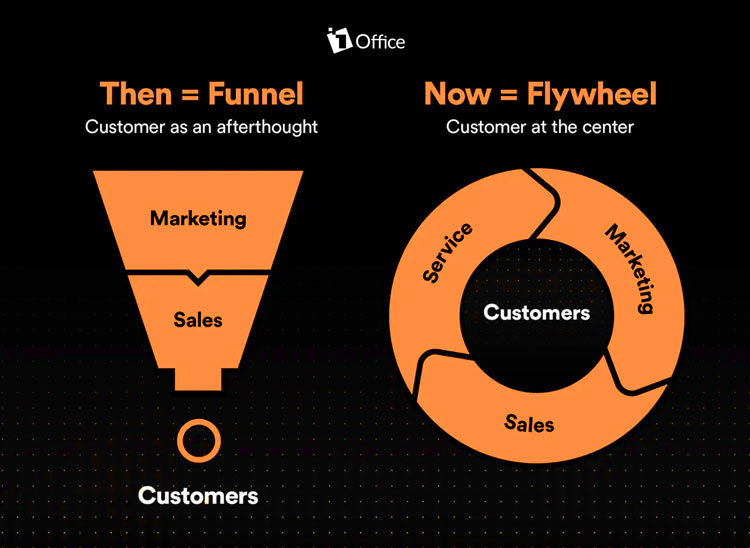
Specifically, the key advantages of the flywheel model over the marketing funnel are:
| Differences | Flywheel Model | Marketing Funnel Model |
| Customer Position | The customer is at the center, playing a decisive role in the business’s growth. | In the funnel model, the customer is at the bottom of the funnel and is the target of all marketing activities. |
| Operating Mechanism | Operates on a cyclical mechanism, running continuously to ensure that new prospects approaching the product do not negatively impact existing customers. | Operates on a top-down linear mechanism like a funnel, where each subsequent stage is influenced by the previous ones. |
| Ability to Shorten Stages | The Flywheel consists of only 3 core stages as mentioned above: Attract – Engage – Delight. | The marketing funnel consists of 4 main stages:
Attract => Consider => Convert => Delight |
Thus, it can be seen that the flywheel model can help businesses shorten campaign implementation stages while having a specific focus on the customer. This ensures all marketing and business activities and strategies are centered around them, not only saving time but also eliminating redundant actions to enhance sales efficiency, thereby facilitating revenue growth.
>> Read more: What is B2B? Characteristics and popular B2B business models
IV. How to effectively apply the flywheel model in business operations (Marketing, Sales, Customer Service)
Once you know what the flywheel is, understand its mechanism, and its outstanding advantages in business operations, the question for businesses is how to apply this model to build an effective business strategy and thereby grow revenue?
Understanding this, in addition to the concept of what the flywheel is and its main stages, we will share with you how to effectively apply the flywheel model to build a sales strategy for your company’s Marketing, Sales, and Customer Service departments.

1. Applying the flywheel model in marketing activities
Understanding what the flywheel is, you will likely ask what role the marketing team plays when applying this model to the professional sales process? In the three stages of the flywheel model—Attract, Engage, and Delight—the marketing team plays a key role in promoting and delivering truly useful content about products/services to customers.
Specifically:
| Attract Stage | Apply the “Right Audience – Right Time – Right Focus” rule to capture customers’ attention and interest in the product.
In this stage, the marketing team needs to measure the effectiveness of their promotional campaigns to find ways to improve and get closer to the target customers. |
| Engage Stage | Build a strategy to create good relationships with customers by making the most of interaction channels like Email, SMS, Chatbot, etc.
It’s necessary to capture basic customer information using conversion tools (Call to Action, Form, Workflow) to track the customer’s interaction process with the business. |
| Delight Stage | At this point, the Marketing team needs to fully utilize their creativity to share truly useful information with customers—information that is both insightful and trendy—to increase the likelihood of customers becoming Promoters, proactively sharing and recommending the product/service to their acquaintances. |
One of the most important steps in marketing is building a strategy to ensure every stage, from promoting and attracting customers to communicating information and ensuring customer satisfaction, runs smoothly. Readers can learn more about an effective marketing strategy implementation model at: What is STP? The strategy of applying STP in Marketing to help businesses conquer the market
2. Applying the flywheel model in Customer Care activities
Customer care service is a powerful driving force that keeps the flywheel model operating continuously. Therefore, the customer care team in each stage needs to:
| Attraction Stage |
|
| Interaction Stage | Use automated chat tools to increase the rate at which customers search for product information, giving you more opportunities to advise them. However, you still need to be regularly available to ensure customers receive the best service. |
| Customer Delight Stage |
|
>> See more: Professional and Effective Customer Care Methods – Top Customer Service Strategies
3. Applying the Flywheel Model to Business Operations (Sales Team)
When potential customers are aware of the product/service, proactively research it, and want a consultation, the Sales team plays the main role in the flywheel’s cycle. Specifically:
| Attraction Stage |
|
| Engagement Stage |
|
| Customer Delight Stage | Carefully prepare product information, attire, and communication style for each customer appointment to both create a good impression and enhance the company’s image. |
V. Real-world example of applying the flywheel model in business operations
As one of the world’s largest e-commerce platforms, Amazon is a prime example of a company with a deep understanding of the flywheel concept and its effective application in various fields. Specifically:
- Providing a wide range of quality products
Amazon offers millions of products to meet every customer’s needs. Their investment in product quality and understanding of consumer psychology has attracted massive traffic to their website.
Thus, in the very first stage (Attract) of the flywheel model, Amazon has performed well and achieved results beyond expectations.
- Enhancing customer experience and reducing shipping costs
Amazon invests in technology and customer experience to improve the shopping journey on its website. When customers find shopping easy and cost-effective, they buy more and more frequently.
Improving the customer experience helps attract new customers and retain existing ones.
- Increasing sales revenue
As Amazon attracts more visitors and buyers to its website, sales revenue increases, generating profits and a budget to invest in new services and improve existing ones.
Thus, we can see that the flywheel model truly delivers high sales efficiency, especially in a fiercely competitive market that increasingly requires businesses to be more flexible in defining their sales strategies.
Simultaneously, with the advancement of technology and the growing popularity of software solutions, more and more businesses are investing in sales management and customer care solutions to enhance business efficiency and achieve sustainable revenue growth. CRM 1Office is a sales management tool that helps effectively optimize business operations through outstanding features, from building and running marketing campaigns, smart customer care, and automatic storage and management of sales information to providing comprehensive reminders for the entire sales and customer care team.
By using 1Office CRM, businesses can more easily and effectively apply the flywheel model to their marketing and sales efforts, thereby enhancing customer experience, increasing revenue, and achieving sustainable business growth.
For more information about the 1Office CRM sales management tool, please contact:
- Hotline: 083 483 8888
- 1Office Fanpage: https://www.facebook.com/1officevn
- Youtube Channel: https://www.youtube.com/c/1OfficeNềntảngquảnlýtổngthểDoanhNghiệp




