What is KRI? The Simplest, Easiest Way to Differentiate KRI, PI, and KPI in Business Management


Recently, many businesses have aimed to build comprehensive evaluation systems based on criteria like KPIs and KRIs. However, they are often surprised during implementation when they cannot clearly distinguish the difference between KPIs and KRIs. So, what is a KRI? How do KRIs differ from KPIs? The answers will be in the article below!
Mục lục
I. What is a KRI? The simplest, easiest-to-understand concepts of KRI, PI, and KPI
KRI (Key Result Indicators): A measure of key results. This measures the outcome of many activities performed by different teams and is the most useful and effective summary metric. The purpose of this metric is to provide a clear view of whether the business is operating in the right direction.
PI (Performance Indicator): Tends to evaluate the means of operation, individuals, or groups, and is assessed regularly to determine what your business needs to do.
KPI (Key Performance Indicator): A metric for evaluating job performance. It is a tool for measuring and assessing work efficiency, expressed through figures, ratios, and quantitative targets. The purpose of this indicator is to evaluate the operational effectiveness of the organization and individuals.
Once businesses understand the concept of KRIs and clearly grasp what KPIs and KRIs are, it will be easier for them to evaluate these indicators to determine the next steps the business should take.
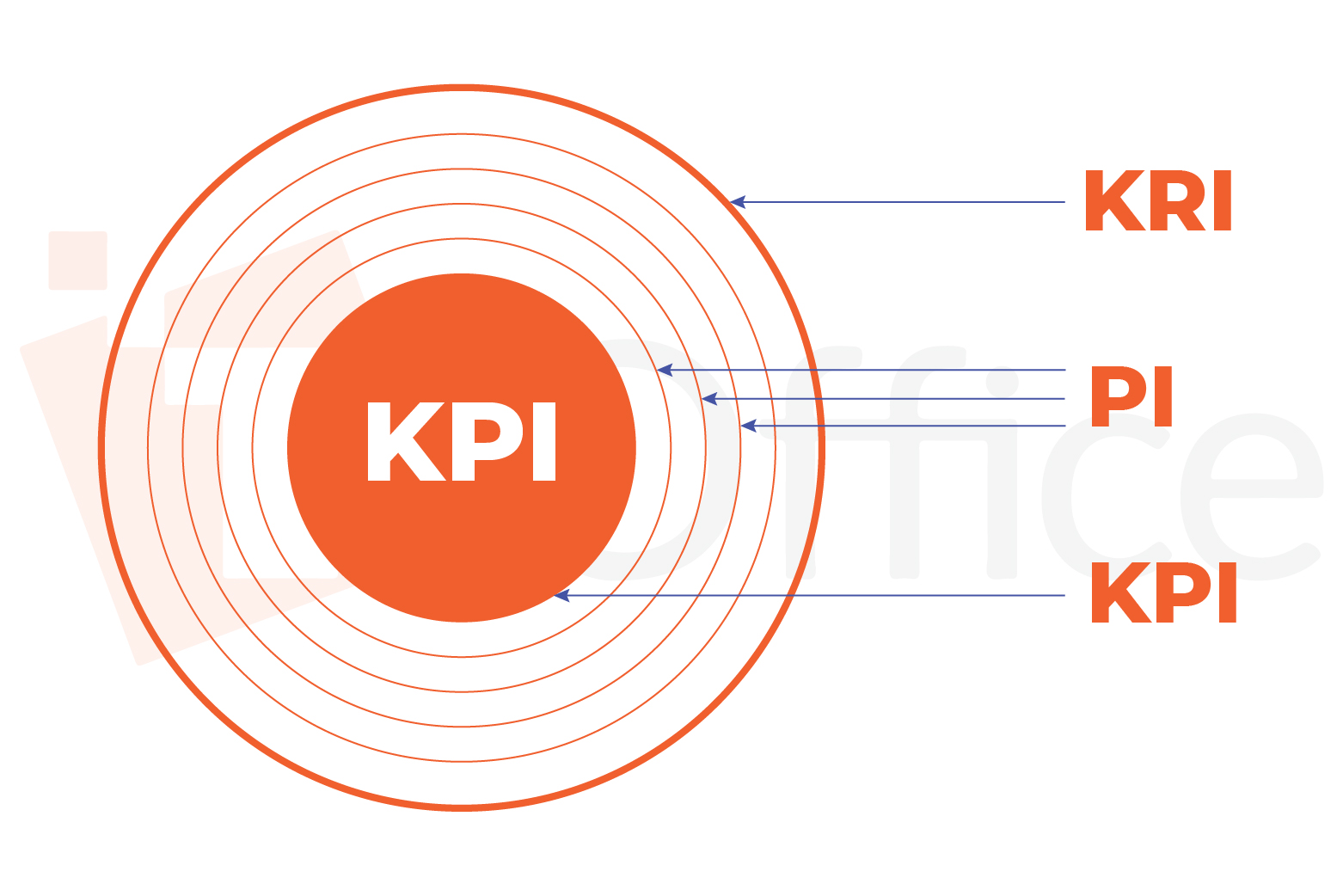
II. How do KRI, PI, and KPI differ? The relationship between KRI and KPI in business management
1. How do KRIs differ from KPIs?
| Comparison Criteria | KRI | KPI |
| Scope | Reflects the results of multiple activities managed through various target metrics | Focuses on specific individual activities |
| Cycle | Conducted monthly, quarterly | Conducted daily, weekly |
| Nature | Financial/non-financial | Non-financial |
| Summary Report Format | Uses trend graphs and overview charts (including results and operational status over a long cycle) | Uses an internal network, detailing activities, targets, etc., to assign responsibility to each individual and department |
| Audience | Not very meaningful for mid-level managers and employees.
Reported to the BOD (Board of Directors) as a summary of results and progress. The CEO is solely responsible for a KRI |
All employees understand and proactively follow it to ensure implementation.
Reported to the CEO, mid-level, and senior management teams. Responsibility can be assigned to one or more individuals or teams working together on a single KPI. |
| Read more now: Key metrics for measuring business marketing effectiveness |
2. The relationship between KRI and KPI in business management
| Aspect | Characteristics |
| Strategic Aspect | KPIs are often allocated top-down in an inverted pyramid structure: Company-wide KPI -> Department -> Team -> Individual. When each individual achieves their KPI target, the entire business achieves its goal. KPIs help the entire business move forward with a common purpose and direction. |
| Measurement Activities | KPIs are intended to measure strategic activities, which mostly include the main profit-generating activities in the organization’s value chain. On the other hand, KRIs measure regular, ongoing activities. |
| Variability | KPIs often change monthly, quarterly, or yearly, depending on the organization’s operational strategy at different points in time. Conversely, KRIs are more stable and rarely change. |
Thus, for comprehensive business management, both KPI and KRI indicators are the backbone of the organization and need to be developed and applied effectively. Businesses should establish evaluation policies and implement them based on the practical factors of each enterprise.
| Read more: 6+ Complete, Detailed KPI Employee Evaluation Forms for All Departments 2022 |
III. Applying KRI and KPI in business management – The key to success
KPIs help businesses in general and each employee in particular see the importance of the various tasks the company is performing, which tasks need to be prioritized, and how successfully completing these elements will ensure good results for the organization in the future.

Using KPIs and KRIs for calculating salaries and bonuses, as some businesses are doing, helps make performance evaluations more specific, fair, and effective. The efforts and work results of employees being evaluated and recognized in a timely, accurate, and fair manner is always considered an effective method for creating work motivation.
For employees at companies that apply a KPI/KRI system, it helps them avoid fumbling with a mountain of tasks or lacking the motivation to overcome inertia, even when they know what needs to be done.
A key advantage of KRIs is their ability to measure and statistically analyze the overall impact of various activities being implemented simultaneously within the business. This helps managers gain a comprehensive and holistic view of the implementation progress, completion level, and overall effectiveness of responsibilities compared to the established strategic plan, as well as partially assess the energy and performance of subordinates from certain perspectives.
Through this article, we hope that businesses have gained a more accurate understanding of the Key Result Indicator (KRI) as well as the differences and relationship between KRIs and KPIs in management activities.
Additionally, to evaluate employees and measure KRI and KPI indicators easily, conveniently, and in a timely manner, businesses need a helpful software solution. 1Office – the leading business management software – will help you do this.
Developed since 2011, 1Office is not only a solution that meets the overall management needs of small and medium-sized enterprises on a cloud computing platform, but it is also an online working environment for businesses on the Internet.
For more details, please contact:
- Hotline: 083 483 8888
- Website: https://1office.vn/
- Fanpage: https://www.facebook.com/1officevn/
- Youtube: https://www.youtube.com/channel/UCeTIRNqxaTwk0_kcTw6SxmA