


 13/05/2026
  325 views
Every business operating in the market has different products and services. For each field, the production process has its own specific requirements. This is where 5M1E (the fishbone model) comes in as a tool to help managers in managing the production process. Let’s explore the 5M1E model in detail with 1Office in the following article!
1. What is 5M1E?
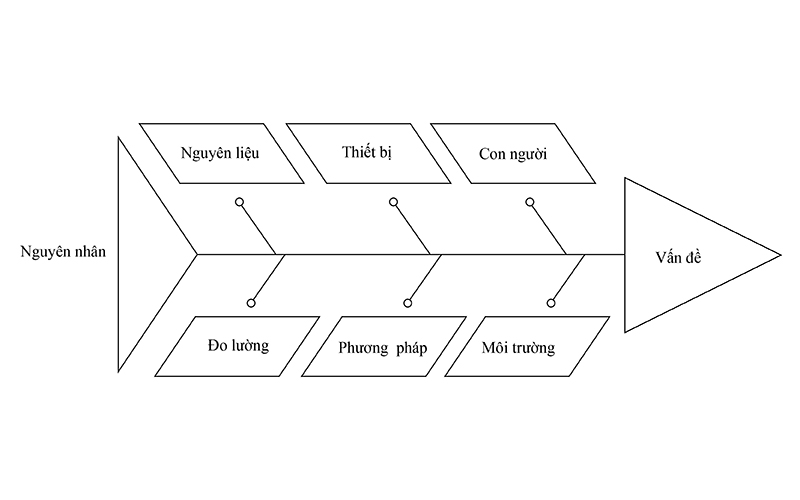
5M1E (also known as the fishbone model) is a term widely used in production and business, an acronym for 6 words: Material – Raw materials, components; Machine – Equipment, machinery; Man – Operator; Method – Operating method; Measurement – Inspection, measurement; and Environment – Working environment, production environment.

These are the 6 important factors that constitute a business’s production management method. From there, products are completed and launched to the market with high quality, and are well-received by customers.
2. The meaning of each value in 5M1E
The 6 factors are abbreviated into the concise term 5M1E to make them easy to remember. To understand in more detail, one must comprehend the meaning and importance of each component as follows:
MATERIAL – Raw materials, components: This is the most important factor in the manufacturing industry. Without raw materials, no product can be created. Even when raw materials are available, their quality will directly affect the finished product (whether the materials are good or poor). If the raw materials are incorrect, the finished product will be defective, which directly impacts production costs.
Therefore, before putting materials into production, there needs to be someone to supervise and inspect the quality of incoming materials according to the specific requirements of the business in each field. In reality, the customer’s purchasing decision later on depends heavily on the production materials. If a defect is found in the materials during inspection, production must be stopped immediately, and depending on the handling method (returning to the supplier or proceeding with disposal), to ensure product quality.
MACHINE – Equipment, machinery: From raw materials to finished products, everything requires machinery. In the Industry 4.0 era, it’s undeniable that machines can replace humans in production and can even do a better job. The modernity of machinery brings higher productivity, with more products being completed in a shorter time compared to purely manual labor. The precision and quality of the products are also superior. With machinery, one needs to pay attention to productivity, machine quality, as well as operating conditions, and it’s necessary to maintain the machinery periodically for the best results.
MAN – Operator: Machines cannot operate without someone to run them, also known as an operator. The machine operator is required to have high expertise in their field of operation as well as the machinery they handle to promptly address any issues that arise. Additionally, in production management, many businesses require machine operators to undergo periodic training. This human element is one of the most important things a business needs to pay attention to during the work process because it is difficult to control and prone to change.
METHOD – Operating method: The operating method is the way the machine operator works during the production process. Having a specific, standardized, and scientific method will help ensure consistent product quality.
MEASUREMENT – Inspection, measurement: In the product manufacturing process, measurement and inspection are the final steps but play a crucial role in deciding whether the product meets standards and can be released to the market. For measurement and inspection, the business needs to have its own methods and measurement standards suitable for its field.
ENVIRONMENT – Working environment, production environment: The working environment includes working conditions and working hours. These two factors intertwine to contribute to the quality of the product. A good working environment includes factors such as machinery, facilities, the work team, surrounding people, and even the weather (for some production industries, e.g., agricultural production,…) – when these factors are stable and balanced, they help production run smoothly. Regarding working hours, they need to be scientific to achieve the best productivity (this is why manufacturing plants often divide work into day and night shifts).
With the factors above, depending on the specific situation, managers can adjust (add/remove) elements of the 5M1E in the production plan to suit their business.
3. The importance of 5M1E for businesses
When applying 5M1E to business operations, it is found that this fishbone model is suitable for all industries. The only difference is that depending on the field of application, there will be different input materials, methods, and measurement checks. The importance of 5M1E in a business can be summarized in the following main points:
– Leaders can analyze causes and handle problems immediately after an incident occurs.
– Objectively assess what the business has and how it is operating through the model.
– During operations, if a problem arises, where does it occur? Does this step directly affect the next step? If this step is changed, will the production result be positively or negatively affected?
– Quickly devise a reasonable production plan or make immediate adjustments when an incident occurs.
However, creating a 5M1E model is not simple; it requires leaders to truly understand their business. Then, thanks to 5M1E, they can bring quality products to the market either directly or by partnering with others. The role of a business partner in business is also equally important, as in today’s competitive environment, businesses need more than just one method to bring goods directly to the market. They can collaborate to create products or join forces in production projects to maximize benefits. For that model, a separate “fishbone” framework needs to be built.
In the process of bringing products to market, businesses can read the article The 7-step B2B sales process to gain more knowledge on approaching their customers. Along with this useful information, 1Office hopes to provide business leaders with another tool to manage production activities effectively, contributing to increased revenue for today’s businesses.
















