


 11/05/2026
  394 views
In the context of fierce competition and constant fluctuations in the labor market, many businesses still struggle with hiring the wrong people, wasting time and money, and the challenge of retaining talent. This situation demands a newer, more effective approach. Instead of recruiting based on intuition or experience, it’s time to apply a systematic recruitment strategy suited to the pace and characteristics of the digital age. This article will reveal 10 effective recruitment strategies to help your business not only attract the right talent but also optimize processes and break through in the digital era.
Mục lục
- 1. What is a recruitment strategy?
- 2. Benefits of a recruitment strategy in modern businesses
- 3. 6 Steps to building an effective recruitment strategy
- 4. Important Note: No Recruitment Strategy is “One-Size-Fits-All”
- 5. 10 Effective Recruitment Strategies to Attract Potential Candidates
- Utilize Automation, AI, and Big Data
- Build a Strong Employer Brand (Employer Branding)
- Optimize the Candidate Experience
- Company Work Environment Promotional Video
- Leverage social media and online platforms
- Internal referral program
- Participate in industry networking events
- Collaborate with educational institutions and professional associations
- Utilize POSM and billboards at physical touchpoints
- Don’t overlook Google for Jobs
- 6. Applying automation in recruitment: A trend in the digital age
- 7. Conclusion
1. What is a recruitment strategy?
A recruitment strategy is a comprehensive, long-term plan that guides how a business attracts, selects, and retains talent aligned with the organization’s development goals. It is not merely a series of disconnected recruitment activities, but a structured system of thinking integrated with the overall HR strategy and business direction.

An effective recruitment strategy should answer the following questions:
- What types of competencies does the business need to achieve its short-term and long-term goals?
- Can internal resources meet these needs, or is external sourcing required?
- Who are the ideal candidates, and where can they be found?
- How can we sustainably approach, persuade, and retain them?
2. Benefits of a recruitment strategy in modern businesses
In a constantly changing market, human resources are not just an operational factor but a competitive advantage. Having an effective recruitment strategy helps businesses ensure the quality of their personnel and sustainably enhance organizational capabilities. Specifically, a recruitment strategy plays a crucial role in the following aspects:
Ensuring alignment between people and organizational goals
A recruitment strategy helps businesses accurately identify the types of personnel needed for each stage of development. Candidate selection is based not only on professional competence but also on their fit with the company culture, work style, and long-term goals.
Enhancing competitive advantage

In a world driven by knowledge and innovation, talent is the most valuable asset. An effective recruitment strategy helps businesses attract outstanding individuals who bring new ideas, superior skills, and high adaptability, thereby creating a distinct competitive advantage in the market.
Hiring the wrong person can lead to serious consequences such as poor work performance, negative impacts on team morale, and costs for retraining or termination. A systematic recruitment strategy with a thorough screening and evaluation process helps minimize this risk, while also contributing to a lower turnover rate for new employees who leave due to a mismatch with the position or work environment.
3. 6 Steps to building an effective recruitment strategy
A recruitment strategy is not a static document or a rigid template. It is a systematic planning process that must be built on practical analysis and closely tied to business objectives.
A recruitment strategy is not a static document or a rigid template. It is a systematic planning process that must be built on practical analysis and closely tied to business objectives.
Step 1: Analyze recruitment needs and objectives

Analyzing recruitment needs means you need to clarify:
- What positions is the business lacking?
- Why is recruitment needed (e.g., expansion, replacement, backup)?
- What are the specific requirements for quantity, and when are the new hires needed?
- How does this position contribute to the overall goals of the department and the company?
Clearly understanding recruitment needs is the foundation for setting the direction of the entire strategy.
Step 2: Define the ideal candidate profile
Based on the job characteristics, organizational culture, and data from successful employees in similar roles, build a specific candidate profile that includes:
- Qualifications and expertise
- Experience & core skills
- Attitude and personal motivation
- Cultural fit factors
The clearer the profile, the more precise the search and the more effective the evaluation.
Step 3: Select and optimize recruitment channels
Based on the ideal candidate profile (Step 2) and the available budget, determine which channels will most effectively reach that candidate pool. Evaluate potential channels such as:
- Company website, internal referrals
- Recruitment platforms (TopCV, VietnamWorks…)
- LinkedIn, Facebook, TikTok (for younger candidate groups)
- Headhunters or specialized partners
- Internal referral programs
Step 4: Create the Job Description (JD)

The Job Description (JD) is the “first door” to attracting candidates. An effective JD doesn’t just list tasks; it should also reflect:
- Job objectives
- Expected outcomes
- Development opportunities and the value offered to the candidate
- The organization’s personality as expressed through the writing style
Step 5: Build a recruitment process & a positive candidate experience
Design a coherent and effective recruitment process, from the moment a candidate submits their application to when they officially start the job. The process should include steps like screening, interviewing, candidate assessment, sending offers, etc. Concurrently, ensure candidates have a positive experience throughout the process (timely, transparent, and friendly communication) to enhance the employer brand.
With 1Office, the recruitment process at your business is fully automated. From creating a candidate pipeline and managing each stage to smart CV screening, all tasks are operated smoothly, efficiently, and with significantly reduced manual intervention.
Step 6: Track, measure, and improve
A recruitment strategy is not a one-and-done task. It’s necessary to establish key performance indicators (KPIs) to track the effectiveness of each activity and the entire process (e.g., time-to-hire, cost-per-hire, conversion rates between stages, effectiveness of each channel…). Based on the collected data, analyze and make necessary adjustments to continuously improve the strategy in the future.
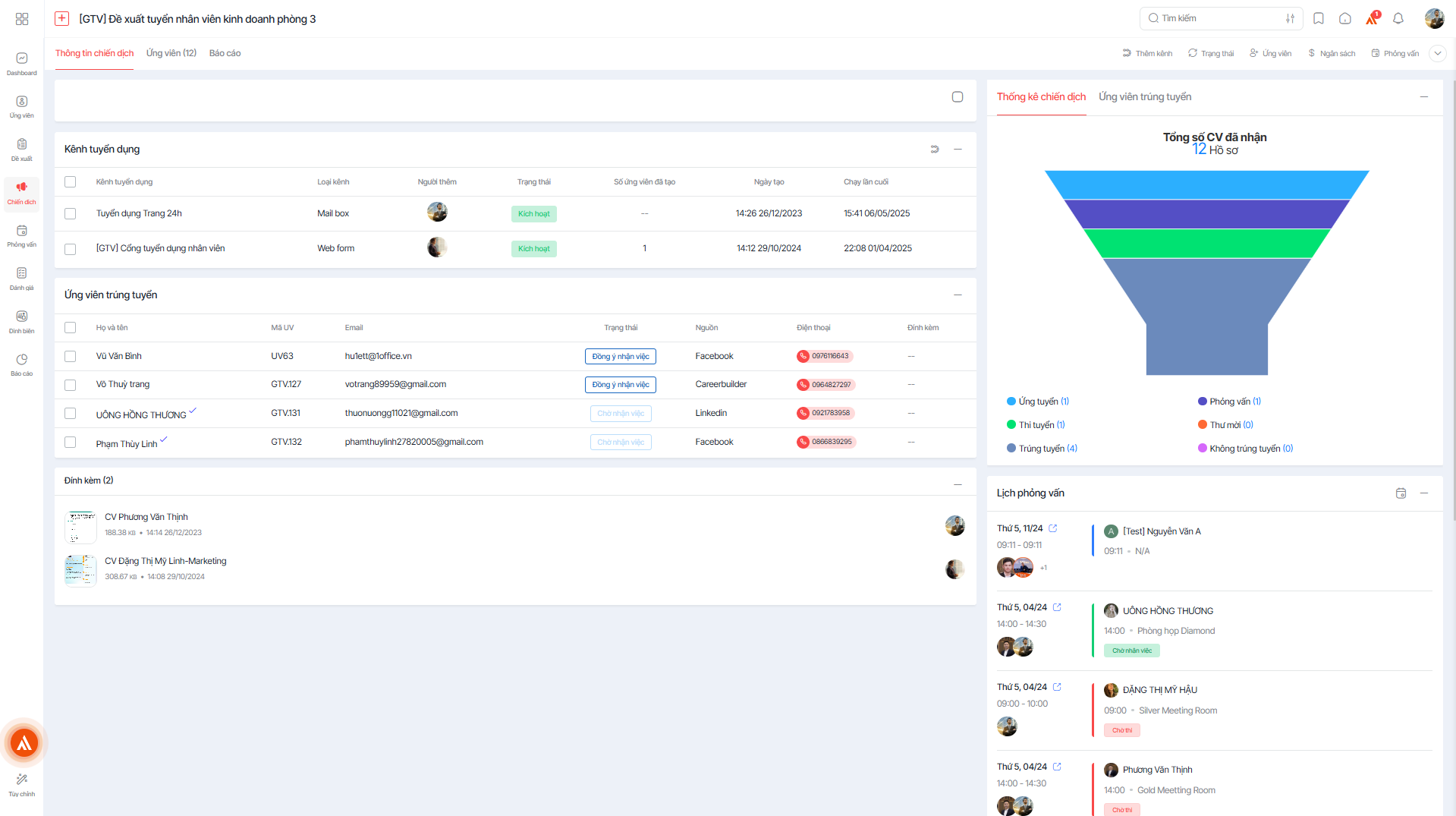
1Office has integrated AI and Low-code technology into its recruitment operations. This platform can provide visual reporting dashboards, helping to build KPI calculation formulas for each position and closely linking KPIs with the company’s OKR objectives.
4. Important Note: No Recruitment Strategy is “One-Size-Fits-All”
Each business has a different scale, culture, and resources, and most importantly, operates in industries with unique characteristics. Therefore, the recruitment strategy needs to be customized to best fit the specific context of your business.
Why are Industry Specifics Important in Recruitment?
- Different Candidate Pools: Depending on the industry (e.g., IT, Manufacturing, Customer Service…), potential candidate groups will congregate in different places (online communities, vocational schools, associations…).
- Specific Knowledge and Skill Requirements: Each industry requires a unique set of professional skills and experience (e.g., coding skills in IT, negotiation skills in Sales, medical knowledge in Healthcare).
- Work Culture and Environment: The characteristic work culture and environment of each industry greatly influence a company’s attractiveness to candidates and how the employer brand is built.
- Legal Regulations and Professional Certifications: Some industries have strict legal requirements for degrees, certifications, and professional licenses (e.g., Accounting, Healthcare, Construction) that the recruitment strategy must adhere to. Understanding these specifics is the foundation for building a truly effective strategy.
5. 10 Effective Recruitment Strategies to Attract Potential Candidates
A recruitment strategy isn’t just about the process; it’s also about the right approach to attract candidates. Below are 10 effective strategies to help your business stand out and attract talent in the market.
Utilize Automation, AI, and Big Data
In the digital age, relying on intuition or manual methods to screen and evaluate candidates is no longer effective. This strategy focuses on applying technology (especially automation) and leveraging big data to make smarter, faster, and more accurate hiring decisions.

Technology helps automate time-consuming tasks, analyze data to make accurate decisions, and even predict candidate trends by:
- AI can screen large volumes of candidate profiles, analyze skills, and experience, and suggest suitability levels more quickly and objectively than manual methods.
- When data on candidates, processes, and recruitment channels is collected and analyzed centrally, businesses can understand which channels are most effective, which stages cause bottlenecks, what the cost-per-hire is, etc. From there, they can optimize their strategy and budget.
Build a Strong Employer Brand (Employer Branding)
The employer brand is how a business is perceived by potential candidates, current employees, and the labor market as a whole. It’s not just a media image but a combination of real experiences, corporate culture, and a consistently conveyed message.
Components of an Employer Brand:
- Employee Value Proposition (EVP): Answers the question “Why should I work at this company?” – it could be a professional environment, growth opportunities, a transparent culture, flexible policies, etc.
- Multi-channel Communication: Careers website, social media, job platforms, internal documents, introductory videos…
- Candidate and Current Employee Experience: Candidates receive prompt, transparent feedback; current employees are listened to, evaluated fairly, and have opportunities for development.
- Consistency between Communication and Reality: The commitments in the EVP must be executed, otherwise, it will create a gap that erodes trust.
Optimize the Candidate Experience
The candidate’s experience throughout the application process—from when they first see the job posting, submit their application, and interview, to when they receive an offer or a rejection notice—is a crucial factor. A mobile-friendly application process, clear communication, prompt feedback, and respect for candidates help enhance the company’s image, even with those who are not selected.
Company Work Environment Promotional Video
Using videos is an effective and authentic way to showcase the company’s culture, work environment, office space, and people. Videos help candidates visualize, feel, and emotionally connect with the business more than written descriptions, thereby increasing its appeal. Recruiters can post videos on popular social media platforms like Facebook and LinkedIn or leverage short-form video platforms like TikTok to expand brand reach.

Recruitment channels are no longer limited to traditional job boards. Proactively creating diverse recruitment content on LinkedIn, Facebook, TikTok, etc., helps reach young candidates, passive job seekers, or those who do not frequently visit job platforms.
>>>Discover 10+ top recruitment websites in Vietnam
Internal referral program
Encourage and implement a reward policy (cash bonuses, gifts, etc.) for current employees when they refer potential candidates from their network. This is often a source of high-quality candidates who are more likely to fit the company culture and have a better long-term retention rate compared to other channels.
>>>Learn more: Internal recruitment process
Participate in industry networking events
Participating in or organizing activities such as job fairs, recruitment days, industry workshops, bootcamps, or events where the company is a guest speaker is an excellent way to meet potential candidates in person, build relationships, promote the employer brand, and collect a database of quality candidates.

Collaborate with educational institutions and professional associations
Collaborate closely with universities, colleges, and vocational training centers through internship programs, scholarship sponsorships, and participation in student job fairs. This is an abundant source of young and potential talent for Junior or intern positions.
Utilize POSM and billboards at physical touchpoints
In locations or areas with high recruitment needs (such as factories, retail branches, etc.), placing physical recruitment boards and POSM in residential areas, labor markets, and employment centers is still effective – especially for general labor.
Don’t overlook Google for Jobs
Google for Jobs aggregates job postings from various sources and displays them prominently on Google’s search results page. Optimizing your company’s job postings to appear on Google for Jobs increases visibility and directly reaches people actively searching for jobs on the world’s most popular search engine.
6. Applying automation in recruitment: A trend in the digital age
Digital transformation is not just happening in production or finance – human resources is also at the center of this wave of change. Recruitment, in particular, is one of the processes most strongly influenced by technology. The application of automation tools, artificial intelligence (AI), and data analytics is gradually replacing manual methods, which are slow and prone to errors.
Why has recruitment automation become a trend?

In a context where businesses need to hire quickly, hire correctly, and control costs effectively, automation is gradually becoming an indispensable part of modern recruitment strategies. The breakthroughs that this technological trend brings to recruitment activities include:
- Saves time and costs: Automatically screening CVs, sending response emails, scheduling interviews, etc., helps reduce manual workload and shorten the recruitment cycle.
- Increases accuracy in candidate assessment: AI can analyze profiles, behaviors, and competencies based on big data, reducing subjective factors.
- Enhances candidate experience: A consistent process, timely feedback, and a professional digital interface help increase offer acceptance rates and build goodwill for the employer brand.
- Facilitates analysis and strategy improvement: An intuitive reporting system and centralized data allow managers to track recruitment effectiveness in real-time and make quick decisions.
1Office – The optimal solution for a smart and comprehensive recruitment strategy
In many medium and large enterprises, managing the recruitment process through separate files or emails has revealed many shortcomings. No matter how well-structured a recruitment strategy is, it will be difficult to implement effectively without a synchronized technology platform for support.
In this context, digitizing the entire recruitment process and linking it closely with other HR functions is a key factor in ensuring information consistency. The solution from 1Office – 1HRM helps automate the entire process and integrates tightly with the existing HR system.
1HRM can help recruiters:
- Automate the recruitment process from posting jobs, receiving applications, screening, and interviewing to sending offers.
- The Low-code platform allows the HR department or managers to customize and build new recruitment processes, forms, and approval flows quickly without deep programming knowledge.
- Centrally manage candidate profiles, categorized by position, application source, and recruitment stage.
- Connect directly with job standards and job descriptions.
- Track recruitment effectiveness in real-time with reports and charts easily created on the Low-code platform.
Register for a free 1Office Demo account!
Additionally, 1Office has focused on integrating AI – Artificial Intelligence technology into the modules of its ecosystem, with clear benefits such as:
- Eliminates unsuitable profiles, reducing the manual screening burden for recruiters and saving significant time and effort.
- Suggests the most potential candidates from the existing data pool or external sources, helping employers quickly reach quality talent, shortening search time, and increasing successful hiring rates.
- Predicts future personnel needs and identifies labor market trends.
- AI can assist in suggesting content for job descriptions (JDs) or job standards based on position, industry, and existing criteria, ensuring completeness and consistency.
With the two “springboards” of AI and Low-code, 1HRM is the platform for implementing effective recruitment strategies, helping businesses make faster decisions, manage smarter, and deploy more flexibly.
7. Conclusion
In this volatile digital era, building and implementing an effective recruitment strategy is a key factor for businesses to attract and retain talent. From building a strong employer brand and optimizing the candidate experience to fully leveraging automation and AI, each strategy contributes to the success of the recruitment process. At 1Office, we provide an integrated human resource management platform that allows businesses to operate smart recruitment, seamlessly connected with other business functions. With the motto “Optimize every second,” 1Office will accompany businesses in building the right workforce.
Start optimizing your recruitment strategy today
















