


 09/05/2026
  165 views
New seal application form is a topic frequently searched by businesses, agencies, and organizations when newly established, remaking a seal due to loss or damage, or changing legal information. However, not all cases require “applying for” a seal in the traditional sense. In this article, we provide a standard application form for the correct entities, along with detailed instructions to help you comply with regulations, avoid errors, and save time on procedures.
Mục lục
- I. Corporate Seals and Organizational Seals
- II. Detailed Guide to New Seal Issuance Procedures for Businesses
- III. Hướng dẫn thủ tục cấp con dấu mới cho cơ quan, tổ chức, chức danh nhà nước
- IV. Các mẫu đơn xin cấp con dấu mới
- V. Important notes when using a company seal
- Seal content: Comply with legal regulations
- Seal management: Clear personnel – clear responsibility – clear process
- Using the seal: Correct authority – correct document – correct principles
- Electronic seals: A modern governance trend and its practical benefits
- When changing the seal sample or the number of seals
- VI. Frequently Asked Questions
- Is a company seal mandatory?
- Can a business have multiple seals?
- Is there a penalty for losing a company seal?
- When does a company seal become effective?
- Is it necessary to notify the seal specimen when changing the company address?
- Does an electronic seal have the same legal validity as a physical seal?
I. Corporate Seals and Organizational Seals
In business operations and administrative management, a seal is not just a formal verification tool but also carries legal value associated with the legal entity status, signing authority, and legal liability of the user. However, since the Law on Enterprises 2020 took effect and related decrees were amended, the concept and procedures for seals have changed significantly, especially the distinction between businesses and other organizations/agencies.
Failure to clearly distinguish the applicable entities often leads to a common mistake: businesses search for a “new seal application form” when current law no longer requires it. Therefore, before looking for forms or procedures, businesses and organizations need to correctly understand the legal nature of the seal.

General Introduction to Seals
A seal is understood as the legal identifier of an authorized organization or individual, used to stamp on documents and papers to confirm the legality, authenticity, and intent of the issuing entity. In a business environment, the seal is associated with important activities such as signing contracts, issuing internal decisions, and transaction records with partners and state agencies.
In terms of legal significance, a seal helps to:
-
Affirm the legal entity status of the business or organization
-
Confirm the authority to issue documents
-
Serve as a basis for resolving disputes when legal risks arise
Classification of Seals in Practice
Depending on the purpose and context of use, seals are currently divided into many different types. Understanding each type helps organizations use them within the correct scope, avoiding misuse or exceeding authority.
-
Legal entity seal: The official seal of the business or organization
-
Title seal: Used for titles such as Director, Chairman, Head of Department
-
Miniature seal: A smaller version, often used for quick stamping on vouchers
-
Embossed seal, wax seal: Used for anti-counterfeiting purposes and authenticating special documents
-
Electronic seal: Associated with digital signatures in electronic transactions
Key Legal Bases (Updated to 2026)
The current legal system governing seals no longer has a unified framework applicable to all entities. Instead, each group of entities is governed by different legal documents, with completely different approaches.
-
Law on Enterprises 2020:
Businesses have full discretion over the form, quantity, and content of their seals. Notably, the obligation to notify the seal specimen before use has been abolished, marking a major shift towards legal autonomy. -
Decree 99/2016/ND-CP:
Applies to state agencies, armed forces units, socio-political organizations, cooperatives, and foreign organizations operating in Vietnam. This group must still manage their seals under a registration and licensing mechanism. -
Decree 130/2018/ND-CP:
Regulates digital signatures and electronic seals, creating a legal framework for electronic transactions and digital transformation in businesses.
Clearly Distinguishing Procedures for Businesses vs. Organizations/State Agencies
This is the most important content and also the part that most often causes confusion when businesses search for a “new seal application form”.
For businesses established under the Law on Enterprises 2020, current law no longer has the concept of “applying for a seal” in the traditional sense. Businesses:
-
Decide on the seal specimen themselves
-
Choose the seal engraving service themselves
-
Do not need to submit a license application
-
Only need to provide notification in the business registration file if there are related information changes
Conversely, for state agencies, organizations, and official titles, the use of seals is still strictly managed. These entities:
-
Must prepare an application to issue or register a seal specimen
-
Submit the application file to the competent police authority
-
Can only use the seal after it has been approved
Other economic organizations such as cooperatives and unions of cooperatives do not fall under the Law on Enterprises and must still comply with the provisions of Decree 99/2016/ND-CP, therefore they are required to follow the legal procedures for seal registration.
II. Detailed Guide to New Seal Issuance Procedures for Businesses
In this section, it is crucial to clarify a very important principle: not every case of “making a new seal” is an administrative procedure. Since the Law on Enterprises 2020, businesses have been granted almost absolute autonomy over their seals. Therefore, the “new seal issuance procedure” for businesses is no longer a request-and-grant process, but mainly an internal procedure combined with some notification or registration procedures in special cases.
Below is a detailed guide for each practical situation that businesses often encounter.
Case 1: Newly Established Business (Initial Seal)
For a new business, the seal is considered one of the elements that finalizes its legal status to begin transactions. However, unlike in the past, businesses do not need to submit an application for a seal to the police department. Current law allows businesses to engrave, use, and be responsible for their own seals.
The core principle is:
The business has full discretion to decide the quantity, form, content, and time of use of the seal, provided it does not violate legal prohibitions.
In practice, the implementation process usually follows these steps:
-
Decide on the seal specimen internally
The authority to decide on the seal specimen belongs to:<ul data-start="1323" data-end="1510
-
Hoặc Cục Cảnh sát QLHC về TTXH – Bộ Công an, tùy từng đối tượng cụ thể
Hồ sơ doanh nghiệp cần chuẩn bị bao gồm:
-
Văn bản đề nghị đăng ký lại mẫu con dấu
-
Xác nhận trình báo mất con dấu của cơ quan công an (nếu mất dấu)
-
Giấy chứng nhận đăng ký mẫu con dấu cũ (nếu còn)
-
Giấy giới thiệu hoặc ủy quyền kèm CCCD/CMND của người đi nộp hồ sơ
-
Bản sao công chứng Giấy chứng nhận đăng ký doanh nghiệp
Quy trình thực hiện thường theo trình tự:
-
Trình báo mất con dấu (nếu con dấu bị mất)
-
Chuẩn bị đầy đủ hồ sơ
-
Nộp hồ sơ (trực tiếp, trực tuyến hoặc qua bưu chính)
-
Nhận kết quả gồm con dấu mới và Giấy chứng nhận đăng ký mẫu con dấu
Thời gian giải quyết trên thực tế thường khoảng 03 ngày làm việc.
Chi phí bao gồm lệ phí theo quy định và chi phí khắc dấu tại đơn vị cung cấp dịch vụ.
Lưu ý quan trọng: Doanh nghiệp có thể bị xử phạt hành chính nếu không trình báo và thông báo việc mất con dấu kịp thời, đặc biệt khi con dấu bị lợi dụng cho hành vi trái pháp luật.
Trường hợp 3: Doanh nghiệp đăng ký thêm con dấu
(dấu chi nhánh, văn phòng đại diện, dấu chức danh, v.v.)
Pháp luật hiện hành cho phép doanh nghiệp sử dụng nhiều hơn một con dấu song song, phục vụ cho việc phân quyền, mở rộng quy mô hoặc quản trị nội bộ. Đây là quyền tự chủ rất lớn mà nhiều doanh nghiệp vẫn chưa khai thác hiệu quả.
Về thủ tục, việc tạo thêm con dấu:
-
Không cần xin phép cơ quan công an
-
Doanh nghiệp tự quyết định mẫu dấu và mục đích sử dụng
-
Nếu có nhu cầu minh bạch hóa, doanh nghiệp có thể thông báo hoặc đăng ký mẫu dấu thông qua Phòng Đăng ký kinh doanh
Điều quan trọng là doanh nghiệp cần:
-
Ban hành quy chế quản lý và sử dụng con dấu nội bộ
-
Phân định rõ trách nhiệm sử dụng từng loại dấu
-
Tránh lạm dụng dấu chức danh hoặc dấu chi nhánh gây rủi ro pháp lý
III. Hướng dẫn thủ tục cấp con dấu mới cho cơ quan, tổ chức, chức danh nhà nước
Khác với doanh nghiệp hoạt động theo Luật Doanh nghiệp, cơ quan, tổ chức và chức danh nhà nước không được tự chủ hoàn toàn về con dấu. Việc sử dụng con dấu trong nhóm đối tượng này gắn chặt với quản lý hành chính nhà nước, nhằm bảo đảm tính thống nhất, kiểm soát thẩm quyền và phòng ngừa rủi ro trong hoạt động công vụ.
Do đó, khi cấp con dấu mới, các cơ quan, tổ chức và chức danh nhà nước bắt buộc phải thực hiện thủ tục đăng ký mẫu con dấu tại cơ quan công an có thẩm quyền, theo đúng trình tự được quy định tại pháp luật chuyên ngành.
Đối tượng áp dụng
Thủ tục cấp con dấu mới theo cơ chế quản lý hành chính áp dụng cho nhiều nhóm chủ thể khác nhau, bao gồm cả khu vực công và một số tổ chức ngoài doanh nghiệp. Việc xác định đúng đối tượng là bước đầu tiên để tránh nhầm lẫn thủ tục.
Các đối tượng thuộc diện bắt buộc đăng ký con dấu gồm:
-
Cơ quan nhà nước, đơn vị vũ trang nhân dân
-
Tổ chức của Đảng Cộng sản Việt Nam
-
Mặt trận Tổ quốc Việt Nam và các tổ chức chính trị – xã hội
-
Các hội, quỹ, tổ chức xã hội, tổ chức xã hội – nghề nghiệp
-
Tổ chức kinh tế như hợp tác xã, liên hiệp hợp tác xã
-
Tổ chức nước ngoài hoạt động hợp pháp tại Việt Nam
-
Các chức danh nhà nước được pháp luật quy định có sử dụng con dấu riêng
Cơ quan có thẩm quyền đăng ký mẫu con dấu
Thẩm quyền tiếp nhận và giải quyết hồ sơ cấp con dấu mới được phân định theo cấp thành lập và phạm vi quản lý của cơ quan, tổ chức hoặc chức danh đề nghị cấp dấu.
-
Cục Cảnh sát Quản lý hành chính về Trật tự xã hội – Bộ Công an
Áp dụng đối với cơ quan, tổ chức và chức danh nhà nước do Trung ương thành lập hoặc thuộc thẩm quyền quản lý của Trung ương. -
Phòng Cảnh sát Quản lý hành chính về Trật tự xã hội (PC06) – Công an tỉnh, thành phố trực thuộc Trung ương
Áp dụng đối với các cơ quan, tổ chức và chức danh do địa phương thành lập hoặc quản lý.
Việc nộp hồ sơ sai thẩm quyền có thể khiến thủ tục bị kéo dài hoặc bị yêu cầu thực hiện lại từ đầu.
Hồ sơ đăng ký mẫu con dấu mới
So với doanh nghiệp, hồ sơ cấp con dấu mới cho cơ quan, tổ chức nhà nước có tính chặt chẽ và kiểm soát cao hơn, bởi con dấu gắn liền với quyền lực công và thẩm quyền hành chính.
Hồ sơ cơ bản cần chuẩn bị bao gồm:
-
Văn bản đề nghị đăng ký mẫu con dấu mới, lập theo mẫu thống nhất, có xác nhận của cơ quan chủ quản hoặc cấp có thẩm quyền
-
Giấy tờ chứng minh việc thành lập hợp pháp, như:
-
Quyết định thành lập
-
Giấy phép hoạt động
-
Điều lệ hoạt động
(bản sao có chứng thực hoặc bản sao kèm bản chính để đối chiếu)
-
-
Giấy giới thiệu hoặc văn bản ủy quyền
-
CCCD/CMND/Hộ chiếu của người trực tiếp nộp hồ sơ
Quy trình thực hiện
Thủ tục cấp con dấu mới cho nhóm đối tượng này được thực hiện theo trình tự hành chính rõ ràng, bảo đảm tính kiểm soát và minh bạch.
Quy trình cơ bản gồm:
-
Chuẩn bị đầy đủ hồ sơ theo đúng quy định pháp luật
-
Nộp hồ sơ tại cơ quan công an có thẩm quyền (trực tiếp, trực tuyến hoặc qua bưu chính)
-
Cơ quan tiếp nhận kiểm tra tính đầy đủ, hợp lệ của hồ sơ
-
Cấp con dấu mới và Giấy chứng nhận đăng ký mẫu con dấu
Trong quá trình xử lý, cơ quan công an có quyền yêu cầu bổ sung hoặc làm rõ hồ sơ nếu phát hiện thông tin chưa phù hợp.
Thời gian giải quyết và chi phí
Trong điều kiện hồ sơ đầy đủ, hợp lệ, thời gian giải quyết thường khoảng 03 ngày làm việc kể từ ngày tiếp nhận. Đây là mốc thời gian phổ biến được áp dụng trong thực tiễn quản lý con dấu.
Chi phí thực hiện bao gồm:
-
Lệ phí đăng ký con dấu theo quy định của Nhà nước
-
Chi phí khắc dấu tại đơn vị được chỉ định hoặc được chấp thuận
IV. Các mẫu đơn xin cấp con dấu mới
Ở phần này, nội dung cần được trình bày theo hướng hỗ trợ thực hành, giúp người đọc có thể dùng ngay, nhưng đồng thời phải làm rõ đúng bản chất pháp lý để tránh hiểu sai rằng mọi doanh nghiệp đều cần “đơn xin cấp con dấu mới”.
Thực tế, chỉ một số trường hợp cụ thể mới phát sinh văn bản đề nghị liên quan đến con dấu, còn với doanh nghiệp mới thành lập, pháp luật không quy định mẫu đơn riêng cho việc cấp con dấu.
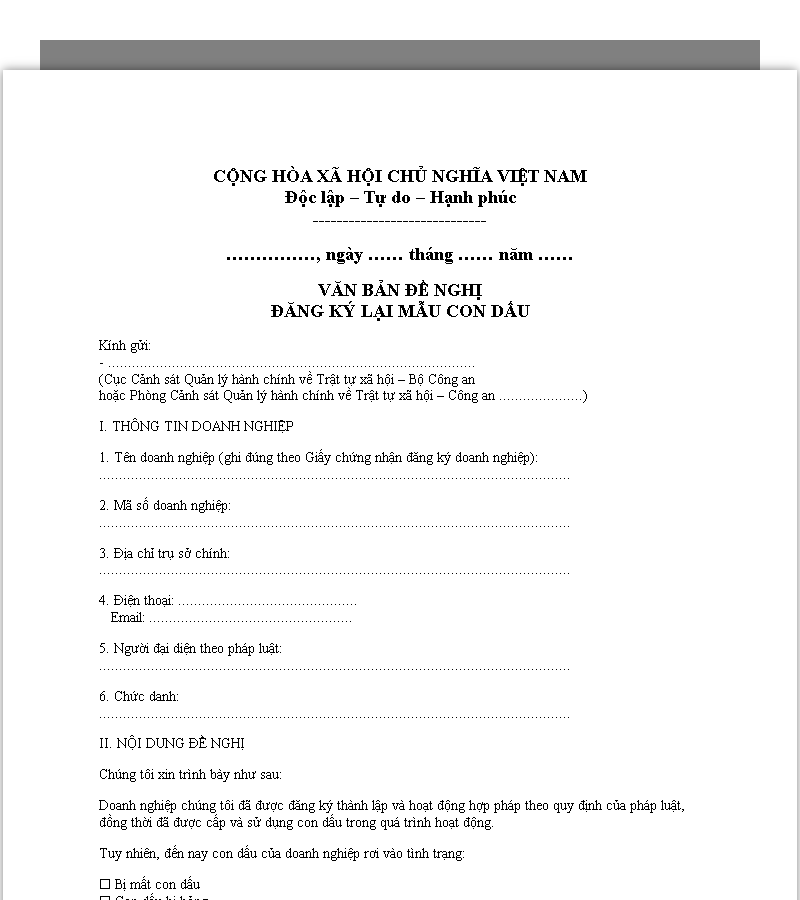
Mẫu 1: Văn bản đề nghị đăng ký lại mẫu con dấu cho Doanh nghiệp (áp dụng khi mất, hỏng, biến dạng con dấu)
Mẫu văn bản này được sử dụng trong trường hợp doanh nghiệp đã từng đăng ký mẫu con dấu theo cơ chế quản lý cũ hoặc buộc phải làm lại con dấu do mất, hỏng, biến dạng và có yếu tố quản lý hành chính liên quan. Đây không phải mẫu đơn áp dụng cho mọi doanh nghiệp, mà chỉ dùng khi có phát sinh thủ tục với cơ quan công an.
File mẫu tham khảo:
Download Word Template: Request to re-register a company seal sample
(Businesses can edit this based on their actual situation and the requirements of the receiving authority)
When filling out the form, pay special attention to the following content:
-
The full name of the business as stated in the Certificate of Business Registration
-
Business code
-
Head office address
-
Reason for re-registering the seal (lost, damaged, no longer usable, etc.)
-
Commitment to managing and using the seal in accordance with legal regulations
-
Signature and full name of the legal representative, and seal impression (if the old seal is still available)
In case of a lost seal, this request form must usually be accompanied by a confirmation of the loss report from the police authority where the business is headquartered.
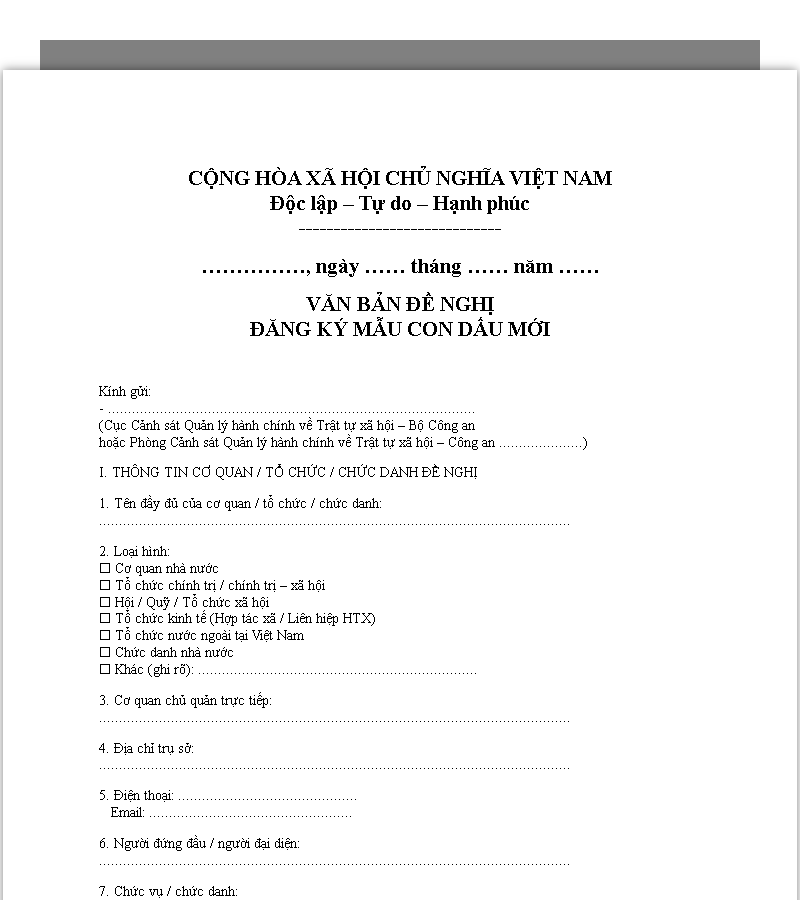
Template 2: Request to register a new seal sample for a State Agency / Organization / Title
This is a mandatory document template for state agencies, organizations, and titles when applying for a new seal or re-registering a seal sample in accordance with the law on seal management.
Depending on the type and management level, the police authority may provide a unified template or require it to be drafted according to a standard content framework. However, the content of the document basically revolves around the core legal information of the requesting unit.
Reference template file:
Download Word Template: Request to register a new seal sample
Important information that needs to be filled in accurately includes:
-
Name of the agency, organization, or title requesting the seal
-
Legal basis for establishment (establishment decision, charter, operating license, etc.)
-
Direct managing authority
-
Type of seal requested (agency seal, title seal, etc.)
-
Purpose of using the seal
-
Information of the person assigned to manage the seal
-
Signature, full name, and confirmation seal of the competent authority
V. Important notes when using a company seal
In legal practice and corporate governance, the risk lies not in “not having a seal,” but in managing and using the seal incorrectly. A seal used without proper authority, lost, or misused can lead to significant consequences: voided contracts, internal disputes, and even legal liability for the representative.
Therefore, even though the law has granted greater autonomy, businesses and organizations still need to establish a strict, transparent, and controlled seal management mechanism.
Seal content: Comply with legal regulations
Although the form of the seal can be self-determined, it must still comply with certain legal limitations. Designing the seal content incorrectly can result in the seal not being recognized or being required to be changed.
Businesses and organizations need to ensure:
-
Do not use the national flag, national emblem, or symbols of state agencies
-
Do not use words or images that violate fine customs and traditions
-
Do not cause confusion with state agencies, armed forces, or political organizations
-
The information on the seal is consistent with the registered legal documents
Seal management: Clear personnel – clear responsibility – clear process
A common mistake is to assign the seal without assigning responsibility. This leads to lax document control and potential disputes when incidents occur.
Businesses and organizations should:
-
Issue internal regulations on the management and use of the seal
-
Clearly designate the person who holds and is authorized to use the seal
-
Clearly define the cases in which the seal can be used and the procedure for requesting its use
-
Apply secure storage measures to prevent loss or damage
In case of a lost seal, it is necessary to:
-
Immediately notify the competent authority
-
File a report in accordance with regulations
-
Proactively manage risks that may arise while waiting for a new seal
A seal is only legally valid when used for the right purpose and in the right context. Stamping documents indiscriminately, without being linked to signing authority, can render the document invalid.
When using the seal, note the following:
-
The document must have a valid signature before being stamped
-
The content of the document must be consistent with the authority of the signatory
-
Stamp in the correct position, clearly, without smudging or overlapping
-
Use the correct type of ink as per internal regulations
Electronic seals: A modern governance trend and its practical benefits
In the context of digital transformation, electronic seals and digital signatures are gradually replacing traditional seals in many transactions. Current law recognizes the legal validity of electronic seals if they are created and used in accordance with regulations.
The outstanding benefits of electronic seals include:
-
Signing and approving documents remotely
-
Saving time and operational costs
-
Increasing security and control
-
Suitable for multi-branch and flexible work business models
When changing the seal sample or the number of seals
During operations, businesses and organizations may need to change the seal sample or use additional seals. This must be handled carefully to avoid legal conflicts.
Points to note:
-
Determine whether it is necessary to notify or register with the competent authority, depending on the applicable entity
-
Issue an internal decision on changing or adding a seal
-
Carry out the procedure to destroy the old seal (if no longer in use) to prevent its misuse
VI. Frequently Asked Questions
The FAQ section provides quick answers and practical solutions, especially suitable for business owners, administrative/HR managers, or individuals directly handling legal procedures. The answers below are presented in a way that is legally compliant, easy to understand, and practical.
Is a company seal mandatory?
Under current law, a
Can a business have multiple seals?
Yes. The law allows businesses to use more than one seal concurrently. A business can have:
-
Multiple corporate seals
-
Seals for branches and representative offices
-
Title seals for internal management purposes
The important thing is not the number of seals, but rather:
-
Having clear internal regulations
-
Specific authorization for use
-
Strict control over the stamping process
Is there a penalty for losing a company seal?
Losing a seal itself does not automatically result in a penalty. However, a business or organization may face administrative fines if they:
-
Fail to report the lost seal promptly
-
Fail to notify the competent authorities as required by regulations
-
Allow the seal to be misused, leading to legal consequences
Therefore, upon discovering a lost seal, it is crucial to address the issue immediately to avoid prolonged risks.
When does a company seal become effective?
For businesses, the seal becomes effective as soon as the business decides to use it, regardless of whether the seal specimen has been notified or registered (except for some specific cases under old regulations).
For state agencies, organizations, and official titles, the seal is only effective after it has been issued by the police authority and a Certificate of Seal Specimen Registration has been granted.
Therefore, it is necessary to clearly distinguish the applicable entity to determine when the seal becomes legally valid.
Is it necessary to notify the seal specimen when changing the company address?
Typically, it is not mandatory to notify the seal specimen just for a change of address, unless:
-
The content on the seal includes the business address
-
Or the change of address leads to changes in other legal information on the seal
In these cases, the business should:
-
Have a new, appropriate seal engraved
-
Make a notification or update the information (if transparency is desired)
Does an electronic seal have the same legal validity as a physical seal?
Yes, if used in accordance with legal regulations. An electronic seal associated with a valid digital signature is recognized by Vietnamese law as having legal validity equivalent to a physical seal in many transactions.
Electronic seals offer many benefits:
-
Remote signing and approval, independent of location
-
Suitable for electronic transactions and digital transformation
-
Reduces the risk of loss and forgery
However, to ensure legal validity, businesses need to:
-
Use a legitimate digital signature service
-
Adhere to the correct electronic signing process
-
Store electronic data according to regulations
















