


 10/05/2026
  1673 views
A company seal is a special asset with high legal value and significant risks if misused, lost, or handed over without clear documentation. The seal handover minute is the most crucial administrative document, accurately recording the time, condition, and responsibility of transferring the seal from the old holder to the new one, helping to clearly define who is legally responsible in case of an incident. This is not just an administrative procedure but also a “shield” protecting the organization from risks of fraud, disputes, or criminal liability. In this article, we will provide a detailed introduction to what a seal handover minute is, its purpose, legal role, practical importance, and the legal basis according to Decree 99/2016/ND-CP, Decree 56/2023/ND-CP, and the latest regulations – helping you understand and create accurate and secure minutes for seal management in 2026!
Mục lục
- 1. General Introduction to Seal Handover Minutes
- 2. Cases Requiring a Seal Handover Minute
- Internal Handover within a Business/Organization
- Seals That Are No Longer Valid
- Other Special Cases
- Decree 56/2023/ND-CP amending and supplementing a number of articles of Decree 99/2016/ND-CP
- Decree 30/2020/ND-CP dated March 5, 2020, on clerical work
- Other related legal documents
- Prohibited acts regarding seals and legal liability for violations
- 4. Guide to Creating a Standard Seal Handover Record
- 5. Common Company Seal Handover Record Templates
- 6. Important Notes for Handing Over and Managing Company Seals
- 7. Frequently Asked Questions About the Seal Handover Record
- Who is authorized to sign the seal handover record?
- Does the seal handover record need to be notarized?
- How to handle a lost seal before the handover?
- What are the responsibilities of the handover and receiving parties after the handover?
- Is it necessary to re-issue the seal sample registration certificate when changing the seal manager?
1. General Introduction to Seal Handover Minutes
A seal handover minute is an official administrative document created between the handing-over party (the former seal holder, treasurer, chief accountant, unit leader, etc.) and the receiving party (the newly assigned seal manager) to record the transfer of the corporate seal (round seal, title seal, embossed seal, etc.) in a transparent, clear, and responsible manner.
This document details:
- Seal information (form, engraved content, registration number, date of issue).
- Condition of the seal at the time of handover (intact, damaged, remaining ink, etc.).
- Time and place of handover.
- Commitment of the receiving party regarding the responsibility for managing, using, preserving, and reporting incidents.
- Confirmation signatures of the parties (often with a witness or a representative of the leadership).

Legal and administrative role:
The seal handover minute is an important legal document that clearly defines the moment of transferring responsibility for the seal’s use, helping to determine who is accountable for any wrongdoing related to the seal (e.g., fraudulent stamping, misuse of the seal causing damage). This is a mandatory document in internal administration, especially during personnel changes (resignation, transfer, appointment to a new position involving the seal).
Importance
- Defining responsibility: Helps to clearly delineate the legal responsibilities of the former and new holders in case of incidents related to the seal (fraud, forgery, misuse).
- Ensuring process transparency: Ensures the seal handover is conducted openly, with evidence, avoiding situations of a “lost seal” or “unclear custody.”
- Preventing risks and disputes: Serves as a solid legal basis during inspections or investigations by state agencies (police, inspectors) or in cases of internal disputes or litigation related to the seal.
- Legal compliance: According to Decree 99/2016/ND-CP (on management and use of seals), Circular 01/2021/TT-BKHĐT, and new regulations on seal management (from January 1, 2025), enterprises and agencies must create a handover minute when changing the seal holder, especially when re-registering the seal or transferring a position.
- Serving inspection and control: It is a mandatory document for internal audits, tax inspections, and examinations by business registration agencies or the police to verify the seal management process.
A seal handover minute is not just an administrative procedure but also an essential legal tool to define responsibility, ensure transparency in the administrative process, and prevent risks related to the seal – one of the most important legal assets of businesses and state agencies in Vietnam.
2. Cases Requiring a Seal Handover Minute
Handing over a seal is a mandatory process under Vietnamese law to ensure transparency, clearly define user responsibility, and avoid legal risks associated with the corporate seal – a special asset of businesses and state agencies. Creating a seal handover minute is not just an administrative procedure but also a preventive measure against disputes, fraud, and misuse of the seal causing damage. Below are common cases that require a seal handover minute (updated according to Decree 99/2016/ND-CP, Decree 30/2020/ND-CP, Circular 01/2021/TT-BKHĐT, and the latest regulations for 2026):
Internal Handover within a Business/Organization
This is the most common case, occurring when there is a change in the person directly managing and using the seal within the unit.
- When changing the seal manager (Director, Chief Accountant, Head of Department): When appointing, dismissing, transferring, or upon the resignation of the seal holder (usually the legal representative, chief accountant, or an authorized employee). The minute must record the time of transfer, the condition of the seal, and the commitment of responsibility from the new holder.
- Handover to the clerical or archival department: When transferring the seal from the direct user to the clerical or archival department for centralized management (commonly applied in state agencies and large enterprises).
- Temporary handover to an authorized person: When the seal holder is absent for an extended period (business trip, leave, illness), a temporary handover is made to a legally authorized person. The minute must clearly state the temporary period and the conditions for return.
Seals That Are No Longer Valid
When a seal is no longer valid (registration expired, change in business information, or business cessation), a handover minute must be created for handling according to regulations.
- Handover for historical archiving: According to Decree 30/2020/ND-CP and Decision No. 22/2021/QD-TTg (on document archiving), old seals must be handed over to the unit’s archival department or a state archival agency for historical preservation and reference.
- Handover for destruction: When a business is dissolved, ceases operations, or the seal is revoked, a handover minute must be created to transfer the seal to the business registration agency (Department of Planning and Investment) or the police for destruction as regulated (accompanied by a destruction minute).
Other Special Cases
- When the seal is deformed, worn, or damaged and needs re-registration: Create a handover minute for the old seal to be submitted to the business registration agency or the police for revocation, while simultaneously registering a new seal.
- When a business is divided, separated, merged, or consolidated: According to the 2020 Law on Enterprises, a seal handover minute must be created between the new/old legal entities to define responsibility for seal use during the restructuring process.
- When a lost seal is found after its validity has been canceled: Create a handover minute for the recovered seal to be submitted to the business registration agency for handling as regulated (it may be destroyed again or archived).
- Handover of professional seals (military, national defense sectors): According to Circular 138/2021/TT-BQP (Ministry of National Defense), professional seals (title seals, military embossed seals) require a strict handover minute when changing the manager, witnessed by a security unit or the national defense seal management agency.
A seal handover minute is mandatory in all cases of changing the manager, expiration of validity, business restructuring, or special handovers. Creating a timely and detailed minute helps to clearly define legal responsibility,
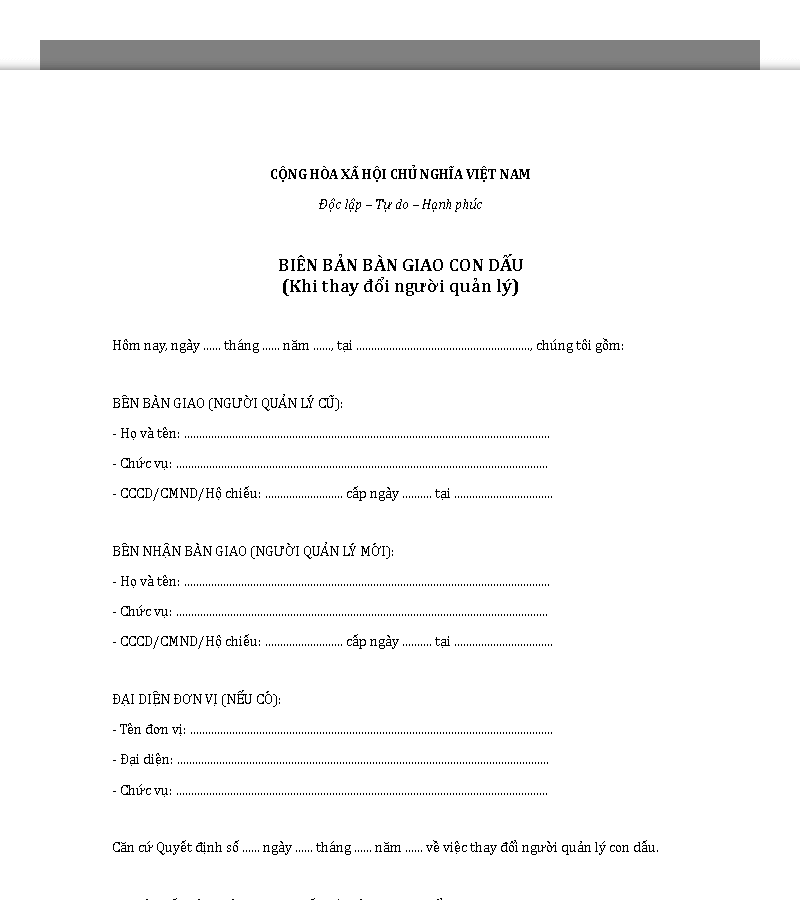
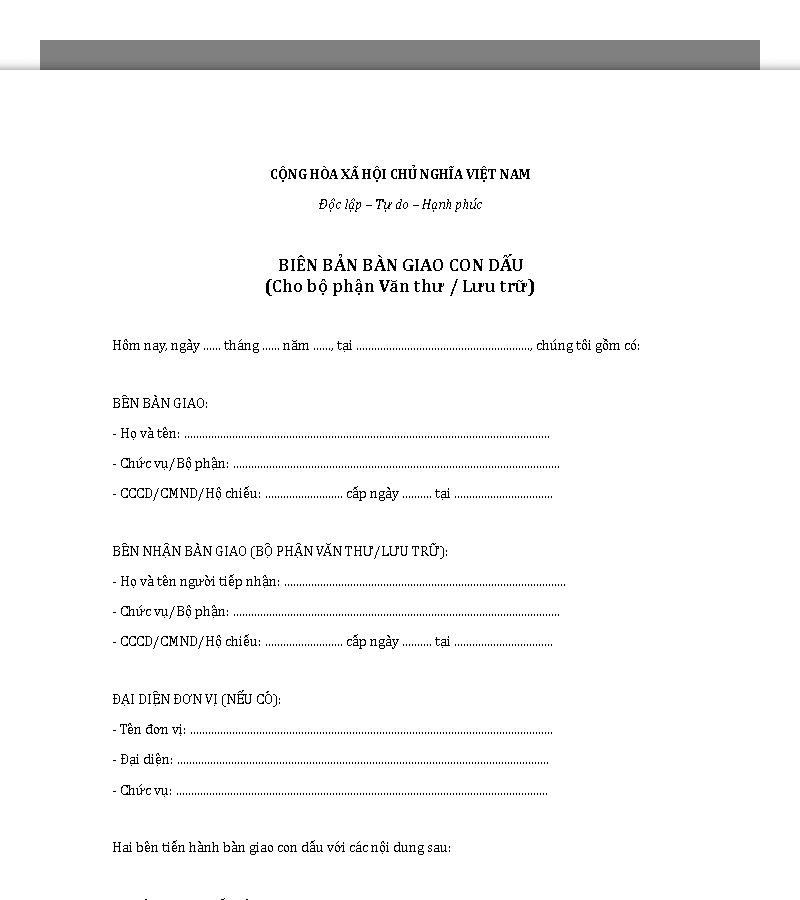
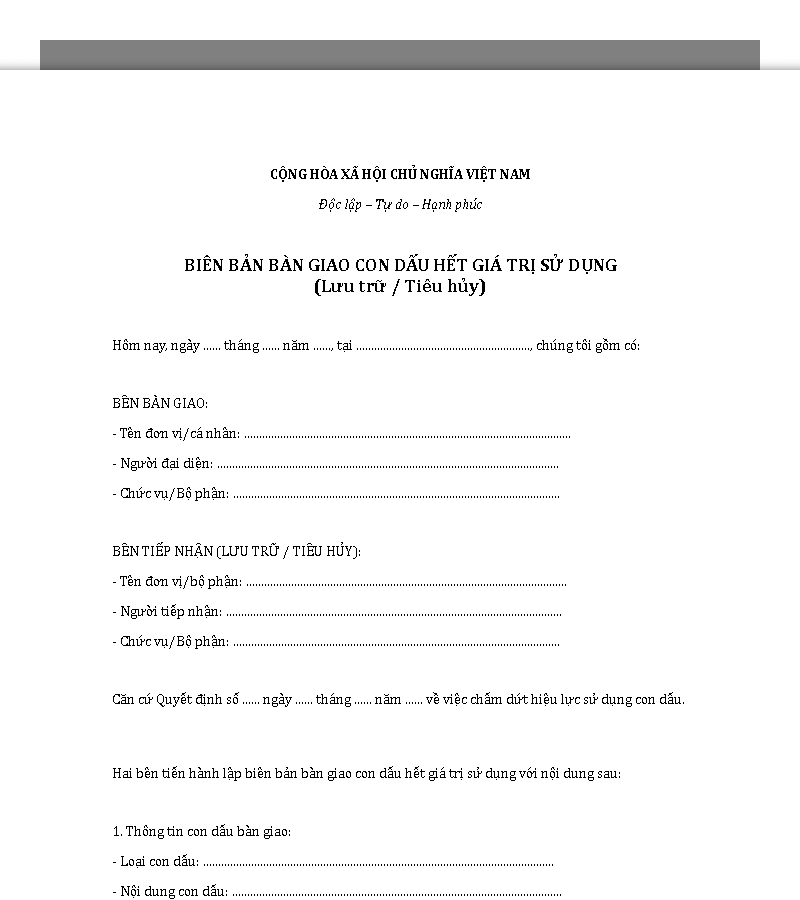
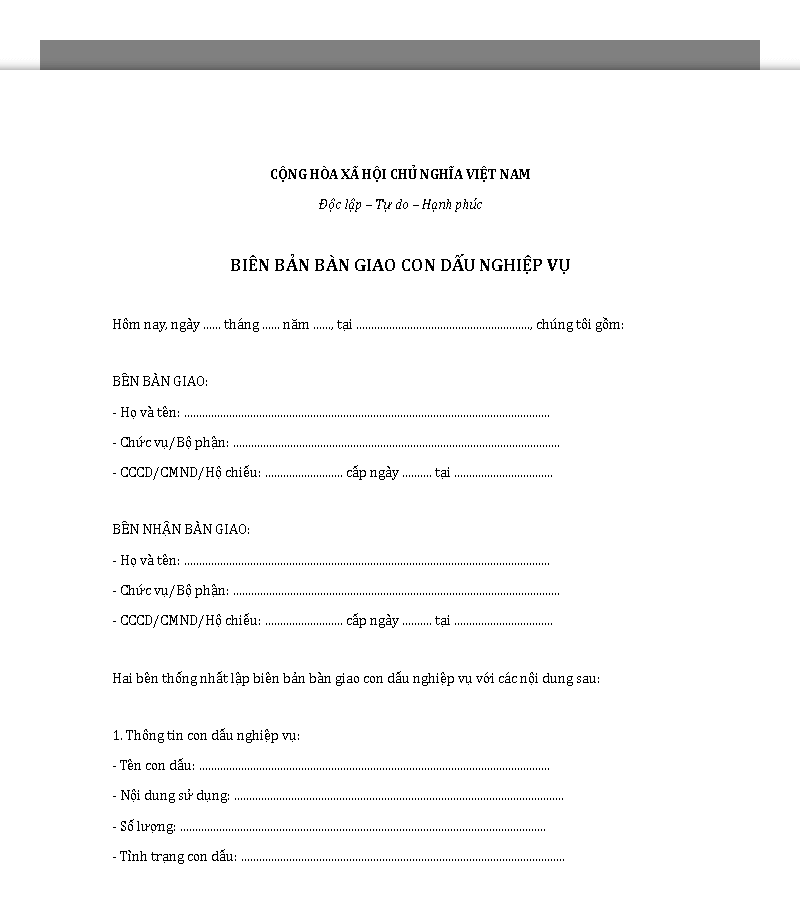
This decree updates and supplements regulations on seal management in the context of digital transformation and administrative procedure simplification (effective from 2023–2026): According to Article 6 of Decree 99/2016/ND-CP (amended by Decree 56/2023/ND-CP), the following acts are prohibited: Legal liability for violations: The Vietnamese legal system strictly regulates the management and handover of seals to ensure safety, transparency, and accountability. A seal handover record is a mandatory document in all cases of changing managers, expiration of use, or organizational restructuring, helping to clearly define legal responsibilities and prevent the risks of fraud and misuse of seals. A seal handover record is a mandatory administrative document required by Vietnamese law (Decree 99/2016/ND-CP, amended by Decree 56/2023/ND-CP, and Decree 30/2020/ND-CP on clerical work), aimed at ensuring transparency and clearly defining the time and responsibility for transferring the seal – a special legal asset of an agency, organization, or enterprise. The creation of the record must strictly adhere to the format of administrative documents and core content to ensure the record has the highest legal validity, serving for inspection, auditing, or dispute resolution. Below is a detailed guide on how to create a standard seal handover record. The record must be presented in the standard administrative document format (Decree 30/2020/ND-CP): National Emblem, Motto: Centered, bold, font size 14–16: Independence – Freedom – Happiness Record Title: Bold, font size 14–16, centered: Time and place of record creation: Record the exact minute: At: … (e.g., Management Office – XYZ Co., Ltd., 3rd floor, 123 Le Loi Street, District 1, Ho Chi Minh City) <li style="font-weight: 400;" aria-level="2A standard company seal handover record is a mandatory document to define legal responsibility, ensure transparency in the administrative process, and prevent the risk of seal misuse. The company seal is the “legal soul” of a business or organization. Any changes in its management, use, or disposal must be recorded transparently and clearly to avoid legal risks, fraud, or criminal liability. A common company seal handover record is a mandatory administrative document that helps pinpoint the exact time of responsibility transfer, the condition of the seal, and the commitment to its proper storage and use. In this section, we have compiled the most common company seal handover record templates, from handovers due to a change in manager, transfers to the archives/clerical department, handovers of expired seals for storage/destruction, to handovers of professional seals in specialized industries. All templates follow a standard structure, are easily editable in Word files, and come with detailed instructions and legal notes for immediate application, ensuring safety, transparency, and strict compliance with Decree 99/2016/NĐ-CP and the latest regulations. When there is a change in the legal representative, chief accountant, treasurer, or an employee authorized to manage the seal (due to appointment, dismissal, resignation, or transfer), a seal handover record is a mandatory document to clearly define the moment of responsibility transfer. This template details the seal’s information, its condition, the commitment to its safekeeping, and the legal responsibilities of the recipient. It helps businesses avoid risks of seal misuse, fraud, or internal disputes, while complying with Decree 99/2016/NĐ-CP and Decree 56/2023/NĐ-CP. Download the Seal Handover Record Template for Change of Manager Now When transferring a seal from a direct user to the clerical or archives department for centralized management (common in state agencies and large enterprises), a seal handover record ensures transparency, security, and compliance with clerical work regulations (Decree 30/2020/NĐ-CP). This template clearly records the seal’s condition, quantity, the commitment to its safekeeping, and the responsibilities of the clerical department, helping the organization tightly control seal usage and prevent loss or misuse during storage. Download the Seal Handover Record Template for Transfer to the Archives/Clerical Department Now When a seal expires (due to expiration date, change in business information, dissolution, or merger), a handover record is a mandatory step to transfer the old seal to the historical archives department or the business registration office for destruction. This template details the seal’s condition, the reason for its expiration, a test impression of the seal, and a commitment to handle it according to regulations. This helps the organization comply with Decree 99/2016/NĐ-CP, Decision 22/2021/QĐ-TTg, and avoid legal risks related to the old seal. Download the Handover Record Template for Expired Seals Now Professional seals (title seals, military embossed seals, seals for specialized sectors like police, national defense, customs) require a stricter handover process due to their high security and confidentiality nature. This template complies with Circular 138/2021/TT-BQP and industry-specific regulations, detailing the seal type, registration number, condition, confidentiality commitment, and legal responsibilities, with the presence of a security unit or senior leadership as witnesses, ensuring absolute safety during transfer in these specialized fields. Download the Professional Seal Handover Record Template Now Handing over and managing a company seal is a sensitive process directly related to the legal standing, responsibilities, and risks of an agency, organization, or business. A minor mistake can lead to serious consequences such as seal misuse, fraud, loss of assets, or criminal liability. Below are the most important notes, categorized by stage and common mistakes, to help ensure a safe, transparent, and legally compliant handover process (in accordance with Decree 99/2016/NĐ-CP, Decree 56/2023/NĐ-CP, and Decree 30/2020/NĐ-CP, updated 2026). The handover of a company seal must be conducted formally, thoroughly, with witnesses, and the records must be carefully stored. By adhering to the points above, the organization will avoid legal risks, fraud, and ensure the responsible use of the seal in accordance with legal regulations (Decree 99/2016/ND-CP, Decree 56/2023/ND-CP). Below are concise, clear answers based on current Vietnamese law (Decree 99/2016/ND-CP, the amending Decree 56/2023/ND-CP, Decree 30/2020/ND-CP, and related documents, updated as of January 2, 2026), combined with practical seal management practices in businesses and state agencies. The authorized signatories are individuals specified in the company’s Charter, Appointment Decision, or a legal Power of Attorney: Note: It is not mandatory according to legal regulations. The seal handover record is an internal document. It only requires the full signatures of all parties (handover party, receiving party, and witnesses, if any) and the company seal (if a legal entity) to be legally valid as evidence before state authorities (police, inspectors, courts). However, notarization/authentication is recommended when: Procedure: Bring the original document to a Notary Office or the People’s Committee of the ward/commune for signature authentication (fee is approximately 50,000–200,000 VND). If the seal is lost, it must not be handed over until legal procedures are completed as required (Decree 99/2016/ND-CP and Decree 56/2023/ND-CP): It is not necessary to re-issue the seal sample registration certificate just because the seal manager has changed. According to Decree 99/2016/ND-CP (amended by Decree 56/2023/ND-CP) and Circular 01/2021/TT-BKHDT: The notes above help ensure the seal handover process is safe, transparent, and compliant with the law. If you need a standard seal handover record template (including a seal information inventory, commitment of responsibility, witnesses), detailed filling instructions, or guidance for special cases (handover when the seal is lost, handover for destruction),Decree 56/2023/ND-CP amending and supplementing a number of articles of Decree 99/2016/ND-CP
Decree 30/2020/ND-CP dated March 5, 2020, on clerical work
Prohibited acts regarding seals and legal liability for violations
4. Guide to Creating a Standard Seal Handover Record
Requirements for form and format of the document
SOCIALIST REPUBLIC OF VIETNAM
SEAL HANDOVER RECORD
At … hours … minutes, on … (day) … (month), 2026Core content of the handover record
5. Common Company Seal Handover Record Templates
Template 1: Seal Handover Record for Change of Manager
Template 2: Seal Handover Record for Transfer to the Archives/Clerical Department
Template 3: Handover Record for Expired Seals for Archiving/Destruction
Template 4: Handover Record for Professional Seals (e.g., in specialized industries)
6. Important Notes for Handing Over and Managing Company Seals
Before the handover
During the handover
After the handover
Common Mistakes and How to Fix Them

7. Frequently Asked Questions About the Seal Handover Record
Does the seal handover record need to be notarized?
How to handle a lost seal before the handover?
What are the responsibilities of the handover and receiving parties after the handover?
Is it necessary to re-issue the seal sample registration certificate when changing the seal manager?
















