11/05/2026
  1249 views
A marketing campaign is a crucial factor that helps businesses reach customers and build their brand in the market. Behind every successful campaign is a methodical investment in strategy, creativity, and the ability to understand users. In this article, 1Office will walk you through 6 outstanding marketing campaigns in Vietnam, drawing lessons to help businesses apply them effectively in practice.
Mục lục
- 1. Successful Marketing Campaigns in Vietnam
- 1.1. Canifa – The #Sayit Campaign – Say What You Want
- 1.2. MB Bank – Rebranding Campaign & Joining the Digital Transformation Race
- 1.3. Sunlight – The “Sunlight for Men” Campaign
- 1.4. Baemin – “Thank You” Campaign on its 3rd Anniversary
- 1.5. Chubb Life – “Because You Are The Whole World” Campaign
- 1.6. Honda – “Bring Money Home to Mom” Campaign
- 2. What do successful marketing campaigns have in common?
- 3. Key Metrics for a Successful Marketing Campaign
- 4. Risk Management & Incident Handling During a Campaign
- 5. Automating Marketing Campaigns with 1Office
- 6. Frequently Asked Questions
1. Successful Marketing Campaigns in Vietnam
1.1. Canifa – The #Sayit Campaign – Say What You Want
Canifa is a very familiar name in the Vietnamese fashion market, known for its diverse product lines and designs that cater to consumer tastes. With this #Sayit campaign, Canifa made a rather “bold” move by targeting a market segment that was not its traditional strength – young adults.
Campaign Context
- Canifa was known as a family fashion brand with significant reach in the over-30 customer segment. However, Canifa still faced challenges in winning over younger customers, especially the young adult group (22 – 28 years old).
- This is understandable as this customer group prefers foreign brands, and Canifa itself was traditionally associated with family-oriented products.
Brand’s Objectives
With a campaign lasting only 2 months, Canifa set the following objectives to capture the young customer segment:
- Increase brand awareness among the young adult group
- Grow market share and sales within the young customer segment
Campaign Overview
- To resonate with young customers, Canifa cleverly tapped into their insights and embedded the message into the #sayit t-shirt product. The message was the desire to express one’s personal voice through fashion.
- The “simple but not plain” t-shirts, along with a catchy slogan, addressed the need for easy-to-wear, fashionable apparel that could express the personality, emotions, thoughts, and lifestyle of young people.
Campaign Execution
The #Sayit campaign was widely promoted by Canifa through various methods:
Social Media
- Using KOLs: A smart move by Canifa was to collaborate with well-known KOLs among young people from various fields, such as: Ong Cao Thang – Dong Nhi, Den Vau, Giang Oi, etc. A special feature of the campaign was that Canifa did not use pre-written, formulaic content. Instead, they let the celebrities tell their own stories through projects, music products, or simply personal, everyday stories.
- Organizing the #Sayit – “Say it, don’t wait” Photo Contest: encouraging young people to share their own stories through photos to inspire them to express their own voices.

PR
Canifa also used two online newspapers popular with young people, Zing News and Kenh 14, with articles focusing on content about fashion, styling tips, etc.
Campaign Results
With a small budget and an execution time of just 2 months, Canifa’s #Sayit campaign delivered impressive results for the brand:
- Massive engagement with over 881,000 interactions, achieving 114% of the KPI
- The number of target customers in the young segment (under 28) increased by 49%
- Product sales increased by 54%
Lessons Learned
With the results achieved, #Sayit deserves to be considered one of the most successful marketing campaigns in Vietnam. This marketing campaign by Canifa demonstrated how the brand effectively utilized KOLs and applied a creative and effective Content Marketing strategy.
| Read more: The 4Cs of Marketing – The Solution for Marketing 4.0 |
1.2. MB Bank – Rebranding Campaign & Joining the Digital Transformation Race
MB Bank (Military Commercial Joint Stock Bank) is currently one of the country’s top banks with a high level of prestige and quality services. Behind that success are relentless efforts to become a professional and convenient digital bank for customers.
Campaign Context
- As a bank under the Ministry of Defense, MB Bank’s image in the minds of consumers was somewhat serious and rigid. This inadvertently became a barrier that made young people hesitant to use the bank’s services.
- The goal set by MB Bank’s leadership for the 2017 – 2021 period was to become a comprehensive, customer-centric digital bank.
Brand’s Objectives
- Reposition the brand in customers’ minds: modern, dynamic, and convenient
- Serve the strategic goal: to become a comprehensive digital bank
Campaign Overview
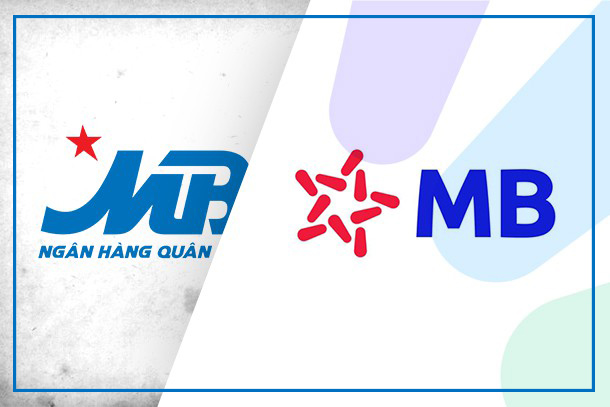
- To create momentum for its digital transformation journey, MB Bank made a bold decision – to change its brand identity. The old logo was completely changed, from the colors and font to the star symbol, expressing enthusiasm, movement, and continuous innovation with the desire to create the most convenient experience for customers.
- With a determination for comprehensive digital transformation to serve customers, in early 2020, the bank officially announced a new version of the MB Bank App, providing many smart utilities and ensuring transaction security to optimize the customer experience.
Campaign Execution
Announcing the new logo and brand identity on the anniversary of its establishment
On November 4, 2019, MB Bank held a ceremony to celebrate its 25th anniversary and officially launched a new logo, simultaneously “revamping” the brand identity at 300 transaction points across the entire system. This was likely an intentional arrangement, showing that this transformation was linked to the bank’s vision and mission, which is “to become the most convenient bank.”
Promotional program for the launch of the new MB Bank App version
- Organized a lucky draw program for new App registrants with a huge budget of up to 2 billion VND
- Launched a series of incentive policies for users of the “My Beloved Family” product package, such as lifetime waivers of transaction and annual fees, offering credit cards with limits up to 100 million VND, etc.
Campaign Results
MB Bank’s marketing campaign created a huge buzz in the market, specifically:
- Gained 1 million users in the individual customer segment
- Nearly 2 million app downloads and 90 million transactions
Lessons Learned
MB Bank’s brand identity change event, despite attracting considerable controversy in its early days, is undeniably one of the famous marketing campaigns that created a stepping stone for the company’s long-term development. MB Bank has shown us a lesson in steadfastly pursuing digital transformation goals and differentiating to lead.
1.3. Sunlight – The “Sunlight for Men” Campaign
Sunlight is a dishwashing liquid brand familiar to Vietnamese consumers, especially housewives. With “Sunlight for Men,” Sunlight not only executed an innovative marketing campaign but also brought about a revolution in mindset by targeting men – who are still quite “unfamiliar” with kitchen chores.
Campaign Context
The image of a “man doing housework” is still quite unfamiliar to most people, especially the adult group (25 – 45 years old) – Sunlight’s target customer group. This was a major challenge but also a mission for Sunlight to break down gender stereotypes when it comes to housework.
Brand’s Objectives
- Change the community’s perception of a social issue – gender stereotypes in housework
- Increase consumer affection for the brand (brand love)
Campaign Overview
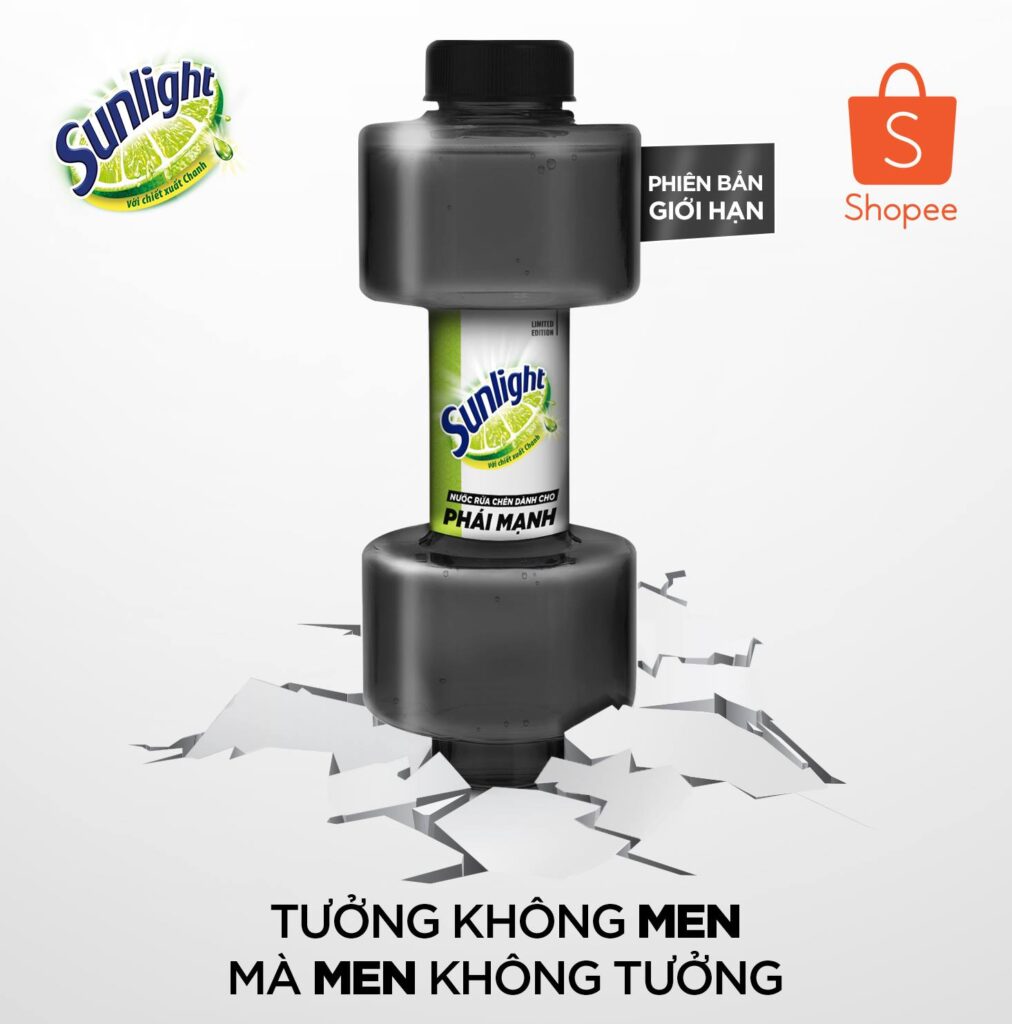
By deeply exploring consumer insights, Sunlight understood the feelings of both genders regarding housework. For women, housework is seen as an obvious responsibility to fulfill the duties of a wife and mother. Meanwhile, men are always hesitant to enter the kitchen, wash dishes, or clean up for fear of being labeled as effeminate. This was the motivation for Sunlight to launch the “Sunlight for Men” product with its unique dumbbell-shaped design and the message “Housework is everyone’s business.”
Campaign Execution
Launching the limited edition “Sunlight for Men”
The special thing about “Sunlight for Men” is that this product was not sold separately on the market but was a promotional gift included with the purchase of a 3.8kg Sunlight dishwashing liquid. This means Sunlight had no intention of launching a new product line but only saw this as a tool to convey its message.
Media
Sunlight released short videos centered around the theme “Housework is everyone’s business,” featuring men who don’t hesitate to share housework with their wives to “have a place” in the kitchen. At the same time, the message was humorously integrated, suggesting that being good at housework could be a way for single men to “escape singlehood.”
Social
- KOLs’ Influence: Sunlight selected KOLs whose images were highly suitable for the campaign, such as the couple Thuy Tien – Cong Vinh, Trang Lou – Tung Son, footballer Bui Tien Dung, Karik, etc., to boost social media communication.
- Sunlight Photo Contest: Sunlight encouraged its customers to “practice” by launching a contest to share moments of family members sharing household chores.
Campaign Results
The results were a well-deserved reward for Sunlight’s efforts, as the brand received a storm of social media engagement with 47,000 interactions and nearly 6,000 discussion shares.
Lessons Learned
Sunlight’s marketing campaign deserves to be among the classic marketing campaigns as it not only increased customer trust and love but also carried a profound social meaning. Sunlight provided a humanistic lesson about a brand daring to speak out on pressing social issues, something not every business can do.
1.4. Baemin – “Thank You” Campaign on its 3rd Anniversary
Baemin is considered a close companion for food lovers in Vietnam. As a fast-food delivery brand from Korea, when Baemin entered the Vietnamese market, there were already several “big players” like Grab Food, Now Food, etc. However, Baemin proved to be just as competitive with its youthful, creative marketing campaigns that greatly delighted consumers.
Campaign Context
- 3rd anniversary, marking the 3-year milestone of Baemin’s presence with Vietnamese consumers.
- Typically, anniversaries are celebrated grandly by brands, highlighting successful milestones during their operation. But Baemin chose its own path, a gentler, more sentimental one. It launched a communication campaign to send thanks and gratitude to customers who had trusted and supported it over the past 3 years.
Brand’s Objectives
- Show gratitude to customers on its 3rd anniversary.
- Increase consumer brand love.
Campaign Overview
- The main activity of the campaign was to send thank-you messages to consumers in various forms. This might sound simple and potentially boring, but with the mindset of a young brand, Baemin conveyed its message in a very cute and heartwarming way.
- Baemin’s thank-you content was very diverse and varied across different platforms, targeting multiple audiences in various contexts, using a slightly scribbled handwritten font true to the “turning three” spirit.
Campaign Execution
For this anniversary campaign, Baemin invested heavily, utilizing numerous communication platforms from online to offline to spread the message to users.
- Out-of-home advertising (Billboards, Pano, LCDs in elevators)
- Advertising on entertainment apps (Youtube, Spotify, Zing MP3)
- Famous fanpages, online newspapers
- Baemin’s fanpage and personal platforms, in-app notifications
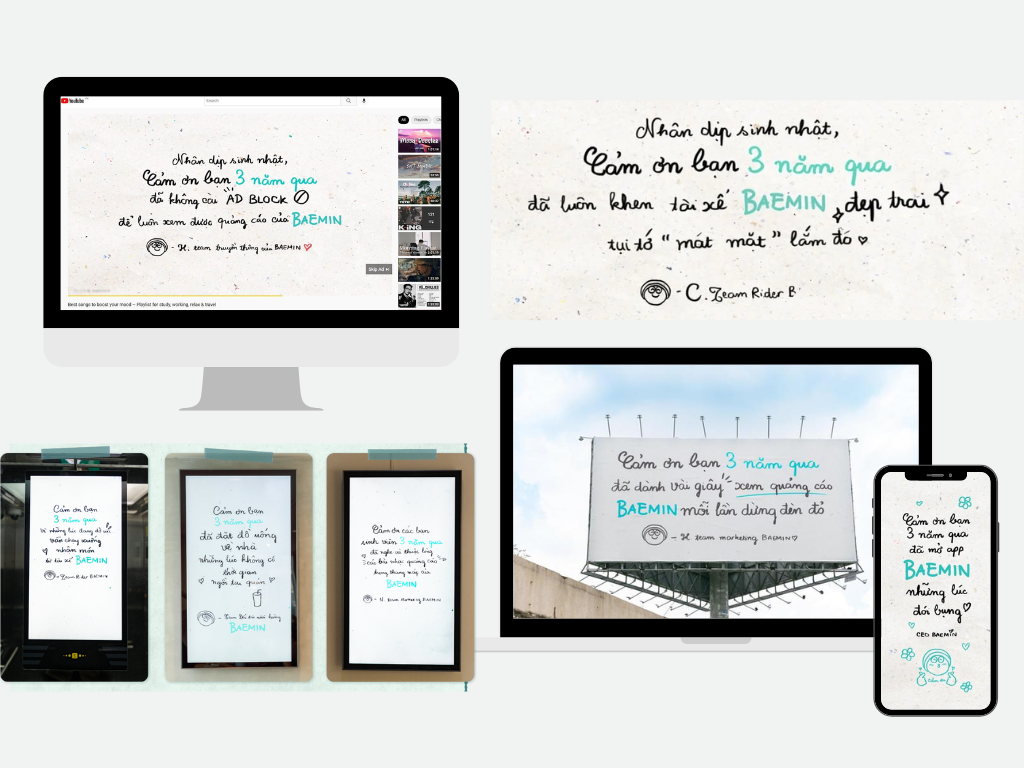
Additionally, Baemin gave limited-edition gifts to lucky customers who ordered food on the app during the anniversary.
Campaign Results
Baemin’s marketing campaign garnered thousands of interactions and shares on social media sites, community groups, and press forums, receiving high praise from industry experts.
Lessons Learned
It’s clear that the viral spread of Baemin’s “Thank You” campaign proved that successful marketing campaigns don’t necessarily have to be grand and expensive. Sometimes, they just need to originate from the heart of the brand—sincerity and a constant focus on the customer.
1.5. Chubb Life – “Because You Are The Whole World” Campaign
Chubb Life is one of Vietnam’s reputable life insurance companies. With the mission “Insurance is Protection,” Chubb Life launched a marketing campaign with the message “Because You Are The Whole World” as an affirmation of the core values this insurance brand pursues.
Campaign Context
- Insurance is no longer an unfamiliar product to Vietnamese consumers. However, many still view it as a luxury investment and are quite hesitant to approach this product.
- With the desire to spread humanistic values to the community and affirm its mission to protect the breadwinners and Vietnamese families, Chubb Life’s campaign struck a chord with the sentiments of millions of Vietnamese hearts regarding their loved ones.
Brand’s Objectives
- Increase brand awareness
- Increase consumer brand love
Campaign Overview
- Chubb Life tapped into consumer insights from a family perspective, realizing that to the world, they might just be “a small grain of sand,” but to one person, they can be “the whole world.” This awareness of personal value motivates them to plan to protect themselves and their families from life’s uncertainties and adversities.
- Chubb Life hit the customer’s pain point by building a message around the “small worlds” within a family and conveying it in a very relatable and accessible way.
Campaign Execution
Release of the Music Video “Because You Are the Whole World”
Chubb Life turned music into a catalyst to connect with users. With an emotional melody and touching footage, Chubb Life’s MV reached millions of viewers’ hearts with a very clear message: “Because we are each other’s world.”
Social Media
- Chubb Life promoted the MV on community fan pages and organized a mini-game to cover the song “Because You Are the Whole World” to increase its reach.
- Organized a writing contest, “Because We Are Each Other’s World,” to encourage people to express their feelings for their loved ones and increase the campaign’s viral spread.
- Launched a sticker set themed “Because You Are the Whole World” on the Zalo app and organized a mini-game to encourage people to download and use the stickers.

PR
Chubb Life collaborated with major online newspapers like Dan Tri, Tuoi Tre, Vietnamnet, Afamily, etc., to reach a wide range of audiences of different ages. Instead of flashy promotions, the brand used relatable, “real people, real stories” about family love from its customers. This allowed the message to be conveyed gently yet effectively.
Campaign Results
- The “Because You Are the Whole World” MV garnered over 6 million views on YouTube and thousands of shares.
- Brand mentions increased by an impressive 87%.
Lessons Learned
The “sweet fruit” that Chubb Life reaped from this campaign teaches us a humanistic lesson for creators: every marketing campaign must be linked to the company’s mission of building value for customers.
1.6. Honda – “Bring Money Home to Mom” Campaign
Honda, the manufacturer holding 80% of the motorcycle market share in Vietnam, consistently proves its leadership with high-quality, well-invested campaigns. “Bring Money Home to Mom,” a collaboration with rapper Đen Vâu, is one of the famous marketing campaigns that helped Honda reach a potential young customer group and affirm its position.
Campaign Context
- Honda’s customer segment is gradually “rejuvenating.” Young people with an active, youthful lifestyle have become a potential customer group that Honda needs to win over.
- In early 2022, Honda planned to launch the Honda Winner X model, targeting young customers.
Brand Objectives
- Increase brand awareness and customer affection for the brand.
- Promote the Honda Winner X product line, encouraging purchases from the young target audience.
Campaign Overview
- By delving into the thoughts and concerns of the younger generation, Honda realized they face life pressures, from worries about “making a living” to career success. The motorcycle is their companion on the journey to fulfill those dreams and ambitions.
- For this campaign, to embrace the Tet holiday spirit, Honda tapped into the emotions of those living far from home to easily connect with young people.
- Honda continued to use the Music Ads formula, similar to the previous “Going Home” campaign, and chose Đen Vâu as the brand ambassador.
Campaign Execution
Release of the Music Video “Bring Money Home to Mom”
The “Bring Money Home to Mom” MV fully leverages Gen Z insights by telling a very relatable story about “making a living.” The Honda Winner X is cleverly integrated, not forced, and helps highlight the MV’s theme and the brand’s spirit – Honda is your durable companion on every road.
Social Media
Honda simultaneously rolled out posts promoting the MV and introducing the new product’s features.
PR
Honda’s campaign also became a hot topic in newspapers popular with Gen Z (Thanh Nien, Kenh 14, etc.) thanks to Đen Vâu’s influence on young people.
Livestream
It’s clear Honda favors the younger generation by organizing the Winner League music festival livestream, featuring Đen Vâu, to give them a chance to interact with their idol and for Honda to introduce the Winner X.
Campaign Results
Despite using the same formula, Honda proved its strength with the MV reaching over 74 million views and hitting #1 on trending charts within hours of its release.
Lessons Learned
Through this campaign, it’s evident that Honda always knows how to reinvent itself to suit its target audience and makes an effort to listen to customers to resonate with them.
2. What do successful marketing campaigns have in common?
It’s easy to see the common thread in the marketing campaigns mentioned above: they all make full use of media and digital platforms. From social media sites and newspapers to media publications, brands leverage everything to reach consumers.
The market trend shifting towards 4.0 forces businesses to change and adapt if they don’t want to fall behind. Currently, all consumer communication and shopping activities can take place entirely on platforms and applications, rather than requiring in-person visits and on-site trials. Therefore, digital transformation is an inevitable trend if businesses want to follow their potential customers.
Read more: What is Marketing Automation? – How to Apply It to Optimize Your Business?
3. Key Metrics for a Successful Marketing Campaign
Measuring effectiveness is the “backbone” of every marketing campaign. Without data, businesses are just spending money on… hope, without knowing if the campaign is actually delivering value. A comprehensive measurement system typically includes 4 key groups of metrics:
3.1 Metrics for Reach & Brand Awareness
Objective: To assess whether the campaign has “reached” the target audience.
-
Reach: Indicates how many people have seen the advertising message. For example: a Facebook Ads campaign reaches 2 million people aged 25–35 in Hanoi.
-
Impressions: The total number of times an ad is displayed, including repetitions. One person can see the same ad multiple times.
-
Brand Lift Study: Some platforms like Google and Facebook support pre- and post-campaign surveys to measure the increase in brand awareness.
-
Share of Voice (SOV): Compares brand presence with competitors in the same industry.
3.2 Metrics for Engagement
Objective: To measure the level of customer “connection” and emotional response.
-
Engagement Rate: (Total likes + comments + shares) / impressions.
-
Video Completion Rate (VCR): The percentage of viewers who watch an entire video ad. A 30-second video with a VCR over 50% is considered highly effective.
-
Click-through Rate (CTR): Indicates the appeal of the content. A low CTR is often a sign that the headline or image is not engaging enough.
-
Time on Page / Bounce Rate: In digital marketing, this metric measures whether visitors are genuinely interested in the content or leave immediately after clicking.
3.3 Metrics for Conversion & Revenue
Objective: To measure the tangible financial results the campaign delivers.
-
Conversion Rate: The percentage of customers who take a desired action (purchase, sign up, download app).
-
Cost per Acquisition (CPA): The average cost to acquire one new customer.
-
Return on Ad Spend (ROAS): Revenue from advertising / advertising cost. For example: A ROAS of 5 means that for every $1 spent on advertising, $5 in revenue is generated.
-
Customer Lifetime Value (CLV): The average value a customer brings throughout their entire lifecycle. A campaign might lose money on the first purchase but be profitable in the long run if the CLV is high.
3.4 Metrics for Long-Term Value
Objective: To ensure the campaign delivers more than just short-term results.
-
Net Promoter Score (NPS): Measures the willingness of customers to recommend the brand to others.
-
Customer Retention Rate: The percentage of customers retained after the campaign.
-
Brand Equity Score: Market research that measures brand affinity, trust levels, and brand image in the minds of customers.
4. Risk Management & Incident Handling During a Campaign
A successful marketing campaign depends not only on a creative idea or a large budget, but also heavily on risk management capabilities. In the context of Vietnam’s rapidly changing market, unpredictable consumer behavior, and the powerful viral nature of social media, even a small incident can turn into a crisis. Therefore, businesses need to treat risk management as a “defense system” from the very beginning, rather than waiting for an incident to escalate before handling it.
4.1 Common Risks
No matter how carefully prepared, a campaign always has potential risks. Some common risks that marketers in Vietnam often encounter include:
-
Budget overruns: due to overly broad targeting, rising ad costs, or lack of monitoring.
-
Message misinterpretation: using sensitive language/imagery related to culture, politics, or gender.
-
Communications crisis: a single negative clip or post can trigger a wave of boycotts.
-
Lower-than-expected performance: low CTR, poor conversion rates, not meeting KPIs.
-
Technical errors: landing page crashes, broken links, registration forms not submitting, incorrect data tracking.
These risks can lead to consequences ranging from budget loss and reduced ROI to long-term damage to the brand’s reputation. Therefore, the first step in risk management is to fully identify all potential threats so you are not caught off guard when an incident occurs.
4.2 Risk Management & Handling Strategy
To effectively control a campaign, businesses need to implement a risk management framework consisting of 4 stages: predict – monitor – respond – recover.
-
Prepare contingency plans (Plan B, Plan C):
-
If the budget goes out of control, set CPA/CPM alert thresholds (20–30% higher than expected) to promptly pause ad groups and adjust targeting.
-
If a communications crisis occurs, prepare a “rapid response script” and assign an official spokesperson.
-
If technical issues arise, set up a redirect mechanism to a microsite or Google Form, and have a technical team on standby 24/7.
-
-
Monitor in real-time with a dashboard:
-
Use Google Data Studio, Looker Studio, or Power BI to monitor CPA, CPC, CTR, and CR.
-
Also check behavioral metrics: bounce rate, average session duration, social sentiment.
-
Set up automatic alerts (email/SMS/Slack) when metrics exceed thresholds.
-
-
Communications crisis management:
-
Verify information before responding.
-
Issue a clear and transparent official statement.
-
Communicate consistently across multiple channels (website, fanpage, press).
-
Handling approach: do not evade, do not blame, be ready to apologize and commit to resolving the issue.
-
-
Budget & technical control:
-
Set Daily Caps & Campaign Caps to limit spending.
-
Run small A/B tests before deploying a large budget.
-
Periodically check tracking codes, pixels, and server backups to ensure stability.
-
-
Recovery & restructuring after an incident:
-
Assess the damage to finances, brand, and customers.
-
Update SOPs, add new tools, and train the team.
-
Turn the incident into a case study to learn from for the next campaign.
-
In other words, risk management is not just a “firefighting” solution when a crisis erupts, but a comprehensive strategy that helps businesses maintain security, strengthen customer trust, and turn a crisis into an opportunity to reposition the brand.
5. Automating Marketing Campaigns with 1Office
To execute an impressive marketing campaign, a well-thought-out plan and thorough preparation are not enough. In the Industry 4.0 era, when all activities can take place on the Internet, managers need an optimal tool to leverage the power of digital platforms and automate marketing campaigns for maximum effectiveness.
CRM Software 1Office is a comprehensive Marketing – Sales – Customer Care solution that helps businesses achieve their automated sales goals. This helps increase revenue, accelerate the sales process, and easily acquire target customer groups. The outstanding features of 1Office that support a business’s marketing campaigns include:
- Update the operational status of campaigns for easy progress tracking.
- Diversify customer care methods by sending emails and SMS messages according to pre-set workflows.
- Easily select the time to send emails to customers. Allows filtering of recipients directly within the software.
- Categorize email and SMS campaigns sent to customers to clearly track the results of each method.
- Provide detailed statistics on the number of customers who have opened emails/SMS and how far they have read to optimize content.
- From the statistical results, evaluate the detailed situation of each campaign to create appropriate plans.
The article above has summarized 6 successful marketing campaigns in Vietnam and presented a marketing automation solution to help businesses optimize their marketing campaigns.
Get a free consultation & demo of 1Office CRM software
6. Frequently Asked Questions
Does a successful marketing campaign require a large budget?
No. A large budget can help increase reach, but the deciding factors are still correct insights, a clear message, and a suitable implementation strategy. Many effective campaigns come from good ideas and accurately addressing customer needs.
How do you know if a campaign is truly successful or just trending on social media?
You need to look at metrics like leads, sales revenue, conversion rates, cost per lead, and customer retention rates. If a campaign only gets many views and shares but doesn’t generate business results, it cannot be considered truly successful.
Why do many creative campaigns still fail?
It’s often because the campaign only grabs attention but doesn’t address the right customer needs, isn’t aligned with business goals, or lacks a clear conversion path. Creativity without practical effectiveness can easily result in “a lot of noise but no sales.”
Does a successful marketing campaign need KOLs?
Not necessarily. KOLs can help increase reach and credibility, but they are not the deciding factor in every campaign. If the message is wrong or the product isn’t compelling enough, having KOLs won’t guarantee effectiveness.
Is there any software that helps businesses track and manage marketing campaigns more effectively?
Yes. If a business wants to track leads, coordinate marketing with sales, and manage customer data more centrally, they can consider the Marketing Management Software from 1Office to help monitor campaign effectiveness and optimize the customer care process.
For more detailed information, please visit:
- Hotline: 083 483 8888
- Website: https://1office.vn/
- Fanpage: https://www.facebook.com/1officevn/
- Youtube: https://www.youtube.com/channel/UCeTIRNqxaTwk0_kcTw6SxmA