


 11/05/2026
  543 views
Types of maternity leave application forms are always updated to comply with legal regulations and ensure the rights of employees. In this article, 1Office will introduce businesses to the 7 latest maternity leave application templates for HR departments to reference and prepare for personnel management.
Mục lục
- 1. Regulations on Maternity Leave Application
- 2. 7 Maternity Leave Application Templates in Word for All Scenarios
- 2.1 Maternity Leave Application Form
- 2.2. Maternity Benefit Application Form (for those who have already resigned)
- 2.3. List for Processing Maternity and Sick Leave Benefits
- 2.4. Application Form for Extended Post-Maternity Leave
- 2.5. Statistical Form for Individuals Receiving Maternity Allowance
- 2.6. Paternity Leave Application Form for Men
- 2.7. Maternity Leave Application for Teachers and Public Officials
- 3. Checklist of Documents to Prepare with Your Maternity Leave Application
- 4. Common mistakes when writing and submitting a maternity leave application
- 5. Answering common questions about maternity leave benefits for employees
- 6. Conclusion
1. Regulations on Maternity Leave Application
Maternity leave is an employee’s right and is protected by Vietnamese law. Below are the regulations on maternity leave based on the 2019 Labor Code:
1.1 Timeframe for Submitting a Maternity Leave Application
How far in advance can an employee submit a maternity leave application? Pursuant to Clause 1, Article 102 of the 2014 Law on Social Insurance, employees must notify the HR department of their planned maternity leave at least 45 days before the leave date. However, in case of an emergency, the employee has the right to notify the employer as soon as possible. Additionally, the maternity leave application dossier is regulated in Clause 1 and Clause 2 of Article 100, and Clauses 1, 2, 3, and 4 of Article 101 of this Law.
In addition, the timeframe for submitting a maternity leave application may also be specified in the labor contract between the employee and the employer. According to legal regulations, the labor contract must clearly state the timing of maternity leave, the advance notice period, and the application submission procedure. However, if the labor contract does not clearly specify the timing of maternity leave and the application submission timeframe, the legal regulations on the submission timeframe will apply.
Additional reference: Article 102, Law on Social Insurance 2014
See more: Guide on How to Write a Leave Request Email [+5 Free Templates]

1.2 How long is an employee’s maternity leave?
According to Article 139 of the 2019 Labor Code, female employees are entitled to 06 months of maternity leave before and after childbirth (the number of months may vary depending on the mother’s needs and health conditions). The prenatal leave period must not exceed 02 months, and it is mandatory to take at least 04 months of leave before returning to work.
If a female employee gives birth to twins or more, from the second child onwards, the mother is entitled to an additional month of leave for each child. This means that if a female employee gives birth to twins, she is entitled to 7 months of maternity leave (2 months of prenatal leave + 5 months of postnatal leave). If she gives birth to triplets, the maternity leave period is 8 months (2 months of prenatal leave + 6 months of postnatal leave).
During the statutory maternity leave period, if a female employee wishes to return to work early, she must provide advance notice and submit a certificate from a competent medical facility confirming that returning to work early will not be detrimental to her health. Conversely, after the statutory maternity leave period ends, if the female employee still needs more time off, she can negotiate with the employer for an additional period of unpaid leave.
Additional reference: Article 139, Labor Code 2019

1.3 Beneficiaries of the Maternity Regime
The beneficiaries of the maternity regime are employees as defined in points a, b, c, d, dd, and h of Clause 1, Article 2 of the 2014 Law on Social Insurance. An employee is entitled to maternity benefits in one of the following cases:
- Pregnant female employees.
- Female employees giving birth.
- Female employees acting as surrogate mothers and mothers who hire surrogates.
- Employees adopting a child under 06 months of age.
- Female employees using an IUD, or any employee undergoing sterilization.
- Male employees who are contributing to social insurance and whose wives give birth.
However, employees must comply with legal regulations on maternity leave and the employer’s policies regarding maternity leave and benefits.
Additional reference: Article 30 and Article 31, Law on Social Insurance 2014
1.4 Necessary Conditions to Receive Maternity Benefits
According to Article 31 of the 2014 Law on Social Insurance, to be eligible for maternity benefits, an employee must meet the following conditions:
The employee must have paid social insurance for at least 06 months within the 12 months prior to childbirth or adoption. In addition, for an employee who has paid social insurance for 12 months or more but has to take leave during pregnancy for prenatal care as prescribed by a competent medical facility, they must have paid social insurance for at least 03 months within the 12 months prior to childbirth.
If an employee terminates their labor contract, working contract, or resigns before giving birth or adopting a child under 06 months of age, they are still entitled to maternity benefits as stipulated in Articles 34, 36, 38, and Clause 1 of Article 39 of the 2014 Law on Social Insurance.
Additional reference: Article 31, Law on Social Insurance 2014

2. 7 Maternity Leave Application Templates in Word for All Scenarios
2.1 Maternity Leave Application Form
This is a standard form used to apply for maternity leave. It specifies the employee’s information, the leave period, and the expected return-to-work date.
Download link: [1OFFICE] Maternity Leave Application Form
2.2. Maternity Benefit Application Form (for those who have already resigned)
This form is used when an employee has already resigned but is still eligible for maternity benefits. It provides the employee’s information, resignation date, maternity details, and a request to receive maternity-related benefits.
Download link: [1OFFICE] Maternity Benefit Application Form (for those who have already resigned)
2.3. List for Processing Maternity and Sick Leave Benefits
This list is used to itemize employee cases for maternity or sick leave benefits. It provides detailed information for each employee, including name, ID number, date of birth, leave start date, and expected return date.
Download link: [1OFFICE] List for Processing Maternity and Sick Leave Benefits
2.4. Application Form for Extended Post-Maternity Leave
The application for extended post-maternity leave allows an employee to have more time to recover and care for their newborn without having to return to work immediately. The employee presents their request and hopes for the employer’s consideration and approval for the extension.
Download link: [1OFFICE] Application Form for Extended Post-Maternity Leave
2.5. Statistical Form for Individuals Receiving Maternity Allowance
This form is used to compile statistics and evaluate individuals who have been approved for and are receiving maternity allowance. The information includes name, ID number, date of birth, maternity leave period, and other relevant details.
Download link: [1OFFICE] Statistical Form for Individuals Receiving Maternity Allowance
2.6. Paternity Leave Application Form for Men
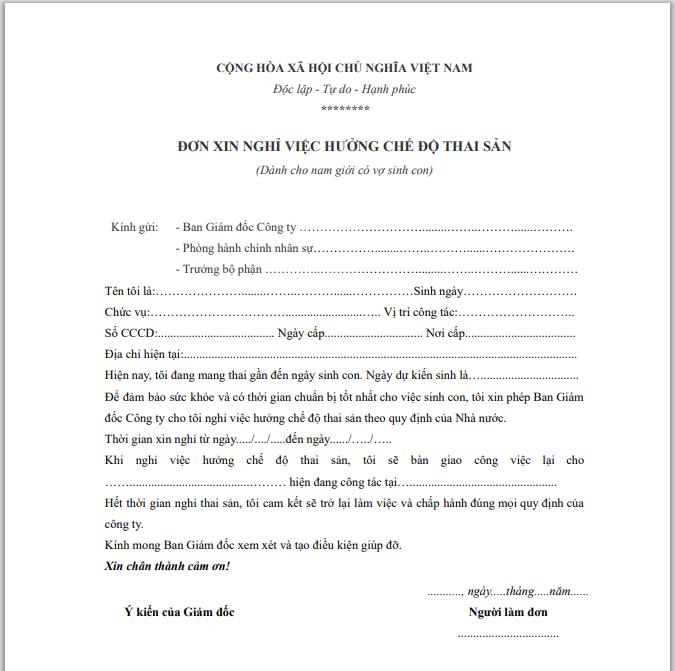
This is a special form for men who wish to take paternity leave to care for and raise their child after their wife gives birth. This form provides the man’s personal information, information about his wife and child, the expected leave period, and related requests.
Download link: [1OFFICE] Paternity Leave Application Form for Men
2.7. Maternity Leave Application for Teachers and Public Officials
The purpose of the maternity leave application for teachers and public officials is to notify and request maternity leave in accordance with the provisions of the Law on Social Insurance and related regulations.
Download link: [1OFFICE] Maternity Leave Application for Teachers and Public Officials.doc

3. Checklist of Documents to Prepare with Your Maternity Leave Application
To ensure a swift approval process for maternity leave and to secure benefits according to the Law on Social Insurance, employees need to prepare a complete set of documents. A standard maternity leave application file typically includes the following papers:
3.1 Maternity Leave Application Form
The maternity leave application form is the most crucial document, expressing the employee’s wishes and leave duration. The form must clearly state the start date of the leave, the expected return-to-work date, and information about the person to whom work will be handed over (if any). This document must be signed by the employee and approved by their direct manager or the HR department to ensure its legality.
3.2 Child’s Birth Certificate or Certificate of Live Birth
The child’s certificate of live birth or birth certificate is an essential document for the application. The certificate of live birth, issued by the hospital, is often used if the birth certificate has not yet been processed. Once the procedure is complete, a notarized copy of the birth certificate will be added. This serves as the legal basis for the company and the Social Insurance agency to process maternity benefits for the employee.
The Social Insurance (SI) book or a data extract from the SI agency is also a necessary document. This document proves the duration of insurance contributions, ensuring the employee meets the minimum requirement of contributing for at least 6 months within the 12 months prior to childbirth to be eligible for maternity benefits.
3.4 Copy of Personal Identification (ID Card/Citizen ID)
Additionally, a copy of personal identification (ID Card/Citizen ID) must be submitted for the competent authority to verify and authenticate personal information. Employees should use a notarized copy to avoid errors or missing information when submitting the file to the Social Insurance agency.
3.5 Other documents (case-by-case)
Depending on the specific case, other documents may be required. For example, if the child passes away after birth, the employee must submit a death certificate. If a male employee applies for paternity leave benefits, a birth certificate or a copy of the child’s birth registration and a marriage certificate are required. In the case of a C-section or if the mother has related medical conditions, a hospital discharge paper or a medical certificate from a healthcare facility is needed to complete the application.
 Checklist of documents for a maternity leave application
4. Common mistakes when writing and submitting a maternity leave application
Submitting the application too close to the leave date
One of the most common mistakes when applying for maternity leave is submitting the application too close to the leave date. This makes it difficult for the HR department to process the paperwork and leaves the company with insufficient time to arrange for a replacement or reallocate tasks. In some cases, a late submission can even delay the employee’s maternity benefits from the Social Insurance agency. Therefore, employees should prepare their maternity leave application and related documents early, typically at least 15–30 days before the leave date, to ensure all procedures go smoothly.
Missing signatures or attached documents
This mistake often occurs because employees are not fully aware of the required documents for a maternity leave application. Some applications lack the employee’s or manager’s signature, rendering the application invalid. Additionally, if important documents like the birth certificate, social insurance book, or a copy of the ID card are not fully attached, the Social Insurance agency will refuse to process the benefits. To avoid this, employees should create a checklist before submitting their application and consult with the HR department for detailed guidance.
No work handover plan
Another commonly overlooked mistake is not creating a work handover plan before going on maternity leave. This can easily disrupt operations, affect project timelines, and increase the workload for colleagues. A lack of handover can also impact the employee’s own reputation and professional evaluation. Therefore, before taking leave, employees need a specific plan: list their current responsibilities, their completion status, relevant contacts, and hand them over to their replacement. This not only ensures work continuity but also demonstrates the employee’s sense of responsibility and professionalism
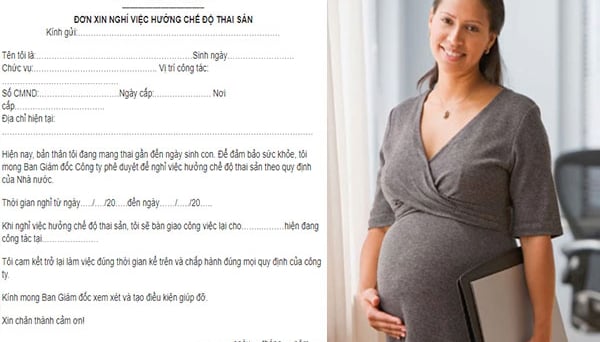 Common mistakes when writing a maternity leave application
5. Answering common questions about maternity leave benefits for employees
Are male employees entitled to paternity leave benefits?
Male employees who are contributing to social insurance and whose wives have given birth are entitled to paternity leave benefits as stipulated in Article 31 of the 2014 Law on Social Insurance. The leave duration depends on the condition of the mother and baby and is calculated within the first 30 days from the date of birth. Specifically:
- 05 working days
- 07 working days if the wife undergoes a C-section or gives birth prematurely (before 32 weeks);
- 10 working days for the birth of twins, with an additional 03 working days for each subsequent child in a multiple birth;
- 14 working days if the wife gives birth to twins or more and requires a C-section.
If I give birth after contributing to social insurance for 6 months, am I eligible for maternity benefits?
According to Clause 2, Article 31 of the 2014 Law on Social Insurance, an employee who has contributed to social insurance for 6 months or more within the 12 months prior to childbirth is eligible for maternity benefits. Additionally, the regulation regarding the 12-month period before childbirth or adoption is specified in Clause 1, Article 9 of Circular No. 59/2015/TT-BLDTBXH.
If I contributed to social insurance at two different companies, am I still eligible for maternity benefits?
If an employee has worked and left multiple companies but still meets the requirement of contributing to social insurance for 6 months or more within the 12 months prior to childbirth (in a normal case), they are still entitled to maternity benefits.
Can I receive unemployment insurance benefits during my maternity leave?
If an employee resigns immediately after their maternity leave ends, they can still receive unemployment insurance benefits, provided they meet the conditions stipulated by the law on unemployment insurance.
How is the maternity benefit amount determined?
Pursuant to Article 39 of the 2014 Law on Social Insurance, an employee is entitled to a monthly allowance equal to 100% of the average monthly salary on which social insurance contributions were based for the 06 months preceding the leave.
If the employee has contributed to social insurance for less than 06 months, the maternity benefit amount, as stipulated in Article 32, Article 33, Clauses 2, 4, 5, and 6 of Article 34, and Article 37, will be the average monthly salary of the months for which contributions were made. Additionally, the maternity benefit amount may vary based on the employment contract and legal regulations.
6. Conclusion
Above is all the information 1Office has compiled about maternity and paternity leave applications for both men and women in all fields and industries. We hope that the provided leave application templates for employees have given HR departments more information to manage personnel most effectively.
Additionally, the 1Office request management feature module provides a library of professional request templates and a fully automated approval process that syncs with payroll data. This helps businesses manage and process requests more efficiently, saving time and improving work productivity.
Get a demo of the 1Office request management feature
So, if your business needs a request management tool to effectively solve this issue, please contact us via Hotline: 083 483 8888 for a consultation and a free software trial.
















