09/05/2026
  198 views
Are you looking for a Memorandum of Understanding (MOU) template for business collaborations, investment projects, or M&A? In this article, 1Office will compile over 8 standard MOU templates, complete with drafting instructions, legal notes, and direct download files, to help you quickly create a proper, professional document and minimize the risk of disputes.
Mục lục
- 1. What is a Memorandum of Understanding (MOU)?
- 2. Comparing a Memorandum of Understanding with other legal documents
- 3. Hướng dẫn soạn thảo biên bản ghi nhớ chuẩn xác và hiệu quả
- 4. Các mẫu biên bản ghi nhớ phổ biến (Kèm File tải xuống)
- 4.1. Mẫu Biên bản ghi nhớ chung (General MOU)
- 4.2. Mẫu Biên bản ghi nhớ hợp tác kinh doanh/đầu tư
- 4.3. Mẫu Biên bản ghi nhớ làm việc
- 4.4. Mẫu Biên bản ghi nhớ dự án/chương trình
- 4.5. Memorandum of Understanding Template for Education/Research
- 4.6. Memorandum of Understanding Template with Government Agencies/Non-Profit Organizations
- 4.7. Memorandum of Understanding Template for Deposits/Reservations (if not using a Deposit Agreement)
- 4.8. International Memorandum of Understanding Template (Bilateral/Multilateral)
- 5. Real-life Scenarios for Using an MOU
- 6. Frequently Asked Questions about Memorandums of Understanding (FAQs)
1. What is a Memorandum of Understanding (MOU)?
A Memorandum of Understanding (MOU) is a written agreement established between two or more parties to record an initial consensus on the principles, direction, or intent to cooperate in a specific field or project. In the legal and practical context of Vietnam, an MOU is often used in the pre-contract stage, when the parties have reached a certain level of agreement but have not yet signed a formal contract.
An MOU demonstrates the goodwill and meeting of minds of the parties, while also outlining the basic principles for future cooperation. In essence, it is a directional agreement that records the initial negotiation results and is generally not intended to create legally binding obligations for the entire content, unlike a complete civil or commercial contract.
In practice, an MOU is also known by other names, including:
- Memorandum of Cooperation
- Memorandum of Agreement
- Letter of Understanding
In Vietnam, an MOU is often distinguished from other pre-contractual documents such as:
- MOU (Memorandum of Understanding): Records the preliminary agreement and goodwill to cooperate between parties, serving as a general guideline, commonly used in business collaborations, projects, or strategies.
- LOI (Letter of Intent): Expresses one party’s intention to cooperate, invest, or purchase, with a narrower scope and more of a declaration of desire.
- Term Sheet: Summarizes the core terms, especially economic and control provisions, serving as the basis for drafting a formal contract.
MOUs, LOIs, and Term Sheets are generally not legally binding, unless there is a specific agreement on certain clauses. In practice in Vietnam, MOUs and Term Sheets are more commonly used, especially in cooperation, investment, and M&A transactions.

1.1. Purpose and importance of an MOU in transactions
An MOU is considered a crucial first step in the process of business cooperation, investment, or project implementation (especially in transactions with international elements) in Vietnam. This document is typically used for the following main purposes:
- To record initial intent and goodwill to cooperate: An MOU demonstrates a preliminary agreement between the parties, helping to “frame” the initial commitment without delving into the complex legal bindings of a formal contract.
- To create a basis for future contract negotiations and signing: The contents of an MOU serve as a reference framework, helping the parties develop it into a binding contract, reducing misunderstandings, and saving negotiation time in subsequent stages.
- To establish general principles and direction for cooperation: An MOU outlines the cooperation objectives, scope of work, preliminary responsibilities, and implementation direction, thereby creating clarity from the very beginning.
- To enhance trust and mutual understanding: In the context of Vietnam’s business environment, which is influenced by cultural and legal differences (especially when working with foreign partners), an MOU helps build confidence and lays the foundation for a long-term cooperative relationship.
In summary, the core value of an MOU lies in its flexibility: it allows parties to “test” their intention to cooperate with low legal risk, while also creating momentum to move towards a formal agreement. In practice, many major deals and projects in Vietnam, especially in the investment sector, often begin with a well-drafted MOU.
1.2. Legal characteristics of a Memorandum of Understanding
Under current Vietnamese law, specifically the 2015 Civil Code, there are no specific provisions that directly regulate Memorandums of Understanding (MOUs). Therefore, the legal validity of an MOU is determined based on the content of the agreement and the true intentions of the parties at the time of signing, as reflected in the following characteristics:
In principle, an MOU is not legally binding with respect to the main cooperation commitments: Most MOUs only express the direction and intention to cooperate and do not give rise to mandatory civil obligations like a contract under Article 385 of the 2015 Civil Code. The parties can terminate negotiations or withdraw without compensation, unless otherwise agreed in the MOU.
Some clauses within an MOU can have separate binding effect: In practice, many MOUs explicitly include “binding” clauses, which often cover:
- Confidentiality clause (NDA – Non-Disclosure Agreement);
- Exclusivity or no-shop clause (restricting negotiations with third parties);
- Governing law and dispute resolution clause (court or arbitration);
- Agreements on costs, deposits, or financial obligations arising during the pre-contract stage.
These clauses can be recognized as valid by a court or arbitrator if they are clearly drafted and express the parties’ intention to be bound.
Possibility of an MOU being considered a contract in some cases: If all or part of the MOU’s content fully meets the conditions for a valid civil transaction under Article 117 of the 2015 Civil Code (capable parties, voluntariness, lawful purpose and content), then the MOU or the relevant part may be considered a contract and give rise to corresponding legal obligations.
Evidentiary value in dispute resolution: Although not a fully binding contract, an MOU is still considered legal evidence under the provisions of the Civil Procedure Code. This document can be used to prove the negotiation process, goodwill, breach of good faith obligations, or as a basis for claiming actual damages if fault and loss can be proven.
In summary, an MOU is a flexible legal tool with high directional and symbolic value in practice in Vietnam. However, to mitigate risks and protect their interests, parties must be particularly careful in clearly defining which clauses are (or are not) binding from the drafting stage.
2. Comparing a Memorandum of Understanding with other legal documents
Below is a comparison table to help you distinguish an MOU from related legal documents such as a formal contract, a memorandum of agreement, and a protocol:
2.1. MOU vs. Formal Contract
A Memorandum of Understanding (MOU) and a formal contract are two common types of documents in business negotiations and cooperation, but they have clear differences in nature and legal value under Vietnamese law, primarily based on the 2015 Civil Code and practical application.
Key differences between an MOU and a Formal Contract:
| Criteria | MOU (Memorandum of Understanding) | Formal Contract |
| Legal Validity | Usually not fully legally binding, primarily expressing agreement in principle and goodwill for cooperation. It is only binding if the content meets all the elements of a contract. | Fully legally binding, protected by law, and can be enforced by a court or arbitration. |
| Level of Detail | Concise, outlining general principles, cooperation objectives, and preliminary responsibilities; does not go into details such as pricing, payment terms, or termination conditions. | Detailed, with complete clauses on rights, obligations, penalties for breach, and dispute resolution, ensuring transparency in execution. |
| Binding Commitment | Represents a moral and reputable commitment, not mandatory to execute, except for certain binding clauses (e.g., confidentiality). | Creates clear legal obligations that parties must strictly adhere to; breaches will be handled according to the law. |
| Consequences of Breach | Mainly affects reputation, can be used as indirect evidence in disputes; it is difficult to claim compensation without binding clauses. | A breach leads to compensation for damages, contractual penalties, contract termination, and may even result in litigation in court or arbitration. |
When to use an MOU and when to move to a Contract
- Use an MOU: Suitable for the initial negotiation stage, when parties wish to record goodwill and outline a cooperation framework without being ready for detailed commitments. Examples include research collaborations, preliminary investment projects, strategic partnerships, and complex or multi-party agreements requiring flexible negotiation.
- Switch to a Contract: When the parties have agreed on the details and need a legally binding agreement to protect their interests. Examples include sales of high-value goods or services and asset transfers. A formal contract officializes commitments, reduces the risk of disputes, and ensures enforceability.
2.2. MOU vs. Memorandum of Agreement
In Vietnamese practice, MOUs and memorandums of agreement are often confused because both are documents that record the consensus between parties.
Similarities between an MOU and a Memorandum of Agreement:
- Stage of use: Typically drafted before a formal contract is signed.
- Nature: Principle-based, expresses goodwill for cooperation, and can serve as evidence in a dispute if it meets legal requirements.
- Form: Notarization/authentication is not required (unless it involves special assets).
- Scope of application: Widely used in business, investment, and civil cooperation.
Differences between an MOU and a Memorandum of Agreement:
| Criteria | MOU (Memorandum of Understanding) | Memorandum of Agreement |
| Nature and Origin | Originates from international practice, is formal in nature, and is often used in international transactions or major collaborations between businesses/organizations. | Common in domestic transactions in Vietnam, simpler, often called a “cooperation agreement minutes” or “agreement in principle”. |
| Binding Level | Usually not legally binding, or only partially so (e.g., confidentiality clauses). Primarily expresses the intention to cooperate. | Can be more binding if the content clearly meets the elements of a contract (e.g., profit sharing, capital contribution). |
| Content and Application | Often used for strategic partnerships, long-term projects, international relations, or foreign investment. | More flexible, used for specific issues such as debt settlement, temporary agreements, and small-scale business collaborations. |
| Practical Application | Common in foreign investment, technology transfer, and strategic partnerships. | Often appears in civil relations and domestic business, for example: termination of employment contracts, asset division, and small commercial collaborations. |
Tóm lại, trong hệ thống thực tiễn pháp lý Việt Nam, Biên bản thỏa thuận thường có mức độ cam kết và ràng buộc “tiệm cận” hợp đồng hơn so với MOU.
2.3. MOU và Nghị định thư (Protocol) (nếu có liên quan trong các giao dịch quốc tế)
Trong bối cảnh giao dịch quốc tế, MOU và Nghị định thư (Protocol) đều là công cụ để ghi nhận hợp tác, nhưng có bản chất và vai trò khác nhau:
- MOU (Memorandum of Understanding): Là biên bản ghi nhớ, thể hiện sự đồng thuận nguyên tắc giữa các bên (quốc gia, tổ chức, doanh nghiệp). Thường không ràng buộc pháp lý, dùng để phác thảo phạm vi hợp tác sơ bộ, ví dụ: MOU hợp tác giáo dục giữa hai nước.
- Nghị định thư (Protocol): Là văn bản bổ sung hoặc sửa đổi một hiệp ước/hợp đồng hiện có. Thường có tính ràng buộc pháp lý cao hơn, ghi nhận các thỏa thuận chi tiết hoặc điều chỉnh cam kết hiện có, ví dụ: Protocol Kyoto bổ sung Công ước Khung về Biến đổi Khí hậu.
MOU thường là bước đầu, linh hoạt, phù hợp hợp tác sơ bộ. Protocol mang tính chính thức hơn, ràng buộc và dùng để cụ thể hóa hoặc điều chỉnh các cam kết quốc tế. Tại Việt Nam, MOU phổ biến ở cấp doanh nghiệp hoặc hợp tác sơ bộ giữa các quốc gia, trong khi Protocol thường xuất hiện trong ngoại giao chính thức, giúp tăng mức độ cam kết pháp lý mà không cần ký hiệp ước mới.

3. Hướng dẫn soạn thảo biên bản ghi nhớ chuẩn xác và hiệu quả
Dưới đây là hướng dẫn từng bước để soạn thảo MOU đúng chuẩn, đảm bảo đầy đủ nội dung, tránh rủi ro pháp lý và tăng tính hiệu quả:
3.1. Cấu trúc và Nội dung cần có của một MOU
Một MOU theo thực tiễn Việt Nam thường được xây dựng theo cấu trúc văn bản hành chính hoặc doanh nghiệp, bao gồm các phần chính sau:
(1) Phần mở đầu:
- Quốc hiệu: “CỘNG HÒA XÃ HỘI CHỦ NGHĨA VIỆT NAM”
- Tiêu ngữ: “Độc lập – Tự do – Hạnh phúc”
- Tên biên bản: “BIÊN BẢN GHI NHỚ” hoặc “BIÊN BẢN GHI NHỚ HỢP TÁC” (có thể thêm lĩnh vực cụ thể, ví dụ: “Về hợp tác kinh doanh”)
- Số hiệu: Số/…/BBGN (nếu cần)
- Địa điểm và thời gian: Ví dụ: “Hà Nội, ngày … tháng … năm …”
(2) Thông tin các bên tham gia:
- Tên tổ chức/cá nhân, địa chỉ, mã số thuế (nếu là doanh nghiệp), số điện thoại liên lạc.
- Người đại diện: Họ tên, chức vụ, căn cứ ủy quyền (nếu có).
(3) Căn cứ pháp lý (tùy chọn): Nêu các quy định pháp luật liên quan để tăng tính chính danh, ví dụ: Bộ luật Dân sự 2015, Luật Doanh nghiệp 2020.
(4) Mục đích ghi nhớ: Lý do và mục tiêu hợp tác: Mô tả rõ lý do, mục tiêu chung mà các bên mong muốn đạt được (ví dụ: phát triển dự án, chia sẻ công nghệ, mở rộng thị trường).
(5) Nội dung hợp tác / Điều khoản ghi nhớ:
- Phạm vi và lĩnh vực hợp tác: Xác định lĩnh vực cụ thể (ví dụ: nghiên cứu, sản xuất, phân phối).
- Trách nhiệm và quyền lợi của các bên: Liệt kê nghĩa vụ (cung cấp thông tin, hỗ trợ nhân sự) và quyền lợi (chia sẻ lợi nhuận, sử dụng tài sản trí tuệ).
- Kế hoạch thực hiện dự kiến: Lộ trình, các giai đoạn thực hiện (nếu có).
- Điều kiện tiên quyết: Các điều kiện cần hoàn tất trước khi ký hợp đồng chính thức (ví dụ: thẩm định, phê duyệt cơ quan nhà nước).
- Các điều khoản đặc biệt: Bảo mật thông tin (NDA), độc quyền đàm phán, quyền sở hữu trí tuệ (IP).
(6) Thời hạn và hiệu lực: Thời điểm bắt đầu (thường từ ngày ký), thời hạn hiệu lực (ví dụ: 1-5 năm), điều kiện gia hạn hoặc chấm dứt sớm (thông báo trước 30-90 ngày).
(7) Giải quyết tranh chấp: Ưu tiên thương lượng hòa bình, hòa giải; nếu không thành công thì trọng tài (ví dụ: VIAC) hoặc tòa án có thẩm quyền.
(8) Điều khoản chung và thi hành:
- Luật áp dụng: Pháp luật Việt Nam.
- Ngôn ngữ: Tiếng Việt (hoặc song ngữ nếu có bên nước ngoài).
- Số bản: Lập thành … bản có giá trị pháp lý ngang nhau, mỗi bên giữ … bản.
(9) Chữ ký và xác nhận của các bên: Họ tên, chức vụ, chữ ký và đóng dấu (nếu là tổ chức).
3.2. Lưu ý quan trọng khi soạn thảo và ký kết MOU
Để MOU đạt hiệu quả và hạn chế rủi ro, cần chú ý:
- Rõ ràng và cụ thể: Dùng ngôn ngữ chính xác, tránh mơ hồ. Ví dụ, thay vì viết “hợp tác phù hợp”, hãy ghi “hợp tác trong lĩnh vực sản xuất sản phẩm X với tỷ lệ chia sẻ 50:50” để tránh tranh chấp.
- Xác định tư cách pháp lý và thẩm quyền ký kết: Đảm bảo người ký MOU có quyền đại diện hợp pháp (Giám đốc hoặc người được ủy quyền).
- Tuân thủ pháp luật: Nội dung không được trái Bộ luật Dân sự, Luật Đầu tư, Luật Cạnh tranh hoặc các quy định chuyên ngành.
- Phân biệt điều khoản ràng buộc và không ràng buộc: MOU thường mang tính thiện chí, nhưng có thể quy định một số điều khoản ràng buộc như bảo mật hay độc quyền đàm phán để tăng giá trị pháp lý.
- Điều khoản bảo mật và độc quyền đàm phán: Bảo vệ thông tin nhạy cảm và ngăn các bên đàm phán với đối thủ trong thời gian nhất định.
- Rà soát kỹ trước khi ký: Tham khảo luật sư, trao đổi và chỉnh sửa nhiều lần để tránh sai sót, giữ phiên bản dự thảo tham khảo giữa các bên.
3.3. Quy trình thực hiện MOU
Quy trình soạn thảo và thực hiện MOU thường gồm các bước sau, nhằm đảm bảo chuyên nghiệp và hiệu quả:
- Bước 1 – Đàm phán sơ bộ: Các bên trao đổi mục tiêu, phạm vi hợp tác và xác định thiện chí, đồng thời nêu các vấn đề chính cần giải quyết.
- Bước 2 – Soạn thảo MOU: Bên khởi xướng chuẩn bị dự thảo dựa trên kết quả đàm phán, gửi cho các bên khác để góp ý.
- Bước 3 – Rà soát và chỉnh sửa: Trao đổi, điều chỉnh nhiều lần (qua email hoặc họp trực tiếp) để đạt được thống nhất cuối cùng; tham khảo ý kiến pháp lý khi cần.
- Bước 4 – Ký kết: Tổ chức lễ ký chính thức hoặc ký điện tử, trao bản chính thức cho các bên.
- Bước 5 – Thực hiện và theo dõi: Thực hiện các cam kết trong MOU, tiến tới đàm phán hợp đồng chính thức chi tiết hơn, đồng thời đánh giá định kỳ hiệu quả hợp tác để điều chỉnh hoặc gia hạn.
Hướng dẫn soạn thảo biên bản ghi nhớ chuẩn xác và hiệu quả
4. Các mẫu biên bản ghi nhớ phổ biến (Kèm File tải xuống)
Dưới đây là tổng hợp các mẫu MOU phổ biến, sẵn sàng tải về và áp dụng cho các loại hình hợp tác khác nhau:
4.1. Mẫu Biên bản ghi nhớ chung (General MOU)
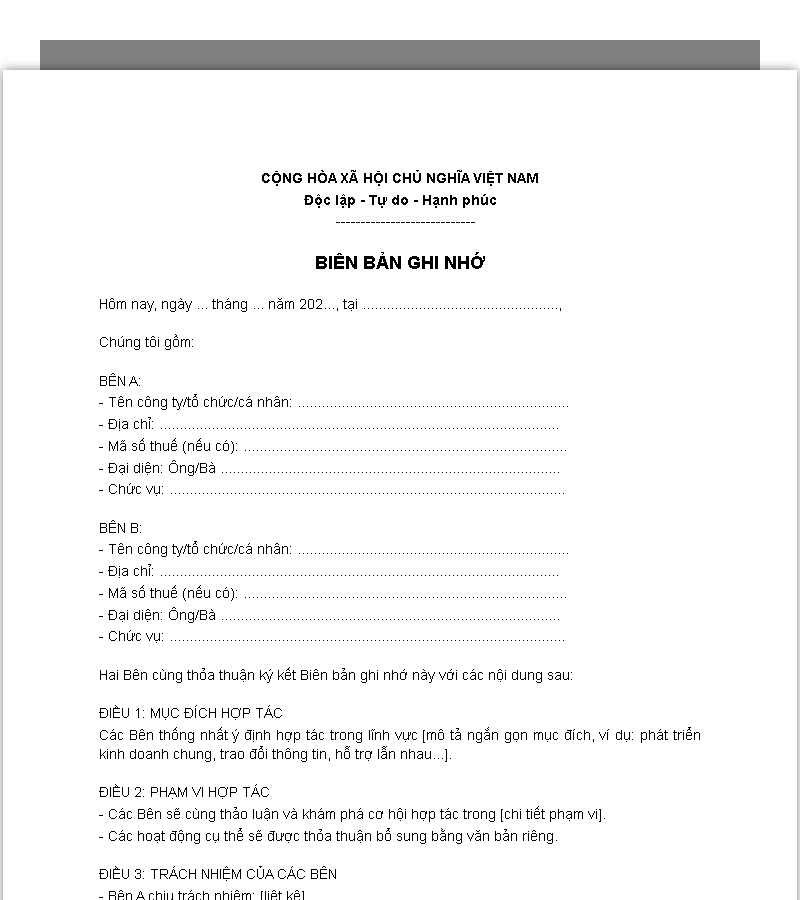
Mẫu này phù hợp cho các thỏa thuận sơ bộ, không quá phức tạp giữa các doanh nghiệp, tổ chức hoặc cá nhân. Nội dung chính thường bao gồm phần giới thiệu các bên tham gia, mục đích hợp tác, phạm vi hoạt động, thời hạn thực hiện và các điều khoản chung. Đây là bước khởi đầu để các bên xác lập cơ sở thiện chí trước khi tiến tới các hợp đồng chi tiết hơn.
>>> Tải ngay Mẫu biên bản ghi nhớ chung
4.2. Mẫu Biên bản ghi nhớ hợp tác kinh doanh/đầu tư
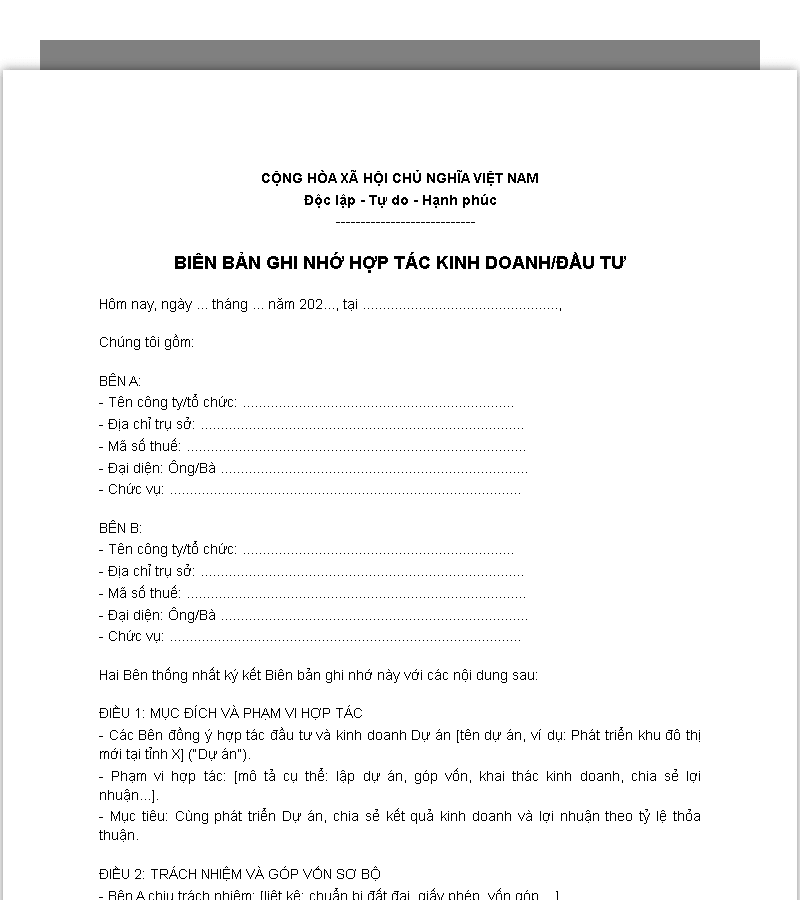
Mẫu này dùng cho các liên doanh, hợp tác phát triển dự án, góp vốn hoặc đầu tư chung. Biên bản ghi nhận mục tiêu của dự án, cách thức phân chia lợi ích, trách nhiệm của các bên và quyền lợi độc quyền tạm thời. Đây là công cụ giúp các bên thống nhất các nguyên tắc hợp tác trước khi ký kết thỏa thuận chính thức.
>>> Tải ngay Mẫu Biên bản ghi nhớ hợp tác kinh doanh/đầu tư
4.3. Mẫu Biên bản ghi nhớ làm việc
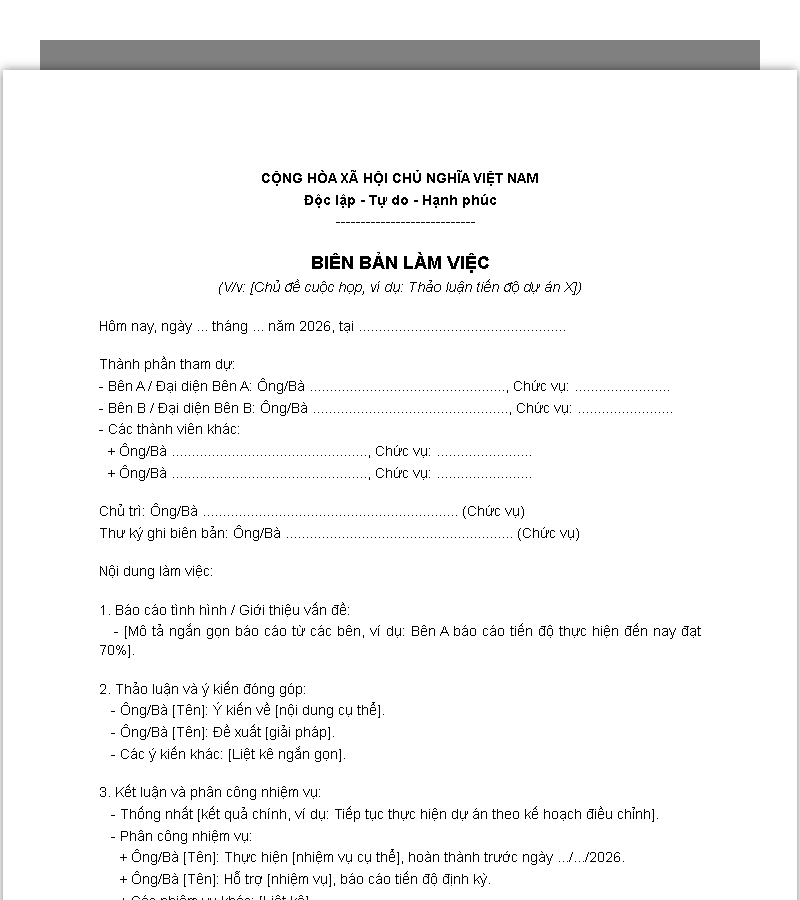
Biên bản này được sử dụng để ghi nhận kết quả các cuộc họp, phân công nhiệm vụ hoặc các cam kết nội bộ giữa các phòng ban hoặc nhóm dự án. Nội dung chính bao gồm thành phần tham dự, các vấn đề đã thảo luận, quyết định được đưa ra và phân công nhiệm vụ cụ thể cho từng cá nhân hoặc bộ phận.
>>> Tải ngay Mẫu Biên bản ghi nhớ làm việc
4.4. Mẫu Biên bản ghi nhớ dự án/chương trình
This template is suitable for specific projects such as construction, product development, or social programs. The memorandum clearly describes the project, the roles of each party, contributed resources, and the implementation timeline. This serves as a basis to ensure all parties clearly understand their responsibilities and commitments in the project.
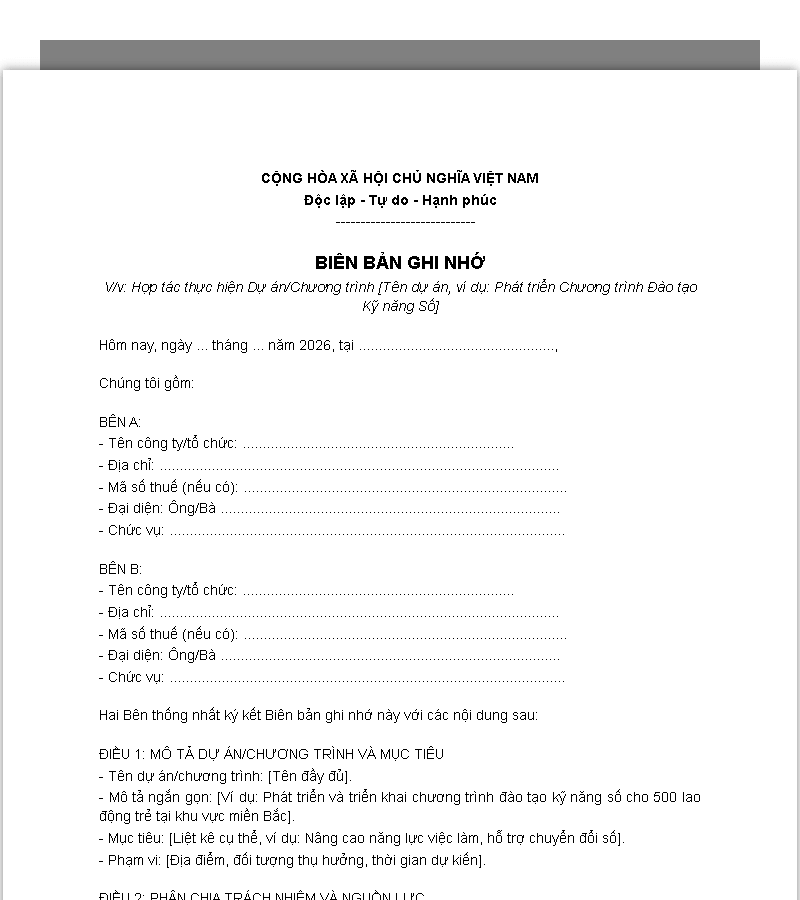
>>> Download the Project/Program Memorandum of Understanding Template now
4.5. Memorandum of Understanding Template for Education/Research
This template is used for collaborations between schools, research institutes, or for student/faculty exchange programs, joint research, or skills training. The main content includes exchange programs, scientific research, skills training, and recruitment priority, helping parties coordinate effectively in educational and research activities.
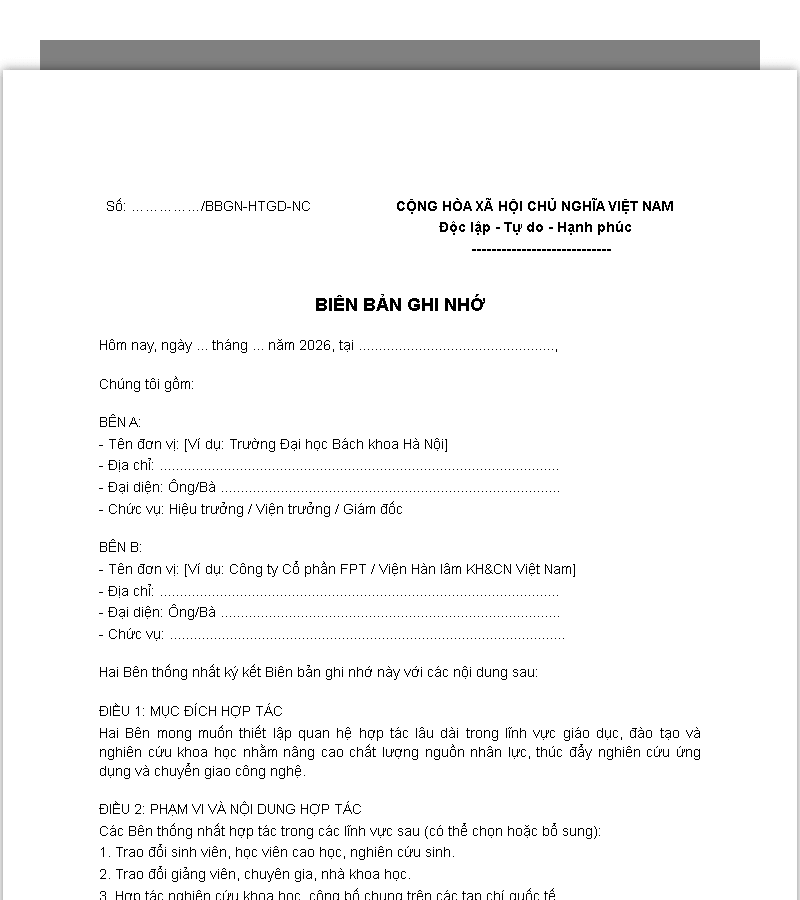
>>> Download the Memorandum of Understanding Template for Education/Research now
4.6. Memorandum of Understanding Template with Government Agencies/Non-Profit Organizations
This is a template for collaborations with government agencies, non-governmental organizations, or for supporting social projects and sponsorships. The memorandum’s content records public interest cooperation goals, reporting responsibilities, and legal compliance, ensuring transparent, legally-grounded collaboration aimed at the common good.
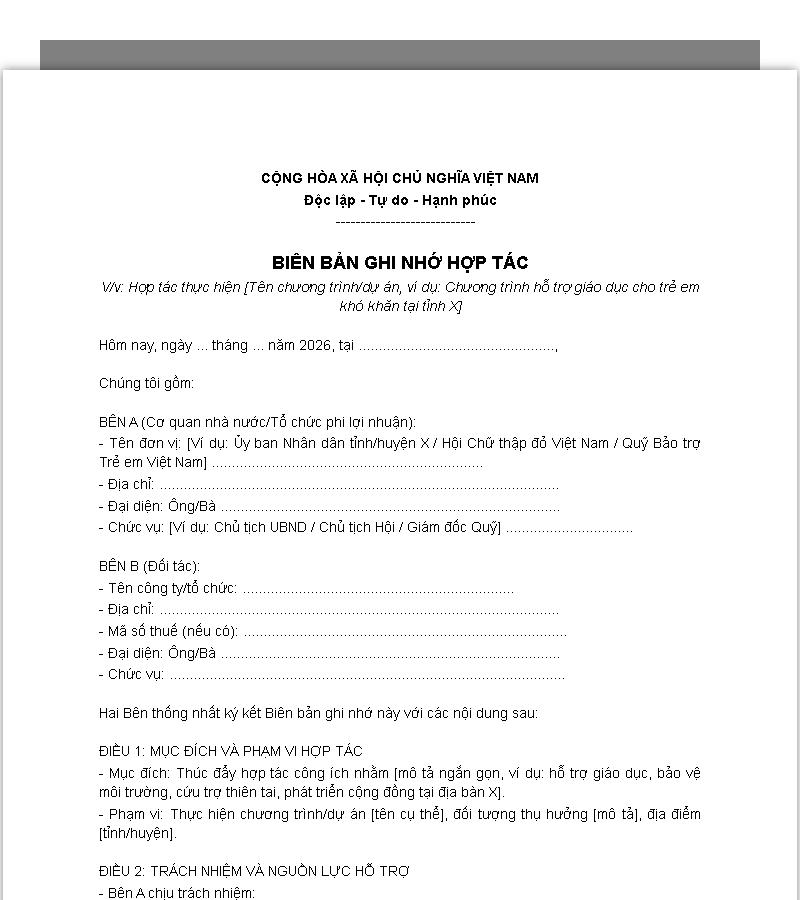
4.7. Memorandum of Understanding Template for Deposits/Reservations (if not using a Deposit Agreement)
Applicable for recording a preliminary deposit for transactions involving the sale of assets or projects like real estate or large goods, in place of a formal deposit agreement. The main content includes the deposit amount, conditions for refund or penalty, and the deadline for signing the official contract, helping to secure the rights and responsibilities of all parties.
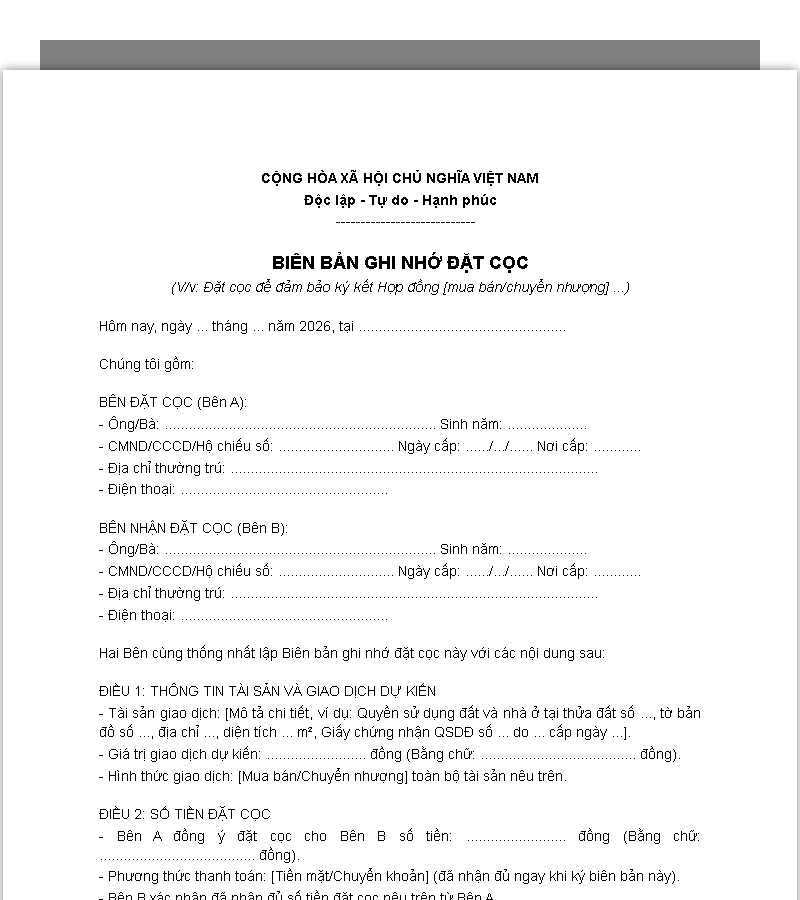
4.8. International Memorandum of Understanding Template (Bilateral/Multilateral)
Used for international collaborations with bilingual language (Vietnamese – English). The content typically includes a bilingual version, confidentiality clauses, and applicable law (Vietnamese or international), helping to ensure legality and transparency in cross-border cooperation.
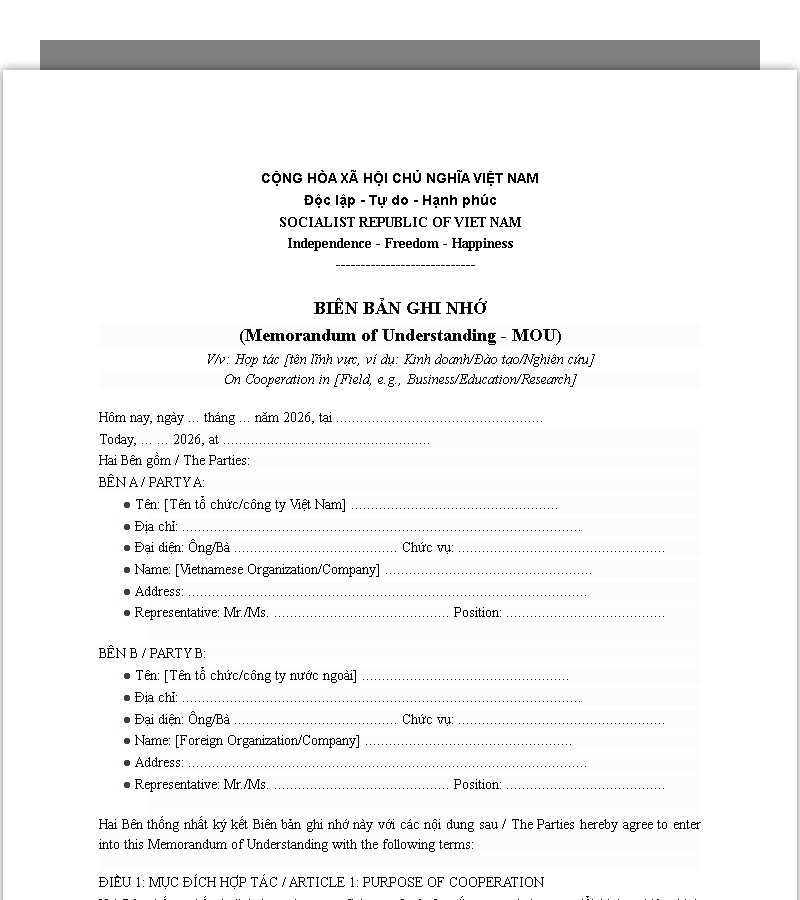
>>> Download the International Memorandum of Understanding Template (Bilateral/Multilateral) now
Image of the International Memorandum of Understanding Template (Bilateral/Multilateral)
| Note on Usage: The templates above are for reference only. Please adjust them to fit your specific situation and consider consulting a lawyer to ensure legal validity, especially for high-value agreements. Although a memorandum of understanding is generally not strongly binding, certain clauses such as confidentiality or exclusivity may still be legally enforceable. |
5. Real-life Scenarios for Using an MOU
Below are real-life examples of when to use an MOU and how to handle common issues and disputes during collaboration:
5.1. Expiration of the Memorandum of Understanding
A Memorandum of Understanding (MOU) typically expires in the following cases, depending on the specific agreement between the parties:
- Expiration of term: An MOU usually has a defined term (e.g., 1-5 years from the signing date) or automatically expires if a formal contract is not signed within the agreed negotiation period.
- Signing a formal contract: When the parties sign a detailed replacement contract, the MOU usually terminates immediately or expires.
- Termination notice: One party sends a written notice to the other; the termination effective date is usually specified in advance (e.g., 30-90 days from the date of receipt of the notice).
- Other events: One party goes bankrupt, the project is canceled, or the parties agree to an early termination. In this case, ongoing activities may be protected if the MOU contains relevant clauses.
Note: It is advisable to clearly define the termination clause from the beginning to reduce the risk of disputes and protect the interests of all parties.
5.2. Consequences of a Party Failing to Comply with an MOU
An MOU is often not as legally binding as a formal contract, so the consequences of a breach will depend on whether it contains specific binding clauses:
- Non-binding MOU: If the MOU has no binding clauses, a party’s failure to perform usually only leads to a loss of trust and may cause negotiations to end, but it does not create liability for damages, unless the breach violates the principle of good faith under Article 3 of the 2015 Civil Code.
- MOU with binding clauses: If the MOU contains binding clauses such as confidentiality or exclusive negotiation, the breaching party may be required to compensate for actual damages, pay a penalty if stipulated in the MOU, and fulfill civil responsibilities under the 2015 Civil Code (Articles 419-429).
- Dispute resolution: In the event of a dispute, the parties can negotiate a resolution or use the MOU as evidence in court. However, because an MOU primarily records initial goodwill, it is difficult to claim significant compensation.
Recommendation: To increase the legal bindingness of important obligations, it is advisable to clearly specify penalties for breaches and compensation directly in the MOU.
5.3. How to Amend or Supplement a Signed MOU
Amending or supplementing an MOU must adhere to the principle of voluntariness and be done in writing.
- Written agreement: All changes must be mutually agreed upon and documented in a supplementary written instrument, which could be an addendum or an amendment, signed by the authorized representative of each party.
- Effectiveness: Amendments are only effective from the date specified by the parties in the supplementary document, which is typically the signing date.
- Content: Only the necessary parts are amended or supplemented; all other content of the original MOU remains unchanged.
In practice, MOU templates often place the amendment and supplement clause at the end of the document to limit future disputes.
5.4. Does an MOU Need to Be Notarized or Authenticated?
Under Vietnamese law (the 2015 Civil Code, the 2014 Law on Notarization), an MOU is an agreement of intent to cooperate, not a contract transferring ownership of assets like real estate, so it does not require notarization or authentication to be effective. The signatures of the parties (and a seal, if an organization) are sufficient for the MOU to be valid. However, parties may voluntarily choose to notarize or authenticate it to increase its evidentiary value, especially if the MOU involves assets that legally require notarization.
5.5. MOUs in M&A: Key Considerations
In mergers and acquisitions (M&A) transactions, an MOU (or LOI – Letter of Intent) is a crucial first step, often non-binding but still containing key provisions.
- Exclusive negotiation clause: Prohibits the seller from negotiating with a third party for a specified period, helping to reduce the risk of the deal being “stolen.”
- Confidentiality (NDA): Ensures that due diligence data is strictly protected, accompanied by penalties for breaches.
- Conditions precedent: Clearly defines the conditions for proceeding to a formal contract, such as completing due diligence and obtaining government approvals under the Law on Competition and the Law on Investment.
- Penalties and compensation: Stipulates consequences for breaches of exclusivity or confidentiality to protect the buyer who has invested in due diligence costs.
- Term and termination: Clearly states the negotiation period and the consequences if a formal contract is not signed.
- Legal risks: Compliance with regulations on competition, and transfer of shares/capital contributions under the 2020 Law on Enterprises and the 2018 Law on Competition.
In M&A, an MOU serves as a framework for negotiations, but it always requires careful review by a lawyer to mitigate post-M&A risks, including issues related to cultural integration and human resource management.

6. Frequently Asked Questions about Memorandums of Understanding (FAQs)
Is an MOU a contract?
No. An MOU (Memorandum of Understanding) is not a formal contract. It only records the initial intention to cooperate and is generally not as legally binding as a contract. However, if an MOU contains specific clauses like confidentiality or exclusive negotiation and meets the elements of a contract under Article 117 of the Civil Code, that part may be considered legally valid and used as evidence in a dispute. Therefore, it is advisable to clearly distinguish between “binding” and “non-binding” clauses in an MOU to avoid confusion.
How long is an MOU valid?
The validity period of an MOU is mutually agreed upon by the parties and stated in the document. It typically begins on the signing date and lasts for a specific period (e.g., 6-12 months) or until a formal contract is signed. An MOU can also be terminated upon notice by one party (usually after 3 months) or be automatically renewed if there are no objections. The term and termination conditions should be clearly defined to avoid disputes.
Can you sue based on an MOU?
Yes, but it depends on the content. If the MOU only expresses an intention to cooperate, it is difficult to demand performance, but you can still sue for a breach of good faith. If the MOU contains binding clauses (confidentiality, exclusivity), the breaching party may be required to compensate for actual damages. An MOU is always considered by the court as supporting evidence in a dispute.
Who should sign the MOU?
The person signing the MOU should be the legal representative of the participating party (Director, Chairman of the Board, or an individual). Otherwise, there must be a clear power of attorney. The signature, title, and seal (if an organization) ensure validity and help avoid disputes.
How many copies of the MOU should be made?
An MOU is usually prepared in 2 original copies, with each party keeping one. All copies have equal legal value. If there are multiple parties or bilingual versions, a corresponding number of copies should be made, and it is advisable to specify which version prevails in case of conflict.
Above is a compilation of 8+ standard Memorandum of Understanding (MOU) templates with downloadable files and detailed instructions. Using the correct template and clearly specifying binding and non-binding clauses will help protect your interests, enhance professionalism in collaborations, and create a favorable foundation for signing a formal contract later.