


Building effective employee performance evaluation criteria


Employees are one of the most important inputs for a business, and the quality of the workforce directly determines the company’s development. Therefore, performance evaluation is an indispensable task in any business. To better understand the criteria for evaluating employee performance, let’s explore with 1Office in the article below.
Mục lục
- I. What is performance evaluation?
- II. Why is it necessary to evaluate employee performance
- III. The performance evaluation process
- Step 1: Determine the basic requirements of the evaluation
- Step 2: Define the scope of the performance evaluation
- Step 3: Finalize documents to support the evaluation
- Step 4: Clearly define the stages and implementation steps
- Step 5: Select appropriate evaluation methods
- Step 6: Train managers on employee evaluation skills
- Step 7: Discuss the content & scope of the evaluation with the employee
- Step 8: Conduct the evaluation based on the established performance standards
- Step 9: Discuss the evaluation results with the employee
- Step 10: Set new goals and challenges for the employee
- IV. Essential factors in performance evaluation
- V. Common difficulties and solutions when building a work implementation process
I. What is performance evaluation?

Performance evaluation is a method that helps managers supervise and monitor whether employees are performing according to the requirements & goals set by the company. This makes it easier for managers to build plans for employees, departments, and the organization in the future.
II. Why is it necessary to evaluate employee performance
Many businesses have incurred significant waste by not evaluating employee performance effectively. Therefore, evaluation is very important because:
1. Helps employees become aware of their capabilities and strive for improvement
Having a specific performance evaluation system will produce transparent and clear results regarding an employee’s progress or shortcomings during their work. These results serve as evidence for employees to assess whether they have performed well, and whether they deserve the salary/bonus/penalty they receive. This is an important basis for employees to identify and overcome their weaknesses, creating opportunities for them to share and learn from senior management.
2. Increases employees’ ability to complete tasks
A performance evaluation form serves as a basis to motivate employees to complete assigned tasks and better understand their work capabilities by seeing and measuring their own progress. In addition, performance results provide a foundation for managers to easily identify bottlenecks in business operations, assist in allocating human resources, and ensure that overall work is completed on schedule and within the projected budget.
If you are struggling to find a solution to track employee work progress, explore with 1Office in the following article: Track work progress
3. Creates motivation at work
Depending on the specific industry and scale of each business, different tools and methods are applied to accurately evaluate employee performance. When the management department performs evaluations well and accurately grasps the performance capabilities of employees or departments, it helps employees clearly see ongoing activities, promptly detect mistakes, and motivates them to work more effectively.
4. Helps the business gain a comprehensive overview and evaluate employees better
During the employee evaluation process, the evaluator can apply various criteria but must always ensure objectivity. Therefore, establishing a systematic performance evaluation system is essential for a business.
An employee performance evaluation system is a tool that encourages managers to provide necessary and appropriate feedback to their departments and subordinates. This helps employees make timely adjustments in a direction that is most beneficial for themselves and for the overall goals of the company they work for.
III. The performance evaluation process
Step 1: Determine the basic requirements of the evaluation
Before starting the evaluation, you need to determine your objective. For example, is the evaluation intended to review for planning training and employee development, or is it to provide a basis for considering salary increases and bonuses? Different evaluation requirements will affect the subsequent steps of the process.
Only by defining clear and specific evaluation requirements can you conduct an accurate assessment that meets the set objectives. Proceeding with an evaluation without clear requirements is like fumbling in the dark without knowing your purpose or destination.
Step 2: Define the scope of the performance evaluation
Once the evaluation objective is determined, this step involves defining the scope and aspects of the assessment. Defining the scope helps ensure the evaluation results are accurate and objective, and also prevents unnecessary waste of resources.
Step 3: Finalize documents to support the evaluation
In practice, the following difficulties often occur during evaluations
– Unclear performance evaluation criteria
– Insufficient documentation for evaluation
Therefore, a complete set of evaluation documents will help make the assessment process fairer and more transparent.
Step 4: Clearly define the stages and implementation steps
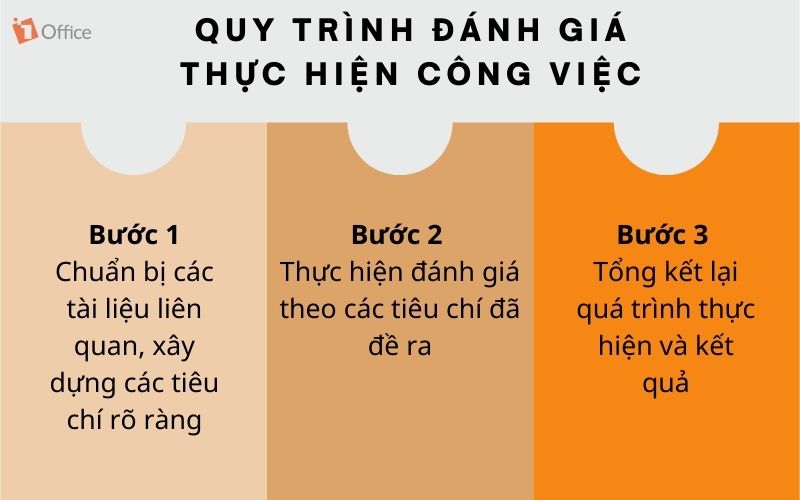
Typically, the evaluation process consists of the following 3 steps:
– Prepare relevant documents, establish clear criteria
– Conduct the evaluation based on the established criteria
– Summarize the implementation process and results
Step 5: Select appropriate evaluation methods
Depending on the specific nature of the business, evaluation methods may vary. We must choose the most suitable method for our company to ensure accurate, fair, and transparent results.
Currently, there are quite a few different evaluation methods that can be mentioned, such as
– Graphic rating scale method
– Checklist method
– Critical incident method
– Narrative method
– Behavioral rating method
See more: What is Kaizen? The most effective way to apply Kaizen in business
Step 6: Train managers on employee evaluation skills
Evaluating employee performance is not an easy task, so managers need to have a firm grasp of the skills and standards for employee evaluation. If managers are not carefully trained, subjective evaluations can easily occur during the process.
To conduct a proper and specific evaluation of an employee’s work process, managers should note a few details:
– Take a comprehensive and complete view of the employee’s work process
– Clearly understand the job objectives and the tasks the employee is responsible for before conducting the evaluation
– Conduct the employee evaluation in a spirit of respect and listening to opinions rather than imposing them
– Direct the evaluation towards the goal of optimizing work, enhancing productivity and employee capabilities, not for judging or criticizing the employee.
Step 7: Discuss the content & scope of the evaluation with the employee
It is difficult to accurately evaluate an employee’s work if the employee does not understand what content and scope you want to evaluate. Therefore, you should discuss and clarify the content and scope of the evaluation with the employee.
To achieve the desired results, you should discuss the following criteria with the employee beforehand:
– What is the purpose of this evaluation period
– What are the evaluation criteria
– What is the time frame for the evaluation scope
– Which group of employees will be evaluated
Step 8: Conduct the evaluation based on the established performance standards
After establishing the evaluation standards, you can apply these standard criteria to assess the employee’s level of job completion. Without suitable standard evaluation criteria, it is difficult to get specific results, which can easily lead to subjective, baseless evaluations.
Step 9: Discuss the evaluation results with the employee
Discussing the results with the employee not only informs them of the evaluation outcome but also serves to agree on and find directions and actions to address weaknesses and build on strengths in their current work.
Step 10: Set new goals and challenges for the employee
If an employee works towards the same goal year after year, they will not only fail to make any progress or strides in their current job, but in the long run, they will gradually become bored with their work.
This also makes it difficult for the company to make significant progress in the future without employees who are constantly creative, willing to accept challenges, and conquer new goals. Therefore, setting new goals and outcomes for employees is extremely necessary. This helps your business continuously optimize its resources to prepare for long-term development.
IV. Essential factors in performance evaluation
Employee performance evaluation may have different aspects in each business, customized to fit the specific characteristics of each company. However, regardless of the process you follow, it needs to meet factors such as:
– Clarity: A precise and appropriate process will help employees achieve better quality in their work.
– Process: The performance evaluation process must ensure that members of your company can coordinate smoothly and in the correct sequence.
– Control: The evaluation process should help managers control and assess the progress and quality of work. This means you need to compare the employee’s work results with the process’s evaluation criteria to clearly determine how the employee is performing.
During your work process, do you still encounter situations like being overloaded, frequently missing tasks, or being late on deadlines? You can learn how to allocate time reasonably to achieve the best results at: Work Scheduling Software
V. Common difficulties and solutions when building a work implementation process
In reality, implementing performance evaluations in many businesses is not easy. You may encounter some difficulties such as:
1. Fear of building a time-consuming process

Employees may fear that building an evaluation process will be time-consuming. They believe that departments/divisions and individuals can communicate directly with each other to resolve issues. In reality, the performance evaluation process plays a very important role for the business. Building the process can be difficult because it will initially take a lot of time to develop and apply it to the business.
2. The process is not up-to-date
During the evaluation development process, your employees may worry that the process is not up-to-date. As a result, employees’ work will fall into a rut.
3. Ineffective performance evaluation process
Your company’s evaluation process may also fail to produce significant, clear results due to a rudimentary documentation system, a lack of reflection of reality, and few forms. Therefore, the resulting evaluations are difficult to measure and do not accurately reflect the employee’s performance.
Performance evaluation helps both managers and employees understand whether work is proceeding according to requirements and achieving effectiveness. Therefore, an ineffective evaluation process can put pressure on your employees. Conversely, implementing a correct and suitable evaluation process can free managers from handling daily incidents, helping employees be more proactive and effective in their work.
If you need more information or advice on solutions for managing and evaluating work, you can contact 1Office. The team of experts at 1Office is always ready to accompany you in improving the overall work efficiency of your business.
For more detailed information, please visit:
Fanpage: https://www.facebook.com/1officevn/
Youtube: https://www.youtube.com/channel/UCeTIRNqxaTwk0_kcTw6SxmA




