


 10/05/2026
  10953 views
An employee handbook is a crucial and essential document for any organization, regardless of its size or industry. It serves as a bridge to build and develop an effective and transparent cooperative relationship between the business and its employees. So, what content should a standard employee handbook include? How can you effectively communicate the necessary information through an employee handbook? 1Office will provide you with information about employee handbooks and a detailed template in the following article.
Mục lục
- 1. What is an employee handbook?
- 2. Why is it necessary to create a company employee handbook?
- 3. What content should an employee handbook include?
- 4. Suggested Structure for a Complete Employee Handbook Template
- 5. FREE DOWNLOAD: The Most Detailed Employee Handbook Template for 2025
- 6. Key Principles for Creating an Employee Handbook
- 7. Frequently Asked Questions about Employee Handbooks (FAQs)
- 8. Conclusion
1. What is an employee handbook?
An employee handbook (Employee Handbook) is a document that compiles the regulations, policies, and guidelines regarding an organization’s work processes.
The main purpose of an employee handbook is to establish consistent rules and standards throughout the organization and ensure that all employees understand and strictly adhere to those regulations. At the same time, the employee handbook also serves as a bridge for the business to convey its mission, work culture, and expectations for its employees.

2. Why is it necessary to create a company employee handbook?
The employee handbook serves as the official code of conduct and operational guide, helping to unify mindsets, protect legal rights, and build a solid cultural foundation for all members of the organization.
Helps new employees get acquainted with the organization
The employee handbook is an indispensable document in the new employee integration training process (onboarding). The employee handbook provides all the necessary information about the company’s regulations, policies, and operational procedures. This information helps new employees better understand how the organization operates, as well as their rights and responsibilities, enabling them to quickly catch up and adapt to the work environment.
Increases transparency in the organizational culture
All information about the company’s regulations and policies is widely communicated to all members through the employee handbook. This helps increase transparency within the organization. Additionally, the employee handbook ensures that all employees operate and comply with the company’s procedures and regulations, helping to tighten discipline in the operational structure.
Minimizes legal risks
If an employee violates a company policy or regulation that they were not informed of or aware of beforehand, the business is likely to face legal claims. However, if employees have been provided with complete information about their responsibilities, rights, and the reward and penalty system in the employee handbook, they will be less likely to violate regulations, and the business can avoid unnecessary legal risks.
Increases engagement and work productivity
When a company has a comprehensive and clear employee handbook, employees will feel more confident and comfortable working in a stable and transparent environment. Furthermore, when employees understand the policies and operational procedures, they can work more effectively, thereby contributing to increased productivity for the business.
See more: Building a Standard and Professional New Employee Onboarding Process
3. What content should an employee handbook include?
The employee handbook is a combination of a cultural identity guide and an internal legal framework, focusing on clarifying the company’s expectations for its employees as well as its commitment to the benefits employees are entitled to.
To meet user needs and be effective, a business must ensure the handbook includes the following content:
- Introduction to the company: This section includes basic information such as the company name, address, phone number; history of formation and development; and the company’s vision, mission, and core values.
- Company policies and regulations: Includes policies related to salary, benefits, discipline, insurance, occupational safety, environmental protection, etc., and regulations on probation, training, promotion, and termination.
- Duties and functions of each department in the company: This section provides information about the organizational structure, including the departments within the company and the duties and functions of each.
- Work procedures: Includes basic work procedures in the company, such as the process for requesting leave, registering for overtime, performance evaluation, and complaint resolution.
- Terms and conditions of the employment contract: Includes the basic terms and conditions of the employment contract, such as base salary, working hours, leave policy, insurance benefits, and other clauses related to employee rights.
- Employee rights and obligations: Includes the rights and obligations of employees in the company, such as the right to request allowances, take leave, and participate in training programs, and the obligation to pay taxes, contribute to insurance, and comply with regulations on occupational safety and environmental protection.
- Technology-related information: Includes information about the software, applications, equipment, and technology used in the company.
- Asset management information: Includes regulations related to the use and management of company assets, including fixed and current assets.
- Other information: In addition to the content listed above, the employee handbook may also include other information such as details about company events and activities, and other information related to the company’s business operations.
All of the above content is fundamental, intended to give employees a general overview of the company, work processes, and their rights and obligations. Depending on the type of business, the content of the employee handbook can be supplemented or adjusted to suit the company’s specific business operations.
4. Suggested Structure for a Complete Employee Handbook Template
An effective employee handbook is not just a collection of rules, but a “cultural map” that helps employees understand how the organization operates and how they contribute to common goals.
Below is a sample structure that you can reference and customize to fit your company’s scale and industry:
Introduction: Company Introduction, Mission, and Core Values
-
Company overview: Name, field of operation, development history.
-
Vision – Mission – Core Values: Helps new employees understand the long-term direction and foundational culture.
-
Message from the Leadership Team: A welcome message, expressing a spirit of partnership and inspiring new employees.
Tip: Use a friendly tone, combined with images or a company development timeline to create an emotional connection and help readers remember easily.
Part 1: HR Policies and Benefits
-
Organizational structure, departmental functions.
-
Timekeeping – leave – overtime policies.
-
How salary, bonuses, allowances, and benefits (insurance, birthdays, holidays…) are calculated.
-
Career progression path, performance evaluation, internal training.
Tip: Present information using tables, charts, or process diagrams to make it easy for employees to look up and avoid misunderstandings.
Part 2: Work Processes, Code of Conduct, and Professional Standards
-
Working hours, dress code, email etiquette, meeting rules.
-
Standards of conduct between colleagues – superiors – clients.
-
Workflows between departments, guidelines for inter-departmental coordination.
-
Minimum professional standards for each position.
Tip: It’s a good idea to include practical examples (small cases or a “how-to-do-it-right” checklist) to help new employees apply the rules easily.
Part 3: Safety, Security, and Labor Discipline Regulations
-
Principles of data security, use of internal accounts, and company assets.
-
Regulations on occupational safety, fire prevention, and occupational health.
-
Violations and corresponding disciplinary actions.
Tip: Maintain a neutral, transparent tone — avoid using threatening language. The goal is to help employees understand and comply, not to create a feeling of being “monitored”.
Part 4: Quick Q&A & Support Contacts
-
Frequently Asked Questions (FAQ):
“What should I do if I forget to clock in?”, “How many days of paid leave am I entitled to?” -
Internal contact information:
HR, IT, Accounting, Administration – with email/extension for quick reference. -
Feedback channels:
Anonymous forms, internal mailboxes, or private chat groups to gather suggestions for improvement.
Tip: This is the most-read section by employees – keep it concise, easy to understand, and always update it when there are changes.
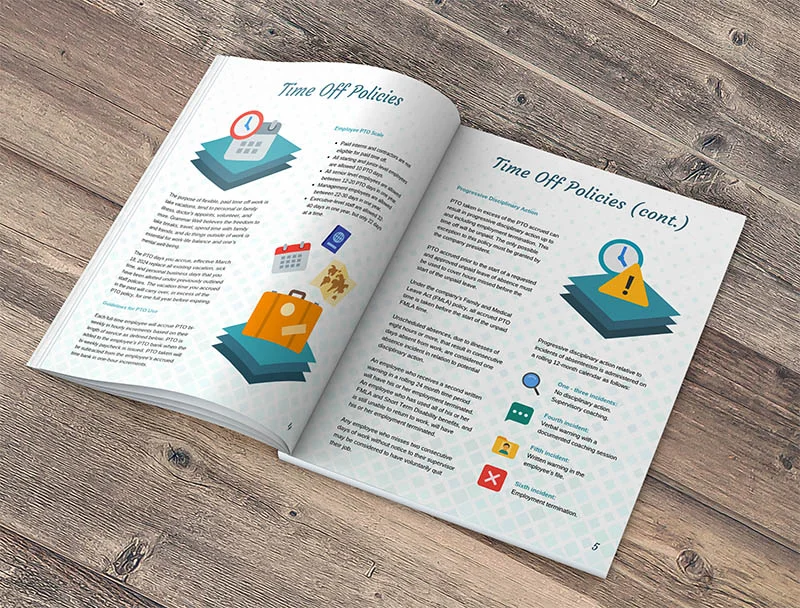
5. FREE DOWNLOAD: The Most Detailed Employee Handbook Template for 2025
If you are looking for an HR handbook template to reference and build for your business, here is the most detailed template with all the basic content suitable for the characteristics of Vietnamese businesses.

6. Key Principles for Creating an Employee Handbook
When creating a company’s employee handbook, there are several principles to follow to ensure its accuracy and effectiveness:
- Completeness: The employee handbook should include all necessary information to help employees clearly understand the company and their roles.
- Up-to-date: The handbook needs to be updated regularly to ensure accuracy and meet employees’ needs.
- Clarity: The information in the handbook should be presented clearly and concisely to help employees grasp it quickly.
- Confidentiality: The employee handbook contains a lot of important information about the company and its employees, so it must be kept confidential and for internal use only.
7. Frequently Asked Questions about Employee Handbooks (FAQs)
Does the employee handbook have the legal validity to replace an employment contract?
No. The employee handbook is a guide that specifies internal regulations. However, for it to have legal value in disciplinary actions or disputes, its content must comply with the Labor Law and be registered with the relevant authorities (if it serves as the Internal Labor Regulations).
What is the most effective format for an employee handbook?
Instead of long, hard-to-read documents, businesses should present the handbook as an E-book with images, diagrams, or short videos to make it more accessible. Additionally, digitizing the handbook on an internal platform allows employees to look up information quickly on their phones, turning the document into a practical work support tool.
The Document module of 1Work (1Office) supports centralized storage, flexible permissions, automatic version control, quick search, digital signature confirmation, and integration with AI Agents to help look up information easily and quickly.
Register for a free feature demo!
How often should the employee handbook be updated?
The handbook should be reviewed at least once a year or whenever there are significant changes in compensation policies, organizational structure, or new legal regulations. Timely updates help prevent misunderstandings and legal risks for the business.
How can we ensure that employees have actually read and understood the handbook?
Businesses can conduct short quizzes after onboarding training or use a “read confirmation” feature in their management software. Incorporating real-life scenarios into the handbook also helps employees better visualize and remember the regulations.
Is it necessary to create different versions of the employee handbook for different job levels?
Generally, common regulations should be applied uniformly. However, for specific roles (such as senior management or field staff), businesses can add separate appendices on specific authorities, responsibilities, and professional standards to optimize management.
8. Conclusion
In this article, 1Office has provided valuable information on the content of an employee handbook and offered a complete and updated template for 2025. To optimize HR management, in addition to creating a well-structured employee handbook, applying HR software is crucial for enhancing management efficiency and quality. For a consultation and a trial of the market-leading HR management software, please contact us at:
- Hotline: 083 483 8888
- 1Office Fanpage: https://www.facebook.com/1officevn
- Youtube Channel: https://www.youtube.com/c/1OfficeNềntảngquảnlýtổngthểDoanhNghiệp
















