09/05/2026
  176 views
The payment request form is an important internal accounting document, commonly used in businesses and public service units to request payment or reimbursement for incurred expenses. However, different types of entities apply different accounting Circulars, causing confusion for many when choosing a template and filling it out. In this article, we have compiled a complete collection of the latest payment request form templates, compliant with Circulars 200, 133, 107, and 79, along with detailed instructions to help you use them correctly, save time, and minimize risks during audits and settlements.
Mục lục
- 1. What Is a Payment Request Form? Definition & Importance
- 2. Legal Regulations on Payment Request Forms: Important Circulars
- 4. Detailed Guide on How to Write a Payment Request Form
- 4.1. General Information
- 4.2. Requester’s Information
- 4.3. Payment Request Details
- Information Errors on Payment Request Forms
- Missing or Incorrect Supporting Documents
- Non-compliance with the Applicable Circular’s Template
- Missing Necessary Signatures or Confirmations
- Discrepancy Between Amount in Figures and Words
- 6. Optimizing the Payment Process: From Manual Paperwork to Digitalization
- 7. Frequently Asked Questions (FAQs) about Payment Request Forms
1. What Is a Payment Request Form? Definition & Importance
In a company’s financial and accounting management system, the Payment Request Form is a crucial internal document, yet it is often overlooked or used incorrectly. In reality, it is not just a “request for money” but a mandatory link that helps control cash flow, legitimize expenses, and ensure compliance with accounting and tax regulations.
Understanding and using the Payment Request Form correctly helps businesses avoid risks during settlement and audits, while also building a transparent spending process with clear responsibilities among departments.
Definition of a Payment Request Form
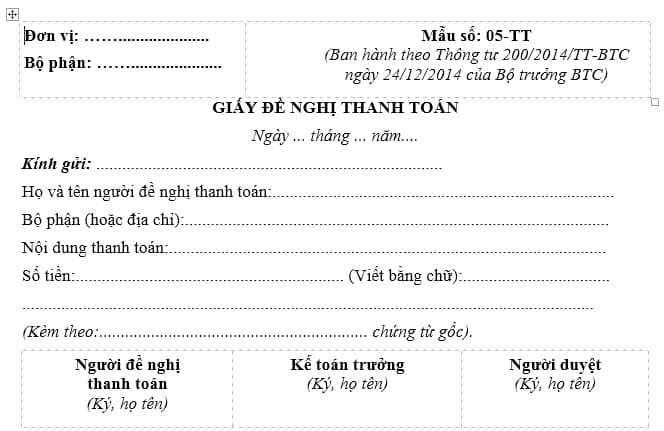
A payment request form is an internal accounting document created by an individual or department that has incurred an expense, with the purpose of requesting the company to pay or reimburse a specific amount of money. This document is usually prepared before payment (or after an advance has been spent), accompanied by relevant invoices and original receipts.
In essence, a Payment Request Form:
-
Serves as a basis for accountants and management to review and approve expenditures
-
Is an intermediate step between incurring an expense and making the payment
-
Helps to legitimize the expense in accounting records
Purpose of Using a Payment Request Form
Depending on the specific nature of operations, the Payment Request Form is used in many different situations, from small, miscellaneous expenses to large-value payments.
Common purposes include:
-
Settling advances / reimbursing employees after business trips or purchases
-
Paying for incurred expenses such as office supplies, repairs, client entertainment, and travel
-
Paying debts to suppliers and partners according to contracts
-
Paying internal costs such as salaries, bonuses, allowances, and subsidies as per decisions
Clearly separating each payment purpose helps accountants classify expenses accurately, reducing confusion and errors during bookkeeping.
The Importance of the Payment Request Form in a Business
Many businesses focus only on invoices and overlook the Payment Request Form, leading to illogical expense records that are difficult to explain during tax or financial audits.
The Payment Request Form plays a crucial role in the following aspects:
-
It is the basis for internal spending control, preventing incorrect, duplicate, or unauthorized expenditures
-
It serves as evidence to prove the reasonableness of an expense, supporting financial and tax audits
-
It helps make the financial process transparent, clarifying who requested, who approved, who paid, and for what purpose
A business with a clear and standardized system of Payment Request Forms, compliant with the applicable accounting Circular, will significantly reduce the risk of having expenses disallowed and enhance professionalism in internal financial management.
2. Legal Regulations on Payment Request Forms: Important Circulars
The creation and use of Payment Request Forms are inseparable from the current legal accounting framework. Although it is an internal document, if not developed and used in accordance with the applicable Circular, businesses may face difficulties in bookkeeping, explanations, and audits.
Therefore, to ensure consistency and validity in financial management, businesses need to clearly identify the accounting Circular they are applying and standardize their Payment Request Form template accordingly.
Overview of Current Accounting Circulars
Currently, accounting law does not issue a single, unified Payment Request Form template for all types of entities. Instead, this document is placed within the internal accounting document system according to each applicable Circular.
The important Circulars include:
-
Circular 200/2014/TT-BTC
Applicable to large and medium-sized enterprises. This Circular stipulates a complete and detailed system of accounting documents suitable for entities with complex financial operations and scale.
In practice, the Payment Request Form is used as an internal document for accountants to make payments and record expenses. -
Circular 133/2016/TT-BTC
Applicable to small and medium-sized enterprises. Compared to Circular 200, the regulations in Circular 133 are more flexible but still require businesses to establish a clear spending control process, in which the Payment Request Form is an important document. -
Circular 107/2017/TT-BTC
Applicable to public service units. For this group, the Payment Request Form is often associated with the process of advances, payments, and budget settlements, especially for expenditures from the state budget, professional tasks, schemes, or projects. -
Circular 79/2019/TT-BTC
Applicable in the field of state budget and financial management, with strict requirements on documentation, authority, and payment procedures. In this case, the Payment Request Form serves as an administrative-financial document for controlling budget expenditures.
The common point of the above Circulars is that they all allow entities to proactively design their own internal document templates, provided they ensure all mandatory content is included and effectively serve the purposes of bookkeeping, control, and archiving.
Is the Payment Request Form an Accounting Document?
In legal terms, the Payment Request Form is an internal accounting document used within an entity’s financial management system. However, it is important to distinguish that it is not a tax document.
Specifically:
-
The Payment Request Form does not replace invoices or other legal documents as required by tax law
-
It is not a direct basis for tax deduction or settlement
-
It has no independent payment value unless accompanied by a payment voucher, payment order, or bank document
Nevertheless, in the accounting system, the Payment Request Form still plays an important role because:
-
It is the basis for reviewing, approving, and controlling expenditures
-
It clearly shows the responsibilities of the requester, the approver, and the accounting department
-
It helps prove the reasonableness and necessity of an expense when explaining to auditors or management authorities
Distinguishing Between a Payment Request Form and a Tax Document
To avoid errors in accounting records, businesses need to clearly distinguish between the following two groups of documents:
-
Payment Request Form
-
Internal document
-
Serves administrative and cost control purposes
-
This form is often used by accountants to request payment for incurred expenses before creating a payment voucher or payment order
-
Clearly states the requester – payment details – amount – accompanying documents
-
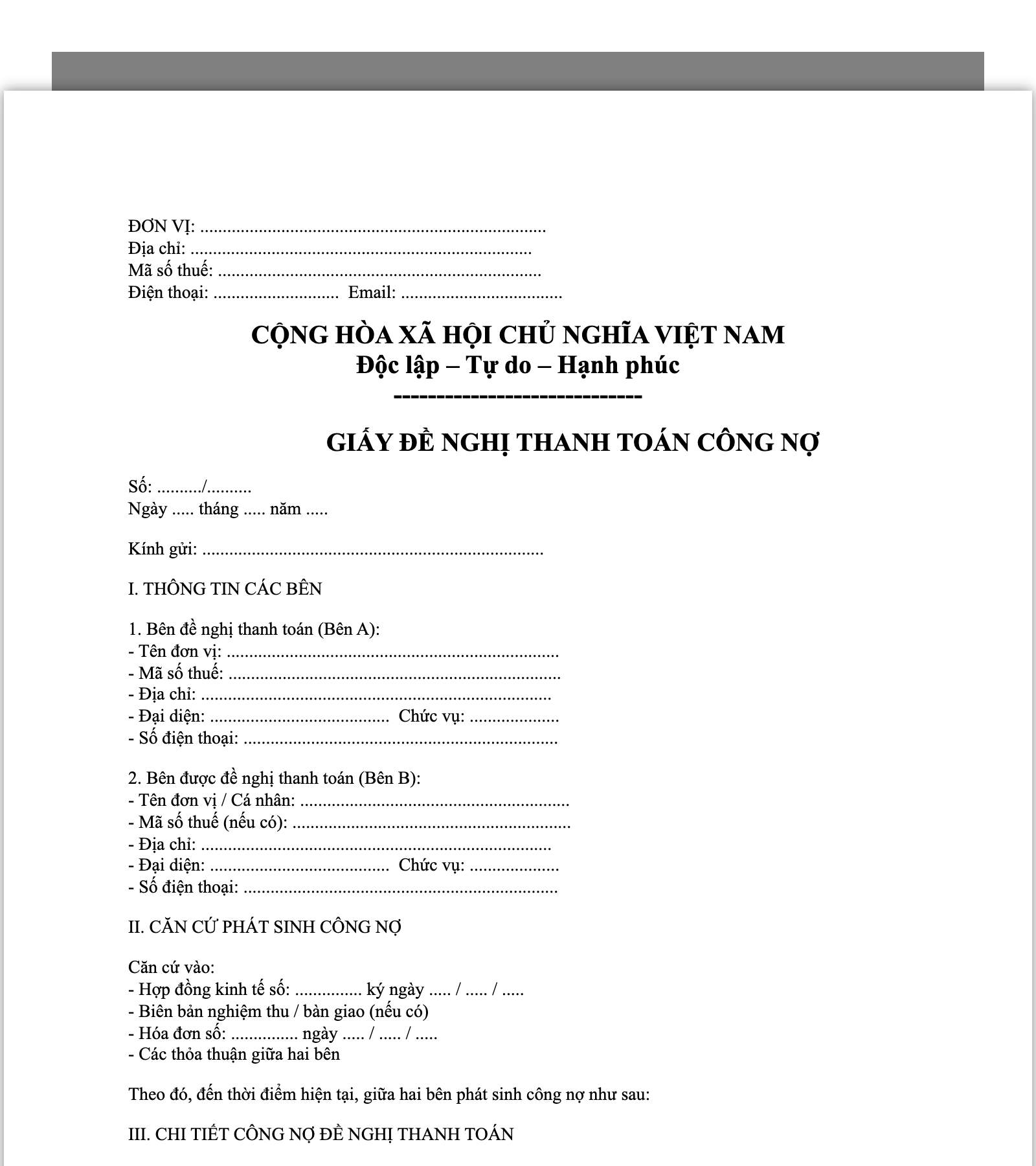
When the business requests payment for accounts payable to suppliers or customers
-
Often used for paying debts for purchases, services, advances, and reimbursements…
-
This form includes additional information such as: contract number, partner code, payment period, outstanding debt balance…
-
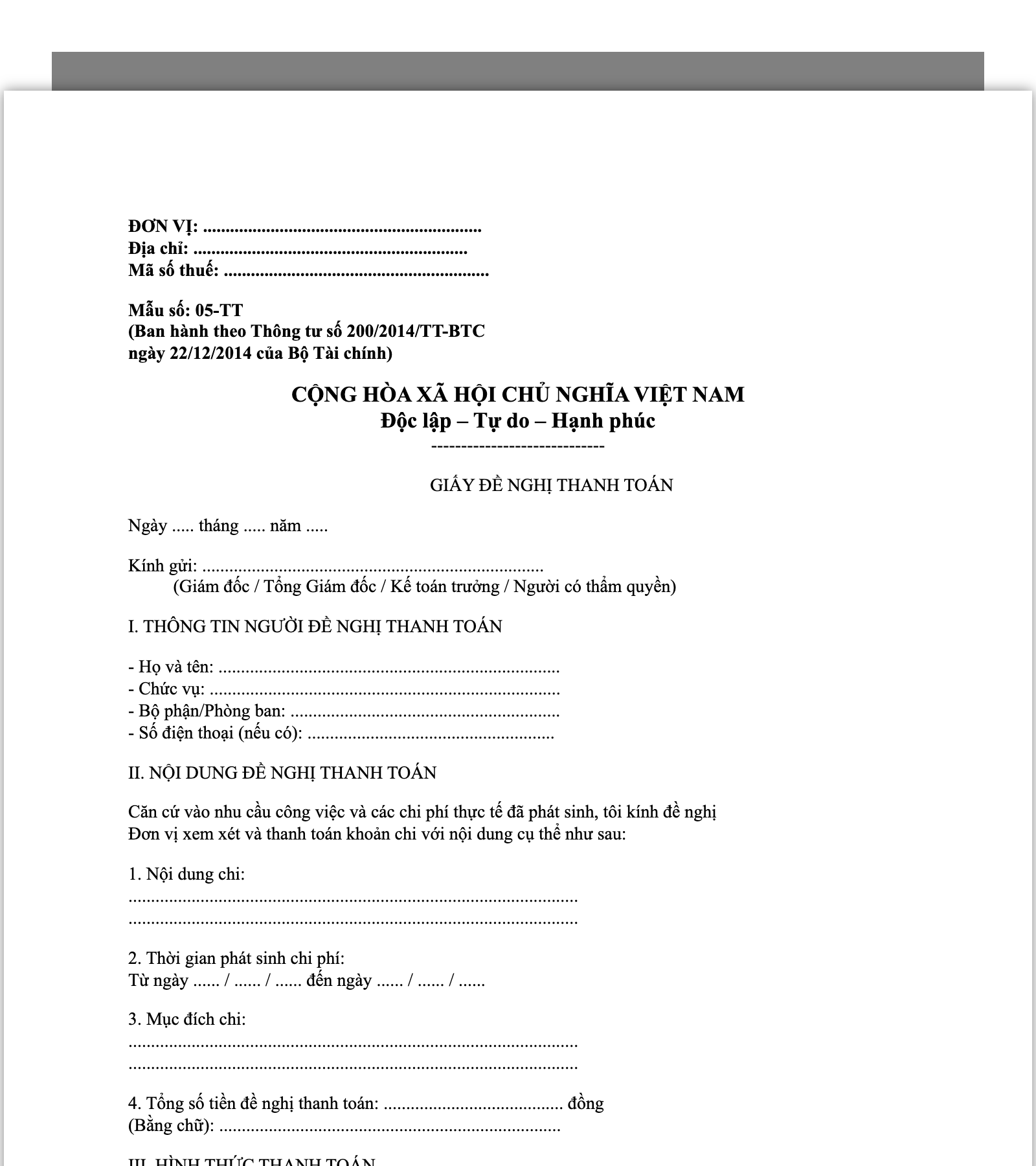
Company/Department name: written in the top left corner, matching the legal name of the business or its subsidiary.
-
Number, day, month, year of creation: helps accountants track, store, and reconcile documents by period.
-
To: clearly state the person or department with the authority to approve the expenditure, usually:
-
Director / General Director
-
Chief Accountant
-
Or the Accounting Department (according to internal regulations)
-
-
Full name of the requester
-
Position
-
Department/Division
-
Assigning responsibility in case of expense errors
-
Cross-referencing with the advance decision (if any)
-
Concise – clear purpose – true to the nature of the expense
-
Avoid vague descriptions like: “incurred expenses”, “other expenses”
-
Payment for business trip expenses in Da Nang from June 5, 2026, to June 7, 2026
-
Payment for office supplies as per Invoice No. 000123 dated June 10, 2026
-
Payment for goods as per Contract No. 05/HĐKT/2026 signed on June 1, 2026
-
Incorrectly writing or abbreviating the unit or department name
-
Vague or unclear payment request descriptions
-
Mistakes in the requested payment amount or omission of important information
-
Failure to attach all relevant invoices, contracts, and reports
-
Attached documents do not match the payment request content
-
Small businesses applying Circular 133 but using a template designed for Circular 200
-
Public sector administrative units using a business template, lacking information on funding sources
-
Missing signatures from the requester, accountant, or approver
-
Signatures not in accordance with internal authorization policies
-
The amount in figures does not match the amount in words
-
Typographical errors or missing currency units
-
Highly dependent on individuals, prone to data entry errors
-
Difficult to control template versions, easy to use outdated forms by mistake
-
Slow approval process, time-consuming paper routing
-
Difficult to aggregate, look up, and reconcile data periodically
-
Automated approval workflows, reducing reliance on paper
-
Minimizing errors from manual data entry
-
Tightly linking payment requests, documents, and accounting entries
-
Centralized data management, easy to access and control in real-time
-
Digital signatures: Allow for the fully online approval of payment requests and related documents while ensuring legal validity
-
E-invoices: Easily link directly to payment records, reducing the risk of lost documents
-
Electronic storage: Convenient for auditing, finalization, and looking up transaction history
-
Many businesses still require a stamp to enhance internal control
-
Some organizations consider the stamp a condition for completing the payment file
- <p data-start="1183
-
Small businesses can be flexible with very small, frequent expenses
-
Companies with strict procedures often still create Payment Request Forms to control spending and avoid duplicate payments
-
Advance Request Form
-
Created before money is spent
-
Purpose: to request an advance to perform a task
-
Does not yet require complete original invoices and documents
-
-
Payment Request Form
-
Created after the expense has been incurred
-
Purpose: for payment or reimbursement of an advance
-
Must be accompanied by valid original documents
-
<li data-start="3
Features & applicable subjects:

Payment Request Form according to Circular 200/2014/TT-BTC (Form 05-TT) 3.5. Debt Payment Request Form (Specifically for partners/customers)
When is this form needed?
Debt Payment Request Form (Specifically for partners/customers) 4. Detailed Guide on How to Write a Payment Request Form
This section serves as a “hand-holding” guide, helping readers not only understand the theory but also fill out the form correctly, completely, and accurately from the very first time. Whether applying Circular 200 or 133, the method of writing a Payment Request Form is essentially the same, differing only in the level of control and internal approval processes.
4.1. General Information
This section shows the legal status and the date the document was created, usually placed at the top of the page.
The following must be fully stated:
Note: Avoid general terms like “To the Board of Directors” if the company has clearly defined the expenditure approval authority.
4.2. Requester’s Information
This section identifies who is responsible for the expenditure.
Required information:
In many businesses, this serves as the basis for:
4.3. Payment Request Details
This is the most important part of the Payment Request Form.
The correct way to write it is:
Examples of standard descriptions:
This content must match the accompanying original documents.
<h3 data-start="1952" data-end="1999
Information Errors on Payment Request Forms
Information errors often stem from using inconsistent templates or filling out forms carelessly. Inaccurate information such as the unit name, requester’s name, expense description, and amount can disrupt the logical flow of the documentation, making it difficult for accountants to control and record transactions.
Businesses should use a standardized template, require the preparer to carefully cross-reference with original documents before submission, and clearly define how to describe expenses.
Missing or Incorrect Supporting Documents
A payment request form is only valid when accompanied by proper supporting documents. Many requests are rejected due to missing invoices, contracts, or acceptance reports, or because the attached documents do not match the requested expense. This not only disrupts payments but also poses risks during tax finalization.
It is necessary to clearly define the list of required documents for each type of expense and only accept submissions that are complete and valid.
Non-compliance with the Applicable Circular’s Template
Each business applies a different accounting regime. Using a payment request form template that does not comply with the applicable Circular can lead to the documentation being deemed non-standard, especially during audits or inspections.
Businesses need to clearly identify the accounting Circular they are applying and standardize their internal document templates accordingly, noting the scope of use directly on the form.
Missing Necessary Signatures or Confirmations
A payment request form lacking authorized signatures is considered procedurally incomplete. In many cases, the absence of the chief accountant’s or approver’s signature causes the request to be put on hold, prolonging processing time.
Businesses should establish a clear signing and approval process and not accept payment requests that lack the required signatures.
Discrepancy Between Amount in Figures and Words
A discrepancy between the amount in figures and in words is a minor error but can cast doubt on the accuracy of the document. This is a common mistake that auditors and regulatory agencies often require to be corrected.
The preparer should double-check carefully before signing and prioritize using template files with formulas that automatically convert numbers to words to minimize errors.
Although a payment request form is an internal document, it directly affects the validity of expenses and the efficiency of financial management. Preparing it correctly from the start not only saves the business processing time but also minimizes legal risks and enhances operational professionalism.
6. Optimizing the Payment Process: From Manual Paperwork to Digitalization
As businesses expand and financial control requirements become stricter, maintaining a manual, paper-based payment process reveals many limitations. Optimizing the payment process is not just about “changing tools,” but about shifting the management mindset—from manual processing to systematic, data-driven, and real-time controlled management.
Pros and Cons of Manual Creation (Word/Excel)
Creating payment request forms using Word or Excel is still a common practice for many businesses, especially small ones. This method is suitable in the early stages when the volume of transactions is low and the organizational structure is lean.
However, as the frequency of payments increases, the limitations become more apparent:
From a management perspective, manual processing causes businesses to spend a lot of time on administrative tasks that generate little value.
Benefits of Applying Accounting Software to the Payment Process
When a business transitions to using accounting software, the payment request form is no longer a standalone document but becomes a step in a closed-loop process—from request and approval to accounting and payment.
Popular accounting software today, such as MISA, ACC, or Bizzi, allows businesses to standardize this entire process on a centralized system.
Notable benefits include:
In the long run, adopting software helps businesses save operational costs while enhancing transparency and financial control.
Besides accounting software, digitalizing the payment process is also linked to other legal and technological tools. This is a key factor that helps businesses operate flexibly, especially in remote or multi-branch work models.
Common digitalization solutions today include:
When these solutions are integrated seamlessly, a company’s payment process shifts from manual and reactive to proactive and data-driven management.
Digitalizing the payment process doesn’t have to be done all at once. Businesses can start by standardizing templates, then gradually integrate accounting software, digital signatures, and e-invoices. This approach reduces the pressure of transition while still achieving significant management efficiencies over time.
7. Frequently Asked Questions (FAQs) about Payment Request Forms
This FAQ section clarifies common issues encountered when preparing and using payment request forms. The answers below are designed to be compliant, practical, and easy to apply, suitable for both small businesses and organizations with strict accounting procedures.
Does a payment request form need to be stamped?
In principle, a payment request form is an internal accounting document, so the law does not require a company stamp. The validity of this document is primarily established through authorized signatures and its connection to a complete payment record.
However, in practice:
Therefore, whether a stamp is required depends on internal financial regulations, not on a mandatory requirement of accounting law.
What is the retention period for a payment request form?
A payment request form is part of the accounting records, so its retention period follows the general regulations for storing accounting documents.
Typically:
In practice, the Payment Request Form is often filed with the expense documentation (payment vouchers/payment orders, invoices, contracts, etc.) to ensure easy cross-referencing.
Is a Payment Request Form necessary for small expenses?
The law does not distinguish between large or small values when it comes to creating a Payment Request Form. The issue depends on the company’s scale and its financial management structure.
In practice:
Even for small expenses, creating a Payment Request Form helps ensure cash flow transparency, especially when a large number of expenses arise.
What is the difference between a Payment Request Form and an Advance Request Form?
These two documents are easily confused, but their nature and timing of use are completely different.
-