


 11/05/2026
  319 views
Grab’s Business Model Canvas is a prime example of a groundbreaking business strategy that helped Grab transform from a small ride-hailing app into Southeast Asia’s leading “super app.” So, how did Grab leverage this model to achieve remarkable growth? Join 1Office to explore the details and draw practical lessons for your business in the following article!
Mục lục
- 1. General Introduction to the Business Model Canvas
- 2. General Introduction to Grab
- 3. Analysis of Grab’s Business Model Canvas
- 4. Strengths in Grab’s Canvas Model
- 4.1. Diverse and Clear Customer Segments
- 4.2. Flexible Core Value – ‘All-in-One’ Solution
- 4.3. Digital and Experience-Optimized Distribution Channels
- 4.4. Sustainable, Experience-Oriented Customer Relationships
- 4.5. Diverse and Continuously Growing Revenue Streams
- 4.6. Strong Technological Resources
- 4.7. Lean and Efficient Key Activities
- 4.8. Extensive Partner Ecosystem
- 4.9. Effective Cost Control
- 5. Business Lessons from Grab’s Canvas Model
- 5.1. Clear customer segmentation helps optimize services
- 5.2. Creating a distinct and sustainable core value
- 5.3. Optimal distribution channels determine the speed of growth
- 5.4. Leveraging technology to create a long-term competitive advantage
- 5.5. Diversifying revenue streams to reduce risk
- 5.6. Strategic partnerships instead of doing everything in-house
- 5.7. Smart cost control for easy expansion
- 6. Grab’s ecosystem expansion strategy
- 6. 1Office – The Solution to Optimize Performance and Accelerate Revenue
1. General Introduction to the Business Model Canvas
The Business Model Canvas is a visual tool that helps businesses describe, analyze, and design their business models systematically. This model is divided into 9 key building blocks that are closely linked, creating a comprehensive picture of how a business creates, delivers, and captures value.
1.1. Customer Segments
Customer Segments is the first and most crucial step in the Business Model Canvas. Businesses need to identify who they are serving, who their target customers are, and what their needs and consumer behaviors are. Customers can be segmented by age, income, geographic location, industry, or by their level of need.
This element defines which customer groups a business serves. Each customer group will have different needs, habits, and willingness to pay, so clear segmentation is the foundation for planning the entire business strategy.
1.2. Value Propositions
Value Propositions are the core benefits that a business promises to deliver to its customers. This could be convenience, time savings, cost savings, superior quality, or a unique solution to a specific problem customers face.
1.3. Channels
Channels are the means and platforms a business uses to reach and deliver value to its customers. These channels can be online or offline, direct or through third parties.
1.4. Customer Relationships
This element describes how a business establishes and maintains relationships with each customer segment. This can be through personal assistance, automation, community building, or regular contact through communication channels.
1.5. Revenue Streams
Revenue Streams reflect how a business generates money from each customer segment. Revenue can come from sales, rentals, service fees, subscriptions, or a combination of multiple sources.
1.6. Key Resources
Key Resources include the essential assets required for a business to operate and deliver value, such as human resources, technology, intellectual property, finances, physical facilities, etc.
1.7. Key Activities
These are the crucial tasks a business must perform to ensure its business model works effectively. This includes product development, marketing, distribution, customer care, maintaining a workflow, etc.
1.8. Key Partnerships
Key Partnerships are the important collaborators that support the business in optimizing resources, reducing risks, accessing new markets, or completing the value chain.
1.9. Cost Structure
The Cost Structure reflects all the costs incurred while operating the business model. Businesses need to manage fixed and variable costs well and optimize expenses to ensure profitability.
Read more: What is the Business Model Canvas? How to create an optimal Canvas model for your business
2. General Introduction to Grab

Grab Holdings Inc. is a multinational technology corporation headquartered in Singapore, with strong operations in the Southeast Asia region. Founded in 2012 in Malaysia by Anthony Tan and Tan Hooi Ling, initially named MyTeksi, Grab quickly expanded its scale, rebranded, and became the leading ride-hailing app in Southeast Asia.
Today, Grab has evolved far beyond traditional ride-hailing services, becoming a super app with a rich ecosystem that serves millions of users daily. Grab’s main services include:
- GrabBike, GrabCar: Technology-based motorcycle and car transportation services.
- GrabFood: Fast and convenient food delivery.
- GrabExpress: On-demand delivery of goods and documents.
- GrabPay: E-wallet and cashless payment solutions.
- GrabFinance: Financial services such as consumer loans and personal finance management.
Currently, Grab operates in over 8 countries in the region, including: Singapore, Malaysia, Indonesia, the Philippines, Thailand, Vietnam, Cambodia, and Myanmar, with hundreds of millions of app downloads and millions of driver-partners.
Grab’s sustainable growth comes not only from its market expansion strategy but also from the effective application of the Business Model Canvas, which helps them accurately capture market needs, optimize resources, and create outstanding value for customers, partners, and investors alike. Grab has become a symbol of innovative technology in Southeast Asia, continuously expanding its influence and reshaping how people move, eat, pay, and use services in the digital age.
In Vietnam, Grab quickly dominated the market by accurately understanding user needs: a convenient, transparently priced, and easy-to-use ride-hailing service. By implementing modern technology, Grab makes booking a ride fast, tracking the journey easy, and optimizes the overall experience.
Not stopping at ride-hailing, Grab expanded into a “super app” with a multi-service ecosystem including GrabFood, GrabExpress, GrabPay, and more. This creates comprehensive convenience for users and increases brand loyalty.
Additionally, Grab actively pursues strategic partnerships with local partners (banks, businesses, drivers), enabling rapid expansion, cost savings, and easy adaptation to the local market. This flexibility and market understanding are Grab’s USP, helping to create sustainable breakthroughs in Vietnam.
3. Analysis of Grab’s Business Model Canvas
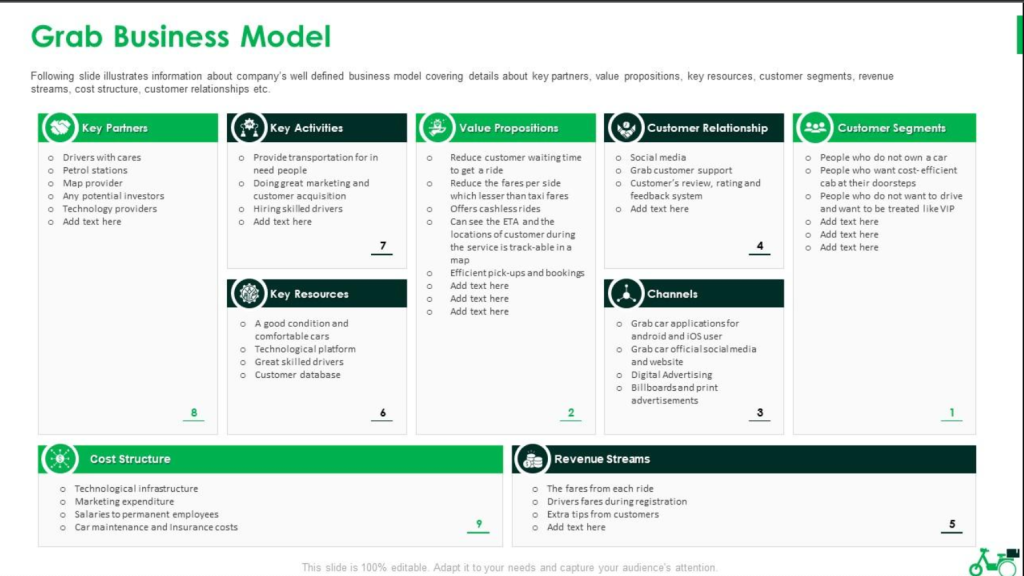
3.1. Customer Segments
Grab serves a diverse range of customer segments, including:
- Individual Users: People who need transportation, food delivery, or express courier services.
- Partner Drivers: Individuals who own a vehicle and want to earn extra income by providing transportation or delivery services.
- Businesses and Restaurants: Entities that need delivery services and want to reach customers through the Grab platform.
- Financial Service Users: Customers who use the GrabPay e-wallet and other financial services.
3.2. Value Propositions
Grab delivers various values to its customer segments:
- Individual Users: Convenience, speed, safety, and a wide range of services on a single platform.
- Partner Drivers: Flexible income opportunities, training support, and welfare programs.
- Businesses and Restaurants: Expanded sales channels, increased customer reach, and optimized delivery processes.
- Financial Service Users: Cashless, secure payments integrated with multiple utilities.
3.3. Channels
Grab uses the following channels to reach and serve its customers:
- Mobile App: The primary platform for users to book services and for drivers to receive requests.
- Website: Provides information and support for customers and partners.
- Support Centers: Resolve inquiries and provide direct support for customers and drivers.
3.4. Customer Relationships
Grab builds and maintains customer relationships through:
- 24/7 Customer Care: Support through multiple channels such as phone, email, and online chat.
- Loyalty Programs: Reward points, promotions, and special offers.
- Feedback and Ratings: Allows users and drivers to rate each other, improving service quality.
3.5. Revenue Streams
Grab generates revenue from the following main sources:
- Service Fees: Commissions from each transaction between drivers and customers.
- Advertising Fees: Revenue from on-platform advertising for partners.
- Financial Services: Fees from payment transactions, money transfers, and other financial services.
3.6. Key Resources
To operate effectively, Grab relies on the following key resources:
- Technology and Platform: The mobile app, positioning system, and technology infrastructure.
- Driver and Partner Network: A large number of drivers and service-providing partners.
- Brand and Reputation: Strong brand recognition and customer trust.
3.7. Key Activities
Grab’s key activities include:
- Platform development and maintenance: Improving the application, ensuring stability and security.
- Partner relationship management: Recruiting, training, and supporting drivers and other partners.
- Marketing and promotion: Attracting new users and maintaining the loyalty of existing customers.
3.8. Key Partnerships
Grab collaborates with many partners to expand and enhance service quality:
- Financial service providers: Collaborating with banks and financial institutions to provide payment and financial services.
- Restaurants and stores: Partners in GrabFood and GrabMart services.
- Technology companies: Collaborating to integrate and improve technology.
The Canvas model helps businesses systematize how they create, distribute, and deliver value. If you want to compare how other businesses—from e-commerce to manufacturing/traditional sectors—apply the Canvas model, you can refer to Shopee’s Canvas model and Vinamilk’s Canvas model.
3.9. Cost Structure
Grab’s main costs include:
- Technology costs: Developing, operating, and maintaining the platform.
- Marketing costs: Advertising, promotions, and loyalty programs.
- Support and operational costs: Personnel, office, and customer support services.
4. Strengths in Grab’s Canvas Model
4.1. Diverse and Clear Customer Segments
Grab classifies customers into distinct groups: service users, driver-partners, businesses, restaurants, and financial users. Each group has different needs and usage behaviors.
- Benefit: Helps Grab design suitable products/services, optimize the experience for each segment, and increase retention and market share expansion.
4.2. Flexible Core Value – ‘All-in-One’ Solution
Grab is not just a ride-hailing app but also provides food delivery (GrabFood), package delivery (GrabExpress), electronic payments (GrabPay), financial services (loans, insurance), and even healthcare.
- Benefit: Provides maximum convenience for users by meeting all their needs on a single platform, thereby increasing Customer Lifetime Value.
4.3. Digital and Experience-Optimized Distribution Channels
Grab uses its mobile app as the main channel where customers book services, drivers receive requests, and businesses manage orders.
- Benefit: Optimizes costs, increases personalization, facilitates easy scaling without significant physical investment, and creates a competitive advantage in technology and cost.
4.4. Sustainable, Experience-Oriented Customer Relationships
Grab invests heavily in 24/7 customer care, a two-way rating system, and the GrabRewards program.
- Benefit: Increases loyalty, builds trust, maintains long-term relationships, and promotes positive word-of-mouth.
4.5. Diverse and Continuously Growing Revenue Streams
Grab earns revenue not only from driver service fees but also from advertising, financial services, business logistics, and restaurant partners.
- Benefit: Reduces dependence on a single revenue source, increases resilience to risks, and maximizes profit from multiple customer touchpoints.
4.6. Strong Technological Resources
Grab possesses an advanced technology platform with AI systems, Big Data, real-time GPS, and a payment infrastructure.
- Benefit: Increases processing speed, optimizes operational efficiency, personalizes services for users → creating a hard-to-replicate technological advantage.
4.7. Lean and Efficient Key Activities
Grab focuses on technology development, partner acquisition, service expansion, and enhancing the customer experience.
- Benefit: Helps Grab quickly adapt to new trends, launch new services, and expand its market faster than competitors.
4.8. Extensive Partner Ecosystem
Grab strategically partners with banks, restaurants, insurance companies, and major financial institutions.
- Benefit: Leverages external resources, increases ecosystem value, and expands the market without significant investment.
4.9. Effective Cost Control
By not owning large physical assets (an asset-light model), Grab reduces fixed costs, focusing on technology and marketing expenses.
- Benefit: Easy to scale without a corresponding increase in costs, helping Grab achieve higher business efficiency.
5. Business Lessons from Grab’s Canvas Model
5.1. Clear customer segmentation helps optimize services
One of the most important factors leading to Grab’s success is its ability to segment customers specifically. Grab not only serves riders but also targets drivers, restaurants, businesses, financial users, and more. Each segment has its own needs and behaviors, and Grab has optimized its services for each group.
Lesson: Businesses need to deeply understand their target customers and segment the market reasonably to develop products/services that meet expectations, enhance the customer experience, and retain customers more effectively.
5.2. Creating a distinct and sustainable core value
Grab does not follow the traditional model of specializing in a single service but focuses on building a comprehensive solution for daily life. The integration of multiple services such as ride-hailing, delivery, food, payments, and finance has helped Grab become a familiar part of millions of people’s lives.
Lesson: Businesses need to define the core value they provide, ensure that this value truly solves customer problems, and create a unique selling proposition that is difficult to replace in the market.
5.3. Optimal distribution channels determine the speed of growth
Grab uses its mobile application as the sole central distribution channel, where all activities from booking rides, making payments, to leaving reviews are carried out. This not only saves costs but also helps Grab reach customers quickly and manage operations effectively.
Lesson: Optimizing distribution channels (especially digital ones) helps businesses scale quickly, reduce costs, and improve customer interaction.
5.4. Leveraging technology to create a long-term competitive advantage
Grab invests heavily in technologies like AI, big data, GPS positioning systems, and electronic payments to enable smart operations and enhance the user experience. As a result, Grab competes not just on price, but also on service efficiency and superior convenience.
Lesson: In the digital age, businesses aiming for sustainable growth must treat technology as a foundation, not only for efficient operations but also for creating differentiation that is difficult to replicate.
5.5. Diversifying revenue streams to reduce risk
Grab does not rely on a single source of income. In addition to service fees from drivers, Grab also earns revenue from advertising, financial services, goods delivery, and partnerships with restaurants and businesses.
Lesson: Diversifying revenue streams is a crucial strategy that helps businesses withstand market risks and optimize profits.
5.6. Strategic partnerships instead of doing everything in-house
Grab partners with banks, insurance companies, restaurants, and more to expand its ecosystem without needing to invest everything from scratch. This helps Grab expand quickly while saving costs.
Lesson: Leveraging the strength of partners is a smart way for businesses to grow fast, reduce financial risks, and access new resources.
5.7. Smart cost control for easy expansion
Grab operates on an asset-light model – it doesn’t need to own vehicles, employ drivers, etc. This results in low operating costs, making it easy to scale into new markets.
Lesson: Designing a flexible business model with few fixed assets helps businesses expand quickly and control costs more effectively.
6. Grab’s ecosystem expansion strategy
Grab is not just a ride-hailing app; it is evolving into a super app with the goal of placing all of a user’s daily needs into a single ecosystem. This expansion strategy is based on the principle: the more services added, the stronger the ecosystem, and the harder it is for customers to leave. This strengthens its sustainable competitive advantage and creates a Network Effect.
The four pillars below are the clearest evidence of Grab’s ecosystem expansion strategy.
GrabFood, GrabMart – growth driven by on-demand needs
GrabFood and GrabMart are two of Grab’s fastest-growing services, capitalizing on the “on-demand consumption” trend among urban users.
Key highlights of the expansion strategy:
-
Focus on on-demand needs: delivering food, essentials, and groceries in 15–30 minutes.
-
Leveraging the existing customer base from the ride-hailing service, reducing new customer acquisition costs.
-
Continuously expanding partnerships: restaurants, supermarkets, convenience stores, and major F&B brands.
-
Optimizing the delivery experience through routing technology and locating the nearest driver.
Significance for the Grab ecosystem:
GrabFood and GrabMart help Grab increase daily app usage frequency, retain users, and generate significant additional revenue without changing its core operational structure.
GrabPay, e-wallet, and the Fintech strategy
GrabPay is a strategic move for Grab to transform from a ride-hailing app into a digital financial platform.
Grab’s fintech development strategy includes:
-
GrabPay e-wallet supports fast, secure payments, increasing user engagement.
-
Installment and consumer loan services through GrabFinancial Group.
-
Collaborating with banks and fintech partners to expand credit limits and diversify financial products.
-
Deep integration into the ecosystem: payments for GrabFood, GrabMart, GrabExpress, ride-hailing, insurance purchases…
Strategic benefits:
-
Creating new revenue streams that are less dependent on delivery operations.
-
Reducing transaction costs and increasing user data for service personalization.
-
Strengthening the “super app” model—once users link their e-wallet, they are less likely to leave the platform.
GrabExpress – Deeply Penetrating the Last-Mile Delivery Market
GrabExpress is a crucial link in Grab’s logistics strategy, playing a role in enhancing the delivery experience for both businesses and individuals.
Highlights of the GrabExpress model:
-
Flexible multi-service options: 2-hour express delivery, super-fast delivery, same-day delivery, inter-district delivery.
-
Tightly integrated with GrabFood & GrabMart, helping to optimize the delivery infrastructure.
-
Turbulence Management: an order allocation system to reduce waiting times.
-
Expanding B2B partnerships with e-commerce platforms, retail businesses, and online stores.
Importance to the Canvas model:
GrabExpress helps expand the ecosystem’s coverage and increase stable revenue from logistics services – a sector growing strongly with e-commerce.
Integrated Service Ecosystem Creates a Network Effect
The Grab ecosystem operates based on a network effect—the more users and partners join, the more the platform’s value increases.
Grab’s network effect is evident in:
-
Users hail a ride → use GrabFood → use GrabPay → use GrabExpress → increasing engagement.
-
Drivers get more orders from multiple services, improving their income → reducing churn.
-
Restaurant, supermarket, and business partners… can access Grab’s massive customer base.
-
Grab collects multi-dimensional consumer data → optimizing algorithms and improving the experience.
Grab can expand rapidly with low marginal costs, but the value it generates increases exponentially – this is the foundation for Grab to become the largest tech unicorn in Southeast Asia.
6. 1Office – The Solution to Optimize Performance and Accelerate Revenue
Grab’s success comes not only from its smart business model but also from its ability to optimize resources and operate efficiently, both internally and externally. For Vietnamese businesses, focusing solely on customers is not enough to achieve strong sales and rapid growth. Revenue comes from team performance and how you manage the smallest daily activities.
The 1Office platform will help you build a comprehensive management system covering customers, people, and work, creating a solid foundation for breakthrough growth.
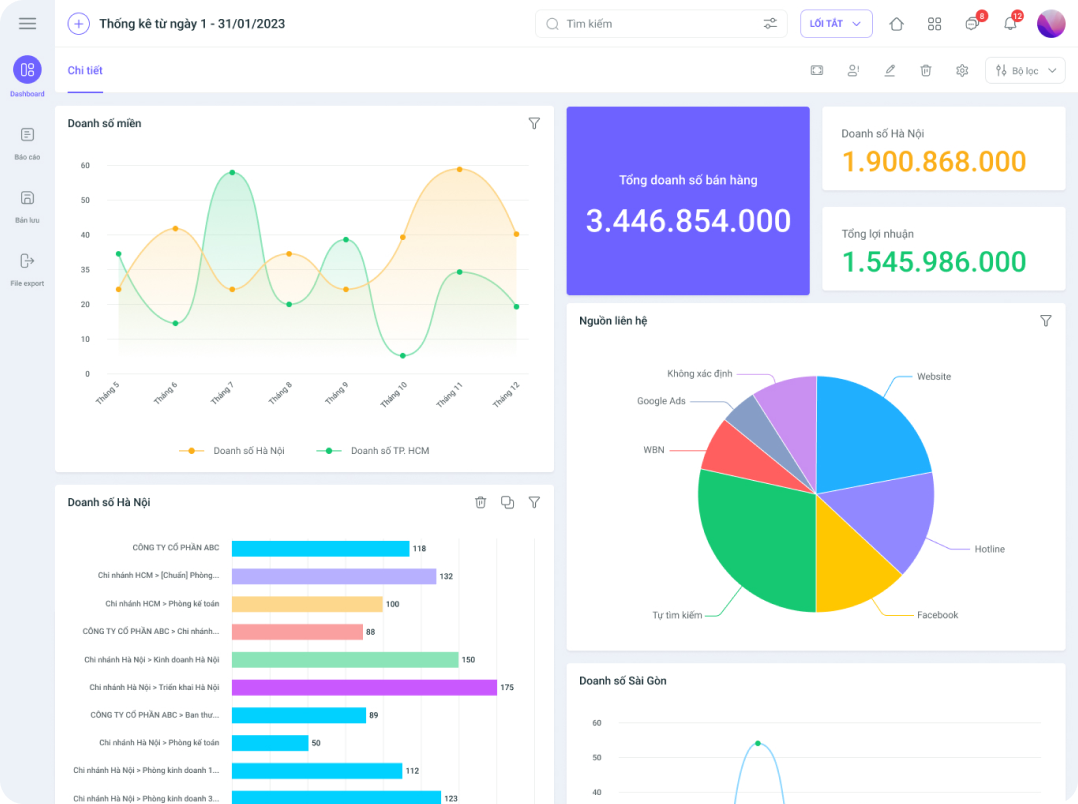
6.1. Manage Customers Tightly with 1CRM – Optimize the Sales Funnel, Increase Closing Rates
Register for a free feature Demo!
It all starts with the customer. 1CRM allows businesses to track the entire customer journey and manage opportunities, contracts, and quotes on a single platform:
- Store all customer data: information, interaction history, transactions.
- Manage a clear sales funnel: know which stage customers are in to provide appropriate care.
- Automate the sales process: send emails, set reminders, update statuses.
- Report sales by employee, team, and product – to devise optimization strategies.
Impact: Helps businesses quickly seize opportunities, avoid missing customers, increase conversion rates, and thereby effectively optimize revenue.
6.2. Manage Sales Teams and Personnel with 1HRM – Performance Management, Fair Measurement
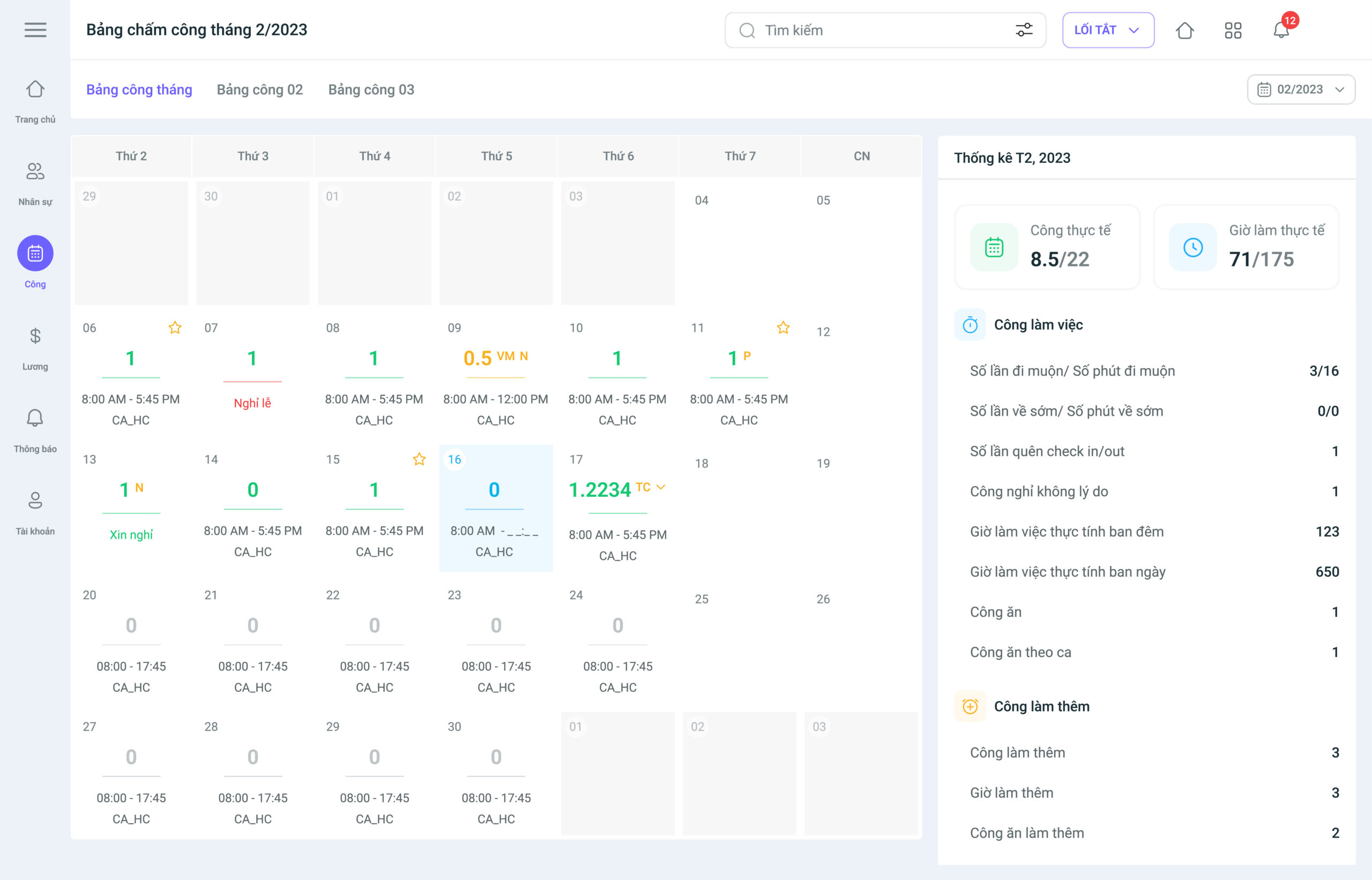
However, no matter how many customers you have, you can’t sell effectively if your team is inefficient. This is why you need 1HRM – a comprehensive personnel management tool:
- Manage detailed KPIs for each position and individual – transparent performance measurement.
- Periodically evaluate skills and work attitude – increasing motivation and fairness.
- Timekeeping, payroll, and bonuses – processed quickly, without errors, ensuring satisfaction.
- Manage personnel costs, development roadmaps, and retain top talent.
Impact: Helps businesses build a professional, efficient, and motivated sales team, avoiding situations of “laziness – slowness – irresponsibility,” thereby ensuring stable and growing revenue output.
6.3. Optimize Daily Work with 1Work – Progress Management, Performance Enhancement
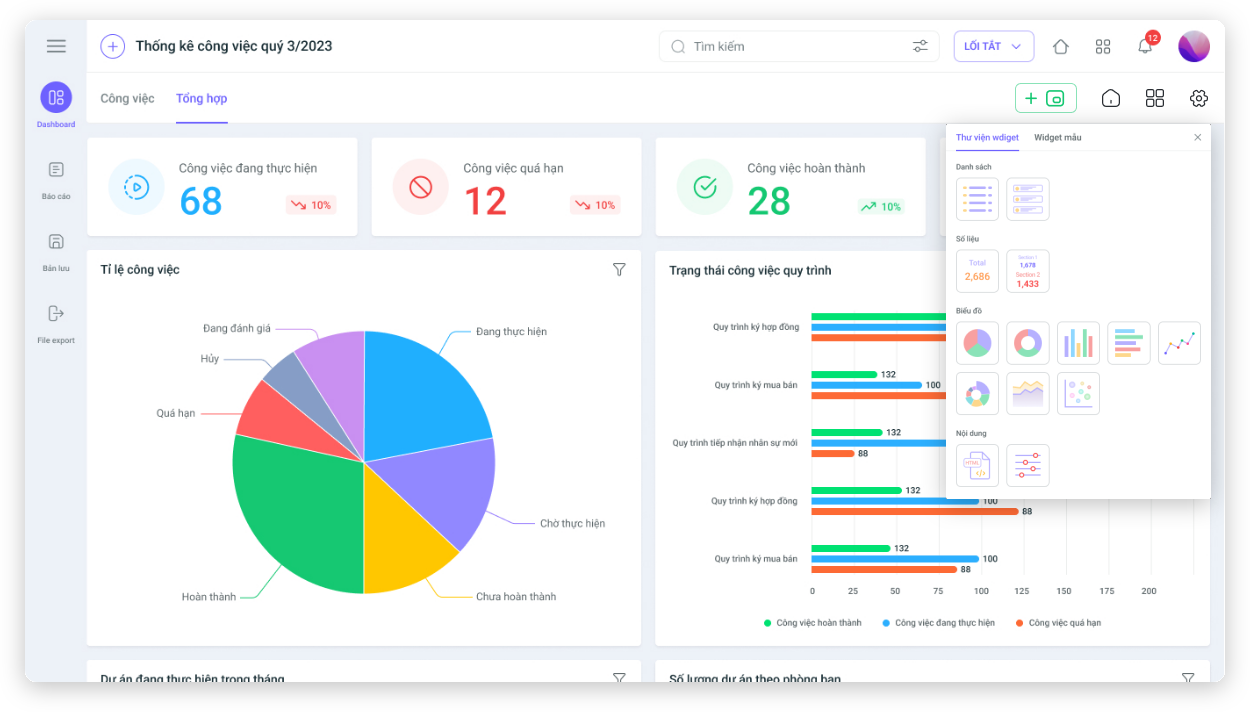
One of the reasons for slow business growth is work stagnation, unclear responsibilities, and a lack of progress tracking. 1Work is the solution to help you control daily tasks:
- Assign tasks clearly with specific deadlines and transparent accountability.
- Track work progress in real-time, avoiding “missed deadlines that go unnoticed.”
- Manage projects and coordinate effectively between departments – no overlapping work.
- Report on each employee’s work performance – identify bottlenecks early and optimize operations.
Impact: Helps teams work more productively, ensures smooth workflows, and avoids wasting time, costs, and opportunities, thereby creating a foundation for sustainable growth.
















