Latest 2026 Business Trip Assignment Decision Template – Free Word File Download


A Business Trip Assignment Decision template is an important administrative document used to record and approve the assignment of officers and employees for domestic or international business trips. This article compiles standard decision templates with complete content that complies with legal regulations, helping businesses issue them quickly, manage effectively, and establish a basis for valid expense reimbursement.
Mục lục
- 1. What is a Business Trip Assignment Decision Template?
- 2. Collection of the Most Popular Business Trip Assignment Decision Templates
- 3. Detailed Guide on How to Draft an Accurate Business Trip Decision
- 4. Business Trip Allowance Policy and Related Legal Regulations
- 5. Special Situations and Important Notes
- 6. Frequently Asked Questions (FAQs)
1. What is a Business Trip Assignment Decision Template?
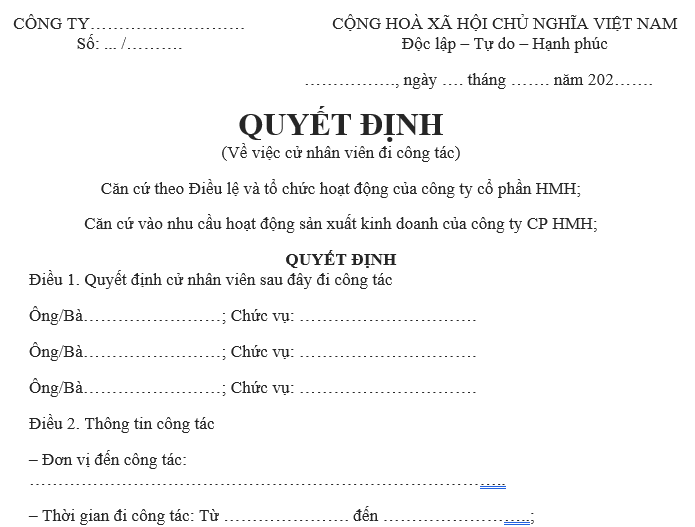
A business trip assignment decision is an administrative document issued by an authorized person in a business, agency, or organization to officially assign work duties outside the main office to an employee, officer, civil servant, or public employee for a specific period.
Legally, this decision serves as:
- A basis for confirming the employee’s legal work assignment
- A basis for reimbursing per diem, travel, and accommodation expenses
- A document proving the employment relationship and official responsibilities in case of risks, disputes, audits, or inspections
2. Collection of the Most Popular Business Trip Assignment Decision Templates
In the practice of human resource management and business operations, a business trip assignment decision is not just an administrative document but also a crucial legal basis for organizing and controlling the work, costs, and responsibilities of employees. Depending on the purpose, scope, and subject of the trip, businesses need to use different decision templates to ensure appropriateness and rigor.
Below is a collection of the most commonly used business trip assignment decision templates today, standardized in content and format, suitable for private enterprises, FDI companies, and administrative agencies and units.
2.1. Domestic Business Trip Assignment Decision Template
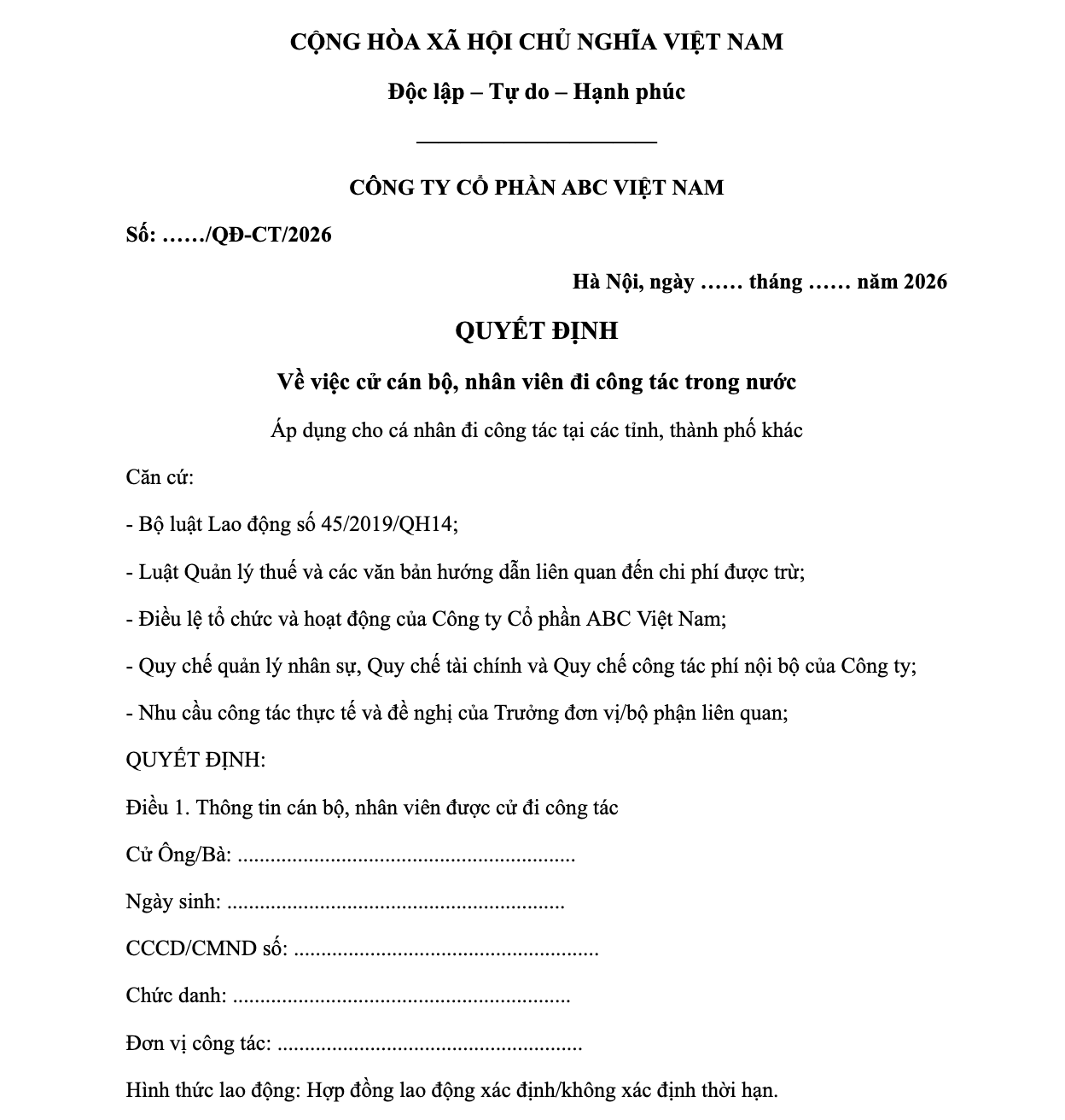
This is the most commonly used template in businesses, applied when assigning an officer or employee for a business trip to another province or city within the territory of Vietnam.
This decision template typically includes:
- Full information of the person being assigned (full name, title, department)
- Location, time, and purpose of the business trip
- Specific tasks to be performed
- Regulations on per diem and transportation
- Responsibility for reporting trip results and the effective date
This template is suitable for short-term business trips, working with partners, clients, regulatory agencies, or conducting on-site surveys.
>> Download the Domestic Business Trip Assignment Decision Template HERE
2.2. Decision Template for Assigning a Group of Officers and Employees on a Business Trip (Multiple People)
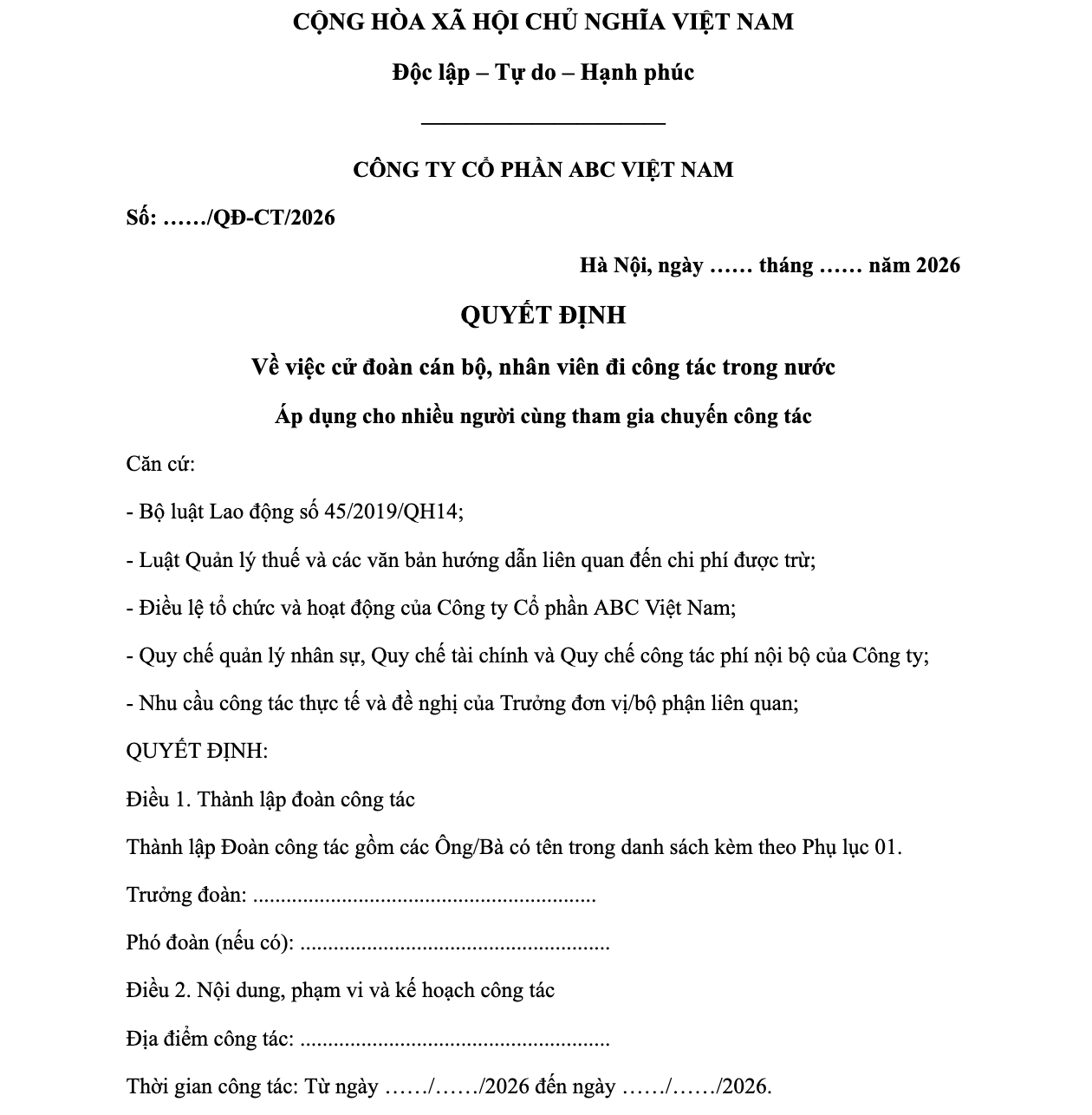
When multiple people participate in the same business trip, especially trips involving inter-departmental coordination or working with multiple partners, businesses should use a decision template specifically for a delegation.
Features of this template:
- Formally establishes a business trip delegation
- Appoints a delegation head and deputy head (if any)
- Includes a list of members as an appendix
- Clearly defines responsibilities for coordination, cost management, and reporting
- Applies per diem policies for each member
This decision template helps businesses tightly manage personnel and costs, while also avoiding overlapping responsibilities during task execution.
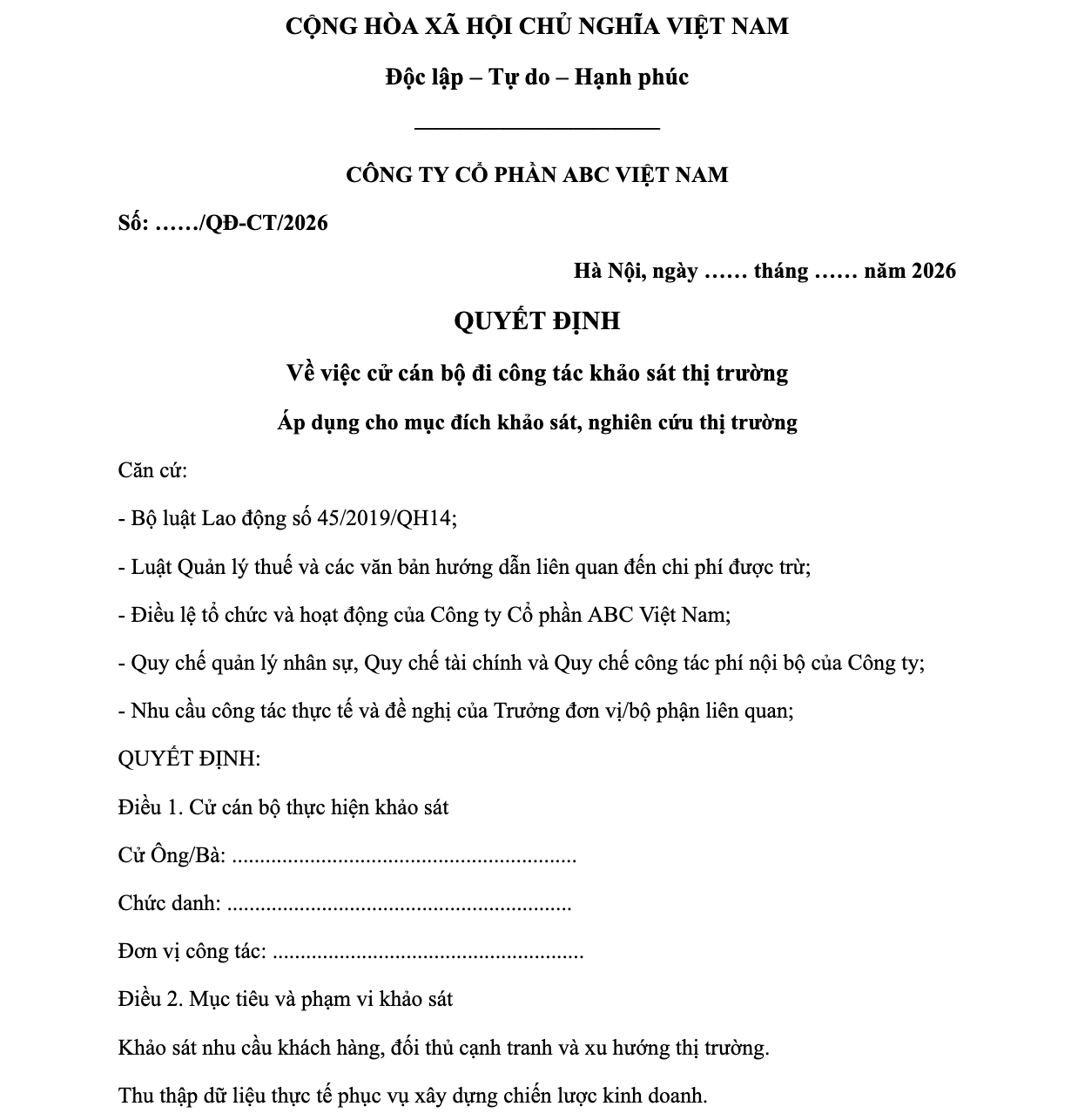
2.3. Business Trip Decision Template for a Specific Purpose
In many cases, a business trip is not just for regular work but also serves a specific professional purpose, such as:
- Market research
- Attending training courses, conferences, or seminars
- Carrying out projects, specialized research
This decision template focuses on clarifying:
- Objectives and scope of the business trip
- Specific professional tasks to be performed
- Mandatory deliverables (reports, documents, proposals)
- Budget and related travel expense policies
Using the correct decision template for the specific purpose helps the business easily evaluate the effectiveness of the trip and serves as a valid basis for cost accounting.
>> Download the Business Trip Decision Template for a Specific Purpose
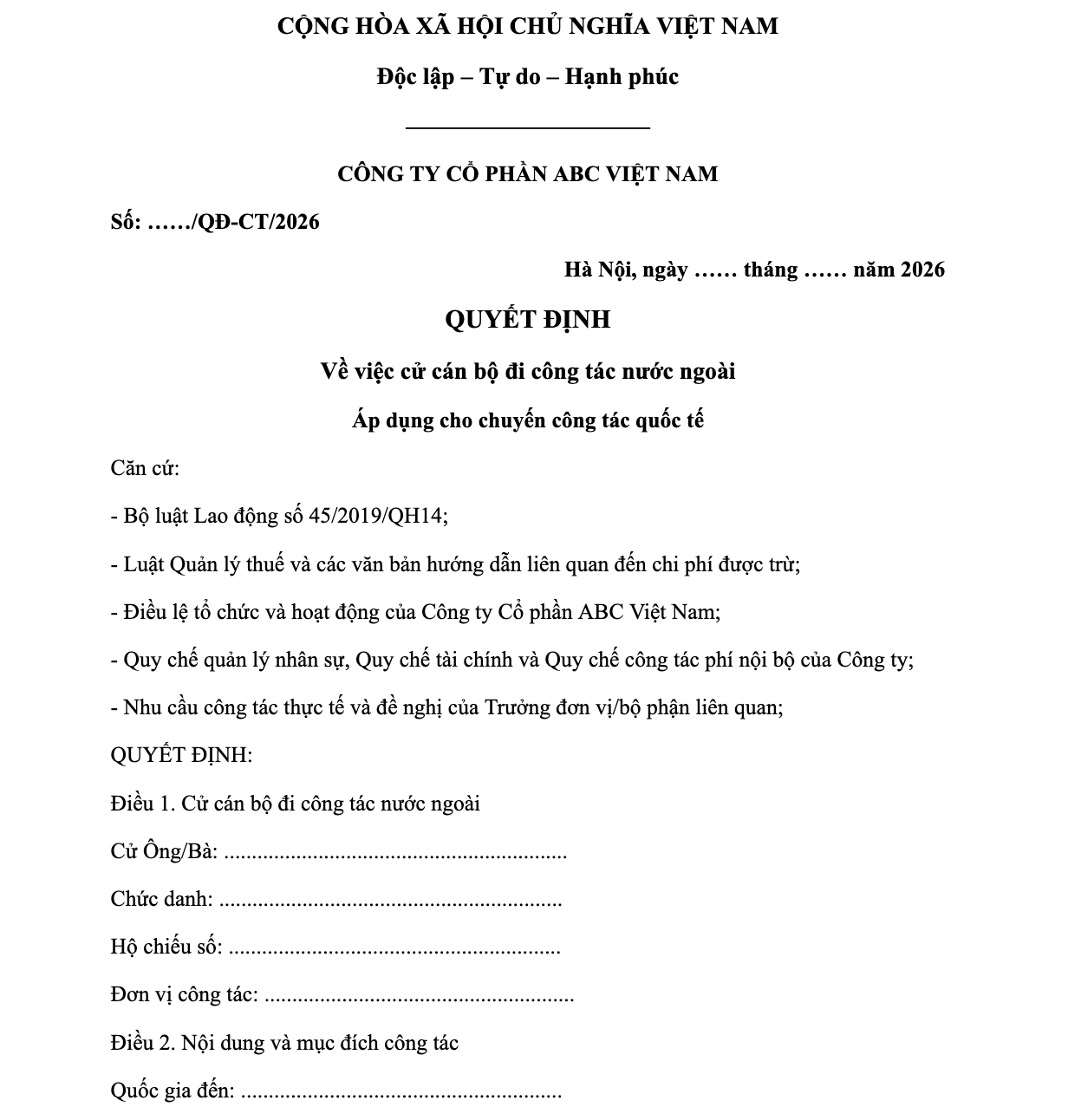
2.4. Overseas Business Trip Decision Template
For international business trips, the decision document needs to be drafted in more detail and with greater rigor than for domestic trips.
The content typically includes:
- Personal and passport information of the assigned employee
- Country, location, and duration of the trip
- Purpose of the trip (working with partners, attending trade fairs, negotiations, training)
- Regulations on costs for airfare, visa, insurance, and accommodation
- Obligation to comply with the laws of the host country and company regulations
This is a mandatory decision template if the business wants overseas travel expenses to be legally recognized and included as valid costs.
3. Detailed Guide on How to Draft an Accurate Business Trip Decision
3.1. Structure of a Business Trip Decision
A valid and properly formatted business trip decision must include all of the following content:
Opening Section
- National emblem and motto according to administrative document regulations
- Name of the issuing agency or unit
- Decision number, symbol; date of issuance
Legal Basis Section
Clearly state the basis for issuing the decision, which typically includes:
- Company charter or organizational and operational regulations
- Personnel management regulations, internal financial regulations
- The Labor Code and related legal documents
“DECISION” Section
- Article 1 – Information of the assigned employee
Clearly state full name, position, and department. - Article 2 – Content of the business trip
Includes: destination, purpose of the trip, duration, mode of transport, and specific tasks assigned. - Article 3 – Travel expense policy and benefits
Reference internal financial regulations, circulars guiding travel expenses, and payment policies. - Article 4 – Effectiveness and Responsibility for Implementation
Determine the effective date of the decision and the responsibilities of relevant departments.
Conclusion
- Recipients
- Signature, full name, and seal of the authorized person
3.2. Notes on Filling Out Information
When drafting the decision, pay special attention to:
- Personal information, time, and location must be accurate and clear
- Use formal, administrative language; avoid ambiguous wording
- Ensure full legal basis and proper signing authority
- The reference number and date of issuance must be consistent with the unit’s document log
4.1. Overview of the Business Trip Allowance Policy
Business trip allowance is an expense paid by the unit to an employee on a business trip to cover reasonable incurred costs, including:
- Travel expenses (train/bus tickets, gasoline, taxi, etc.)
- Accommodation expenses (hotel fees, lodging allowance)
- Meal costs and other allowances as regulated
4.2. Updated Legal Documents (2026)
Some important documents to reference:
- Decree 72/2023/ND-CP: regulating standards and quotas for car usage.
- Circular 12/2025/TT-BTC: amending and supplementing the business trip allowance policy; lodging allowance of 300,000 VND/day for domestic trips.
- Circular 96/2015/TT-BTC: regulating business trip expenses deductible for Corporate Income Tax (CIT) purposes.
4.3. Accounting and Settlement of Business Trip Allowances
For business trip allowances to be accepted during settlement, it is necessary to have:
- A valid business trip assignment decision
- Complete legal documents: train/bus tickets, invoices, expense statements
- A post-trip report on the results of the business trip
- Proper execution of the advance and reimbursement process
Expenses without sufficient documentation or exceeding the set limits may not be accepted during tax settlement.

5. Special Situations and Important Notes
In practice, not every business trip goes according to the initial plan. Therefore, employers need to proactively handle arising situations to ensure the legality of the decision and avoid risks during payment and cost settlement.
5.1. Cases of Changes in Business Trip Plans
Changes to business trip plans are quite common, including changes in time, location, purpose, or the scope of the trip’s tasks.
When changes arise, the unit needs to:
- Issue an adjustment decision or a supplementary document to serve as the legal basis for the changes.
- The adjustment content must clearly state: what is being changed, the effective time, and the reason for the adjustment.
Failure to update changes promptly can lead to:
- Actual information not matching the original decision
- Incurred costs not being accepted during settlement
- The risk of having expenses disallowed or being required to provide explanations by inspection agencies
5.2. Business Trips to Multiple Locations with Multiple Tasks
In cases where an employee is sent on a business trip to multiple locations or performs multiple tasks during a single trip, the business trip decision needs to be drafted in more detail than usual.
Specifically:
- Clearly state each business trip location and the corresponding time
- Describe the main tasks and coordination tasks at each location
- If the content is too long, a detailed appendix should be attached to ensure clarity and ease of tracking
This approach helps to:
- Easily cross-reference with supporting documents for incurred expenses
- Avoid disputes about the scope of assigned tasks
- Facilitate reporting and settlement after the trip
5.3. Notes for Different Types of Businesses
Depending on the type of organization, the regulations applicable to business trip decisions may differ:
- State-owned enterprises, public service units
Must strictly comply with the business trip expense norms and standards issued by the State. Any content exceeding the norms requires a clear legal basis.
- Foreign-invested enterprises (FDI) & private enterprises
Have greater flexibility in regulating business trip expenses, means of transport, and allowance policies. However, it is still mandatory to:- Have internal financial regulations and business trip expense policies
- Issue clear and transparent business trip decisions
- Have internal financial regulations and business trip expense policies
Failure to establish clear internal regulations may result in business trip expenses not being accepted when calculating Corporate Income Tax (CIT).
6. Frequently Asked Questions (FAQs)
Does a business trip decision need an overlapping seal?
An overlapping seal is not mandatory if the decision is only one page. If the decision has multiple pages or the organization has its own internal regulations, it must be done according to those regulations to ensure the document’s integrity.
Is a decision required for a one-day business trip?
Even for a one-day business trip, the organization should still issue a business trip decision. This is an important basis for:
- Paying for incurred expenses
- Managing personnel and work schedules
- Proving the legality of the business assignment
How are domestic and international accommodation allowances applied?
- Domestic trips: applied according to Circular 12/2025/TT-BTC, the current accommodation allowance is 300,000 VND/day.
- International trips: applied according to separate State regulations or the organization’s internal financial policies.
Is the business trip decision the only condition for expense reimbursement?
No. The business trip decision is a necessary but not sufficient condition. For expenses to be reimbursed and accepted during settlement, the following are required:
- Have legal and valid supporting documents
- Comply with internal financial regulations
- Have a post-trip report on the results of the business trip