Latest Standard Work Contract Template [Free Download]


A work contract is an important legal tool in human resource management, helping businesses save costs and maintain flexibility. However, not everyone knows how to draft a work contract correctly. In this article, 1Office will provide the latest work contract template, along with detailed guidance on how to apply it in compliance with legal regulations. You will find important notes for signing a work contract, clearly distinguishing it from an employment contract, and ensuring the rights of both parties.
Mục lục
- 1. What is a work contract?
- 2. Latest standard work contract templates
- 3. Regulations on work contracts
- 3.1. Regulations on the responsibilities and rights of the parties
- 3.2. Regulations on dispute resolution
- 3.3. Regulations on contract duration and validity
- 3.4. Regulations on contract adjustment
- 3.5. Regulations on work contracts in specific industries
- 3.6. Regulations on the termination of work contracts
- 3.7. Regulations on insurance
- 3.8. Regulations on taxes
- 4. Important notes when signing a work contract
- 5. Differentiating between a work contract and a labor contract
- 6. Frequently Asked Questions about Job-based Contracts (FAQ)
- 7. Conclusion
1. What is a work contract?
A work contract is a type of agreement between two parties, in which one party (the assignor) assigns the other party (the contractor) to perform a specific job for a pre-agreed price.

This form of contract does not require close supervision from the assignor over the work process, but only requires the contractor to complete the work to the committed quality and deadline. Work contracts are often used for seasonal, short-term jobs, or for projects that do not require direct management from the employer.
Work contracts can be classified into two main types:
- Lump-sum contract: This is a type of contract where the contractor is fully responsible for the costs of performing the work, including materials and labor. The contract price is clearly defined in advance and does not change unless otherwise agreed. This type of contract is often used for jobs with a clear and fixed scope of work.
- Labor-only contract: In a labor-only contract, the contractor only provides labor and is not responsible for material costs. The assignor will provide the necessary materials or tools for the job, while the contractor focuses solely on performing the agreed-upon work. This is a popular choice for construction, repair, or services that do not require the provision of materials.
2. Latest standard work contract templates
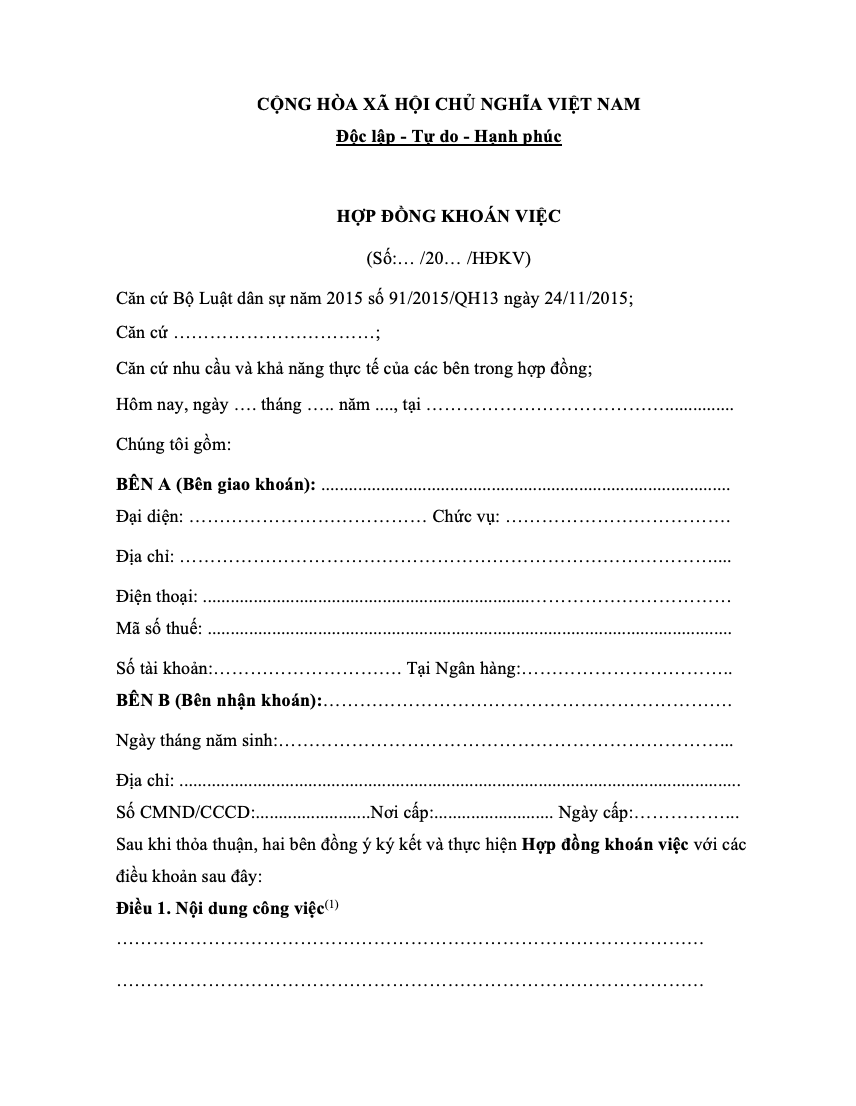
2.1. Basic work contract template
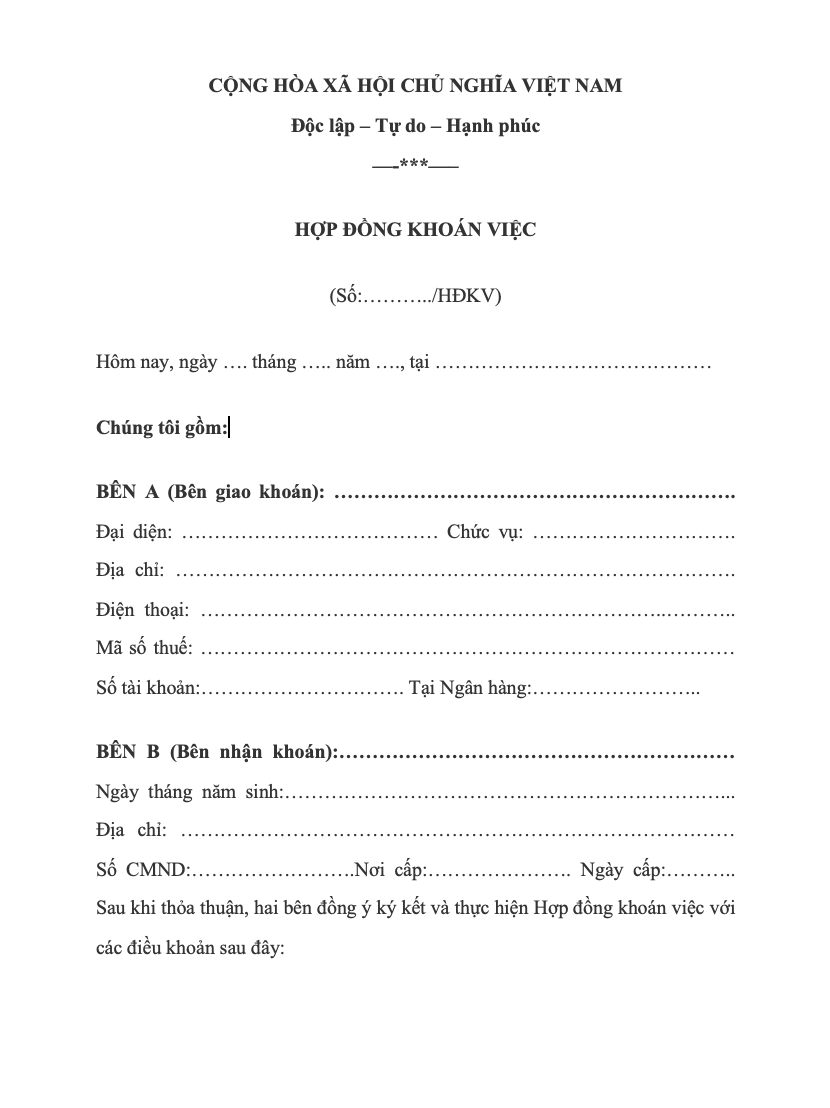
2.2. Hourly work contract template
2.3. Work contract templates by profession
Accounting work contract template
3. Regulations on work contracts
3.1. Regulations on the responsibilities and rights of the parties
In a work contract, the parties need to clearly define their responsibilities and rights to avoid disputes. Specifically:
- Assignor: Is responsible for providing complete information, materials, and tools (if any) to the contractor to perform the work as agreed. The assignor must also make payments on time, at the price committed in the contract.
- Contractor: Must complete the work according to the agreed-upon quality and time requirements. If the work is not completed on schedule or does not meet the requirements, the contractor may be liable for compensation.
3.2. Regulations on dispute resolution
To avoid disagreements during the contract’s execution, the parties should clearly state the dispute resolution clause in the work contract. According to Article 318 of the 2015 Civil Code, the parties can choose to resolve disputes through negotiation, mediation, arbitration, or court. However, if there is no agreement on the dispute resolution method, the parties will have to take the matter to court for resolution.
3.3. Regulations on contract duration and validity
Work contracts are often short-term, so the work performance period and the contract’s effective date are crucial factors. This helps the parties clearly define the work completion time, avoiding situations where the work drags on for too long or where there is ambiguity about the performance of obligations.
According to Article 394 of the 2015 Civil Code, a contract can be terminated prematurely if there is an agreement between the parties or if one party fails to fulfill its commitments. Therefore, the parties need to clarify this clause in the contract to avoid cases of non-completion of work or causing damage to the other party.
3.4. Regulations on contract adjustment
In some cases, a work contract may need to be adjusted due to changes in work performance conditions, such as changes in time, price, or work conditions. According to Article 402 of the 2015 Civil Code, if necessary changes arise, the parties can negotiate and sign a contract addendum to adjust the clauses without affecting the entire contract.
3.5. Regulations on work contracts in specific industries
In some specific industries such as construction, services, or manufacturing, work contracts may have additional specific clauses. For example, in the construction industry, the contracting party may require the contractor to ensure labor safety and comply with environmental protection regulations. These conditions must be clearly stated in the contract to ensure compliance by all parties.
3.6. Regulations on the termination of work contracts
A work contract can be terminated prematurely in some cases, such as:
- The work is completed earlier than expected.
- One of the parties breaches its contractual obligations.
- There is a mutual agreement to terminate the contract.
According to Article 411 of the 2015 Civil Code, if the contract is terminated prematurely, the breaching party may be liable for compensating the other party for damages.
3.7. Regulations on insurance
According to Vietnamese law, the contractor is not required to participate in social insurance (SI), health insurance (HI), and unemployment insurance (UI) as in a labor contract. However, if the work is long-term and continuous, the contracting party can still voluntarily register for insurance for the contractor to ensure their health and social security benefits.
In particular, according to Article 3 of Decree 145/2020/ND-CP on labor contracts, if a work contract is regular, continuous, and lasts for more than 3 months, the contracting party is responsible for enrolling the contractor in social insurance, even without the obligation to sign a formal labor contract.
3.8. Regulations on taxes
Just like other types of civil contracts, work contracts must comply with regulations on personal income tax (PIT) for the contractor. According to Article 15 of Circular 92/2015/TT-BTC, the contractor must declare and pay PIT according to the progressive tax schedule, with tax rates ranging from 5% to 35% depending on the income level.
The contracting party is responsible for withholding PIT from the contractor’s income and paying it to the tax authorities. However, if the contractor’s total income does not reach the taxable threshold, they may not have to pay PIT, and the contracting party does not need to perform this withholding.
To ensure proper compliance, businesses should require the contractor to provide documents related to taxes and insurance (if any) to complete the legal procedures.
- Important notes when signing a work contract
4. Important notes when signing a work contract
Signing a work contract is an important step in the collaboration process between parties. To ensure legal rights and avoid unnecessary disputes, both the contracting party and the contractor need to pay attention to some important points. Below are the necessary notes when signing a work contract.
4.1 Clearly define the scope of work
One of the most important factors when signing a work contract is to clearly define the scope of work. It is necessary to describe in detail the tasks the contractor must perform, the completion time, the required quality, and the work evaluation criteria. This helps ensure both parties clearly understand their obligations and avoid future misunderstandings.
- Example: If the contract relates to a construction project, it is necessary to specify the work items, materials to be used, technical standards, and labor safety requirements.
4.2 Agreement on contract value and payment method
The contract price and payment method are essential elements in a work contract. The contracting party needs to ensure that the agreed price is reasonable and will not change after the contract is signed. The payment method also
4.3 Provisions on work performance and completion time
Performance time is an essential element in a work contract. The assigning party needs to clearly define the start and end time of the work. Additionally, there should be a clause on handling cases of delays or failure to complete the work on time. This will help ensure the rights of both parties and avoid future disputes.
- Note: If the work cannot be completed on time due to force majeure, the parties should agree to adjust the timeline in the contract.
4.4 Provisions on the rights and obligations of the parties
The rights and obligations of both parties must be clarified in the work contract. The assigning party has the right to require the contractor to perform the work on schedule and meet the required quality standards. The contractor has the right to be paid in full and on time. Additionally, the parties also need to define liability for compensation in case of a contract breach.
- Example: If the contractor fails to complete the work to the required quality or on schedule, they will be liable for compensating the assigning party for damages.
4.5 Dispute resolution clause
A work contract should include a dispute resolution clause to ensure that the parties will resolve any arising issues reasonably. Dispute resolution methods may include negotiation, mediation, arbitration, or court proceedings. This clause needs to be specified in detail to avoid situations where the parties cannot resolve a dispute when a problem occurs.
- Note: The parties can agree to choose local arbitration or a court to resolve disputes quickly and effectively.
To protect their interests, the parties should store a copy of the work contract and related documents (acceptance records, payment receipts, tax and insurance documents, etc.). This storage helps the parties easily refer to and use them when necessary, especially in case of a dispute.
- Note: The work contract should be stored for at least 5 years after the contract ends to ensure the parties’ rights in resolving disputes or cross-referencing information.
5. Differentiating between a work contract and a labor contract
| Criteria | Contract for Work | Employment Contract |
| Definition | A contract between the assigning party and the receiving party to perform a specific task, which may not be time-dependent and does not require direct supervision. | A contract between an employer and an employee to establish an employment relationship, where the employee performs work under the management and supervision of the employer. |
| Purpose | To complete the work as agreed, without requiring direct supervision from the assigning party. | To ensure work is performed according to the requirements and supervision of the employer. |
| Duration | Usually short-term, tied to a specific or seasonal job. | Can be long-term or indefinite, depending on the type of employment contract. |
| Work Management | The assigning party does not need to directly supervise the work, only the result is required. | The employer supervises and manages the work, working hours, and company regulations. |
| Insurance Coverage | Participation in social insurance, health insurance, and unemployment insurance is not mandatory (unless otherwise agreed). | The employee must participate in social insurance, health insurance, and unemployment insurance. |
| Leave and Annual Leave | No leave policy as stipulated by law. | The employee is entitled to leave and annual leave as stipulated by law. |
| Remuneration | Remuneration is agreed upon as a lump sum for the completed work, and can be paid based on progress or upon completion. | Salary is paid periodically (monthly, weekly), and may include allowances and bonuses. |
| Protection of Labor Rights | Does not offer as many protections for the contractor as an employment contract does. | The employee’s labor rights are protected, including rights to salary, welfare benefits, social insurance, and health insurance. |
| Obligations of the Receiving Party | Responsible for completing the work as agreed upon without significant supervision. | Must perform work as required by the employer and comply with internal labor regulations. |
| Job Stability | The work is not stable and is usually not long-term. | The work is more stable, especially with a long-term employment contract. |
>>> See more: [Free Download] Latest Standard Labor Contract Template
6. Frequently Asked Questions about Job-based Contracts (FAQ)
Is social insurance mandatory for job-based contracts?
Under current regulations, the contractor is not required to participate in social insurance, health insurance, or unemployment insurance as with a labor contract. However, if the work is long-term, the principal can voluntarily register for insurance for the contractor to ensure their benefits.
Can a job-based contract be used for long-term work?
Job-based contracts are typically suitable for short-term, seasonal work, or projects with a clear scope. If the work is long-term and stable, a labor contract should be signed to ensure the employee’s rights.
Can a job-based contract be converted to a labor contract?
Yes. If the principal wants to manage more closely and ensure the worker’s rights, both parties can agree to sign a labor contract instead of a job-based contract.
Are job-based contracts applicable to all industries?
Job-based contracts are commonly used for industries and jobs that are seasonal, project-specific, or do not require direct supervision. However, for some specific industries or those with strict labor requirements, a job-based contract may not be suitable or may be restricted by law.
Can the principal require the contractor to pay a penalty for not completing the work on time?
Yes. The job-based contract should clearly state the clauses for handling violations, which can include penalties for breach of contract if the contractor fails to complete the work on schedule or meet the required quality.
7. Conclusion
A job-based contract is a useful tool that helps businesses be flexible in managing and utilizing human resources, especially suitable for seasonal, short-term, or project-specific work. However, to ensure the rights of both the principal and the contractor, the contract must be drafted clearly, with complete clauses on the scope of work, execution time, contract value, as well as the rights and obligations of both parties.
In addition, businesses need to comply with legal regulations on taxes, insurance, and dispute resolution to avoid unwanted risks. Choosing the right type of contract that suits the nature of the work will help optimize costs, improve management efficiency, and build a sustainable cooperative relationship between the parties.