


Levels of Management Skills – The Standard Competency Framework for Leaders


To develop leadership capabilities and effectively perform management tasks, it is essential for managers to be fully equipped with and practice the levels of skills. The levels of management skills not only help outline a development path but are also considered a competency framework for leaders in business operations. So, what are the skills of a manager? How can one achieve the different levels of management skills? Let’s find out with 1Office in the following article.
Mục lục
- 1. Why is it necessary to divide management skills into levels?
- 2. The Pyramid Model – Levels of Management Skills
- 3. Secrets to Developing the Levels of Management Skills
- 4. Other Skill Levels That Help Develop Comprehensive Management Capabilities
- 5. Maximize leadership capabilities with 1Office business management software
1. Why is it necessary to divide management skills into levels?
The levels of management skills are a framework that divides the skills a manager needs to achieve into different levels.
Dividing skills into levels helps managers have a standard reference framework to determine where their abilities stand and what skills they lack, thereby planning to cultivate, practice, and enhance their management capabilities.
Additionally, ranking competency levels also serves as a basis for developing a career progression path for leaders. The competency levels will indicate what skills a senior leader or manager needs compared to mid-level and junior managers. This is also the basis for building a management level chart.
Therefore, the levels of skills provide managers with a comprehensive picture of the qualities an executive needs, thereby developing their own capabilities to become their best.
See more: 7 important management skills for managers and 7 ways to improve your management skills
2. The Pyramid Model – Levels of Management Skills
Developing capabilities to achieve the different levels of skills is a long journey that requires managers to have a specific, scientific roadmap. To become a senior leader, one must first build a solid foundation by mastering the most basic management skills and then gradually progressing to higher levels.
Therefore, Kammy Haynes’s management skills pyramid was created as a “handbook” to guide managers on how to develop their management capabilities comprehensively. The pyramid model divides management skills into 4 levels and ranks them in order from basic to advanced. At the same time, the pyramid also shows the mutually supportive relationship between the levels.
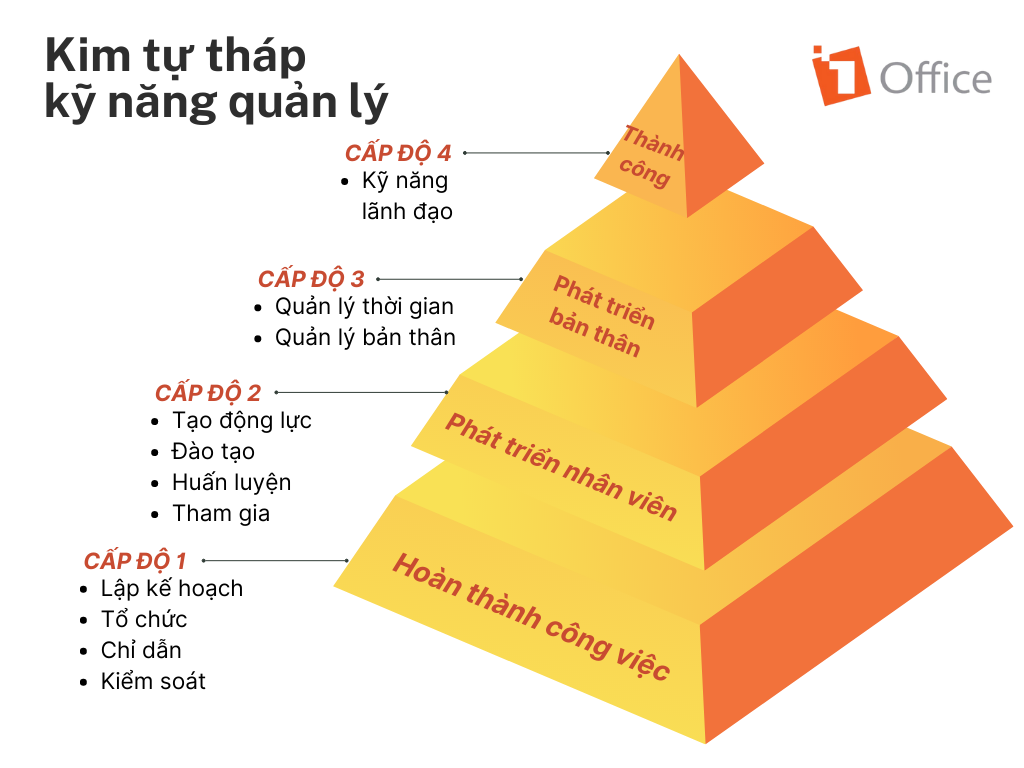
Level 1 – Getting the Work Done
The first level of the pyramid points out the fundamental skills that managers need to master. These are the principles that ensure the organization’s activities are implemented effectively and on schedule. These 4 skills also represent the main functions in management, including:
- Planning – Includes the skill of setting organizational goals and formulating strategies, allocating resources, budget, and time to achieve those goals.
- Organizing – The skill of mobilizing personnel, assigning responsibilities, and establishing processes for effective collaboration and work execution.
- Directing – Providing specific instructions and guidance to help employees perform their functions and tasks correctly; ensuring that all work proceeds in the right direction.
- Controlling – Monitoring, tracking, and reporting on costs and work quality, ensuring that results meet the set objectives. Additionally, this skill includes the ability to control risks to keep losses to a minimum.
Save for later: 4 management functions you need to know when running a business
Level 2 – Developing Employees
Moving up to a higher level in the pyramid are the people management skills that require you to influence your team to boost morale and develop employee capabilities. This set of skills is considered “soft skills” that a manager must master to use resources effectively. The skills needed to develop a team include:
- Motivating – Encouraging employee morale, creating positive incentives that drive them to work hard and strive to achieve goals.
- Training – Providing and equipping employees with the necessary professional knowledge and skills to perform their jobs well. The training skill requires managers to be proficient in all stages of the employee training process, such as identifying needs, setting training objectives, designing the training program, implementing it, and conducting post-training evaluations.
- Coaching – Creating opportunities for each member to improve performance and develop themselves; helping employees leverage their strengths and enhance their capabilities to higher levels.
- Participating – Engaging employees with their work by encouraging autonomy and participation. Also, supporting them by providing advice, new ideas, and solutions to problems.
Read now: Standard Human Resource Training and Development Process for businesses
Level 3 – Self-Development
A manager must be a person of influence for every member of the organization. However, a great manager doesn’t just focus on directing employees but also on their own personal development. This is the essence of level 3 in management skills. This level requires managers to develop two “internal” management skills:
- Time Management – Knowing how to invest and use your time effectively. A leader with good time management skills knows how to arrange and allocate tasks in their schedule for optimal results.
- Self-Management – Self-management skills are like “leading” yourself. It involves outlining plans, setting schedules, and adhering to self-imposed principles to complete work effectively. Additionally, self-management also includes the ability to achieve a work-life balance.
Level 4 – Success
The pinnacle of the pyramid, and the ultimate goal for every manager, is leadership skill.
While leaders often start as managers, not all managers are leaders. Leaders focus on setting direction, vision, and ensuring strategies align with the company’s values and mission. Simply put, leaders work based on vision and direction, which sets them apart from managers.
Therefore, achieving this skill means you have reached the highest peak of management skills.
3. Secrets to Developing the Levels of Management Skills
Build a Development Roadmap
The management skills pyramid is an excellent tool for leaders to build a development and advancement roadmap for themselves. In the roadmap, you need to clarify where you stand on the pyramid and where you want to go, in order to devise suitable development strategies.
Cultivate Missing Skills
Always be conscious of cultivating the skills you lack to fill in the levels of the pyramid. Only when the management pyramid is complete can you fully develop your management capabilities.
Integrate Skills and Talents
Skillfully combining leadership skills with your personal talents can create an advantage for building your personal brand. For example, being a good speaker helps a leader easily win the favor of team members, thereby managing personnel and motivating employees more effectively.
Develop Skill Levels Concurrently
Remember that the journey of developing management competency levels is a long-term plan that requires continuous effort. Your development process doesn’t necessarily have to proceed sequentially from the bottom of the pyramid to the top. And if you find yourself wandering between levels of the management skills pyramid, that’s perfectly fine! All management skills can be built upon and honed simultaneously to become as comprehensive as possible.
4. Other Skill Levels That Help Develop Comprehensive Management Capabilities
Levels of Communication Skills
Communication ability is also one of the indispensable skills for a manager. It is an effective tool for conveying information and building effective relationships. Communication skills are developed through the following levels:
| Level 1 – Basic Communication | The basic level of communication requires managers to have the skill of conveying information to everyone, ensuring accuracy and clarity. It is important to note that the information must be delivered to the right audience and in an appropriate context. |
| Level 2 – Proficient Communication | Managers achieve proficient communication skills when they can flexibly use both verbal and non-verbal communication to enrich their delivery methods. This communication skill can help create a good impression and make others receive information positively. |
| Level 3 – Good Communication | At this level, managers need to have the skills to handle situations that arise during communication, such as conflicts and disagreements. This level requires tact and flexibility in using a combination of words and actions to avoid damaging relationships. |
| Level 4 – Excellent Communication | Upon reaching the highest level of communication, a leader is fully capable of mastering conversations. The pinnacle of the art of communication is persuading and getting others to agree with one’s opinions and viewpoints. Once this skill is mastered, a manager will have the ability to effectively guide and lead team members, thereby building a cohesive organization. |
The levels of presentation skills
A good manager is someone who can confidently present in front of a crowd. Presentation skills not only allow you to convey your message effectively but also enable you to engage and persuade others. A presentation style can also build a personal brand for a leader. To develop your presentation skills, you need to go through the following levels:
| Level 1 – Presentation based on personal understanding |
|
| Level 2 – Based on group research |
|
| Level 3 – Based on self-research |
|
| Level 4 – Based on personal research and experience |
|
The Levels of Listening Skills
Listening skills help leaders proactively and effectively grasp the flow of information within the company. Additionally, this skill helps you “read” the thoughts and emotions of employees to understand what they desire and what issues are hindering them at work. This enables managers to develop suitable strategies to support and boost their team’s productivity.
The levels of listening skills you need to practice are shown in the following table:
| Level 1 – Passive Listening | At this level, the listener pays little attention to the content being discussed, grasps very little information, and may miss some important details. |
| Level 2 – Selective Listening | Selective listening is when the listener does not pay attention to the entire message but only remembers certain content that captures their interest or is relevant to them. |
| Level 3 – Responsive Listening | At this level, the listener provides feedback to the speaker by asking for more information or paraphrasing the message to ensure both parties clearly understand each other’s intent. By listening responsively, the listener is more engaged, focuses their intellect on the listening process, and can understand more information than at previous levels. |
| Level 4 – Empathetic Listening | When listening empathetically, the listener tries to step outside their own perspective and see things from the speaker’s point of view. This is not just about understanding what the person is saying and feeling, but also about sympathizing with it and making an effort to communicate this understanding back to the speaker. |
5. Maximize leadership capabilities with 1Office business management software
To lead a business to success, in addition to being fully equipped with all skill levels, leaders also need to flexibly use support tools to best optimize management.
1Office is the most outstanding business management software on the market today. Not only does it provide the most superior set of business management tools, but 1Office also offers a working ecosystem where all of a company’s operational activities can be digitized on the software.
The main modules of the 1Office all-in-one business management platform include:
- HRM Module – Optimizes human resource management processes with a full range of features: employee profile management, payroll and bonus calculation, compensation and benefits policies, performance management, recruitment & training,…
- WORKPLACE Module – Provides an internal network to help members communicate & exchange information effectively; manages tasks and projects by process, tracks & monitors progress 24/7.
- CRM Module – Offers the most professional toolset for managing Marketing, Sales & Customer Care; helping to improve service quality and boost revenue.
- ADVANCE Module – Automates 90% of business operation processes, minimizing traditional manual tasks
This article from 1Office has provided readers with the levels of skills that a manager needs to achieve to enhance their management capabilities, while also presenting an effective business management technology solution. For a free consultation and a trial experience of the 1Office sales management software, please contact us using the information below.
For more details, please see:
- Hotline: 083 483 8888
- Fanpage: https://www.facebook.com/1officevn/
- Youtube: https://www.youtube.com/channel/UCeTIRNqxaTwk0_kcTw6SxmA




