


What Are B2B and B2C? A Detailed Comparison & How to Choose the Right Fit


B2B and B2C are two popular business models, but many businesses still get confused about their target customers, sales methods, and implementation strategies. Clearly understanding the differences between these two models will help businesses choose the right direction and optimize their business efficiency. In this article, 1Office will help you clearly understand what B2B and B2C are, provide a detailed comparison, and explain how to apply them in practice.
Mục lục
- I. What are the B2B and B2C business models?
- II. Comparing B2B and B2C
- V. Building an effective business model with 1Office’s CRM software
- VI. Frequently Asked Questions about B2B and B2C models (FAQs)
- VII. Conclusion
I. What are the B2B and B2C business models?
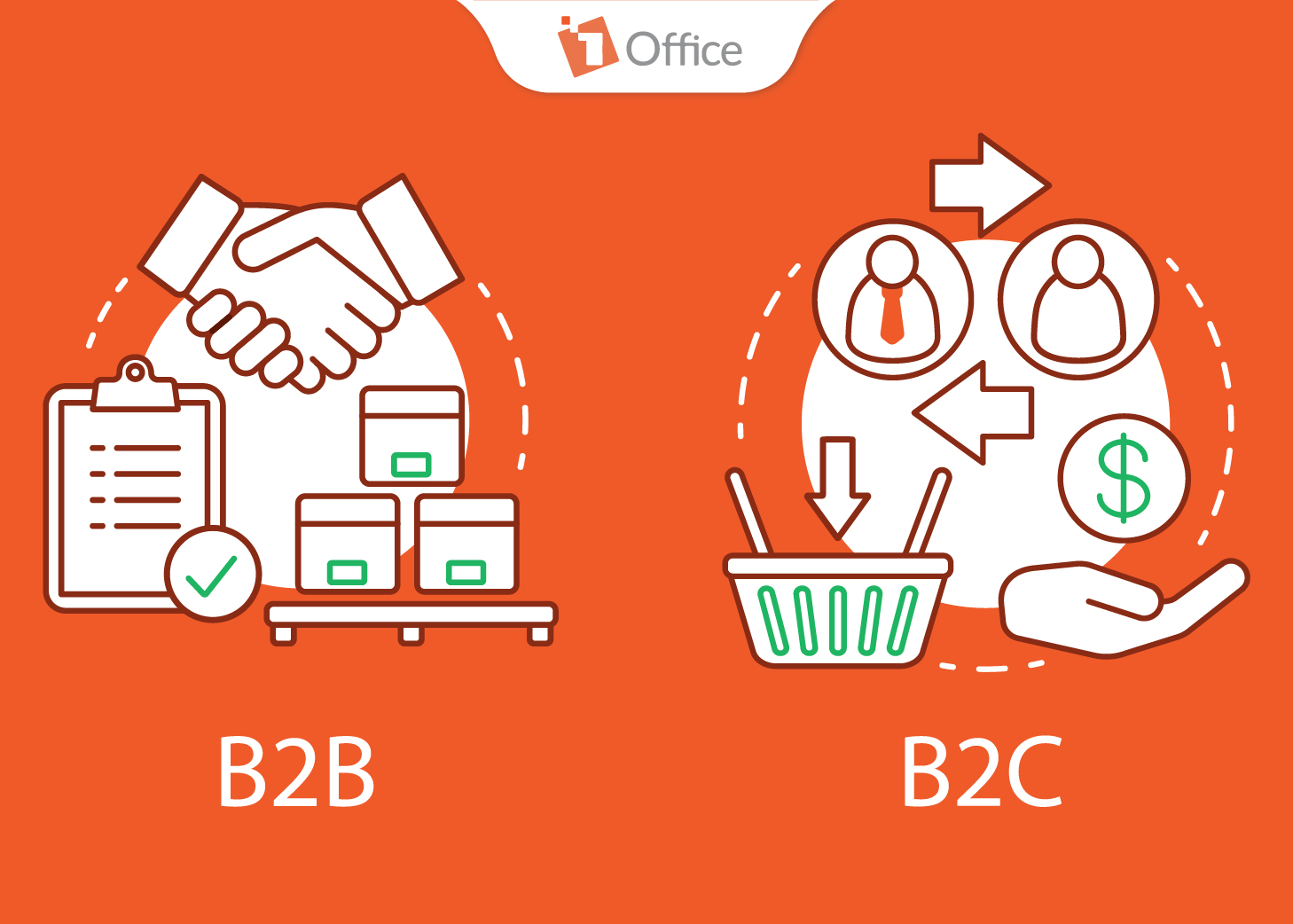
The B2B and B2C business models are two basic forms of transactions in the economy, distinguished by their target audience: B2B focuses on commercial transactions between businesses, while B2C is geared towards providing products and services directly to individual consumers.
- B2B (Business-to-Business): This is an e-commerce business model where transactions occur directly between businesses. Transactions between companies often begin with electronic communications, including communication via e-commerce platforms.
- B2C (Business-to-Customer): These are commercial transactions between a business and individual customers via the Internet. This model applies to any business or organization that sells its products or services to customers over the Internet for personal use.
Regarding these two business models, many managers have compared B2B and B2C to determine which model is suitable to follow and develop. However, in terms of transaction methods, the B2B transaction model is currently the dominant choice when businesses build e-commerce websites.
At the same time, the direction of Vietnamese businesses is also in line with the global trend, using the B2B transaction method as a driving force for e-commerce development and thereby enhancing the competitiveness of enterprises.
Read more: What is B2B? Characteristics and popular B2B business models
II. Comparing B2B and B2C
In business operations, the two most common models are B2B (Business to Business) and B2C (Business to Consumer). Both aim to sell, but they differ significantly in terms of target customers, purchasing cycles, approaches, and marketing strategies. Understanding the difference between B2B and B2C will help businesses choose the right direction.
2.1. Comparing B2B and B2C: Business Model Characteristics
These two popular models often leave many managers wondering, as they have not clearly defined the customer factors, operational methods, and marketing approaches. So, let’s explore the differences between B2B and B2C
| Comparison Factor | B2B | B2C |
|
Target Audience |
Companies |
|
|
Negotiation, Transaction |
Includes factors such as price negotiation, goods delivery, and determining the specifications and technical characteristics of the product. | Does not necessarily include all factors like price, goods delivery, and technical characteristics of the product. |
|
Integration Issues |
It is necessary to ensure that their systems can communicate with each other without direct human intervention | Companies in B2C e-commerce do not have to integrate their systems with their customers’ systems |
|
Marketing Activities |
Marketing targeted at businesses | Marketing targeted at individual customers |
|
Sales Process |
|
|
2.2. The Difference Between B2B and B2C: Types of Operating Models
Popular B2B Models in Vietnam Today
- Seller-Centric B2B Model
With this model, a business that owns an e-commerce site will provide various products and services to retailers and manufacturers.
- Buyer-Centric B2B Model
Companies operating under this model will be responsible for importing goods from manufacturers. Meanwhile, manufacturing companies will visit the website to provide quotes and distribute their products.
- Intermediary B2B Model
In this model, buyers and sellers connect through an e-commerce marketplace. Websites like Sendo, Tiki, Shopee, etc., operate on this model.
- Collaborative Commerce B2B Model
This model is similar to the intermediary B2B model. However, it is more centralized and owned by multiple businesses. This model is often presented in the form of an e-marketplace.
| Read more: Standard 7-Step B2B Sales Process for Every Business |
Popular B2C Models in Vietnam Today
- Direct Seller B2C Model
This is manifested through online retailers. The suppliers here can be small or micro-enterprises, or simply the online version of grocery stores.
- Online Intermediary B2C
These are forms of commerce conducted through e-commerce platforms like Shopee, Lazada, Tiki, etc. It can be said that, compared to the traditional B2C model, the intermediary B2C model is gradually gaining a significant advantage and may very well replace a large part of the direct seller model in the future.
- Advertising-Based B2C
This model uses SEO tools to increase search rankings on Google and attract more free traffic.
- Community-Based B2C
Social media communities are built around the interests of a potential customer group. Based on this factor, businesses can reach consumers, using advertising and marketing methods appropriate to their goals.
| Boost sales with: The B2B Sales Handbook for Businesses |
2.3. Comparing B2B Marketing and B2C Marketing
B2B (business-to-business) marketing and B2C (business-to-consumer) marketing share the same goal of driving sales, but their implementation methods are distinctly different. The differences stem from the target audience, decision-making behavior, communication channels, and message construction. Understanding these differences helps businesses choose more effective marketing strategies for each market.
Decision-Makers
The purchasing decision-maker is the target customer that businesses in the B2B and B2C models target.
- For B2B: The decision-maker is an individual or a leader at the head of an organization
- For B2C: Targets decision-makers within households
Motivation and Purchasing Process
- For B2C customers: their decisions are personal and often made quite quickly, easily influenced by various surrounding factors such as advertising, word-of-mouth, reviews, promotions, and discounts.
- As for B2B customers: the purchasing decision is made from the perspective of the entire organization’s interests and is therefore under pressure. Additionally, B2B products and services involve a relatively complex process, so buyers need to consider carefully, gather information from multiple parties, and try the product before making a decision.
|
Read more: The 4Cs of Marketing – The Solution to the Marketing 4.0 Problem |
2.4. How to Build Customer Relationships in B2B and B2C
Customer relationships are not just about sales transactions; they are the key for businesses to maintain long-term growth. However, depending on the specific nature of B2B (Business to Business) or B2C (Business to Consumer), the approach to building and maintaining these relationships will differ significantly.
In B2B: Building Trust and Long-Term Relationships
Customers in B2B are typically businesses, organizations, or agencies, where the decision-making process is complex, lengthy, and involves multiple stakeholders. Therefore, building relationships in B2B requires patience, professionalism, and a long-term partnership orientation.
Key factors in building B2B relationships:
-
Personalized services: Each business has unique needs, so solutions must be “tailor-made” rather than mass-produced.
-
Value-based consulting instead of just selling products: B2B customers are more concerned with ROI (Return on Investment), operational efficiency, and cost reduction.
-
Trust and brand reputation: A B2B contract often has a high value, and customers will only sign when they have absolute confidence in the provider’s capabilities and commitment.
-
In-depth after-sales care: Continuous maintenance, training, and technical support help strengthen relationships and create opportunities for cross-selling and up-selling.
-
Creating community value: Organizing seminars, workshops, and networking events helps increase engagement and affirm credibility.
Real-life examples:
-
IBM builds B2B relationships by providing not just software but also comprehensive solutions, implementation consulting, and a 24/7 support team.
-
FPT Software (Vietnam) often organizes technology seminars for businesses, both to introduce products and to create networking opportunities, thereby maintaining long-term customer relationships.
In B2C: Winning Emotions and Delivering Fast Experiences
Customers in B2C are individual consumers, and their purchasing behavior is often emotional, fast, and involves few decision-makers. Businesses must focus on creating the most positive and convenient experience for customers.
Key factors in building B2C relationships:
-
Smooth shopping experience: Websites and apps must be easy to use, with fast checkout and on-time delivery.
-
Friendly and flexible customer service: 24/7 hotline, clear return/exchange policies, and enthusiastic customer support staff.
-
Attractive promotional campaigns: Flash sales, vouchers, and loyalty cards help motivate repeat purchases.
-
Frequent communication via digital channels: Email, social media, and chatbots to make customers feel valued.
-
Building a customer community: Fanpages, groups, forums, etc., to increase engagement and brand advocacy.
Real-life examples:
-
Starbucks succeeds thanks to its loyalty program (Starbucks Rewards), creating a feeling of “special care” for each customer.
-
Shopee and Tiki in Vietnam maintain B2C relationships through flash sale programs, free shipping, livestream selling, and 24/7 chatbot support.
| Criteria | B2B (Business-to-Business) | B2C (Business-to-Consumer) |
|---|---|---|
| Relationship Characteristics | Long-term, strong, strategic partnership | Short-term, heavily dependent on immediate experience |
| Purchasing Decision | Multiple stakeholders, complex process | Individual decision, often quick |
| Key Factors | Trust, reputation, expertise, ROI | Experience, emotion, convenience, price |
| Relationship Nurturing Activities | Solution consulting, seminars, after-sales care | Promotions, 24/7 customer support, loyalty programs |
| Typical Examples | IBM, FPT Software | Starbucks, Shopee, Tiki |
V. Building an effective business model with 1Office’s CRM software
1Office is an all-in-one business management software with a customer base of over 5000+ businesses. When using 1Office’s human resource management (HRM), customer relationship management (CRM), and work management (Workplace) modules, you will receive the following benefits:
- Store customer data directly on the system
- Generate automatic sales reports and marketing campaign reports in various formats: Kanban, Gantt chart, etc.
- Standardize the marketing implementation process: Project progress is displayed directly on the system, helping both managers and employees track work progress.
- Assigning tasks has never been easier: With just one click, a manager can assign tasks to their subordinates, and the system will automatically notify the authorized individual of the tasks to be performed.
VI. Frequently Asked Questions about B2B and B2C models (FAQs)
What is the most important difference between B2B and B2C Marketing?
- B2B Marketing focuses on economic value, logic, and long-term trust because purchasing decisions affect the entire organization.
- B2C Marketing prioritizes appealing to emotions, immediate experience, and convenience to encourage individuals to make quick purchases.
Why is the B2B sales process typically longer than B2C?
Due to the high value and direct impact on operations of B2B orders, the process requires the involvement of multiple parties (management, accounting, technical) and goes through many stages of trials and negotiations. In contrast, B2C customers make decisions based on personal needs, so the buying cycle is very short.
Can a business implement both B2B and B2C models simultaneously?
Absolutely. Many businesses today adopt a hybrid model to maximize revenue. However, it is necessary to separate customer care strategies and data management systems to ensure a suitable experience for each target group.
Which communication channels are most effective for each model?
- B2B: Prioritize highly professional channels such as LinkedIn, personalized email marketing, industry webinars, and in-depth analysis articles (Case studies).
- B2C: Focus on popular social networks (Facebook, TikTok, Instagram), display advertising, and e-commerce platforms (Shopee, Lazada).
How to manage a huge customer base of both B2B and B2C without confusion?
Businesses should use the 1Office CRM system to intelligently classify customer data. This tool helps digitize the process from approach and quotation to after-sales care, allowing managers to track the progress and behavior of customers from both models on a single platform.
Register for a free feature Demo!
VII. Conclusion
The above is a general comparison of the differences between B2B and B2C. We hope it will be helpful for readers and managers who are considering which of these two business models to apply. If you are looking for an effective solution to manage your business operations, please contact us for dedicated consultation from our experts.
- Hotline: 083 483 8888
- Fanpage: https://www.facebook.com/1officevn/
- Youtube: https://www.youtube.com/channel/UCeTIRNqxaTwk0_kcTw6SxmA




