


 11/05/2026
  321 views
Are you looking for a way to analyze competitors to optimize your business strategy? The Competitive Profile Matrix (CPM) is a powerful tool that helps you evaluate key competitors accurately and quickly. In this article, we will explain what the CPM is, provide detailed instructions on how to build it, and apply the matrix to your competitive strategy in practice. Join 1Office to discover how to correctly assess the strengths and weaknesses of your competitors, thereby making the right strategic decisions for your business.
Mục lục
- 1. What is the CPM Matrix?
- 2. When to Use the CPM Matrix
- 3. Structure of the CPM Matrix
- 4. Detailed Steps to Build a CPM Matrix
- 5. Practical example of a CPM matrix
- 6. Advantages and Limitations of the CPM Matrix
- 7. Comparing CPM with SWOT, BCG Matrix, and PEST
- 8. Notes for CEOs/Managers when applying the CPM matrix
- 9. Conclusion
1. What is the CPM Matrix?

The Competitive Profile Matrix (CPM) is a strategic tool used to evaluate and compare competitors within an industry or market. Developed within the framework of business strategy research, the CPM helps businesses better understand their competitive position relative to their rivals, enabling them to make sound and effective strategic decisions.
- Assess competitive position: The matrix helps a business clearly identify its position relative to competitors, thereby discovering the strengths and weaknesses of both itself and its rivals.
- Provide a foundation for strategic decisions: By evaluating the most critical factors in the industry, the CPM provides a basis for managers to formulate effective development and competitive strategies.
- Support market analysis: The CPM helps identify key factors that a business needs to focus on improving to enhance its competitiveness, while also helping to uncover new opportunities and challenges in the industry.
2. When to Use the CPM Matrix

2.1. When building a business strategy
- The CPM helps you evaluate and compare competitors in the industry, thereby identifying the key factors to focus on in your business’s development strategy.
- Use the CPM when you want to identify the strengths and weaknesses of your competitors to find strategic opportunities.
2.2. When analyzing competitors
- If you need a clear and comprehensive view of your competitive position relative to your rivals, the CPM is the ideal tool.
- It helps you assess what your competitors are doing well and identify areas where you can improve.
2.3. During marketing planning
- The CPM helps identify critical success factors in marketing, thereby optimizing marketing and product distribution strategies to fit the market.
- For example, you can use the CPM to evaluate competitors’ implementation of communication strategies, pricing, customer service, etc.
2.4. When repositioning a brand
- If your business is looking to change its image or brand strategy, the CPM can help you re-evaluate your brand’s current position in the eyes of customers and compared to competitors.
- It also provides information on the key factors you need to improve to succeed in the repositioning process.
2.5. When conducting a SWOT analysis
- The CPM is an effective complementary tool for a SWOT (Strengths, Weaknesses, Opportunities, Threats) analysis. After identifying your own strengths and weaknesses, you can use the CPM to compare them with competitors and identify opportunities and threats in the market.
2.6. When evaluating the effectiveness of the current strategy
- If you are reviewing your current business or marketing strategy, the CPM can help you identify important factors that your business has not fully exploited or areas where competitors are performing better.
3. Structure of the CPM Matrix
3.1. Critical Success Factors (CSFs)
Definition: Critical Success Factors (CSFs) are the key elements that a business must perform well to achieve success in its industry. These factors can include product quality, brand value, innovation capability, customer service, or product distribution capabilities.
Role in the CPM Matrix: CSFs are the foundation of the CPM because they represent the areas where businesses in the industry must excel to maintain and expand their competitive position. These factors must be identified based on a thorough analysis of the market and competitors.
Examples:
- Market share: In the mobile phone industry, market share is a crucial factor for evaluating success.
- Innovation capability: For the technology industry, the ability to launch new products and innovate technologically is also a decisive factor.
- Customer service quality: In the retail industry, customer satisfaction plays a vital role in retaining consumers.
3.2. Weight
Definition: Weight is the level of importance of each success factor to the overall success of the industry or business. The weight typically ranges from 0 to 1, and the sum of all weights must equal 1.
Role in the CPM matrix: Weight helps determine the degree of influence of each success factor on the business’s success. Factors with a high weight indicate they are more important, and the business needs to invest more in those factors.
Assigning Weights: Assigning weights must be based on a strategic assessment of the industry and the specific characteristics of the business. For example, in the retail industry, the customer service factor may have a higher weight than the pricing strategy factor, as customers place great importance on the shopping experience.
Example:
- Market Share: Weight 0.3
- Product Quality: Weight 0.4
- Price: Weight 0.2
- Customer Service: Weight 0.1
3.3. Rating
Definition: The rating assesses how effectively each competitor performs on the key success factors. The score is usually graded from 1 to 4 or 1 to 5, with the following assessment levels:
- 1: Poor – The business or competitor does not perform the factor effectively.
- 2: Average – The business performs the factor at a moderate level.
- 3: Good – The business performs the factor quite well.
- 4: Excellent – The business performs the factor very well and surpasses competitors.
Role in the CPM matrix: The rating helps quantify the effectiveness of competitors in each factor, thereby providing a clear view of the competitive landscape of companies in the industry.
Example:
Market Share:
- Coca-Cola: 4 (Very Strong)
- Pepsi: 3 (Good)
Product Quality:
- Coca-Cola: 4 (Excellent)
- Pepsi: 3 (Good)
3.4. Weighted Score
Definition: The weighted score is the result of multiplying the weight by the rating for each key success factor. The total weighted score for each competitor indicates their overall competitive position in the industry. The weighted score is calculated as follows:
Weighted Score = Rating x Weight
Role in the CPM matrix: The weighted score provides an overall view of each competitor’s competitive level across important factors. A competitor with a higher total weighted score can be considered to have a stronger competitive strategy.
Example:
Coca-Cola:
- Market Share: 0.3×4=1.2
- Product Quality: 0.4×4=1.6
- Price: 0.2×3=0.6
- Customer Service: 0.1×4=0.4
=> Total Weighted Score = 1.2 + 1.6 + 0.6 + 0.4 = 3.8
Pepsi:
- Market Share: 0.3×3=0.9
- Product Quality: 0.4×3=1.2
- Price: 0.2×3=0.6
- Customer Service: 0.1×4=0.4
- Total Weighted Score = 0.9 + 1.2 + 0.6 + 0.4 = 3.1
In summary, the structure of the CPM matrix:
- Key Success Factors (CSFs): The factors that determine success in the industry.
- Weight: Assesses the importance of each success factor.
- Rating: Assesses the performance of each competitor on the factors.
- Weighted Score: Calculates the overall competitive strength of the competitor.
This structure helps managers and CEOs gain deep insights into their company’s competitive position relative to its rivals, enabling them to decide on appropriate strategies.
4. Detailed Steps to Build a CPM Matrix
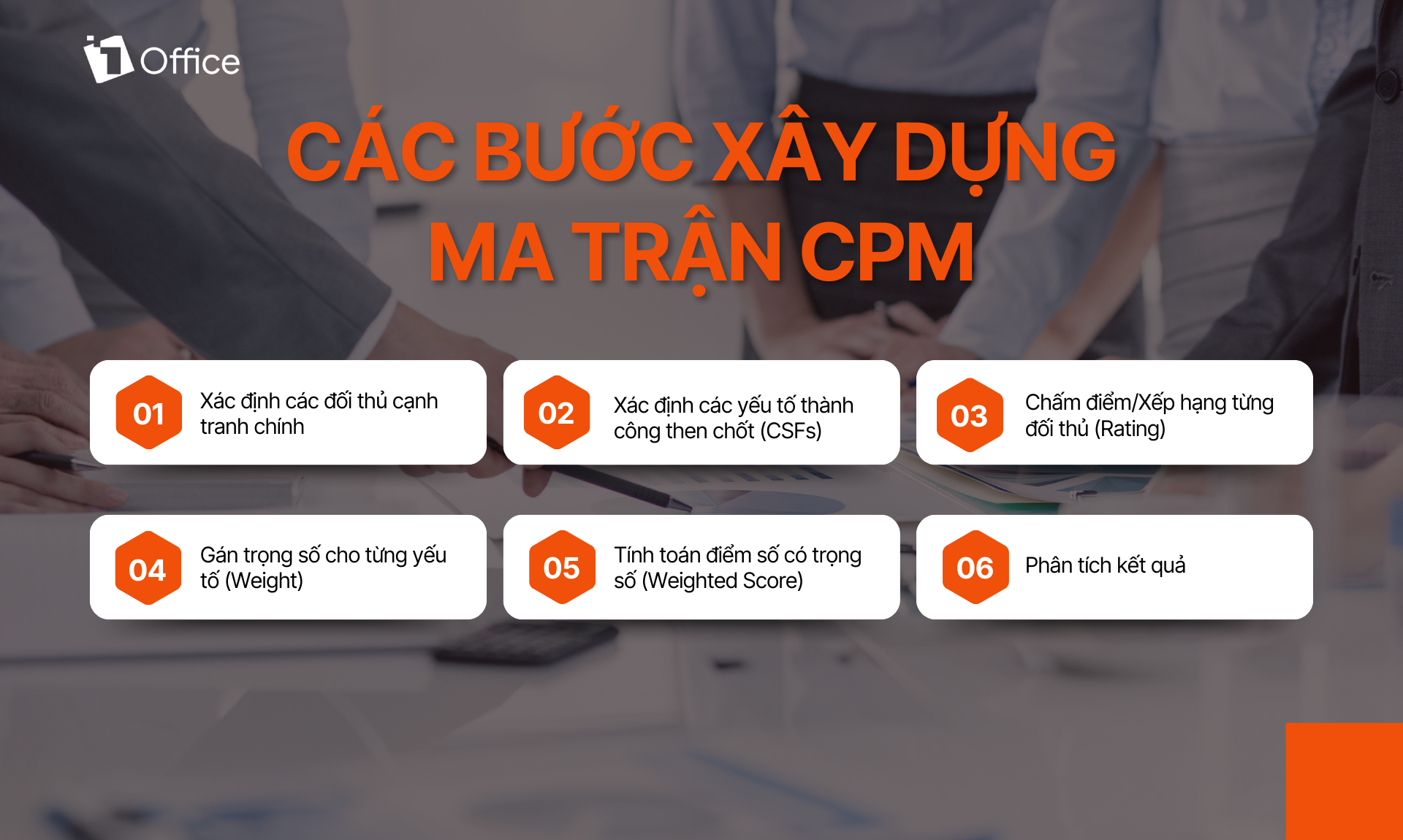
4.1. Step 1: Identify Key Competitors
Objective: First, you need to identify the direct competitors in your industry or field. These competitors can be companies operating in the same market segment or offering similar products/services.
How to do it:
- List all major and minor competitors in the same industry.
- If you are a new business, you can consult market research and industry reports to identify key competitors.
Example: If you are in the beverage business, key competitors could be Coca-Cola, Pepsi, TH True Milk, etc.
4.2. Step 2: Identify Key Success Factors (CSFs)
Objective: Key Success Factors (CSFs) are the critical elements that help a business compete effectively in its industry. These can be factors such as product quality, market share, price, customer service, innovation, etc.
How to do it:
- Based on market analysis and industry specifics, identify the most important factors for success.
- These factors can be identified through SWOT analysis, expert interviews, or by consulting industry reports.
Example: In the mobile phone industry, key success factors may include:
- Market share
- Product quality
- Technological innovation capability
- Distribution network
- Pricing strategy
4.3. Step 3: Assign a weight to each factor (Weight)
Objective: The weight determines the importance of each factor to the overall success of the business in the industry. The weight for each factor will range from 0 to 1, and the sum of all weights in the matrix must equal 1.
How to do it:
- Determine the importance of each factor to the industry or business.
- Consider the factors based on the business’s strategy and objectives.
- Allocate weights so that the total weight is 1.
Example:
- Market share: 0.3
- Product quality: 0.4
- Innovation capability: 0.2
- Customer service: 0.1
4.4. Step 4: Rate each competitor (Rating)
Objective: Evaluate how successfully each competitor is performing on the key success factors. Each competitor will receive a rating from 1 to 4 (or 1 to 5) for each factor:
- 1: Poor – The business or competitor is not performing the factor effectively.
- 2: Average – The business is performing the factor at a moderate level.
- 3: Good – The business is performing the factor quite well.
- 4: Excellent – The business is performing the factor very well and surpasses competitors.
How to do it:
- Evaluate each competitor based on actual data and perceptions of their effectiveness for each factor.
- Each competitor will have a score for each success factor.
Example:
- Coca-Cola has excellent product quality (4), while Pepsi has good product quality (3).
4.5. Step 5: Calculate the weighted score (Weighted Score)
Objective: Calculate the weighted score for each competitor, helping you compare their overall competitiveness. The total score for each factor is the result of multiplying the weight by the rating.
How to do it:
- Multiply the weight of each factor by the corresponding competitor’s rating.
- Sum the weighted scores of all factors to get a total score for each competitor.
Formula: Total Score = Weight x Rating
4.6. Step 6: Analyze the results
Objective: After calculating the total scores, you can compare competitors based on their total weighted scores. The competitor with the higher total score is considered to have a stronger competitive position in the industry.
How to do it:
- Analyze the factors where each competitor is strong or weak.
- Identify strategic opportunities and challenges for your own business based on the analysis.
Example: Based on the results, Coca-Cola has a higher total score than Pepsi, indicating that Coca-Cola has a clear competitive advantage in market share and product quality. However, Pepsi can focus on improving its innovation capability to close the gap.
5. Practical example of a CPM matrix
| Factor | Weight | Coca-Cola | Company A | Company B | |||
| Rating | Score | Rating | Score | Rating | Score | ||
| Market Share | 0.3 | 4 | 1.2 | 3 | 0.9 | 2 | 0.6 |
| Product Quality | 0.3 | 4 | 1.2 | 3 | 0.9 | 4 | 1.2 |
| Innovation Capability | 0.2 | 3 | 0.6 | 3 | 0.6 | 3 | 0.6 |
| Pricing Strategy | 0.1 | 3 | 0.3 | 3 | 0.3 | 4 | 0.4 |
| Customer Service and Distribution | 0.1 | 4 | 0.4 | 3 | 0.3 | 3 | 0.3 |
| Total | 1 | 3.7 | 3 | 3.1 | |||
Conclusion:
- Coca-Cola has the highest total score of 3.7, demonstrating their leadership in the beverage industry in terms of market share, product quality, and customer service.
- Company A achieved an average score of 3.0, remaining a strong competitor, but needs to improve in factors such as market share and customer service.
- Company B has a total score of 3.1, with strengths in product quality and pricing strategy, but is weak in market share and customer service.
6. Advantages and Limitations of the CPM Matrix
6.1. Advantages of the CPM Matrix
Clear Competitive Assessment:
- The CPM matrix provides a visual and systematic overview of a company’s competitive position relative to its industry rivals. This helps managers better understand the factors influencing the success of both their competitors and their own business.
Aids in Accurate Strategic Decision-Making:
- With information on key success factors and the evaluation of each competitor, the CPM matrix helps businesses identify areas for improvement and potential opportunities in their strategy. This assists managers in making sound strategic decisions.
Provides a Comprehensive and Detailed View:
- By evaluating critical factors such as market share, product quality, pricing strategy, and customer service, the CPM matrix helps businesses gain a comprehensive perspective on the market and their competitors.
Easy to Use and Apply:
- The CPM matrix has a simple structure that is easy to understand and apply, even for those without deep expertise in strategic analysis.
Supports Long-Term Strategic Analysis:
- By providing a comprehensive analysis of competitive factors, the CPM matrix can help businesses formulate long-term strategic plans, especially in comparing and tracking competitor changes over time.
6.2. Limitations of the CPM Matrix
Subjectivity in Evaluation:
- The process of scoring competitors and assigning weights to each factor in the CPM matrix can be influenced by the personal opinions of the analyst. This can lead to bias in the analysis and inaccurate results.
Does Not Reflect Factors Beyond Control:
- The CPM matrix focuses only on key success factors that a business can control or influence. However, factors such as market fluctuations, changes in customer behavior, or impacts from external elements like the macroeconomic environment and politics are not fully considered.
Does Not Fully Reflect Market Changes:
- The CPM matrix may not promptly reflect rapid changes in the industry or newly emerging factors. These changes can reduce the accuracy of the matrix over the long term.
Does Not Provide Detailed Competitor Information:
- Although the CPM matrix helps in comparing competitors overall, it does not delve into a detailed analysis of smaller factors or the specific strategies of each rival. This information can be crucial for making detailed strategic decisions.
Requires Frequent Updates:
- To maintain its accuracy, the CPM matrix needs to be updated regularly due to changes in the market and competitors. This can be time-consuming and resource-intensive for businesses.
7. Comparing CPM with SWOT, BCG Matrix, and PEST
| Criteria | CPM Matrix | SWOT | BCG Matrix | PEST |
| Purpose | Evaluate and compare competitors | Analyze strengths, weaknesses, opportunities, and threats | Classify products or business units | Analyze macro-environmental factors |
| Scope of Application | Competitors within the same industry | Comprehensive, applicable to any business or project | Products and business units within the company | External factors affecting the business |
| Key Components | Critical Success Factors (CSFs), scores, weights | Strengths, weaknesses, opportunities, threats | Market share and growth rate of the product | Political, Economic, Social, Technological |
| Level of Detail | Detailed in competitor analysis | Overall and internal business analysis | Detailed analysis of the company’s products | Analysis of the company’s external environment |
| Information Provided | Compares competitors on competitive factors | Analyzes the internal business and its environment | Classifies products/projects according to the matrix | Analyzes macro factors affecting strategy |
| Decision Support Capability | Helps in making competitive strategy decisions | Helps in making overall strategic decisions | Helps in deciding on product investment strategies | Helps understand external factors impacting strategy |
| Advantages | Provides a visual assessment of competitive position, easy to use | Provides a comprehensive overview and is easy to use | Useful for classifying and investing in products | Comprehensive analysis of the macro-environment, supports long-term strategic planning |
| Limitations | Subjectivity in scoring and assigning weights | Lacks detail and can be complex to apply | Only applicable to products or business units | Cannot analyze specific factors in detail, only provides a macro view |
Read more:
>>> What is the BCG Matrix? A detailed guide to analysis and application for businesses
>>> The PEST Model: How to apply it with detailed illustrative examples
8. Notes for CEOs/Managers when applying the CPM matrix
Accurately identify Critical Success Factors (CSFs)
Critical Success Factors (CSFs) play a crucial role in the CPM matrix as they are the determinants of success in the industry.
- Note: Ensure that these factors accurately reflect the reality of the industry and the business. CSFs must be identified based on market analysis, expert consultation, and key competitive factors in the industry.
Recommendation: CEOs and managers should regularly re-evaluate these factors to ensure the CPM matrix remains updated and relevant to the market situation.
Assign appropriate weights to the factors
Weights determine the importance of each success factor to the overall success of the business.
- Note: The allocation of weights must be based on the company’s long-term strategy and objectives. Weights should be distributed to accurately reflect the impact of each factor on the company’s success.
- Recommendation: Weights should be updated periodically according to changes in the market and industry to accurately reflect shifts in customer demand and competitive factors.
Score competitors objectively
Scores help assess a competitor’s level of success in each factor. However, scoring can be influenced by subjectivity.
- Note: CEOs and managers should rely on actual data and objective analysis when evaluating competitors. Avoid incorporating emotional or biased factors.
- Recommendation: Involve multiple departments (marketing, sales, market research, etc.) in the scoring process to increase objectivity and ensure accuracy.
Update and monitor regularly
The CPM matrix is not a static tool. Competitive factors and competitors’ positions can change over time.
- Note: CEOs and managers should update the CPM matrix periodically, at least quarterly or whenever there is a significant change in the industry.
- Recommendation: Use the CPM matrix not only for current analysis but also to predict future trends, thereby building flexible and adaptive strategies.
Consider factors outside the CPM matrix
The CPM matrix focuses only on internal competitive factors and competitors, not covering macroeconomic factors or elements beyond the company’s control.
- Note: CEOs and managers should not rely solely on the CPM matrix for strategic decisions but should combine it with other analytical tools like SWOT, PEST, and Market Analysis.
- Recommendation: The CPM matrix should be used as a decision-support tool, not the sole tool.
Analyze CPM matrix results to formulate appropriate strategies
The CPM matrix will reveal competitors’ strengths and weaknesses, but how the business responds and improves its strategy is the most critical factor.
- Note: CEOs and managers need to review the CPM matrix results to devise adjusted strategies for marketing, product, pricing, and customer service.
- Recommendation: If a competitor’s strength is market share, the business should focus on improving product quality or distribution strategy to compete effectively.
Ensure flexibility in competitive strategy
The market is always changing, and not all competitive factors can be predicted.
- Note: The factors in the CPM matrix are temporary, and changes in customer demand, technology, or the market can rapidly alter a company’s position.
- Recommendation: CEOs and managers must ensure that the competitive strategy is built to be flexible, adaptable to change, and regularly adjusted.
9. Conclusion
The CPM matrix is an important tool that helps CEOs and managers evaluate and compare their company’s competitive position against rivals in the industry. By identifying critical success factors and scoring competitors, this matrix provides a clear view of the strengths and weaknesses of the business and its competitors, thereby enabling accurate strategic decisions.
However, to be highly effective, the CPM matrix must be applied with precision in identifying factors and objectivity in scoring. Furthermore, regular updates to the matrix are necessary to reflect changes in the market and among competitors. When used in conjunction with other analytical tools like SWOT and PEST, the CPM matrix will help a business enhance its competitive advantage and formulate suitable, sustainable development strategies.
















