


 10/05/2026
  152 views
Corporate communication is not just a tool for connecting information but also the “golden key” to building corporate culture and enhancing operational efficiency. So how can your business stand out in a fiercely competitive landscape? Let’s explore effective communication strategies that contribute to strengthening the bond between members and optimizing development potential.
Mục lục
- 1. What is corporate communication?
- 2. The elements that form corporate communication
- 3. 5 steps to establish a corporate communication process
- 4. 5 reasons why businesses should conduct internal and external communications simultaneously
- 5. Key considerations when building a corporate communication strategy
- 6. Building Corporate Communication with the 1Office Toolkit
1. What is corporate communication?
Corporate communication refers to the methods an organization uses to communicate with various audiences: employees, customers, the media, partners, etc.
A business must build its own communication strategy because it brings many benefits:
- Running a successful business is demonstrated through effective communication with everyone. While internal communication is the key to building a strong company culture, external corporate communication shapes your company’s PR image.
- Promoting the business’s image: Through communication campaigns, businesses can promote their image and brand, as well as their products and services, to the general public or to potential customers specifically.
- Conveying the business’s message to all its employees to build a cohesive relationship, creating a bridge between individuals and the collective big picture.
2. The elements that form corporate communication
Corporate communication has two main forms: Internal communication and external communication.

2.1. Internal communication
Internal communication includes forms of communication and information exchange among employees within an organization or between different units within the same organization. Internal communication consists of:
- Formal communication: Communication based on predefined channels.
- Informal communication: Communication that arises from the social and individual needs of people, not based on predefined channels.
Typically, internal communication is established to disseminate information, develop plans to be completed, and outline organizational goals. Moreover, it is also a way to connect employees with the organization.
See also: Build an internal communication plan with 6 simple steps + Detailed template form now
2.2. External communication
External communication is how a business presents its image to the public. Therefore, the job of the marketing department is to create campaigns that can convey the message the business wants to send to consumers, competitors, etc.
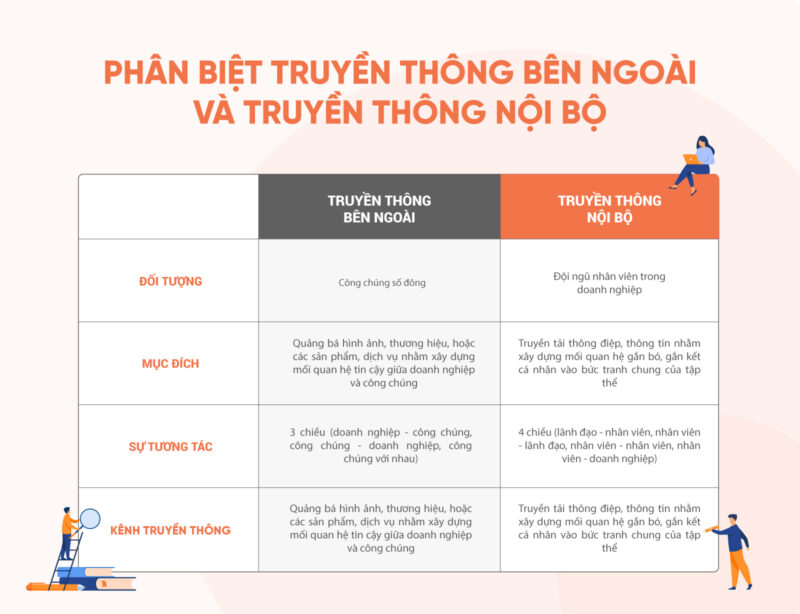
2.3 Comparison between the two forms of communication
Similarities:
- Requires a specific, long-term plan: A detailed communication plan is built based on analysis, statistics, and testing. In addition, this plan must include future projections because establishing a brand’s image through communication is a process that takes time, not just a day or two.
- Requires multi-directional interaction from communication: The back-and-forth interaction of communication tools has a very rapid spread to both the public and the staff. Besides, with just a few clicks to send or share, interaction occurs in many different directions, both positive and negative, yet the benefits it brings to the brand are immense.
Differences:
3. 5 steps to establish a corporate communication process
To convey messages effectively, a business needs a clear, systematic communication process. These 5 steps will help you define objectives, assign responsibilities, create a detailed plan, set an appropriate budget, and implement the campaign coherently, thereby ensuring all messages are delivered at the right time and achieve optimal effectiveness.
3.1 Define your objectives
Just like any other business plan, defining the objectives your business needs to create a long-term marketing campaign is extremely important.
Identifying the target audience is crucial because this factor will affect revenue and the effectiveness of the advertising campaigns the business implements.
For different customer segments, the business will have different types of products/services as well as different advertising communication campaigns. Therefore, the organization needs to clearly identify potential and existing customer segments to devise an effective approach.
3.2. Decide who is responsible
Every process must have a designated person responsible for supervision and management. Typically, to excel in a management role for a process, a manager should focus on developing the following skills:

- Writing skills: The main goal of communication is to interact with people through specific channels. Therefore, this is a mandatory skill for a communication professional. As technology continues to develop, communication activities are no longer limited to advertisements and press articles but have expanded to emails, blogs, social media posts, etc. Thus, writing is one of the most frequently used skills if you work in the communication field.
- Research skills: To support information gathering and data analysis, research skills are one of the mandatory requirements for a manager. Typically, to evaluate whether a campaign is effective, you will need to analyze data, identify market trends, and assess potential risks. If you are an external communication professional, you will frequently work with the press, social media content, etc. Therefore, this skill is even more important as you will need to research suitable partners for your business to implement its brand-building campaigns.
- Critical thinking: A large part of a communication professional’s job is to explain the creative thinking and ideas of the team. In addition, to get a marketing campaign approved, the manager needs to present the project’s feasibility, its outstanding features, and what makes it different from competitors’ campaigns. Therefore, this is a crucial skill that managers must possess.
- Technical skills: To measure the effectiveness of each communication campaign, a manager must rely on the final data collected and analyze it. As a manager, you are certainly familiar with data analysis tools and market trend measurement tools. Understanding how to use these tools can give communication professionals an advantage over others, allowing them to guide their organization to achieve high results.
3.3. Create a roadmap
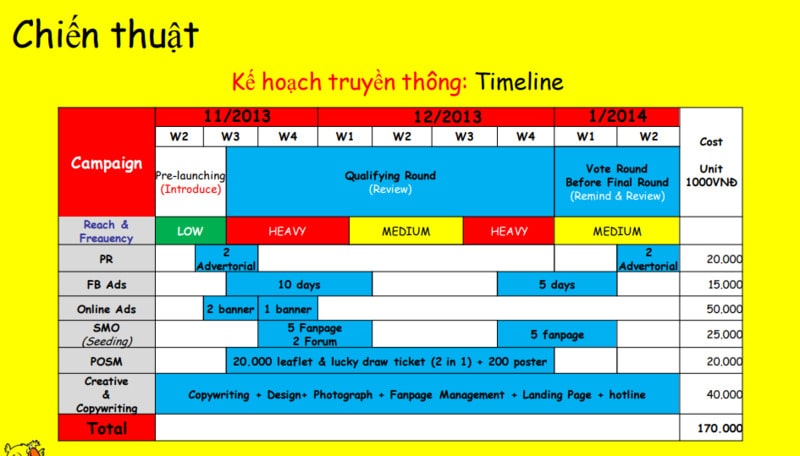
After deciding on the key factors—objectives and the person responsible—the next step is for the manager to build a detailed plan for the company’s communication activities. The structure of a communication plan will include the following parts:
- Objectives: Must meet the 5 criteria of SMART; it’s necessary to distinguish between the company’s internal and external objectives.
- Target audience: Typically, the audience a business targets when building a communication plan includes:
Community influencers
Industry experts
Government agencies and departments
Groups, communities on social media
Press and media agencies
- Strategy development: To build a suitable strategy, you can base it on the following questions:
What tools will be used throughout the plan?
How will you deliver information to the public?
What is the outreach process?
How will the communication plan for press and social media unfold?
- Risk analysis: This task helps you easily deal with difficulties that arise during implementation. Additionally, you can also identify shortcomings in the plan and make timely adjustments.
- Evaluation criteria: Establishing accurate evaluation criteria for a communication plan will help managers identify successes as well as limitations encountered when organizing event communications. Some general criteria for evaluating a company’s communication plan include:
Sentiment Score = (Positive Mentions – Negative Mentions) / (Positive Mentions + Negative Mentions)
=> The sentiment score ranges from -1 to 1; the higher the value, the higher the level of favorability.
Brand communication plan template:
3.4. Set a budget
Budget estimation: Estimating the budget will help you balance the different stages of the communication plan appropriately. Therefore, creating a detailed and complete budget will help the company’s communication event achieve a higher success rate.
3.5. Put the plan into action
Don’t forget to include regular plan reviews as part of your strategy, so you can see what works and what doesn’t.
4. 5 reasons why businesses should conduct internal and external communications simultaneously
Modern businesses not only need to communicate externally to reach customers but also internally to engage employees. Implementing both forms simultaneously helps create message consistency, enhance trust, strengthen inter-departmental collaboration, and build a strong brand image from the inside out.
4.1. Better strategic alignment
If the external and internal departments do not work together as a team, it will be impossible to achieve strategic alignment among stakeholders when implementing the communication plan.
According to statistics, if an organization does not implement its communication plans simultaneously, only 14% of employees understand the company’s goals and development direction.
4.2. Shape the brand from the inside out
Running corporate communication plans both internally and externally will help bridge the gap between the products and customer services the company provides and the actual consumer experience. All employees must clearly understand their products and services, which will help them develop the products better. Additionally, internally communicating product features to employees will help them build better communication plans.
4.3. Build trust with employees and customers
For example: If a company is developing its brand message, it is essential to create talking points for both internal and external use. This approach will help the marketing department create messages that engage employees and motivate their actions.
Moreover, as Herb Kelleher – the American billionaire and lawyer – said: “Treat your employees the way you treat your customers.”

Because when employees feel valued, they will dedicate all their efforts to the organization, and as a result, your company’s products will be continuously improved.
Therefore, implement internal and external corporate communications simultaneously to balance the interests of both customers and employees.
4.4. Build a strong community for your brand
A strong community around your brand will include both employees – who contribute to building the brand – and customers – who consume the organization’s brand.
Creating a positive experience for employees and customers is an effective communication method. Therefore, to have a strong community, ensure that your corporate communication strategy is consistent between the organization’s external and internal audiences.
4.5. Create consistency in the message the business wants to convey
If internal and external communications are not carried out simultaneously, the messages will become fragmented and inconsistent, causing confusion and anxiety for employees.
Especially during the recent Covid-19 pandemic, you must tell the truth and inform both internal and external audiences of any strategic decisions that may affect them. If your brand is not transparent and clear, then when consumer demand decreases due to reduced income, the products your business provides will certainly never be chosen.
5. Key considerations when building a corporate communication strategy
To build an effective communication strategy, businesses need to consider many important factors to ensure the message is delivered correctly, to the right audience, and achieves optimal results. Here are the key points:
-
Ensure clear and consistent messaging
-
Every business message, whether for internal or external communication, needs to be presented clearly and consistently.
-
Avoid sending the same information with different wording across various channels, as this can easily cause confusion or contradictions in the perceptions of employees, customers, and partners.
-
-
Customize for each audience
-
Each audience group has different needs and interests. For example, employees are interested in internal policies, customers care about products and service experiences, while investors focus on business performance.
-
The communication strategy needs to be flexible, adjusting content and format to suit each audience to increase interaction effectiveness.
-
-
Periodically evaluate and adjust
-
Communication is an ongoing process, not a “one-and-done” campaign.
-
Businesses need to regularly check results, collect feedback from employees and customers, and then adjust the strategy, content, and delivery channels to align with reality and business goals.
-
-
Combine online and offline communication
-
To increase reach, businesses should combine both online (social media, email, website) and offline (seminars, notice boards, events) communication channels.
-
This coordination helps ensure the message has wide coverage, while also creating multi-dimensional interaction and enhancing the overall effectiveness of the communication strategy.
-

6. Building Corporate Communication with the 1Office Toolkit
With an internal corporate communication network system operated and designed like a miniature social network, Workplace is where leaders can convey messages to company members. Additionally, employees can quickly follow and update information and news related to the business without spending too much time, such as:
- Newsfeed: Displays all internal information and employee statuses, prioritized by importance and interaction level
- Notification Management: Sends notifications to all members on the social platform when new content is posted on the wall
- Sharing: Share statuses, posts, photos, videos, documents, tasks, projects, etc., on your own wall, a colleague’s wall, or a group’s wall
- Post Interaction: Like, react, thank, and discuss posts
- Groups: Allows users to create different groups within the company
In addition, Workplace can also help users track work progress and project completion percentages through established task and process tools.
For more detailed information, please visit:
Fanpage: https://www.facebook.com/1officevn/
Youtube: https://www.youtube.com/channel/UCeTIRNqxaTwk0_kcTw6SxmA
















