


 11/05/2026
  445 views
Financial leverage is a tool that helps investors and businesses increase their profitability from borrowed capital. But what is financial leverage, what is its formula, and how can it be used without turning opportunities into risks? This article will help you understand everything from the concept to its practical application.
Mục lục
- 1. What is financial leverage?
- 2. The role and benefits of financial leverage in investment
- 4. The Correct Financial Leverage Formula
- 5. The Impact of Interest Rates, Exchange Rates, and Market Fluctuations on Financial Leverage
- 6. Personal Financial Leverage vs Corporate Financial Leverage
- 7. Risks of Using Financial Leverage
- 8. How to Effectively Apply Financial Leverage in Investing
- 9. The Impact of Financial Leverage on Profitability
- 10. Conclusion
1. What is financial leverage?
Financial leverage is the use of borrowed capital for investment or business purposes to increase potential profits for a company or individual. In other words, it is the technique of using borrowed funds instead of equity to amplify potential returns from investments. When a business uses financial leverage, it utilizes loans from banks or investors to finance its operations instead of relying solely on its own capital.
Financial leverage is considered a “double-edged sword” because if a business achieves a rate of return from its operations that is higher than the cost of borrowing (interest rate), the resulting profit will far exceed the initial equity, thereby increasing shareholder value. However, if the rate of return

Example: Mr. A wants to invest in the stock market, specifically in stocks valued at 2 billion VND. Mr. A decides to use financial leverage of 1.2 billion VND from a bank.
After 1 year, Mr. A sells the stocks for 2.5 billion VND and repays the bank loan (principal and interest) of 1.32 billion VND, and the initial equity of 800 million VND. Thus, after 1 year, Mr. A’s profit is: 2.5 billion – 1.32 billion – 800 million = 380 million VND.
2. The role and benefits of financial leverage in investment
Financial leverage acts as a tool to amplify the capital power of investors and businesses. Instead of relying solely on their own capital, utilizing borrowed funds or other financial instruments allows them to expand their investment scale, increase profits, and improve their competitive edge.
The role of financial leverage in investment
Financial leverage plays a crucial role in helping investors and businesses optimize their resources to achieve financial goals.
Expanding investment scale
Financial leverage allows investors to participate in large projects or purchase high-value assets without using all of their own capital. This helps expand the scope of investment and increases profit opportunities.
Increasing capital efficiency
Instead of using all their own capital, investors can combine it with borrowed funds to diversify their investment portfolio, reducing the risk of concentrating on a single area.
Driving profit growth
When the return on investment is higher than the cost of borrowing, the excess profit brings significant added value to the investor. This
Financial Leverage from Debt Financing
This is the most common type of financial leverage, used when a business or investor borrows capital from banks, credit institutions, or issues corporate bonds to finance business or investment activities.
- How it works: Using borrowed capital to invest and generate returns higher than the cost of borrowing.
- Advantages:
- Does not dilute shareholder ownership.
- Easily accessible if the business has a good reputation.
- Disadvantages:
- Pressure to repay principal and interest.
- Financial risk if the project does not generate expected returns.
Financial Leverage from Preferred Equity Financing
A business issues preferred stock to raise capital from investors. Preferred stock typically comes with a fixed dividend rate.
- How it works: Investors act as “soft creditors” with priority rights to receive dividends before common shareholders.
- Advantages:
- No fixed interest payments like debt.
- More flexibility in cash flow management.
- Disadvantages:
- May affect the interests of common shareholders.
- Cost of capital can be higher than debt.
Financial Leverage from Derivatives (Derivative Leverage)
Leverage is created through derivative instruments such as futures, options, or swaps.
- How it works: Investors only need to put down a fraction of the capital (margin) to control a large amount of assets.
- Advantages:
- Increases the potential to amplify profits from small market fluctuations.
- Requires less initial capital compared to direct investment.
- Disadvantages:
- Risk of losing the entire margin amount if the market moves against expectations.
- Requires specialized knowledge to be used effectively.
Financial Leverage from Leasing Financing
Leasing financing is a method where a business uses an asset without purchasing it outright, instead paying a periodic fee to the lessor.
- How it works: Utilizing leased assets to increase productivity or profits without a large initial outlay.
- Advantages:
- Reduces the pressure of initial investment capital.
- Flexibility to change assets when necessary.
- Disadvantages:
- Total leasing cost can be higher than the asset purchase cost.
- No ownership of the asset at the end of the contract.
Financial Leverage from Trade Credit (Trade Credit Leverage)
This is a form of credit extended by suppliers, allowing a business to delay payment or purchase goods and services on installment.
- How it works: Using goods or services first and paying later.
- Advantages:
- No need to borrow directly from a bank.
- Optimizes cash flow.
- Disadvantages:
- Short credit terms, requires good cash flow management.
- High implicit interest rate if not paid on time.
4. The Correct Financial Leverage Formula
The Formula
To calculate the financial leverage ratio, individuals/businesses can apply the following 2 formulas:
| Debt to Total Assets Ratio (D/A) | D/A = Debt / Total Assets |
| Debt to Equity Ratio (D/E) | D/E = Debt / Equity |
Where:
- Debt: Includes the company’s short-term and long-term loans.
- Total Assets: Includes all of the company’s assets.
- Owner’s Equity: Includes charter capital, retained earnings, and other funds.
Real-world Example: An investor invests in stocks with a total debt of 50 million and total assets of 300 million. Therefore, the investor’s debt-to-asset ratio will be: D/A = 50/300 = 1:6. This ratio means: If the stock price increases or decreases by 5%, the investor will gain or lose at a ratio of 1:6, which is 30%.
Formula for Calculating the Degree of Financial Leverage (DFL)
The Degree of Financial Leverage (DFL) is calculated as follows:
| Degree of Financial Leverage | DFL = EBIT / (EBIT – I) |
Where:
- EBIT is earnings before interest and taxes; calculated using the following formula EBIT = Q x (p – v) x F where Q is the quantity of products, p is the selling price, v is the variable cost per unit, and F is the fixed cost.
- I is the interest payable
- DFL is the degree of financial leverage.
Practical example: Ms. B runs a fashion business with a total capital of 100,000,000 VND. Of this, she has 50,000,000 VND available (i.e., owner’s equity) and borrows 50,000,000 VND at an interest rate of 10%/year. It is projected that in the next year, Ms. B’s store will have:
- Earnings before interest and taxes: EBIT = Q x (p – v) x F = 20,000,000 VND
- Interest payable: I = 50,000,000 x 10% = 5,000,000 VND
Therefore, the degree of financial leverage is: DFL = 20,000,000 / (20,000,000 – 5,000,000) = 1.34%
This coefficient means: When profit increases/decreases by 1%, the return on equity will increase/decrease by 1.34%.
Formula for calculating Return on Equity (ROE)
The formula for calculating Return on Equity (ROE) is as follows:
| Return on Equity (ROE) = Net Income / Average Shareholder’s Equity |
Trong đó:
- Net profit after tax is the company’s profit after deducting taxes and expenses.
- Average equity is the arithmetic mean of the beginning and ending equity.
> See more: What is Profit Margin? Formula, Meaning, and Role
5. The Impact of Interest Rates, Exchange Rates, and Market Fluctuations on Financial Leverage
Financial leverage does not exist in isolation; it is always influenced by macroeconomic and market factors. Among these, interest rates, exchange rates, and asset price fluctuations are the most impactful variables:
-
Loan Interest Rates
When interest rates are low, businesses or investors can use leverage to expand their scale or increase profits, as the cost of borrowing is lower than the expected return. However, when interest rates rise, the cost of debt increases, reducing profit margins and even turning profits into losses. For example, if a real estate company borrows from a bank to develop a project and the interest rate increases by 2–3% per year, the debt repayment pressure could cause the project to incur heavy losses even if sales are successful. -
Exchange Rates
For businesses borrowing in foreign currencies (USD, EUR, JPY, etc.), exchange rate fluctuations can significantly alter debt repayment costs. If the domestic currency depreciates, the amount required for repayment in the local currency will be much higher, increasing the risk of insolvency. Conversely, with good management, a business can take advantage of stable exchange rates to borrow foreign currency more cheaply. -
Market and Asset Price Fluctuations
Financial leverage is often used in investments (stocks, real estate, commodities, etc.). When the market is growing, leverage helps to amplify profits quickly. But during a market downturn, this same amplification mechanism will multiply losses, potentially even leading to negative equity for the investor. This is why financial crises are often accompanied by the collapse of organizations or individuals who have used excessive leverage.

6. Personal Financial Leverage vs Corporate Financial Leverage
Financial leverage can be applied at both the individual and corporate levels, but the objectives, scope, and risk levels are very different:
6.1 Personal Financial Leverage
-
Common applications: Mortgages for home purchases, consumer loans, using margin in stock trading, or borrowing capital for a small startup.
-
Objectives:
-
Improve standard of living (house, car, travel, consumption).
-
Capitalize on short-term investment opportunities to generate profit.
-
-
Risks:
-
If an individual loses their job, experiences a drop in income, or suffers investment losses, they may become unable to repay their debt.
-
With mortgages, there is a risk of asset seizure by the bank.
-
With margin loans, there is a risk of a margin call, leading to losses of both principal and interest.
-
-
Unique characteristics: Individuals typically have fewer risk management tools (such as hedging or debt restructuring). Therefore, they must carefully calculate their monthly cash flow and choose an appropriate borrowing ratio.

-
Corporate Financial Leverage
-
Appears in the form of bank loans, bond issuance, financial leasing, or capital mobilization from partners.
-
Objectives: expand production and business operations, invest in new projects, and increase profits for shareholders.
-
Risk: the burden of interest payments and the pressure of debt repayment when the market fluctuates, especially for businesses that borrow heavily for long-term investments.
-
Unique characteristic: businesses have an advantage over individuals because they can manage risks using various tools (hedging, debt restructuring, issuing shares, diversifying revenue).
-

7. Risks of Using Financial Leverage

Although financial leverage offers many benefits, it also comes with unavoidable risks. Especially in an unstable economic environment, the consequences of using financial leverage can be severe. Below are some key risks that investors should be aware of.
Debt and Financial Pressure
When using financial leverage, borrowing money means the investor is responsible for repaying this debt. If the investment does not yield the expected returns or even results in a loss, the investor will face significant financial pressure.
This pressure can lead to mental stress, affecting the investor’s decision-making ability. In some cases, this pressure can lead to a fire sale of assets, causing even greater losses.
Solvency
The worst-case scenario occurs if the investor is unable to repay the debt. This can lead to bankruptcy or loss of collateral. When the market declines, asset values can drop sharply, making debt repayment more difficult than ever.
This not only affects the initial investment but can also have long-term consequences for personal or business finances. Therefore, careful consideration is needed before using financial leverage.
Risks from Market Volatility

The investment market is constantly changing and cannot be accurately predicted. When investing with financial leverage, investors can be affected by external factors such as economic recessions, policy changes, or financial crises.
This volatility can reduce asset values and decrease profitability. In a worst-case scenario, investors may have to sell assets at a much lower price than the purchase price, leading to significant losses.
8. How to Effectively Apply Financial Leverage in Investing
To use financial leverage effectively to increase investment returns, the first important step is for investors to clearly define their goals and plans.
It is necessary to calculate the expected rate of return against the cost of borrowing, as leverage only truly adds value when the investment return is higher than the interest rate. At the same time, investors should prioritize projects or assets with stable growth potential that align with their acceptable risk level.
Diversifying the investment portfolio is also essential to minimize the risk of relying on a single source of profit.
In addition, strict risk management is a key factor for success when using leverage. Investors need to closely monitor cash flow and the ability to repay loans, while also establishing clear stop-loss thresholds to minimize losses when the market is unfavorable.
Financial leverage should only be applied in areas that one understands well in order to accurately assess opportunities and risks. If necessary, derivative instruments, such as options or futures contracts, can be used to protect capital from market volatility.
When interest rates change or market conditions are not as expected, investors need to quickly make appropriate decisions to protect profits and assets.
With thorough preparation, financial leverage will become a powerful tool, helping investors increase profits sustainably while ensuring financial safety.
Here are some ways to use it effectively in investing:
- Analyze the current financial situation, including income, expenses, and debt repayment capacity, to choose a loan that suits your financial ability and investment goals.
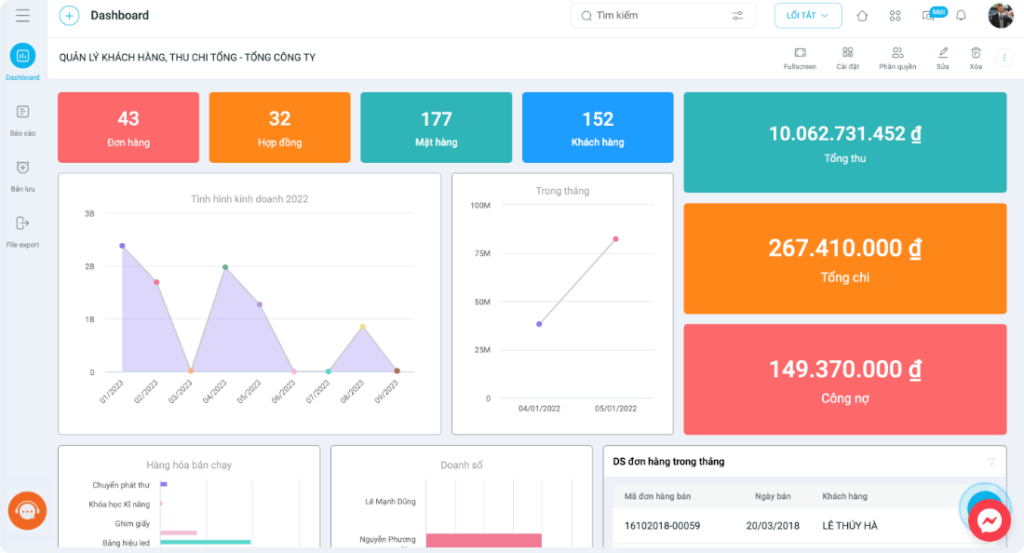
- Use business financial management software to evaluate investment effectiveness and risk management tools to minimize losses.
- Businesses should use financial leverage cautiously and have a contingency plan to deal with potential risks.
- You should closely monitor market fluctuations and asset values to adjust the leverage ratio accordingly.
9. The Impact of Financial Leverage on Profitability
Financial leverage is a crucial tool that helps businesses and investors increase potential profits, but it also comes with significant risks. The impact of financial leverage on profitability can be analyzed through two main aspects: increasing return on equity and financial risk.
Increasing Return on Equity (ROE)
Financial leverage allows a business or investor to use borrowed capital to undertake projects without relying entirely on their own funds. When the rate of return from the project is higher than the cost of borrowing, this profit difference will significantly increase the return on equity (ROE).
For example: If a business uses only its equity to invest and achieves a 10% profit, its ROE will also be 10%. But if the business uses additional borrowed capital with an interest rate lower than the rate of return, the ROE could increase to 15% or higher. This makes the business more attractive to investors and promotes long-term growth.
Increased Financial Risk
Despite its ability to amplify profits, financial leverage also increases risk. If the return from the project is lower than the cost of borrowing, the business or investor not only loses profit but also faces the pressure of interest payments, leading to a decrease in equity.
For example: When the market experiences negative fluctuations, if the actual return is only 5% while the borrowing cost is 8%, the business not only incurs a loss but also has to cut other resources to maintain operations. This can lead to bankruptcy if the leverage ratio is not controlled.
Indirect Impact on Business Value
Using financial leverage wisely can improve a company’s financial image, increasing the confidence of investors and partners. However, if overused or used at the wrong time, the company may be perceived as high-risk, causing future capital-raising costs to increase.
10. Conclusion
Financial leverage is a powerful tool that helps businesses and investors increase profits by using borrowed capital to expand the scale of investment and optimize capital efficiency. When applied effectively, financial leverage not only boosts profit growth but also helps diversify investment portfolios and seize market opportunities without waiting to accumulate equity.
However, it is also a “double-edged sword” with inherent risks such as debt repayment pressure, poor solvency, or losses due to market fluctuations. To make the best use of this tool, investors need to manage risks tightly, invest only in areas they understand, and ensure that the expected rate of return significantly exceeds the cost of borrowing.
















