11/05/2026
  314 views
What is IFRS and what is its importance for businesses? Today, the International Financial Reporting Standards (IFRS) have become the common language of global finance. It is a crucial step in financial reporting, helping to enhance transparency, build credibility, and open up international investment opportunities. So, let’s explore with 1Office what IFRS is, the transition roadmap, and the valuable benefits it brings to businesses in the article below!
Mục lục
- 1. What is IFRS? An Overview of International Accounting Standards
- 2. List of International Financial Reporting Standards (IFRS)
- 3. Should businesses adopt IFRS standards?
- 4. What are the regulations on the IFRS adoption roadmap in Vietnam
- 5. What is the preparatory roadmap for transitioning from VAS to IFRS
- 6. What is the difference between IAS and IFRS?
- 7. What are the risks of applying IFRS?
1. What is IFRS? An Overview of International Accounting Standards
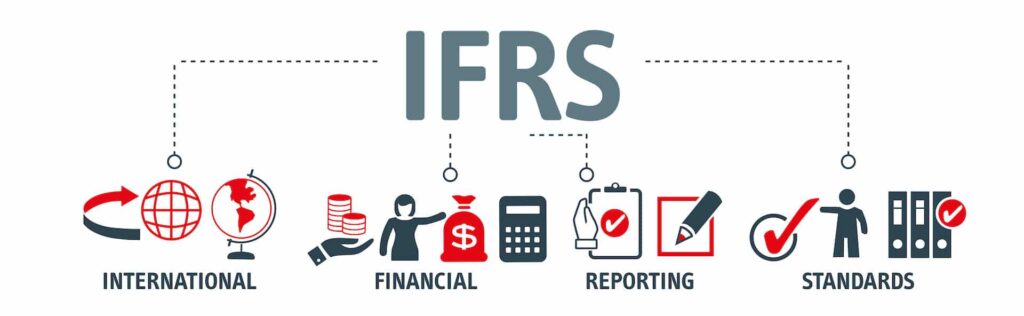
IFRS stands for International Financial Reporting Standards, a set of international accounting standards developed by the International Accounting Standards Board (IASB). The main objective of IFRS is to create a globally uniform system of accounting and financial reporting standards. This enhances the transparency, reliability, and feasibility of corporate financial reports.
IFRS standards include detailed regulations and guidelines on reporting specific financial items, defining, classifying, measuring, and disclosing economic and financial events. Businesses must comply with IFRS when preparing and presenting their financial statements, unless there are specific local requirements or restrictions. Some of the key roles of IFRS include:
- Ensuring transparency and reliability: Provides clear and accurate financial information, allowing stakeholders to assess the operational performance and financial position of the business.
- Creating a common language for financial reporting: Helps create a common language for businesses worldwide, thereby making it easier to compare and understand the financial statements of different companies.
- Enhancing the feasibility and efficiency of international transactions: Businesses can more easily engage in international transactions and collaborations when all parties use the same accounting standards.
- Facilitating global investment and cooperation: Promotes the potential for economic growth and sustainable development on an international scale.
- Strengthening fairness and expanding markets: IFRS helps achieve consistency and uniformity in corporate financial reporting. This avoids discrepancies and conflicts in reports, creating an accurate and fair information base for all stakeholders.
2. List of International Financial Reporting Standards (IFRS)
The content of the International Financial Reporting Standards (IFRS) includes a series of detailed standards and guidelines on how to report specific financial items of a business. Below are some key points within the content of IFRS:
| No. | Standard | English Name | Summary |
| 1 | IFRS 1 | First-time Adoption of International Financial Reporting Standards | Requires the preparation of a complete set of financial statements for the first IFRS reporting period and the preceding period. |
| 2 | IFRS 2 | Share-based Payment | Requires the recognition of share-based payments in the financial statements. |
| 3 | IFRS 3 | Business Combinations | Establishes the principles and requirements for how an acquirer accounts for a business combination. |
| 4 | IFRS 5 | Non-current Assets Held for Sale and Discontinued Operations | Specifies the accounting for and presentation requirements in financial statements for non-current assets held for sale. |
| 5 | IFRS 6 | Exploration for and Evaluation of Mineral Assets | Specifies certain aspects of financial reporting for costs incurred in the exploration for and evaluation of mineral resources. |
| 6 | IFRS 7 | Financial Instruments: Disclosures | Requires disclosures in financial statements to evaluate the significance, nature, and extent of risks arising from financial instruments and how the entity manages those risks. |
| 7 | IFRS 8 | Operating Segments | Requires entities with debt or equity securities to provide information about their products and services, major customers, geographical areas, etc. |
| 8 | IFRS 9 | Financial Instruments | Addresses the classification of financial assets and liabilities, initial recognition, and initial and subsequent measurement. |
| 9 | IFRS 10 | Consolidated Financial Statements | Establishes principles for the presentation and preparation of consolidated financial statements when one entity controls one or more other entities. |
| 10 | IFRS 11 | Joint Arrangements | Establishes principles for the financial reporting of entities that have an interest in joint arrangements. |
| 11 | IFRS 12 | Disclosure of Interests in Other Entities | Requires the disclosure of information to evaluate the nature, risks, and benefits of interests in other entities and the effects of those interests. |
| 12 | IFRS 13 | Fair Value Measurement | Defines fair value, sets out a framework for measuring fair value, and requires disclosures about fair value measurements. |
| 13 | IFRS 14 | Regulatory Deferral Accounts | Specifies special accounting for the effects of rate regulation. |
| 14 | IFRS 15 | Revenue from Contracts with Customers | Provides a comprehensive revenue recognition model for all contracts with customers. |
| 15 | IFRS 16 | Leases | Establishes principles for the recognition, measurement, preparation, and presentation of lease transactions |
| 16 | IFRS 17 | Insurance Contracts | Specifies the accounting for insurance contracts. |
List of International Financial Reporting Standards
3. Should businesses adopt IFRS standards?
The answer is YES. The decision to adopt IFRS standards for a business is a strategic one and needs careful consideration. While it brings many benefits in terms of transparency, reliability, and credibility for the business, it also comes with many challenges. Therefore, consulting with experts and understanding the legal and tax requirements in the country where the business operates is necessary before making a final decision.
Here are some factors that businesses should consider when deciding to adopt IFRS standards:
- Transition costs: Transitioning from current accounting standards to IFRS can require a significant investment of time, human resources, and finances to train staff, update accounting systems, and make initial adjustments.
- Legal and tax requirements: Some countries have specific legal and tax requirements for businesses and may require the application of different accounting standards. Therefore, businesses should consider local legal and tax requirements before deciding to adopt IFRS.
- Scale and industry: The scale and industry of the business are also factors to consider. Some small businesses or those operating in a single country may not need or find it suitable to adopt IFRS.
4. What are the regulations on the IFRS adoption roadmap in Vietnam
On March 16, 2020, Regulations on the roadmap for applying financial reporting standards in Vietnam were issued through Decision No. 345/QD-BTC by the Ministry of Finance. According to this decision, the IFRS adoption process will be implemented in 3 phases:
Preparation Phase (from 2020 to the end of 2021)
In the initial phase, the Ministry of Finance will prepare the necessary conditions to implement the adoption of IFRS in Vietnam. Preparatory activities include publishing the Vietnamese translation of IFRS, training human resources on IFRS, developing IFRS application guidelines, and related tasks to support businesses in preparing for the next phase.
Voluntary Adoption Phase (from 2022 to the end of 2025)
During this phase, businesses are allowed to voluntarily adopt IFRS for their financial statements. At the same time, the Ministry of Finance will also select some businesses (such as parent companies of state-owned economic groups, listed companies, and large-scale public companies that are unlisted parent companies) to pilot the application of IFRS for consolidated financial statements.
Mandatory Adoption Phase (from after 2025)
From after 2025, the adoption of IFRS will become mandatory for all businesses in Vietnam. All parent companies of state-owned economic groups, all listed companies, and all large-scale public companies that are unlisted parent companies must prepare consolidated financial statements according to IFRS.
In addition, other businesses that are parent companies have the right to voluntarily prepare consolidated financial statements according to IFRS and are also allowed to voluntarily prepare separate financial statements according to IFRS. When a business adopts IFRS, it must ensure it provides complete information and clear, transparent explanations to tax, management, and supervisory authorities to ensure the determination of obligations to the state budget.
5. What is the preparatory roadmap for transitioning from VAS to IFRS
The information regarding Decision No. 345/QD-BTC by the Ministry of Finance is a crucial step in the transition process from Vietnamese Accounting Standards (VAS) to International Financial Reporting Standards (IFRS). Accordingly, this transition will become mandatory and is expected to be implemented from 2025. Below is a roadmap that Vietnamese businesses can refer to for transitioning from VAS to IFRS:
Phase 1: Research and Assessment
- Conduct research and learn about the requirements and regulations of International Financial Reporting Standards (IFRS).
- Determine the scope of the transition from Vietnamese Accounting Standards (VAS) to IFRS and assess the impact of IFRS adoption on the business.
- Evaluate the strengths and weaknesses of the current accounting system based on VAS and identify areas needing adjustment for the transition to IFRS.
Phase 2: Planning and Preparation
- Develop a detailed plan for the transition from VAS to IFRS, including implementation steps, specific objectives, and a timeline.
- Conduct IFRS training for employees so they can understand and apply this international standard in their daily work.
- Adjust the accounting system and software to meet the requirements of IFRS standards.
Phase 3: Testing and Application
- Select a number of financial statements to test the application of IFRS, mastering the related processes and tasks.
- Voluntarily apply IFRS to the selected financial statements, thereby evaluating its effectiveness and compatibility with the current business environment.
Phase 4: Evaluation and Adjustment
- Assess the compatibility between the current VAS-based accounting system and IFRS requirements. Simultaneously, review and evaluate the results from the IFRS application testing phase.
- Make necessary adjustments to correct or improve the IFRS application process based on the evaluation results.
Phase 5: Implementing Adjustments
- Implement the adjustments and improvements that were positively evaluated during the transition to IFRS.
- The business must always ensure transparency and clarity when implementing adjustments.
Phase 6: Reporting, Monitoring, and Improvement
- Disclose information about the transition to IFRS and provide necessary guidance to relevant stakeholders.
- Continuously monitor and evaluate the effectiveness of IFRS application and make necessary adjustments to ensure full and timely compliance.
- Optimize the transition process and enhance the quality of financial reporting under IFRS to ensure compliance with international regulations and improve the company’s financial governance.
6. What is the difference between IAS and IFRS?
| Content | IAS (International Accounting Standards) | IFRS (International Financial Reporting Standards) |
| Issuance Date | Issued before 2001. From 2001 onwards, most IAS standards have been replaced or amended to form IFRS. | Applied from 2001 onwards and continues to be updated with new standards being issued. |
| Issuing Body | International Accounting Standards Committee (IASC) | International Accounting Standards Board (IASB) |
| Presentation and recognition of long-term assets | Contains basic standards for the presentation and recognition of long-term assets, but they are not as comprehensive or detailed as IFRS. | Provides detailed and clear standards for the presentation and recognition of long-term assets, including standards on valuation, control, and required disclosures in financial statements. |
| Number of standards | Consists of 41 standards that are being gradually revised; currently, 23 standards are still in effect. | Consists of 16 standards, with IFRS 17 being an update that replaces IFRS 4. |
| Updates and development | No longer updated or developed like IFRS, but the principles and concepts from IAS standards have been integrated into IFRS. | Continuously updated and developed by the International Accounting Standards Board (IASB). |
Comparison table of the differences between IFRS and IAS
7. What are the risks of applying IFRS?
Applying IFRS requires significant dedication and caution from businesses to ensure the accuracy and reliability of financial statements according to international standards. Below is a table showing some of the risks for Vietnamese businesses when applying IFRS:
| Risks of IFRS adoption | Mitigation measures |
| The transition process from VAS to IFRS can be complex and require significant effort. | Develop a detailed transition plan, ensure staff are trained on IFRS, and conduct a voluntary trial implementation before mandatory adoption. |
| Businesses may misinterpret or fail to fully meet IFRS requirements. | Ensure the accounting team is trained and thoroughly understands IFRS, and conduct internal checks and financial statement audits to ensure accuracy and IFRS compliance. |
| To transition to and adopt IFRS, businesses must invest heavily in training and adjusting their accounting systems. | Develop an effective and optimized training plan, focusing on the most critical elements. Simultaneously, optimize the transition process to minimize costs. |
| The transition from VAS to IFRS can make it difficult to compare business performance across different periods. | Provide clear and detailed information about the differences between VAS and IFRS in financial reports. Use alternative indicators or metrics to continue comparing and evaluating business performance. |
| Small and medium-sized enterprises may face difficulties in the transition due to a lack of resources and experts. | Seek support from experts and consulting agencies to assist with the transition process. Collaborate with professional firms or other businesses to share resources and experience. |
Some risks and remedial measures when applying IFRS
We hope that through the above article, accounting and finance professionals have gained a more detailed understanding of what IFRS is, as well as the regulations and transition roadmap for International Financial Reporting Standards for Vietnamese businesses. We wish your business success!