


 09/05/2026
  105 views
Inventory turnover is one of the key metrics that helps businesses evaluate the effectiveness of their inventory management, cash flow, and overall operations. In this article, let’s join 1Office to explore what inventory turnover is, the significance of this ratio, the standard calculation method, and solutions to help businesses optimize their inventory turnover more effectively in the 2026 business landscape.
Mục lục
1. Overview of Inventory Turnover
Below are the basic concepts to help you understand what inventory turnover is and why this metric is important in business administration:
1.1. What is Inventory Turnover?
Inventory Turnover is a metric that reflects the number of times inventory is sold and replaced over a specific period (usually a year). This ratio indicates the speed at which inventory is converted into revenue during that period.
Simply put, inventory turnover shows how quickly a company “turns over” its stock. If inventory is sold and replenished multiple times during the period, the turnover will be high; conversely, if goods remain in stock for a long time, the turnover will decrease.
From a management perspective, inventory turnover is a crucial measure that helps businesses:
- Evaluate sales performance and product consumption
- Determine if inventory levels are appropriate
- Control holding costs and avoid tying up capital
A high inventory turnover ratio usually indicates that goods are selling quickly, cash flow is freed up in a timely manner, and business operations are flexible. Conversely, a low turnover is a warning sign of slow-moving inventory, posing risks of increased costs, obsolescence, or reduced capital efficiency.
In other words, inventory turnover is not just an accounting figure but also a critical management data point, reflecting the suitability of a company’s purchasing, production, and distribution strategies.

Inventory turnover reflects the frequency of selling and replenishing goods in stock over a specific period
1.2. The Significance of the Inventory Turnover Ratio
Here are the key significances of the inventory turnover ratio in evaluating capital efficiency and inventory management:
Assess the appropriateness of inventory levels: The inventory turnover ratio indicates whether a company is maintaining suitable stock levels, thereby balancing its ability to meet market demand with capital efficiency.
Reflect sales performance and capital management:
- High turnover: goods sell quickly, capital is freed up promptly, and holding costs are reduced.
- Low turnover: goods sell slowly, inventory stagnates, and capital is “trapped” in stock.
Warn of operational risks:
- An excessively high turnover can signal a risk of stockouts during sudden demand spikes or supply chain disruptions.
- An excessively low turnover increases the risk of inventory becoming obsolete, damaged, or devalued, which affects liquidity.
Support management decision-making: This ratio helps businesses adjust their purchasing, production, sales, and inventory stocking strategies to align with business realities.
Basis for stakeholder evaluation: Inventory turnover is a metric that banks, investors, shareholders, and management use to assess a company’s financial health and operational efficiency.
Must be considered in the industry context: There is no “standard” turnover rate for all businesses. Evaluation requires comparison over time, against competitors, and with industry averages to determine the optimal threshold.
1.3. Comparing Inventory Turnover with Other Metrics
Within the system of inventory management metrics, inventory turnover stands out for its ability to directly reflect the speed of goods movement. Meanwhile, other metrics typically focus on individual aspects of inventory operations, specifically:
- Days Inventory Outstanding (DIO): Indicates the average number of days goods remain in stock; essentially, it is the inverse of inventory turnover.
- Sell-through rate: Reflects the percentage of inventory sold during a period, emphasizing sales results rather than turnover speed.
- Average inventory value: Measures the amount of capital tied up in stock but does not indicate how quickly the goods are moving.
- Inventory-to-sales ratio: Compares inventory levels to sales revenue, helping to assess capital efficiency in business operations.
By combining the elements of consumption speed and capital efficiency, inventory turnover is often considered the “core” metric in inventory analysis, helping businesses optimize cash flow and enhance operational efficiency.
More than just an accounting figure, inventory turnover also reflects inventory health and a company’s operational flexibility. Properly understanding and monitoring this metric helps managers adjust their purchasing, sales, & stocking strategies accordingly, thereby creating a sustainable competitive advantage in a dynamic business environment.
Comparing the differences between inventory turnover and other metrics
2. Formula and How to Calculate Inventory Turnover
Below is the standard formula and a simple, practical guide on how to calculate inventory turnover:
Step 1: Determine the Calculation Scope
First, the business needs to define the time period for calculating inventory turnover, which can be monthly, quarterly, or annually, depending on the specific nature of its operations:
- Commercial, retail, and businesses with continuous goods movement: should calculate monthly.
- Manufacturing companies: suitable for quarterly or annual calculation.
- Businesses with long-term projects: usually calculate annually.
At the same time, it is necessary to identify the inventory items for calculation: by individual SKU or product group. For effective management, businesses should classify items in as much detail as possible (by group, SKU, product line), as a higher level of detail will yield a turnover analysis that is closer to reality.
Step 2: Collect Necessary Data
The business needs to prepare the following information for each identified inventory item:
- Cost of goods sold (COGS) for the analysis period.
- Inventory value at the beginning and end of the period.
This data is typically sourced from the Income Statement, Balance Sheet, or Inventory In-Out-Stock Report.
Step 3: Calculate Inventory Turnover and Days Sales of Inventory
<span style="font-weight:
|
Inventory Turnover Ratio = Cost of Goods Sold / Average Inventory Value |
Where:
- Average inventory value is calculated using the formula: (Beginning inventory + Ending inventory) / 2
- Cost of goods sold is determined for the specific analysis period (month, quarter, or year).
Once you have the turnover rate, the business can then calculate the number of days in one turnover cycle:
|
Days in Inventory = Number of Days in Accounting Period / Inventory Turnover Ratio |
Convention for the number of days per period:
- Year: 365 days
- Quarter: 90 days
- Month: 30 days
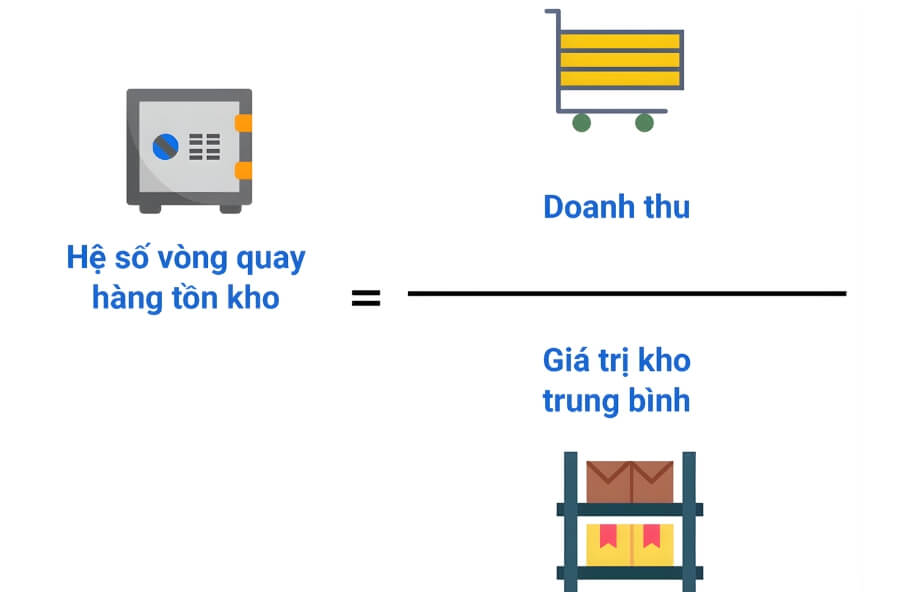
Inventory turnover formula
3. Who is interested in a company’s inventory turnover?
Below are the groups that need to monitor and analyze inventory turnover to support management, investment, and operational decisions:
- Banks, credit institutions: Are concerned with the stability of business operations, the speed at which inventory is converted into cash, and the company’s ability to meet its principal and interest payment obligations on time.
- Shareholders, capital contributors, Board of Directors: Monitor the efficiency of investment capital usage, especially whether capital is “stuck” in inventory or is being circulated reasonably to create added value.
- Board of Directors, Supervisory Board, Sales Department: Rely on financial indicators to assess the actual operational situation, thereby adjusting production and business strategies to improve operational efficiency.
- Potential investors: Analyze financial indicators to value the company, assess its attractiveness and risks before making an investment decision.
4. What is a good inventory turnover ratio? Industry benchmarks
Evaluating whether an inventory turnover ratio is high or low doesn’t have a “standard” number that applies to all businesses; it depends on many factors such as industry, operating model, and specific business strategy. Through the examples and analysis in the previous sections, it can be seen that the number of turns and the days in inventory differ significantly between manufacturing and trading companies.
Based on operational realities and market averages, you can refer to the estimated annual inventory turnover for some industries as follows:
| Industry / Business Type | Inventory Turnover Characteristics | Reference Inventory Turnover (turns/year) |
| Retail | Fast consumption rate, goods move in & out continuously | 4 – 6 |
| Wholesale | Depends on the demand of the retail system | 3 – 5 |
| Manufacturing | Requires time for the production process, slower turnover | 2 – 4 |
| Automotive, high-value goods | High value, low sales frequency | 2 – 3 |
| Fashion | Fast-moving consumer goods, affected by seasonality | 4 – 5 |
| Groceries, essential goods | Stable demand, very high sales frequency | 12 – 14 |

What is a good inventory turnover ratio? Industry benchmarks
5. How to improve and optimize inventory turnover
Optimizing inventory turnover helps businesses free up capital, reduce storage costs, and enhance market responsiveness. The faster goods move, the higher the business efficiency. Below are key solutions that businesses should implement:
Method 1 – Boost consumption with marketing and cross-selling
- Strengthen marketing and multi-channel promotions to increase shopping demand.
- Implement promotions, discounts, combos, and bundled offers to accelerate sales.
- Apply cross-selling to increase order value and reduce inventory.
Method 2 – Manage procurement based on forecasting and inventory grouping
- Forecast demand based on sales data and market trends to avoid surpluses.
- Classify inventory into groups (A – B – C) to develop appropriate procurement and management strategies.
Method 3 – Shorten the turnover cycle
- Optimize production, transportation, and distribution processes.
- Procure goods more frequently in moderate quantities instead of in large batches.
Method 4 – Negotiate effectively with suppliers
- Negotiate better purchase prices for flexibility in adjusting sales prices and stimulating demand.
- Build long-term partnerships to ensure a stable and flexible supply chain.
Method 5 – Apply warehouse management technology
- Use warehouse management software to track inventory in real-time.
- Analyze inventory data, turnover rates, and receive alerts for slow-moving items.
Method 6 – Encourage pre-orders for high-value products
- Implement deposit and pre-order policies to reduce inventory pressure.
- Create special offers for customers who pre-order.
Method 7 – Monitor and analyze periodically
- Track inventory turnover on a monthly and quarterly basis.
- Compare across periods and product groups to detect anomalies and adjust strategies promptly.
In summary, optimizing inventory turnover is a continuous process that requires a synchronized combination of marketing, inventory management, supplier relations, and technology. Regular analysis will help businesses make accurate decisions and enhance their competitive capabilities.

How to improve and optimize inventory turnover
6. Frequently Asked Questions
Question 1: What does inventory turnover indicate?
Inventory Turnover indicates how many times a company’s inventory is sold and replaced over a specific period (usually a year). This metric reflects the speed of goods movement, the efficiency of inventory management, and the ability to convert inventory into revenue.
A high turnover ratio usually indicates that goods are selling quickly and working capital is being used effectively. Conversely, a low turnover ratio may be a sign of stagnant inventory, which reduces business efficiency.
Question 2: What factors does inventory turnover affect in financial statement analysis?
The inventory turnover ratio directly impacts several important factors, including:
- Liquidity and cash flow: A fast inventory turnover helps recover capital sooner.
- Asset utilization efficiency: It affects profitability ratios like ROA.
- Holding costs: Related to the costs of storage, shrinkage, and obsolescence.
- Financial risk: Prolonged stagnant inventory can reduce profits or increase debt pressure.
In financial analysis, inventory turnover is a key indicator for assessing the quality of working capital management and the operational health of a business.
Question 3: Who should be concerned about “inventory turnover”?
“Inventory turnover” is a metric that not only accountants but also many other roles should pay close attention to:
- Business owners, management: To control costs and cash flow.
- Investors, shareholders: To evaluate business performance and risk levels.
- Banks, credit institutions: To assess debt repayment capacity and asset management when providing capital.
- Accountants, auditors: To analyze financial statements and detect anomalies.
- Warehouse and supply chain departments: To improve receiving, shipping, and inventory processes.
Question 4: Is a high inventory turnover ratio always good?
A high inventory turnover ratio is often a positive sign, but it’s not always good if it exceeds a reasonable level for the industry and business model.
- Positive aspects: Goods sell quickly, reducing holding costs, improving cash flow, and limiting the risk of obsolete inventory.
- Risks if too high: It can lead to stockouts, missed sales opportunities, or the need for urgent procurement at higher costs.
Therefore, inventory turnover is considered “good” only when it aligns with the specific characteristics of the industry and business strategy. Businesses should compare it with the industry average and monitor trends over multiple periods.
Question 5: Do small businesses need to track this metric?
Yes, and it’s actually very necessary. Small businesses often have limited capital, so stagnant inventory can easily create financial pressure. Tracking inventory turnover helps:
- Avoid overstocking.
- Forecast demand more accurately.
- Improve cash flow and maintain stable operations.
Simply tracking it periodically on a quarterly or annual basis is effective enough; complex calculations are not always necessary.
Question 6: How often should inventory turnover be re-evaluated?
The frequency of evaluating inventory turnover varies depending on the type of business and the speed of goods movement. Common suggestions are as follows:
- Retail, FMCG, fashion: Should be monitored monthly or quarterly due to rapid fluctuations and seasonality.
- Manufacturing, distribution: Usually evaluated quarterly or annually when preparing financial statements.
- All businesses: At least once a year to compare with previous periods and the industry average.
Recommendation: Combine inventory turnover tracking with related metrics like Days Sales of Inventory (DSI) to get a more comprehensive view of inventory management efficiency.
Conclusion
Inventory turnover reflects not only sales speed but also a company’s ability to manage materials, control costs, and utilize capital. To optimize this metric, businesses need a transparent inventory tracking system that updates in real-time and is closely linked to work progress, projects, and financial plans.
1Office provides a 4-dimensional project & task management platform, integrated with supplies, raw materials, and inventory management for each project on a single system. This allows businesses to control inventory turnover more accurately, reduce excess inventory, and optimize sustainable cash flow in 2026. Contact 1Office for a consultation on an inventory and project management solution tailored to your business’s operating model.
















