


 10/05/2026
  172 views
Net profit is one of the most important indicators for assessing how much a business is actually earning after deducting all expenses. But what is net profit, what is its formula, and why does this indicator have such a significant impact on business decisions? This article will help you understand everything from its concept and significance to its practical application.
Mục lục
- 1. What is Net Profit?
- 2. What is the Significance of Net Profit?
- 3. The Role of Net Profit
- 4. Net Profit Formula:
- 5. Factors Affecting Net Profit
- 6. Methods for Optimizing Net Profit in Business
- 6.1. Increase revenue through effective marketing strategies
- 6.2. Optimize Cost of Goods Sold (COGS)
- 6.3. Tightly manage operating expenses
- 6.4. Tightly control financial costs
- 6.5. Take advantage of tax incentives and manage taxes effectively
- 6.6. Increase labor productivity
- 6.7. Risk management and contingency for unusual costs
- 6.8. Inventory Control
- 6.9. Optimize Pricing Strategy
- 6.10. Discontinue Unprofitable Products/Services
- 7. Differentiating Net Profit from Other Financial Metrics
- 8. Frequently Asked Questions (FAQ)
- 9. Financial Ratios Related to Net Profit
- 9. Conclusion
1. What is Net Profit?
Net Profit is the final profit a business earns after deducting all expenses from revenue, including the cost of goods sold, operating expenses, interest, income taxes, and other costs. This is a crucial financial indicator that allows managers to evaluate the business’s performance, reflecting its profitability and stability in financial activities.
Net profit is also known as net income and is often presented in financial statements under the “Profit after tax” category. This indicator plays a core role in measuring the success and sustainability of any business, regardless of its size or industry.
2. What is the Significance of Net Profit?
Net Profit reflects the “financial health” of a business. It is a core indicator for assessing a company’s true profitability and holds significant importance in:
Assessing actual business performance
- Net profit shows how much a business actually earns after deducting all expenses from revenue.
- It is a metric for determining the effectiveness of current business strategies.
A measure of financial sustainability
- High net profit indicates that a business can sustain its operations long-term, even when facing economic difficulties.
- Conversely, low or negative net profit suggests that the business may be facing financial risks.
Basis for investment and lending decisions
- Investors and credit institutions often rely on net profit to assess a business’s earning potential before making investment or lending decisions.
Impact on stock value and market confidence
- Stable growth in net profit helps a business attract shareholder interest and maintain a high stock price.
Determining the ability to pay dividends
- Net profit is the basis for a business to distribute dividends to shareholders. The higher this indicator, the greater the ability to pay dividends.

3. The Role of Net Profit
Net profit plays a central role in a business’s financial planning and management, specifically:
Guiding business strategy
- Net profit helps businesses identify which areas or products generate the highest value to focus investment and development on.
Controlling and optimizing costs
- By analyzing net profit, businesses can identify unnecessary expenses and implement appropriate cost-cutting measures.
Making decisions to expand or downsize
- Stable net profit is a sign for a business to confidently expand its operations. Conversely, if net profit is negative, downsizing or restructuring should be considered.
Motivation to improve productivity and quality
- Good net profit is a goal that motivates departments within the business to work more efficiently and improve product/service quality.
Building trust and credibility
- A business with high and stable net profit will find it easier to build credibility with customers, partners, and investors.
4. Net Profit Formula:
To calculate net profit, a business can apply the following general formula:
Net Profit = Revenue – (Cost of Goods Sold + Operating Expenses + Financial Expenses + Corporate Income Tax + Other Expenses)
Where:
– Revenue: The total amount of money a business receives from selling products, services, or other activities during an accounting period.
– Cost of Goods Sold (COGS): Includes costs directly related to producing or purchasing products, such as: raw materials, production labor, and shipping costs
- Cost of Goods Sold = Beginning Inventory + Production Costs during the Period – Ending Inventory
– Operating Expenses: Includes business operating costs, such as employee salaries, office rent, marketing and advertising, and maintenance.
– Financial Costs: These are costs related to borrowing capital, such as bank interest, bond issuance costs, or other loans.
– Corporate Income Tax: This is the tax that a business must pay based on its earnings before tax (EBT).
- Corporate Income Tax = Taxable Profit x Corporate Income Tax Rate
– Other Expenses: Includes non-recurring expenses such as compensation for damages, contract penalties, and other losses.
Illustrative example:
– A business has the following figures for the accounting period:
- Revenue: 2,000,000,000 VND
- Cost of Goods Sold: 700,000,000 VND
- Operating Expenses: 200,000,000 VND
- Financial Costs: 50,000,000 VND
- Corporate Income Tax: 40,000,000 VND
- Other Expenses: 30,000,000 VND
– Applying the formula:
- Net Profit = 2,000,000,000 – (700,000,000 + 200,000,000 + 50,000,000 + 40,000,000 + 30,000,000) = 980,000,000 VND
Note:
- Net profit is not the basis for calculating the total amount of money a company receives. In addition to cash expenses, a company’s income statement also includes non-cash expenses like depreciation, amortization, etc.
- Businesses need to use appropriate accounting methods to recognize revenue, expenses, and corporate income tax.

5. Factors Affecting Net Profit
Net profit is strongly influenced by many different factors: from revenue and cost of goods sold to operating expenses and corporate income tax. Each factor plays a crucial role in determining the final profit level.
Revenue
Revenue is the main income of a business and directly determines net profit. When revenue increases while costs remain stable, net profit will also increase. Conversely, if revenue decreases but costs do not decrease accordingly, net profit will be negatively affected.
Example: A business applies a discount strategy to increase sales volume. However, if costs are not controlled, net profit may not increase as expected.
Cost of Goods Sold (COGS)
Cost of goods sold (COGS) is the cost associated with producing or purchasing products. If the cost of goods sold is high, the profit margin will decrease, leading to lower net profit. Conversely, optimizing COGS, such as negotiating raw material prices or using modern production technology, will improve profitability.
Operating Expenses
Operating expenses include salaries, rent, printing costs, and other items. These are necessary expenses that need to be managed closely. A sound cost optimization strategy, such as using operational management tools instead of traditional methods, can help businesses save money and improve net profit.
Financial Costs – Interest and the Capital Management Challenge
Financial costs include loan interest, bond issuance fees, or other borrowing costs. When interest rates rise, financial costs also increase, reducing net profit. Effective cash flow management and restructuring high-interest loans can help reduce costs and increase profit.
Corporate Income Tax
Corporate income tax is a mandatory expense that directly affects net profit. However, businesses can take advantage of tax incentive policies or reasonable cost deductions to reduce this burden.
Extraordinary or One-time Costs
Extraordinary costs, such as contract penalties or compensation for damages, can have a sudden impact on net profit. Businesses need to build contingency funds or manage risks effectively to avoid unwanted negative outcomes.
Example: A business is fined for a contract violation, leading to a decrease in net profit for the period.
Market and Macroeconomic Factors
Economic growth, inflation, or recession all impact a company’s revenue and costs. A favorable market will help a business increase revenue and improve profits. Conversely, an economic recession can cause a sharp decline in revenue and an increase in operating costs.
6. Methods for Optimizing Net Profit in Business
Optimizing net profit is the primary goal of every business. To achieve this, businesses need to apply effective strategies, from increasing revenue and reducing costs to improving operational processes. The following are common and effective methods to help businesses optimize their net profit:
6.1. Increase revenue through effective marketing strategies
Increasing revenue is one of the most direct ways to impact and improve net profit. Businesses can apply several strategies, such as:
- Diversify products/services: Offer new products or improve existing ones to attract more customers.
- Expand the market: Reach new markets, especially international ones, to increase sales opportunities.
- Apply marketing technologies: Effectively use online advertising tools like Google, Facebook, SEO, and social media to enhance reach to potential customer segments.
6.2. Optimize Cost of Goods Sold (COGS)
Reducing the cost of goods sold will help businesses improve their profit margins:
- Negotiate raw material prices: Work with suppliers to agree on more competitive prices.
- Automate production: Use technology to reduce labor costs and increase production efficiency.
- Strategic procurement: Place large orders to get price incentives or find cheaper alternative suppliers.
6.3. Tightly manage operating expenses
Operating expenses account for a large portion of a business’s total costs. Reducing or optimizing these expenses is necessary:
- Cut unnecessary expenses: Re-evaluate the effectiveness of each cost, such as advertising and office operations, to eliminate non-value-adding expenses.
- Outsourcing: Use outsourced services for non-core tasks like IT, Accounting, etc., to reduce personnel costs.
- Leverage technology: Apply financial software, sales management software, and customer service software to automate processes and reduce processing time.
1Office – an all-in-one business management software, with its sales and expense management features, is a comprehensive support tool that helps businesses operate efficiently and save maximum resources with outstanding features such as:
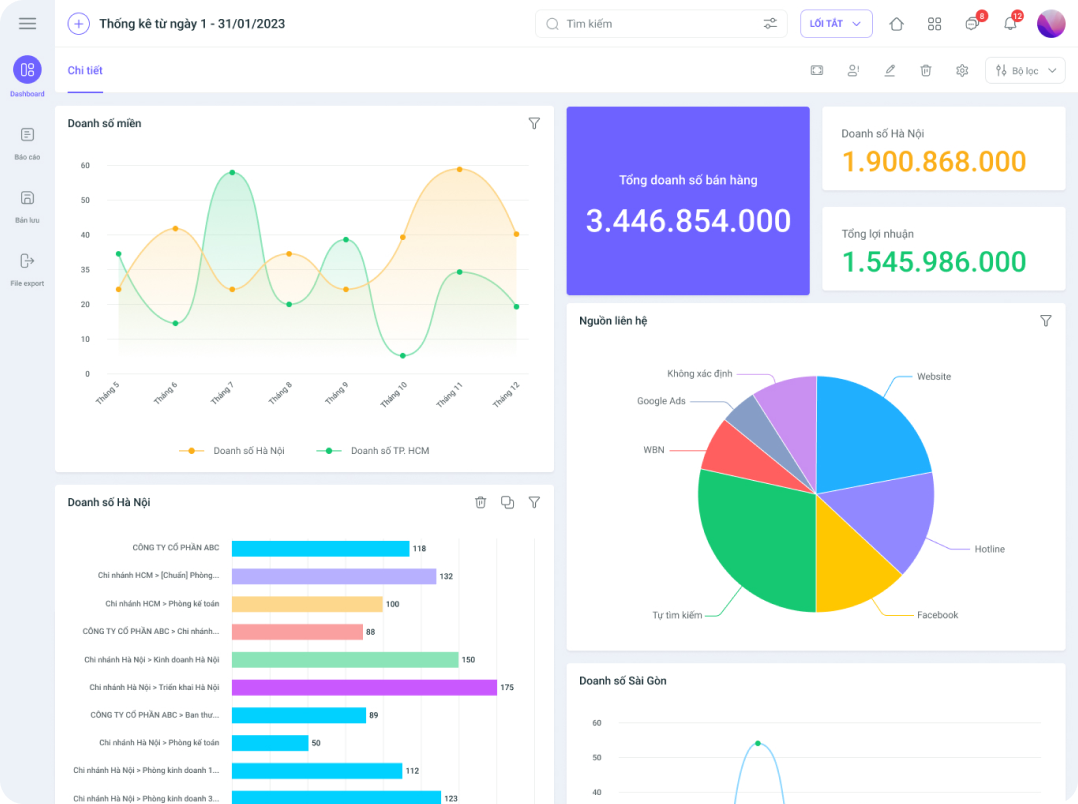
- Track the cash flow of all account types in the business in real-time
- Automate the expense approval process, minimizing waiting time and reducing manual errors.
- Visual reporting system that displays expenses in real-time. Provides accurate data to support financial planning and budget optimization.
- Provide sales metrics such as revenue, closing rate, and employee performance. Suggest suitable sales strategies based on data analysis.
- Record and categorize expenses by item (personnel, supplies, marketing, operations). Compare actual costs with the plan for timely adjustments.
Register for a free feature Demo!
6.4. Tightly control financial costs
Financial costs, such as loan interest, are one of the major factors affecting net profit. Some methods to effectively control financial costs include:
- Debt restructuring: Negotiate interest rates or loan terms to reduce financial pressure.
6.5. Take advantage of tax incentives and manage taxes effectively
Corporate income tax can be optimized through legal methods:
- Apply tax incentive policies: Take advantage of tax reduction, depreciation, or cost deduction programs permitted by the government.
- Tax planning: Ensure proper reporting of expenses to reduce taxes payable without violating the law.
6.6. Increase labor productivity
An effective workforce will help reduce costs and increase profits:
- Train and develop employees: Enhance employees’ skills and work productivity.
- Create motivation: Apply reasonable reward and penalty policies to encourage employees to work more effectively.
- Apply technology: Integrate work management tools, such as the 1Office work and project management software, to minimize processing time and improve productivity.
6.7. Risk management and contingency for unusual costs
Unusual costs such as contract penalties or financial losses can affect net profit. Businesses need to:
- Build a contingency fund: Ensure sufficient financial resources to handle unexpected situations.
- Conduct regular risk assessments: Analyze potential risk factors to implement appropriate preventive measures.
- Inventory of unprofitable products/services: Recover capital and minimize storage costs.
6.8. Inventory Control
- Effective inventory management: Ensure inventory levels are appropriate for market demand.
- Minimize inventory: Reduce storage costs and the risk of obsolescence.
- Optimize the inventory management process: Use technology to track and manage inventory effectively.
6.9. Optimize Pricing Strategy
- Analyze the market and competitors: Determine a price point that is suitable for the market and competitive with rivals.
- Calculate production costs and desired profit: Ensure the selling price is higher than the production cost and yields the desired profit.
- Apply flexible pricing strategies: For example, discounts for bulk purchases, seasonal pricing.
>>> Read more: 15+ Effective Product Pricing Strategies
6.10. Discontinue Unprofitable Products/Services
- Analyze the performance of each product/service: Identify products/services that are not generating profit.
- Stop producing or providing unprofitable products/services: Focus resources on high-profit products/services.
- Liquidate inventory of unprofitable products/services: Recover capital and minimize storage costs.
7. Differentiating Net Profit from Other Financial Metrics
| Metric | Definition | Formula | Significance |
| Net Profit | Profit after deducting all costs, including cost of goods sold, operating expenses, financial expenses, taxes, and other expenses. | = Revenue – Cost of Goods Sold – Operating Expenses – Financial Expenses – Taxes | Evaluates the true profitability of the business after accounting for all expenses. This is the ultimate indicator of financial performance. |
| Gross Profit | Profit from the company’s core business operations after deducting the cost of goods sold. | = Revenue – Cost of Goods Sold | Reflects the ability to manage production or service costs. It is a key indicator for evaluating the performance of core business operations. |
| EBITDA (Earnings Before Interest, Taxes, Depreciation, and Amortization) | Profit before deducting interest expenses, taxes, depreciation, and amortization of fixed assets. | = Revenue – Cost of Goods Sold – Operating Expenses | Reflects the profitability of core business operations without being affected by financial structure or asset depreciation. |
| Net Cash Flow | The amount of cash remaining after the business has spent on all operating, investing, and financing activities. | = Cash In – Cash Out | Evaluates cash flow management and liquidity. It is crucial for ensuring the business has enough cash to sustain operations. |
8. Frequently Asked Questions (FAQ)
How to analyze net profit in a financial statement?
- Identify the net profit in the income statement
- Compare period-over-period to assess trends
- Analyze influencing factors such as revenue, expenses, and taxes
- Compare with metrics like gross profit and EBITDA
Does a higher net profit always mean the business is better?
Not necessarily. A high net profit may not reflect long-term efficiency if the business cuts back on investment or development costs.
How to calculate net profit for a self-employed individual?
Net Profit = Revenue – Expenses – Taxes
(Expenses include raw materials, operations, marketing, rent, etc.)
What is the impact of net profit on a company’s stock?
An increase in net profit often has a positive effect on stocks, but the stock price also depends on growth, the market, and the company’s strategy.
Is net profit the only factor that determines a company’s stock value?
No. Stock value also depends on growth, capital structure, and industry potential.
Does a business need to pay personal income tax when distributing net profit?
Yes. Dividends are typically subject to a personal income tax of around 5% as regulated.
Can charter capital be increased using net profit?
Yes. A business can use after-tax profit to increase its charter capital if approved.
What is the significance of a decrease in after-tax profit?
It can be positive (investment in expansion) or negative (decreased business efficiency), depending on the specific cause.
Is after-tax profit an asset or a source of capital?
It is a source of capital, part of the owner’s equity on the balance sheet.
Net profit not only reflects overall business performance but also serves as a basis for calculating many important financial ratios, helping businesses assess profitability and overall financial health. The three most common ratios are: Net Profit Margin, Return on Assets (ROA), and Return on Equity (ROE). Below is a detailed analysis of each ratio:
9.1 Net Profit Margin
Net Profit Margin (%) = (Net Profit / Net Revenue) × 100
Example: Net Profit = 2,000,000,000 VND; Net Revenue = 20,000,000,000 VND
Net Profit Margin = (2,000,000,000 / 20,000,000,000) × 100 = 10%
Meaning:
-
It shows the amount of profit a business earns for each dollar of revenue after deducting all expenses, taxes, and interest.
-
A higher ratio indicates that the business manages costs well, has an effective business model, and has high profitability.
Illustrative Example:
If a business achieves a net profit of 2 billion VND on a total revenue of 20 billion VND, the net profit margin is:
→ 2 / 20 × 100% = 10%.
This means that for every 100,000 VND in revenue, the business earns a profit of 10,000 VND after deducting all expenses.
9.2 Return on Assets
ROA (%) = (Net Profit / Average Total Assets) × 100
Example: Net Profit = 1,200,000,000 VND; Average Total Assets = 15,000,000,000 VND
ROA = (1,200,000,000 / 15,000,000,000) × 100 = 8%
Meaning:
-
ROA measures the efficiency of using assets to generate profit.
-
This ratio indicates how much net profit is generated for each dollar of assets.
-
A high ROA shows that the business manages its assets efficiently and wastes little investment capital.
Illustrative example:
A company has a net profit of 1.2 billion VND, and its average total assets during the period are 15 billion VND → ROA = 1.2 / 15 × 100% = 8%.
This means that every 1 VND of assets generates 0.08 VND of profit.
9.3 Return on Equity
ROE (%) = (Net Profit / Average Shareholder’s Equity) × 100
Example: Net Profit = 3,000,000,000 VND; Average Shareholder’s Equity = 20,000,000,000 VND
ROE = (3,000,000,000 / 20,000,000,000) × 100 = 15%
Meaning:
-
ROE shows the efficiency of using owner’s (shareholder’s) equity to generate profit.
-
This is the metric that investors are most interested in, as it shows the actual level of return on their contributed capital.
-
A high ROE often reflects a company with strong competitive advantages and sustainable profitability.
Illustrative example:
If a company’s net profit is 3 billion VND and its average shareholder’s equity is 20 billion VND → ROE = 3 / 20 × 100% = 15%.
This shows that every 100 VND of shareholder’s equity generates 15 VND of profit.

9. Conclusion
Through this article, 1Office hopes to have given you a deeper insight into net profit, its formula, and its significance, so you can effectively manage cash flow and business performance.
















