What is the Business Model Canvas? How to Build a BMC Model from A-Z


The Business Model Canvas (BMC) not only helps managers shape business ideas concretely but is also an important tool for managing and developing a business effectively. So, what is the Business Model Canvas? How is this Canvas model built and applied? Let’s explore the details with 1Office in the article below.
Mục lục
I. What is the Business Model Canvas?
1. Definition
The Canvas model is a tool that helps systematize business strategy into the simplest structure. The main feature of this model is to help companies and businesses consolidate sales activities using criteria for converting potential customers.

In Vietnam, many businesses have applied the Business Model Canvas to analyze their company’s situation, analyze competitors, build business plans, and find solutions to generate the highest profits.
2. 3 Key Advantages of the BMC Model
The Business Model Canvas is a business model that is quite popularly applied in businesses today to improve and develop new business activities. Below are the 3 main benefits that the Business Model Canvas brings to organizations.
- Focus: Planning your business with the Canvas model helps you focus on important aspects instead of presenting all the information at length. This makes the business plan more concise and focused.
- Flexibility: Everything is presented concisely, making it easy for observers to check, test, and edit the content.
- Clarity: Your employees will grasp the entire business plan and understand the goals you are aiming for.
See more: Application of Maslow’s hierarchy of needs in business 4.0
II. The 9 Key Pillars of the Business Model Canvas – BMC
The structure of a typical Business Model Canvas includes the following 9 components:
- Market Segments
- Value Propositions
- Channels
- Customer Relationships
- Revenue Streams
- Key Resources
- Key Activities
- Key Partnerships
- Cost Structure
See more: The most detailed and systematic guide to creating a business plan
III. How to Create an Effective Business Plan for Your Company Using the Canvas Model
The Canvas Model represents 4 key factors of a business. They are: customers, financial capacity, infrastructure, and business performance. Therefore, to build an effective business model, business owners need to focus on these 4 factors.
Above, we have reviewed the 9 components of the Business Model Canvas. In this section, we will delve into the analysis of the 9 factors in the Business Model Canvas to get more ideas for developing your business activities.
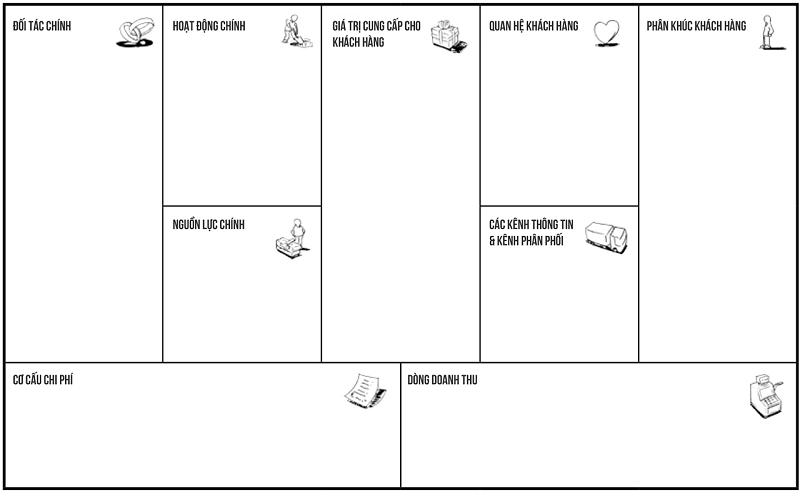
1. Customer Segments
Customer segments are the first factor to consider in the sample Business Model Canvas. To accurately identify and classify the potential customer base, businesses need to:
- Clearly analyze customer needs and problems
- Clearly identify the customer group you want to deliver the most value to.
- Who is most likely to make a purchase.
2. Value Propositions (Value Propositions Canvas)
The Business Model Canvas helps businesses deliver quality products and services to customers. The 2 core factors you need to define when building this effective business model are:
- Which customer criteria are you meeting?
- What is the core value you provide to the customer?
The value proposition is delivered to customers through several attributes such as: work efficiency, enhancing the corporate brand, minimizing business risks, convenient multi-dimensional interaction,… In particular, the Canvas model helps analyze competitors and quickly devise solutions to outperform them.
3. Business Partners
Business partners are the collaborators of a company. They can be individuals, organizations, or businesses that partner with the company to create more value.
To find suitable business partners in the Business Model Canvas, business owners need to clearly analyze:
- Who are our key partners, our most important partners?
- What criteria help build strong, long-lasting partnerships?
4. Key Activities
The business needs to arrange and describe the important tasks that must be done to operate the business strategy most effectively.
- What value do these key activities bring to the company?
- What is the order of execution for these tasks?
- What are the distribution channels, customer acquisition channels, and revenue streams?
5. Content and Customer Acquisition Channels
Content and distribution channels are understood as the marketing strategy to reach customers. Depending on the industry, each company will have its own suitable channels to approach customers.
- Which channel brings the highest order conversion rate?
- Which information channels do your customers frequently visit?
- Which channel is most active and has the best communication effect?
- How can you connect the delivered content to purchasing customers?
6. Customer Relationships
The Business Model Canvas analyzes the forms of customer relationship management according to the following standards:
- Personal assistance: This is the interaction between employees and purchasing customers. Support is provided during the sales process to answer customer questions.
- Automated services: This is an automated customer care system. The most typical example everyone knows is amazon.com, which automatically suggests books based on previous purchases.
- Communities: This allows for direct interaction between buyers and the company. On community platforms, all knowledge is shared and support is provided by previous buyers themselves.
7. Key Resources
The company’s resources include: financial, human, intellectual, physical, services, etc. These are important factors for operating and developing the business.
- Which resources bring the most value to the company?
- What is the most important factor in the distribution and customer acquisition channels?
8. Cost Structure
The Business Model Canvas helps businesses anticipate the costs that will be incurred:
- Sales and marketing costs
- Personnel costs
- Which activities consume the most costs?
9. Revenue Streams
Revenue is a key factor that determines the development and survival of a business. Therefore, the business needs to clearly define:
- What value will the company’s product provide that customers are willing to pay for?
- What is the revenue for each product? What is the total revenue?
Read more: What is BSC? How to build a successful strategy with the BSC model
IV. Examples of the Business Model Canvas in large enterprises
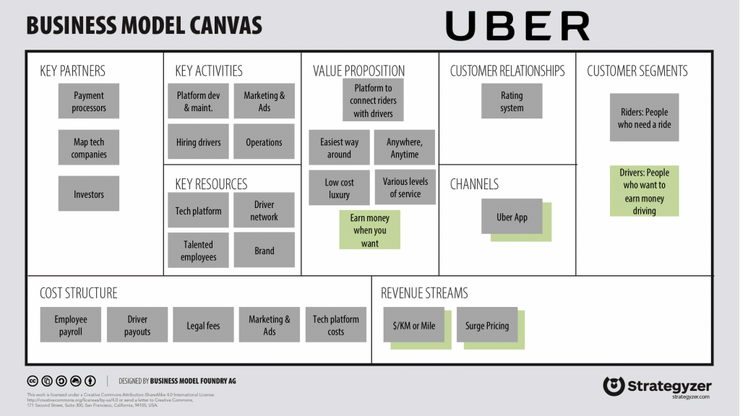
The Canvas Model is currently widely applied. Major global companies like Apple, Uber, and BMW are all successfully applying this business model in their management activities.
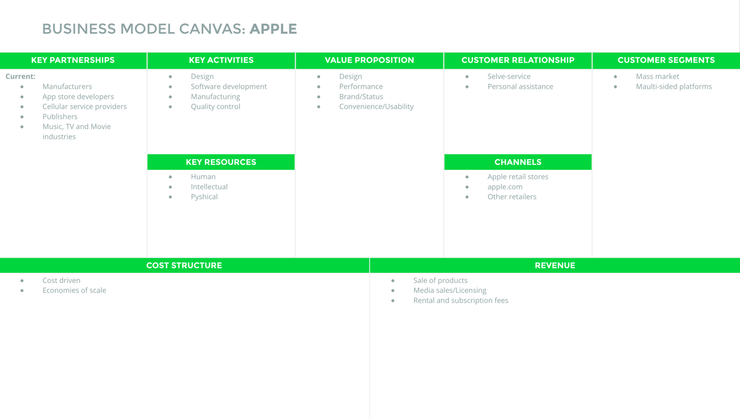
1. Apple
Apple is considered a successful example of applying the Canvas model worldwide. As part of its product development strategy, the American tech giant launched the iPod product line with exclusive music apps like iTunes, delivering an excellent music experience to customers. Although Apple was not a prominent name in the music market, its new products, smart experiences, and innovative sales approach helped the company achieve long-term success.
It can be seen that Apple seamlessly combined the core elements of the Business Model Canvas with its previous successes to achieve even greater ones.
2. Uber
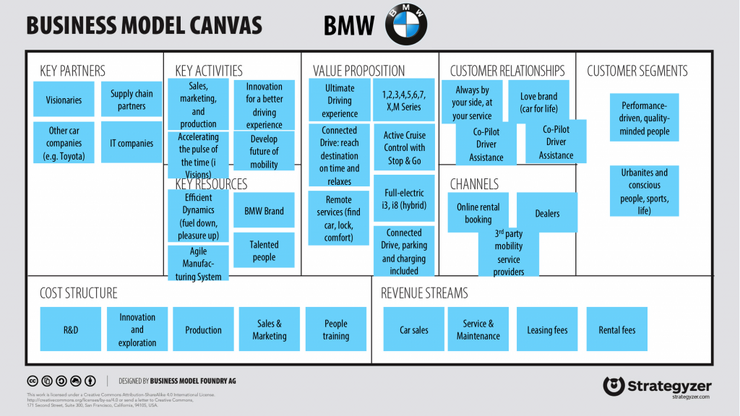
The article above has provided comprehensive information on what the business model canvas is. Businesses can apply the 9 elements in this business model to build an effective sales strategy like Amazon. If you have any questions or requests, please contact us for assistance.
For more detailed information, please see:
Register for a consultation: 083 483 8888
Fanpage: https://www.facebook.com/1officevn/
<span style="vertical