


 09/05/2026
  1218 views
Handing over premises – whether it’s a rental apartment, a business office, a warehouse, or land for a construction project – is always a pivotal moment that determines the rights and responsibilities of all parties throughout the period of use. A detailed and transparent premises handover record not only documents the actual condition, accompanying assets, and utility meter readings but also serves as a solid legal “shield” to prevent future prolonged disputes over damages, security deposits, or boundaries. In this article, we provide a comprehensive guide covering everything from the definition, importance, legal regulations, and standard structure to an effective handover checklist and the most common premises handover record templates – helping landlords, tenants, investors, and contractors carry out the process professionally, safely, and with minimal risk!
Mục lục
I. What Is a Premises Handover Record?
A premises handover record is an administrative document (or a written agreement) created between the relevant parties to officially document the transfer of premises (house, office, warehouse, land, construction site, etc.) from the delivering party (owner, investor, lessor) to the receiving party (tenant, contractor, buyer, user).
This document details the condition of the premises at the time of handover (physical condition, furniture, fixed equipment, included utilities, any damages), the assets and materials handed over with it, and also confirms the parties’ agreement on the time of transfer of usage rights, management rights, and related obligations.
Simply put: This is a “certificate” confirming that the premises have “changed hands” clearly and transparently, similar to a house handover record in a real estate transaction or a warehouse handover at the end of a lease agreement.
Differentiating common types of premises handovers
| Handover Type | Key Parties | Main Purpose | Key Features |
| Construction Site Handover | Investor → Construction Contractor | Handing over land/project for construction according to the construction contract | Clearly specifies boundaries, land status, obstacles, site utilities, and site acceptance minutes |
| Rental Premises Handover | Landlord/Owner → Tenant (office, residence, warehouse) | Handing over for the tenant’s use according to the lease agreement | Focuses on the condition of furniture, floors, walls, electricity and water, door locks, security deposit, and utility debts |
| Land Handover | Land Transferor (individual/business/state) → Transferee (project, investment) | Transferring land use rights for projects, investment, or cultivation | Clearly specifies boundaries, coordinates, and land status (whether there are trees, temporary structures, or land disputes) |
Tầm quan trọng của biên bản bàn giao mặt bằng
- Cơ sở pháp lý để xác nhận việc chuyển giao quyền và nghĩa vụ Biên bản là chứng cứ pháp lý quan trọng xác nhận thời điểm bên nhận chính thức có quyền sử dụng, quản lý mặt bằng. Đây là căn cứ để tính thời hạn thuê, thời gian thi công, thời điểm bắt đầu tính khấu hao tài sản cố định (nếu có).
- Minh bạch hóa thông tin, tránh tranh chấp sau này Ghi nhận rõ ràng hiện trạng ban đầu giúp hai bên tránh tranh cãi về “ai làm hỏng cái gì” khi trả mặt bằng hoặc kết thúc hợp đồng. Ví dụ: Nếu tường bị nứt khi bàn giao, bên thuê không bị quy trách nhiệm khi trả nhà.
- Ghi nhận hiện trạng, tài sản đi kèm tại thời điểm bàn giao Liệt kê chi tiết: nội thất cố định (tủ bếp, điều hòa, sàn gỗ), thiết bị (máy lạnh, đèn, ổ cắm), tiện ích (điện nước, internet), và tình trạng hư hỏng (nếu có). Đây là cơ sở để quyết toán tiền cọc, bồi thường khi kết thúc hợp đồng thuê.
- Làm căn cứ để giải quyết các vấn đề phát sinh Trong tranh chấp (thuê nhà bị hư hỏng, chậm thi công, tranh chấp ranh giới đất), biên bản bàn giao là tài liệu đầu tiên tòa án hoặc cơ quan hòa giải xem xét. Nếu không có biên bản, bên yếu thế thường chịu thiệt thòi lớn.
Tóm lại: Biên bản bàn giao mặt bằng không phải thủ tục hình thức mà là công cụ pháp lý thiết yếu trong mọi giao dịch liên quan đến bất động sản, cho thuê, thi công. Việc lập biên bản chi tiết, khách quan và có chữ ký đầy đủ sẽ giúp các bên bảo vệ quyền lợi tối đa, giảm thiểu rủi ro tranh chấp kéo dài và tốn kém.
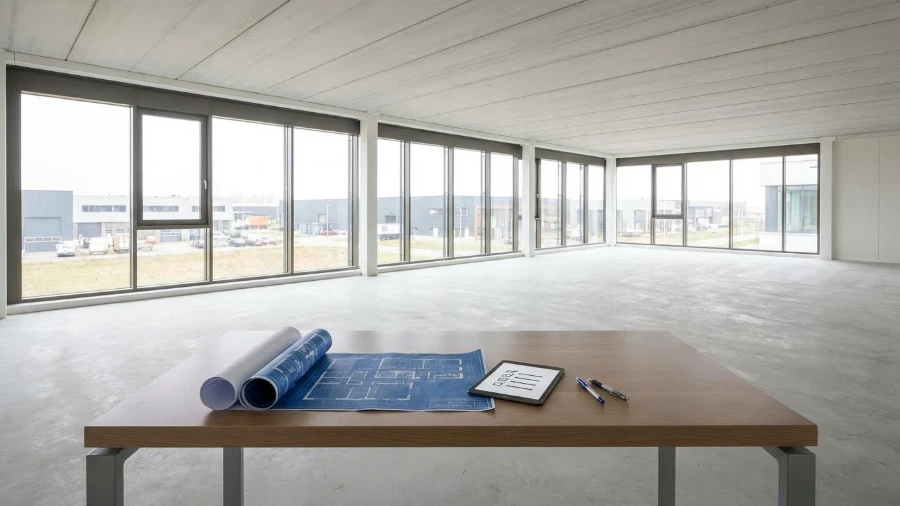
II. Các Loại Biên Bản Bàn Giao Mặt Bằng Phổ Biến
Bàn giao mặt bằng – dù là nhà ở cho thuê, văn phòng kinh doanh, kho bãi hay đất thi công dự án – luôn đòi hỏi một biên bản rõ ràng để ghi nhận hiện trạng, tài sản đi kèm và trách nhiệm của các bên ngay từ giây phút đầu tiên. Tùy theo mục đích sử dụng (cho thuê, thi công xây dựng, chuyển nhượng đất đai…), biên bản bàn giao mặt bằng được chia thành nhiều loại với nội dung và yêu cầu pháp lý khác nhau. Trong phần này, chúng tôi sẽ giới thiệu chi tiết các loại biên bản bàn giao mặt bằng phổ biến tại Việt Nam, từ mẫu bàn giao cho thuê nhà ở, văn phòng, kho bãi đến bàn giao mặt bằng thi công xây dựng và bàn giao đất – kèm đặc điểm, nội dung chính và lưu ý pháp lý để bạn dễ dàng chọn mẫu phù hợp, đảm bảo minh bạch và tránh tranh chấp kéo dài sau này!
Mẫu 1: Mẫu chuẩn biên bản bàn giao mặt bằng thi công.
Bàn giao mặt bằng thi công là bước quan trọng đầu tiên trong mọi dự án xây dựng, giúp chủ đầu tư và nhà thầu xác nhận rõ ràng hiện trạng đất, ranh giới, mốc giới, vật cản và các điều kiện sẵn sàng để triển khai công trình. Một biên bản chuẩn không chỉ đảm bảo tính pháp lý theo Luật Xây dựng và Nghị định 06/2021/NĐ-CP mà còn là căn cứ vững chắc để xử lý tranh chấp về tiến độ, thay đổi hiện trạng hoặc trách nhiệm bảo vệ mặt bằng. Mẫu này được thiết kế đầy đủ, chi tiết, dễ áp dụng cho mọi công trình xây dựng dân dụng và công nghiệp.
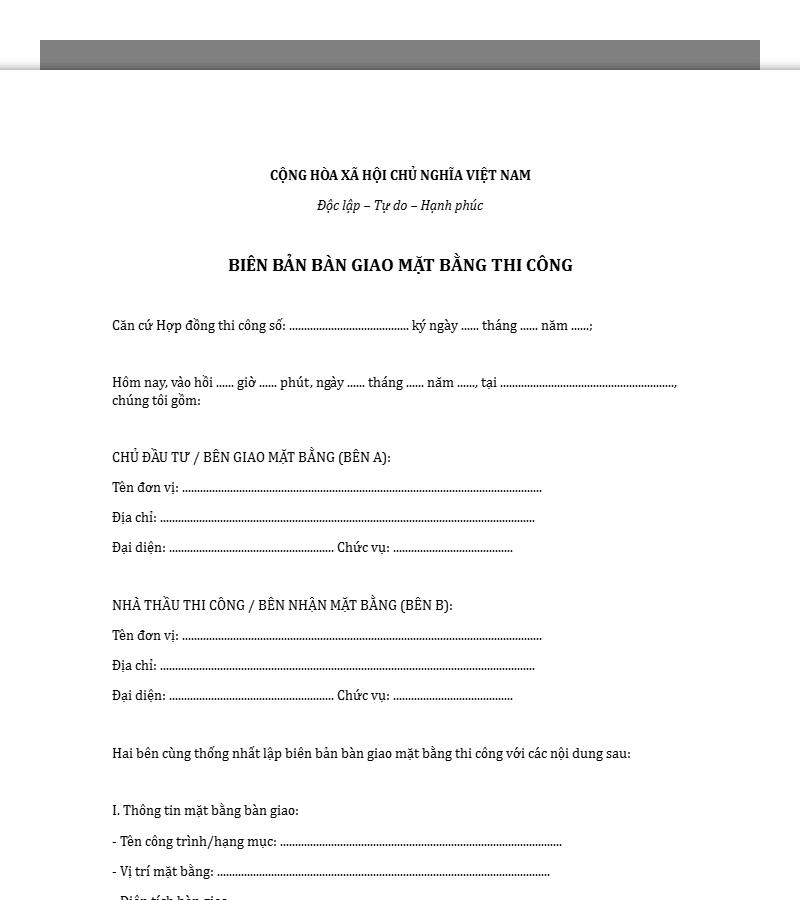
Tải Ngay Mẫu Biên Bản Bàn Giao Mặt Bằng Thi Công
Mẫu 2: Mẫu biên bản bàn giao mặt bằng cho thuê văn phòng
Khi cho thuê văn phòng, biên bản bàn giao mặt bằng là tài liệu then chốt để ghi nhận hiện trạng văn phòng, nội thất cố định, thiết bị văn phòng, hệ thống điện nước và chỉ số công tơ tại thời điểm bàn giao. Mẫu này giúp chủ cho thuê và doanh nghiệp thuê tránh tranh chấp về hư hỏng, tiền cọc, chi phí sửa chữa sau này, đồng thời đảm bảo minh bạch theo quy định của Luật Kinh doanh bất động sản. Đây là mẫu chuyên dụng, phù hợp cho văn phòng hạng A, B hoặc co-working space.
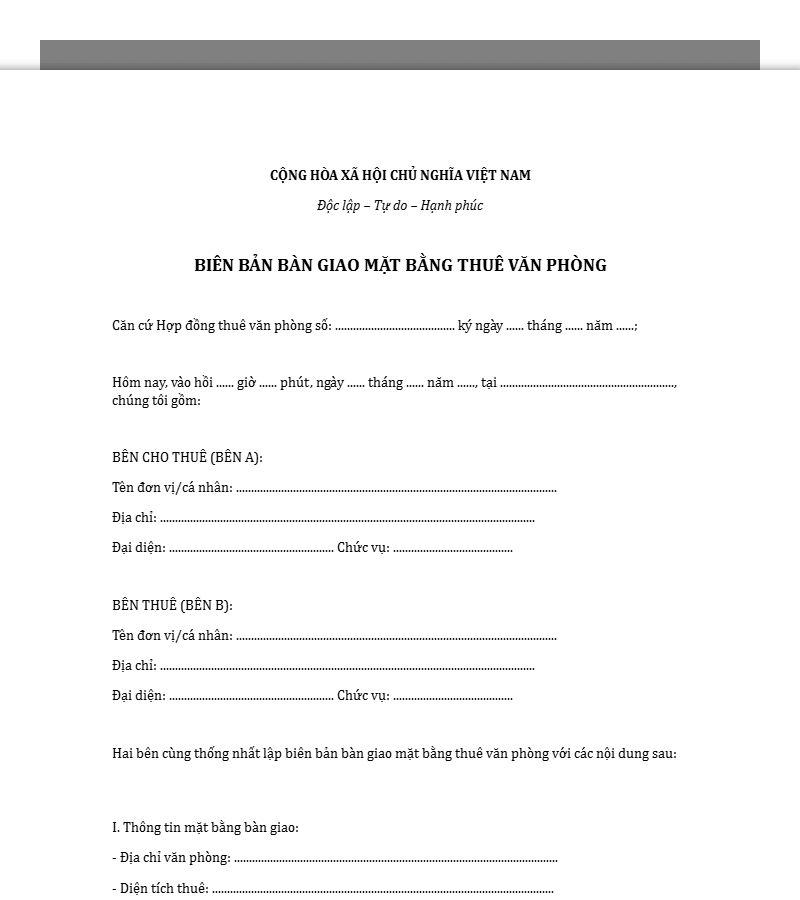
Tải Ngay Mẫu Biên Bản Bàn Giao Mặt Bằng Thuê Văn Phòng
Mẫu 3: Mẫu biên bản bàn giao nhà/căn hộ cho thuê
Bàn giao nhà ở hoặc căn hộ cho thuê đòi hỏi biên bản chi tiết về tình trạng nhà, nội thất, thiết bị gia dụng, sàn gỗ, sơn tường, hệ thống điện nước và các hư hỏng tồn tại. Mẫu này giúp chủ nhà và người thuê thống nhất rõ ràng về hiện trạng ban đầu, bảo vệ quyền lợi khi hoàn trả nhà (trả tiền cọc, bồi thường hư hỏng), đồng thời là chứng cứ pháp lý quan trọng nếu xảy ra tranh chấp. Mẫu được cập nhật chuẩn 2026, phù hợp cho nhà riêng, căn hộ chung cư hoặc nhà phố.
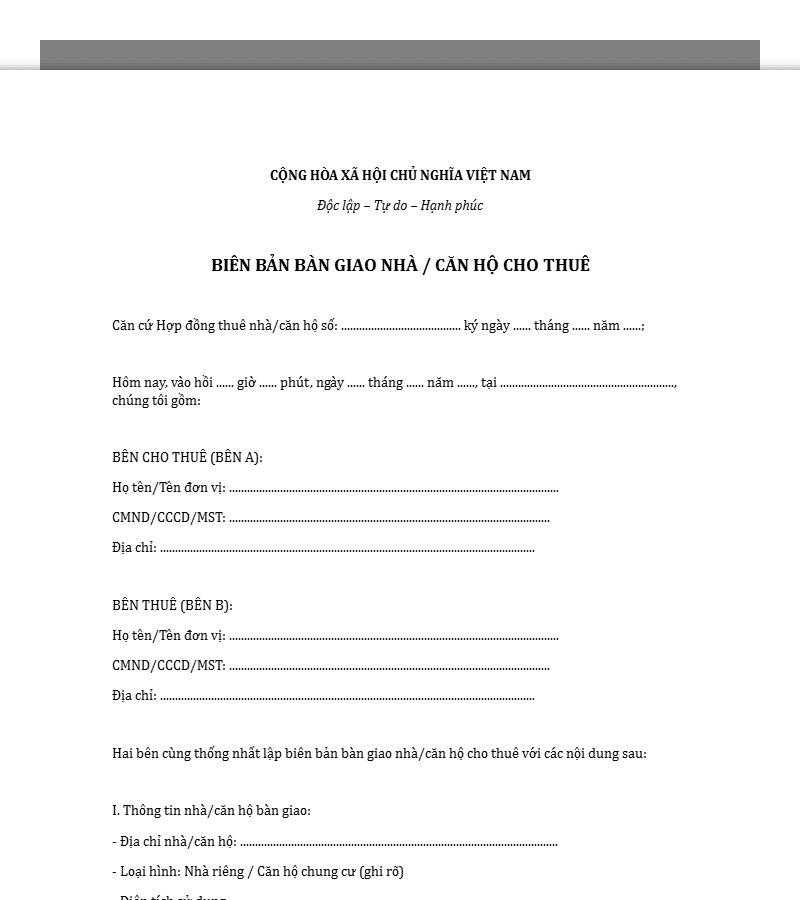
Tải Ngay Mẫu Biên Bản Bàn Giao Nhà, Căn Hộ Cho Thuê
Mẫu 4: Mẫu biên bản bàn giao mặt bằng đất trống
Bàn giao mặt bằng đất trống (đất dự án, đất nông nghiệp, đất kho bãi) cần biên bản ghi nhận chính xác ranh giới, tọa độ, hiện trạng đất (cỏ dại, cây cối, vật cản, tranh chấp nếu có) và tình trạng pháp lý. Mẫu này đặc biệt quan trọng trong các dự án đầu tư, xây dựng kho xưởng hoặc canh tác, giúp các bên tránh tranh chấp ranh giới đất đai theo Luật Đất đai 2024. Đây là mẫu chuyên sâu, khuyến nghị mời đại diện UBND phường chứng kiến.
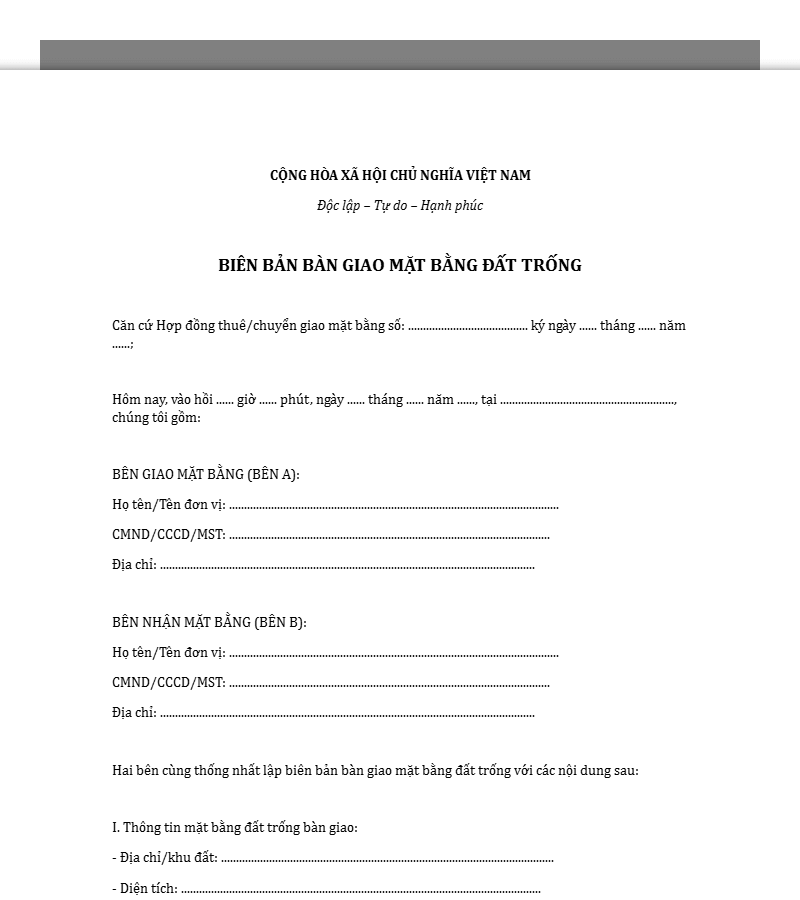
Tải Ngay Mẫu Biên Bản Bàn Giao Mặt Bằng Đất Trống
Mẫu 5: Mẫu biên bản bàn giao mặt bằng thi công nội thất
Khi bàn giao mặt bằng để thi công nội thất (văn phòng, nhà ở, showroom, nhà hàng…), biên bản cần mô tả chi tiết hiện trạng thô, hệ thống điện nước sẵn có, vị trí tường, sàn, trần và các yêu cầu đặc biệt. Mẫu này giúp chủ đầu tư và đơn vị thi công nội thất thống nhất trách nhiệm bảo vệ mặt bằng hiện có, tránh tranh chấp về hư hỏng trong quá trình thi công. Mẫu được thiết kế chuyên biệt, phù hợp cho các dự án nội thất cao cấp hoặc cải tạo nhanh.
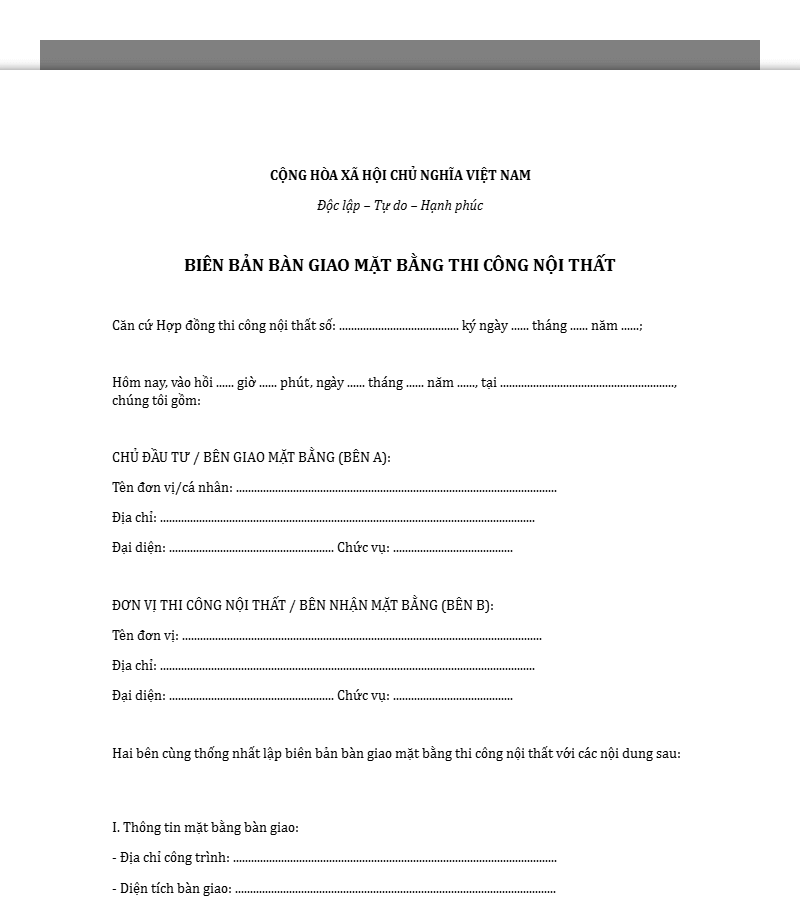
Tải Ngay Mẫu Biên Bản Bàn Giao Mặt Bằng Thi Công Nội Thất
III. Hướng Dẫn Chi Tiết Cách Lập Biên Bản Bàn Giao Mặt Bằng
Biên bản bàn giao mặt bằng cần được lập theo thể thức văn bản hành chính chuẩn tại Việt Nam (Nghị định 30/2020/NĐ-CP về công tác văn thư), đảm bảo tính chính xác, khách quan và có giá trị pháp lý cao nhất. Dưới đây là hướng dẫn chi tiết cấu trúc, nội dung và các lưu ý quan trọng khi lập biên bản (cập nhật thực tiễn 2025).
Các thành phần tham gia
- Bên bàn giao: Chủ sở hữu, chủ đầu tư, bên cho thuê, đại diện pháp nhân (Giám đốc, Chủ tịch HĐQT hoặc người được ủy quyền).
- Bên nhận bàn giao: Bên thuê, nhà thầu thi công, bên mua/mượn sử dụng mặt bằng.
- Đại diện pháp lý (nếu có): Người được ủy quyền bằng văn bản (giấy ủy quyền hợp lệ).
- Người làm chứng: Nhân chứng trung lập (đại diện phòng ban khác, nhân viên công ty, hoặc người dân địa phương).
- Chính quyền địa phương / ban quản lý công trình (bắt buộc trong một số trường hợp):
- Đại diện UBND phường/xã (đối với bàn giao đất, mặt bằng lớn, hoặc có tranh chấp tiềm ẩn).
- Ban quản lý dự án, giám sát công trình (đối với bàn giao thi công xây dựng).
Cấu trúc và nội dung cơ bản của một biên bản chuẩn
Quốc hiệu, tiêu ngữ
CỘNG HÒA XÃ HỘI CHỦ NGHĨA VIỆT NAM
Độc lập – Tự do – Hạnh phúc
- Tên biên bản BIÊN BẢN BÀN GIAO MẶT BẰNG (V/v bàn giao mặt bằng cho thuê / thi công / chuyển giao quyền sử dụng…)
- Thời gian, địa điểm lập biên bản Hồi … giờ … phút, ngày … tháng … năm 2025 Tại: …………………………………………………………… (ghi cụ thể địa chỉ mặt bằng, ví dụ: Tầng 5, tòa nhà ABC, số 123 đường XYZ, phường 5, quận 1, TP. Hồ Chí Minh)
- Thông tin chi tiết các bên liên quan
- Bên bàn giao: Tên: Công ty TNHH Bất động sản DEF Địa chỉ: …………………………………………………………… Đại diện: Ông Nguyễn Văn A – Chức vụ: Giám đốc Số CCCD: ……………………………………………………………
- Bên nhận bàn giao: Tên: Anh Trần Văn B Địa chỉ: …………………………………………………………… Số CCCD: ……………………………………………………………
- Người làm chứng / đại diện chính quyền (nếu có): Ông Lê Văn C – Đại diện UBND phường X
- Legal Basis
- Pursuant to the Civil Code 2015 (Articles 117, 428 on civil transactions).
- Pursuant to the Lease/Purchase/Construction Contract No. … dated …/…/…
- Pursuant to the Land Law 2024 (if related to land), Construction Law 2014 (amended) (if for construction).
- Pursuant to the agreement of the parties.
- Detailed Handover Content
- Project/Premises Name/Address: Private house at 456 Le Loi, Ward 7, District 3, Ho Chi Minh City.
- Area, boundaries: Usable area of 120m², boundaries as per the attached diagram (Appendix 01).
- Current condition of the premises (detailed description):
- Walls, floors, ceiling: Good condition, no cracks, newly painted in 2024.
- Main doors, windows: Original locks, in normal working order.
- Fixed equipment: 02 air conditioners, 01 kitchen cabinet, 03 power outlets, LED lighting system.
- Utility meter readings at the time of handover: Electricity: 1,250 kWh, Water: 45 m³.
- Existing damages (if any): Small crack on the living room wall (approx. 5cm), noted and both parties agree not to hold the receiving party responsible.
- Other issues: No boundary disputes, no obstructions, premises are clean and ready for use.
- Confirmation of Handover and Acceptance The handing-over party confirms that it has handed over the entire premises and accompanying assets in the condition described above. The receiving party confirms that it has received them in full, inspected them thoroughly, and accepts the current condition.
- Comments from Parties No other comments / or specify if there are additions.
Confirmation Signatures of All Parties
REPRESENTATIVE OF THE HANDING-OVER PARTY REPRESENTATIVE OF THE RECEIVING PARTY
(Sign, print full name, and stamp) (Sign, print full name)
WITNESS / GOVERNMENT REPRESENTATIVE
(Sign, print full name)
Important Notes When Preparing the Record
- Information must be accurate, transparent, and public: Do not conceal damages or misrepresent the condition → this can lead to future disputes.
- Thoroughly check the actual condition against the record/contract: Both parties should inspect, measure, and test equipment (electricity, water, air conditioning) together before signing.
- Clearly state the number of copies of the record made: Usually 03 copies with equal legal validity (01 for the handing-over party, 01 for the receiving party, and 01 for records or the authorities if needed).
- Use wet signatures: Handwritten signatures are preferred (do not use electronic signatures unless required by regulation, especially for civil real estate transactions).
- Include photos and videos as evidence (highly recommended): Take panoramic shots of the premises, close-ups of damages, and photos of utility meter readings → attach as an appendix and state in the record “See photo appendix dated…”.
- Ensure all parties read and agree to the content: Read the record aloud before signing and ask for any additional comments. If someone refuses to sign, clearly state the reason and invite a witness.
In summary: A standard premises handover record must be complete, detailed, objective, and supported by visual evidence (photos/videos). Proper preparation will help parties avoid prolonged disputes over damages, deposits, repair responsibilities, or boundaries when the contract ends.

IV. Legal Regulations for Premises Handover Records
A premises handover record is a legally significant document in real estate transactions, leases, and construction in Vietnam. Although the law does not require a record in all cases, when one is created, it must comply with relevant legal regulations to ensure its validity and ability to serve as proof before state agencies or courts.
General Legal Basis
- Civil Code 2015 (amended and supplemented with some articles 2023–2025)
- Article 117: Conditions for the validity of civil transactions (voluntary, not in violation of the law).
- Article 428: Unilateral termination of contract performance.
- Article 429: Statute of limitations for initiating a lawsuit regarding a contract (3 years from the date the rights are infringed).
- Articles 280–281: Liability for non-contractual damages (if the premises are damaged due to the fault of the receiving party). → The handover record serves as evidence confirming the fulfillment of the obligation to hand over the premises as per the contract.
- Land Law 2024 (effective from 01/01/2025)
- Articles 188, 189: Land use rights and the transfer of land use rights must be made in writing.
- Article 195: Handover of land for investment projects must include a handover record clearly stating boundaries and current condition. → Applies to the handover of land for project sites, investment, and cultivation.
- Construction Law 2014 (amended and supplemented in 2020 and with the latest guiding documents of 2025)
- Articles 107, 108: Acceptance and handover of construction works/sites.
- Decree 06/2021/ND-CP (guiding construction implementation): Requires a construction site handover record between the investor and the contractor, clearly stating the condition, boundary markers, and obstructions. → Mandatory for handing over sites for construction projects.
- Law on Real Estate Business 2014 (amended 2023–2025)
- Articles 17, 18: Real estate lease and sale contracts must be in writing.
- Article 57: Handover of houses and construction works must include a handover record noting the condition and accompanying assets. → Applies to the handover of leased premises (offices, houses, warehouses) or the sale of real estate.
Legal Validity of the Premises Handover Record
- It is a document proving the fulfillment of contractual obligations. The record confirms the moment the receiving party officially obtains the right to use the premises, marking the start of the lease/construction period, and serves as the basis for calculating rent, deposits, and asset depreciation (if any).
- It is a basis for resolving disputes and compensation. If a dispute arises (damage to walls or floors, delayed return of premises, boundary disputes), the court or mediation body will prioritize the handover record as primary evidence. A record with complete signatures and a detailed description of the condition will help the aggrieved party easily prove the other party’s responsibility.
| Legal Risks | Potential Consequences | Prevention Methods |
| Missing or inaccurate information | The record is considered to have no evidentiary value | Conduct a physical inspection with all parties, measure the area, record electricity/water meter readings, attach photos/videos |
| Lack of complete signatures from all parties | The record is invalid or difficult to prove | Ensure all relevant parties (transferor, transferee, witnesses) sign by hand and affix a seal (if a legal entity) |
| Failure to clearly describe the actual condition | Disputes over “who damaged what” when returning the premises | Describe in detail: walls, floors, doors, fixed equipment, existing damages (with close-up photos) |
| Failure to invite a government representative (when necessary) | Difficult to prove in case of land or boundary disputes | Invite the People’s Committee of the ward/commune to witness for large plots of land or premises with potential disputes |
How to resolve disputes when they arise
- Direct negotiation: The parties meet, compare the handover record and the original contract to agree on repairs and compensation.
- Local mediation: Mediators from the ward/commune People’s Committee or a commercial mediation center (highly effective, cost-saving).
- Filing a lawsuit in court: Submit a lawsuit to the People’s Court of the district where the premises are located.
- Statute of limitations: 3 years from the date the violation is discovered (Article 429 of the 2015 Civil Code).
- Key evidence: Handover record, contract, photos of the current condition, repair invoices.
- The court will prioritize records with complete signatures and visual evidence (photos/videos).
In summary: A premises handover record has legal value equivalent to a contract performance document. Creating a standard, detailed, and evidence-backed record is the most effective way to prevent legal risks in real estate, leasing, and construction transactions in Vietnam today.

V. Effective Premises Handover Checklist
To ensure the premises handover process is smooth, transparent, and avoids future disputes, both the handing-over party (landlord, investor, lessor) and the receiving party (tenant, contractor) should follow the detailed checklist below. This checklist is based on common practices in Vietnam in 2025 to help minimize legal and financial risks.
Checklist for the Handing-Over Party (Landlord / Investor / Lessor)
- Inspect assets, equipment, and current condition before handover
- Conduct a full inventory of the premises: walls, floors, ceilings, windows, main doors, fixed furniture (kitchen cabinets, shelves, air conditioners, lights…).
- Note any existing damage (cracks, water leaks, warped floors, broken outlets…).
- Check fixed equipment: air conditioners, ceiling fans, water heaters, water tanks, door locks… (perform basic operational tests).
- Re-measure the actual area and compare it with the contract.
- Prepare all relevant documents and paperwork
- Lease/purchase/construction contract (original or certified copy).
- Ownership documents: Red/pink book (land use rights certificate), construction permit (if required).
- Invoices for furniture and fixed equipment (if handed over).
- Most recent utility bills, current meter readings.
- Floor plan drawing (if available).
- Draft a detailed handover record
- Prepare a handover record with a specific description of the current condition.
- List all accompanying assets and existing damage.
- Prepare a photo/video appendix of the current condition (taken before handover).
- Notify all parties of the handover time and location
- Provide written notice (email, Zalo message, invitation letter) at least 3–7 days in advance.
- Invite witnesses (if necessary), a representative from the ward People’s Committee (if handing over a large plot of land or if there is potential for dispute).
- Ensure all relevant parties confirm their attendance.
- Ensure the premises are ready for handover
- Clean the premises, remove obstacles and trash.
- Check that the electrical, water, and fire protection systems are functioning normally.
- Lock doors and windows securely, do not leave personal belongings behind.
Checklist for the Receiving Party (Tenant / Contractor)
- Thoroughly inspect the premises, assets, and equipment against the contract
- Measure the actual area and compare it with the contract.
- Check the condition: walls, floors, ceilings, doors, fixed furniture, equipment (test turning on/off air conditioners, lights, faucets…).
- Compare the list of accompanying assets with the contract (check for missing or damaged items).
- Compare with the information in the draft record
- Read the draft record carefully, check if the description of the current condition is accurate.
- If there are discrepancies (new damage, missing equipment), request corrections immediately before signing.
- Record, take photos, and shoot videos as evidence
- Take panoramic and close-up photos of specific areas: cracks, water leaks, outlets, electricity/water meters.
- Shoot a short video (of the entire premises, testing equipment) for documentation.
- Note the time of the photos/videos in the record.
- Check the electrical, water, and fire protection systems (if any)
- Check the electricity and water meter readings at the time of handover.
- Test the electrical system (lights, outlets, circuit breakers), water system (shower, sink), fire extinguishers, and drainage system.
- Clearly record the initial readings to avoid future bill disputes.
- Request clarification on any unclear or problematic points
- Ask clearly about existing damage and the responsibility for repairs.
- Request additions to the record if new issues are discovered.
- Do not sign if you do not agree or have not inspected thoroughly → state the reason for refusal to sign (if necessary) and invite a witness.
General notes for both parties
- Always conduct a joint physical inspection before signing (do not sign in a hurry).
- Attach photos/videos as an appendix to the record.
- Prepare the record in 03 copies of equal value (each party keeps one, the remaining copy is for filing or submitting to authorities if needed).
- Sign by hand, affix a seal (if a legal entity), and read the record aloud to confirm no one has any other opinions.
Following this checklist completely will help the premises handover process proceed professionally, transparently, and with minimal future disputes.
















