


 10/05/2026
  15130 views
In the course of work, transferring to other branches or changing workplaces within the company is very common. To carry out this transfer, it is necessary to comply with the provisions of the Law on Enterprises and related labor regulations. So, what constitutes a personnel transfer decision that meets both formal and legal standards? Let’s find out with 1Office in the following article.
Mục lục
- What is a personnel transfer decision?
- Differentiating between transfers and other forms
- Objectives & Common Forms of Personnel Transfer
- In which cases are personnel transfers permitted?
- Basic contents of a personnel transfer decision
- A 5-Step Process for Issuing a Standard & Effective Personnel Transfer Decision
- 3 Standard Personnel Transfer Decision Templates
- Guide on How to Handle Situations When an Employee Disagrees with a Transfer
- Key Considerations for Personnel Transfer Decisions
What is a personnel transfer decision?

A personnel transfer decision is an administrative-HR document that expresses a company’s or organization’s decision to move an employee from one job position or work unit to another. This decision may include transferring to another branch, changing job positions, or moving between different departments within the organization.
A personnel transfer decision is often made based on various factors, including skill needs, career development, internal organizational adjustments, or other factors related to human resource management. The transfer process is usually carried out according to company regulations and may require agreement and notification to the involved employees.
Differentiating between transfers and other forms
Below is a comparison table to help businesses easily distinguish between transfers, rotations, and secondments:
| Criteria | Reassignment | Rotation | Secondment |
| Concept | Transferring officials and civil servants from one agency to another by decision of a competent authority. | Assigning or appointing leading and managerial officials and civil servants to another unit for a specified period for training and development according to task requirements or planning. | Sending civil servants to work for a limited period at another agency outside the scope of management to meet task requirements. |
| Subjects | Officials, civil servants. | Leading and managerial officials and civil servants. | Civil servants. |
| Post-application Staffing Status | Becomes part of the receiving agency’s staff. | – | Remains part of the sending agency’s staff. |
| Basis for Implementation | • Task requirements.
• Civil servant utilization planning/schemes. • Job position changes as per regulations. |
Based on task requirements and approved personnel planning. | • Sudden, urgent tasks.
• Work that needs to be resolved within a specific period. |
| Duration | Not specified. | At least 3 years; special cases are decided by the competent authority. | A maximum of 3 years (unless otherwise stipulated by specialized laws). |
| Deciding Authority | The head of the civil servant management agency or the competent authority as prescribed by regulations. | According to the decentralization of personnel management by the Party and the law. | The head of the civil servant management agency or submits to the competent authority for decision. |
Objectives & Common Forms of Personnel Transfer
Below is an overview of the objectives and common forms of personnel transfer in a business:
Objectives of Personnel Transfer
Below are the core objectives that both businesses and employees aim for when implementing personnel transfers:
| From the business’s perspective | From the employee’s perspective |
|
|
Types of personnel transfers
In terms of form, personnel transfers are usually divided into 2 main groups:
Form 1 – Temporary Transfer
This is a short-term transfer. The business does not need the employee’s consent, but the total transfer period cannot exceed 60 days/year. The employee must be notified at least 3 working days in advance, and the salary during the transfer period must not be less than 85% of the old salary and not lower than the regional minimum wage.
Form 2 – Official Transfer
An official transfer applies when the business assigns an employee to a new long-term or permanent job, and this form requires the consent of the transferred person. The employee will be notified 7 working days in advance, sign a new labor contract or an appendix to the contract, and the new salary must still be at least 85% of the old salary and not lower than the regional minimum wage.
Regulations and laws on personnel transfers
According to the 2019 Labor Code (amended and supplemented in 2020):
- Personnel transfer regulations: The employer has the right to temporarily transfer personnel (maximum 60 days/year) in urgent cases (natural disasters, epidemics, sudden production needs) without the employee’s consent (Article 29).
- Is consent required for a personnel transfer?
- Temporary cases: Consent is not required for urgent reasons.
- Regular or long-term cases (internal personnel transfer): Written consent from the employee is required, unless otherwise specified in the labor contract or collective labor agreement.
- Notice period for personnel transfer: At least 3 working days before implementation (except in urgent cases).
Legal reasons for personnel transfer: Business production needs, organizational restructuring, risk prevention, or personal reasons (skill enhancement).
In which cases are personnel transfers permitted?

According to legal regulations, when signing a labor contract, both parties must adhere to the content of the signed contract. During the contract’s execution, any changes require the consent of both parties. However, in certain cases, to protect the rights and interests of the employer, the law allows the employer to implement measures different from the company’s internal rules and change the content of the labor contract when transferring an employee to another job, provided it is correctly stipulated in the contract.
Accordingly, the employer has the right to transfer an employee to another job in the following situations:
- In the event of natural disasters, fires, or epidemics;
- When it is necessary to apply measures to overcome or prevent natural disasters or occupational accidents;
- In case of occupational diseases;
- In case of power or water supply incidents;
- Due to production and business needs, and other specific details stipulated in the company’s internal rules and labor contract.
The period for transferring an employee to a job different from the one specified in the labor contract shall not exceed 60 cumulative working days in a year, unless there is written consent from the employee.
Rights during a work transfer and the impact of personnel transfers
- Rights during a work transfer:
- Salary and benefits must not be lower than before (unless otherwise agreed).
- Impact of personnel transfer on salary: Salary cannot be unreasonably reduced; if the new position has a lower salary, compensation or an agreement is required.
- Travel and accommodation costs (if transferring to a distant location) are covered by the company.
- Impact of personnel transfer: Can be positive (skill development) or negative (pressure to adapt). If the transfer is unlawful, the employee has the right to file a complaint or terminate the contract (with compensation).
Basic contents of a personnel transfer decision
If the business drafts the personnel transfer decision document itself, the drafter needs to ensure the following basic contents and notes:
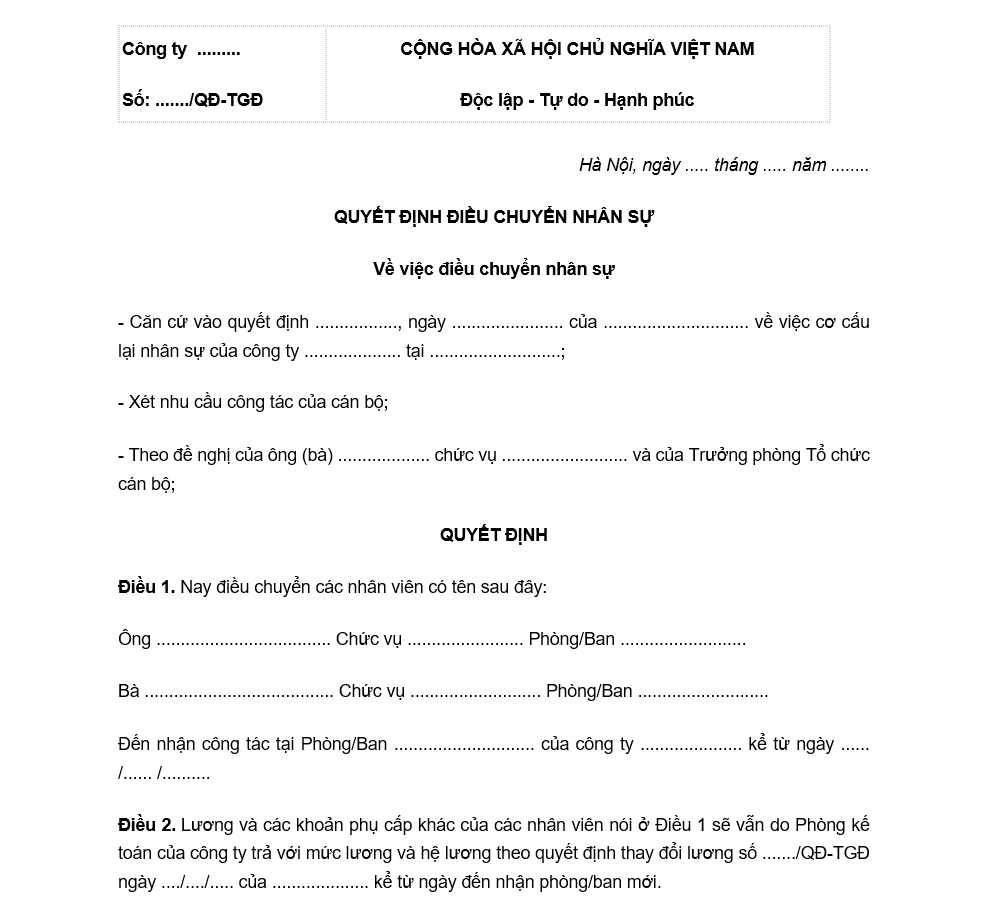
- In the top left corner of the personnel transfer form, the unit name and decision number must be clearly stated;
- The official heading and title are mandatory in the document;
- In the content section, the job title of the transferred person, the name of the organization, and the name of the current department where they are working must be described in detail. Additionally, the location where the employee will take up their new position after the transfer must be clearly stated. Article 1 also mentions the name of the organization and location, as well as the start date at the new department;
- Article 2 must specify the salary and method of salary payment for the employee. This section needs to clearly state the name of the new department responsible for paying the salary and the specified salary level;
- Article 3 should mention which individuals and departments will implement the decision, and also specify the place of receipt for the decision;
- Signature of the company director or an authorized signatory
A 5-Step Process for Issuing a Standard & Effective Personnel Transfer Decision
Below is a 5-step process to help businesses conduct personnel transfers in a systematic, transparent, and effective manner:
- Step 1: When a need for transfer arises, the HR department will work with the management board and heads of relevant departments to agree on and issue the transfer decision.
- Step 2: HR notifies the employee of the decision. In the case of a formal transfer, the employee has 7 days to consider and respond.
- Step 3: After the employee confirms, the HR department informs the current department to carry out the work handover and complete all related paperwork.
- Step 4: The new department onboards the employee according to internal procedures. If it is a permanent transfer, the HR department will proceed to sign a new labor contract.
- Step 5: After the transfer process is complete, HR should survey and listen to feedback from the employee to understand their experience, thereby improving the process for future cases.

3 Standard Personnel Transfer Decision Templates
Below are some of the latest decision templates, ensuring standard formatting, complete information, and legal validity:
Personnel Transfer Decision Template
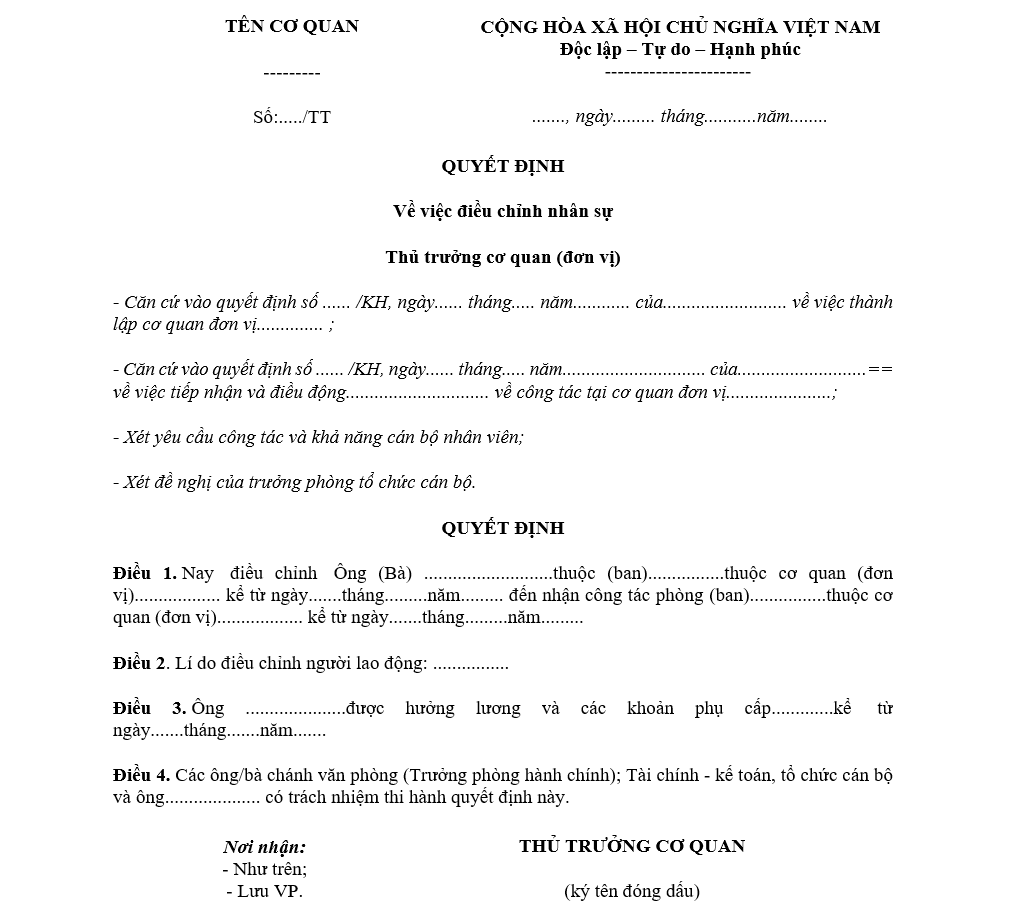
Personnel Adjustment Decision Template
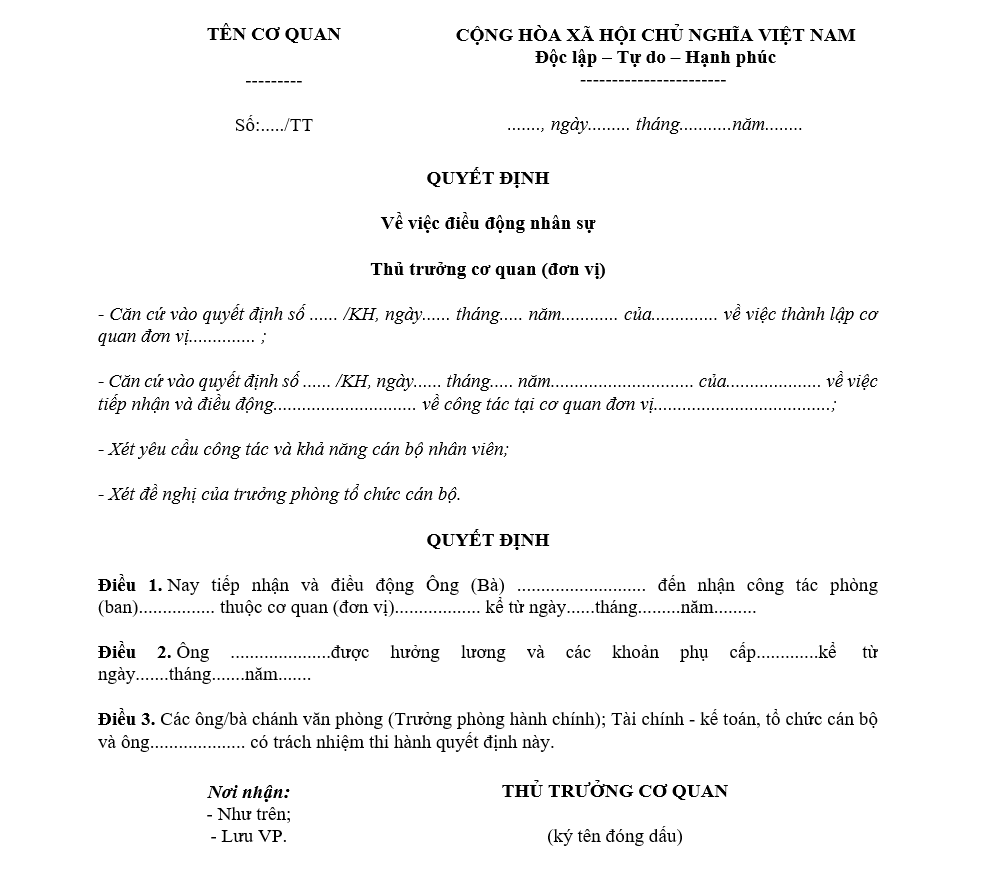
Personnel Mobilization Decision Template
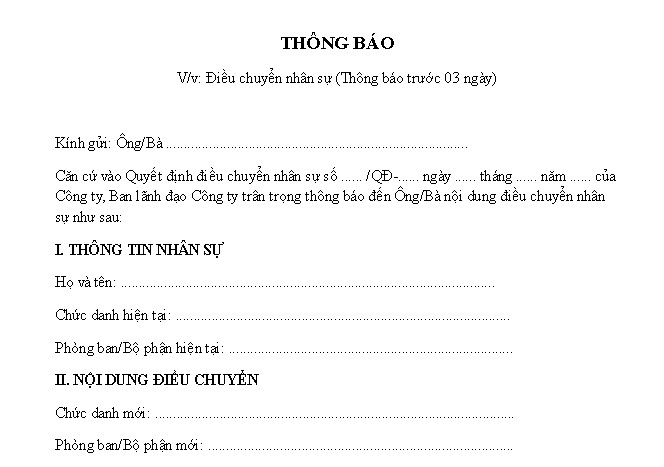
Personnel Transfer Notification Template
Download now Personnel Transfer Notification Template (docs file)
Personnel Transfer Official Letter Template
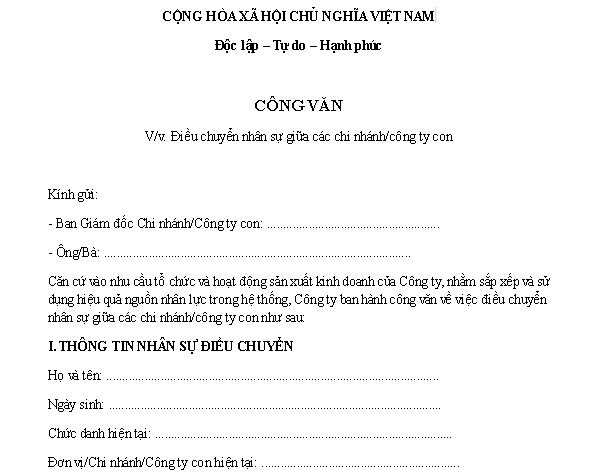
Download now Personnel Transfer Official Letter Template (docs file)
Guide on How to Handle Situations When an Employee Disagrees with a Transfer
Transfers can lead to disputes if the employee does not consent. In such cases, the business needs to handle the situation cautiously and in accordance with the law:
- Clearly analyze the rights and obligations of both parties: The business must prove that the transfer is necessary for production and business operations and is consistent with the scope of work agreed upon in the contract. Conversely, the employee has the right to refuse if the transfer significantly changes their working conditions or does not comply with legal regulations.
- Engage in dialogue and persuasion: Organize a direct internal discussion to explain the reasons, benefits, development opportunities, and accompanying support. Transparent communication helps reduce opposition and fosters understanding.
- Consider alternative solutions: If the employee has difficult circumstances or a reasonable cause, the business can consider adjusting the position, the transition roadmap, or finding a more suitable personnel alternative.
- Note the legal consequences if the business violates regulations: If a transfer is illegally forced, the business may face complaints, administrative penalties, compensation for damages, or be required to reinstate the employee to their former position.
Key Considerations for Personnel Transfer Decisions

When using the personnel transfer decision template, you should note the following:
- Compliance with laws and internal procedures: Ensure that the announcement document and the transfer process fully comply with legal regulations and the company’s internal procedures. Clearly define the processes, procedures, and legal requirements related to personnel transfers.
- Information security and privacy: Pay attention to ensuring the security and privacy of employee information in the decision. This ensures that personal information is not disclosed or used for improper purposes.
- Interaction and communication: Maintain positive interaction and clear communication with all relevant parties. This includes notifying the employee of the transfer decision, interacting with the proposer and approver of the transfer, and contacting other relevant parties (if any) to ensure understanding and support throughout the transfer process.
- Regular review and updates: The decision template should be updated regularly to ensure it remains relevant and current with the organization’s needs and changes.
Above is a compilation of 3 personnel transfer decision templates, along with notes on the format and necessary content for the transfer announcement document. We hope this article will help businesses draft documents that ensure legal compliance and protect employee rights.
Every personnel transfer decision has a significant impact on morale and work performance. But if your business is still handling transfers manually—drafting decisions in Word, sending approvals via email, and updating information by hand across multiple separate files—it’s easy for discrepancies or inconsistencies to arise between departments. With 1Office, especially when integrated with AI, the entire transfer process can be automated: the system suggests templates, checks validity based on job title, seniority, and career path, and synchronizes information across the entire system. Each decision is not only correct—it’s also transparent, justified, and backed by supporting data.
















