10/05/2026
  40413 views
BSC and KPI are two important tools that help businesses shape, measure, and manage business performance. The proper combination and application of these two tools will help businesses achieve strategic goals and improve operational efficiency. So, let’s explore the differences, implementation methods, and common mistakes to avoid when applying these two concepts with 1Office!
Mục lục
- 1. What are the concepts of BSC and KPI?
- 2. Comparing the differences between BSC and KPI
- 3. The Relationship Between BSC and KPI
- 4. Guide to Implementing KPIs using the BSC Format
- Step 1: Provide knowledge about KPIs and BSC to all employees
- Step 2: Define and align on objectives and strategic perspectives
- Step 3: Set objectives and KPI standards for each perspective
- Step 4: Implement and test KPIs within the business
- Step 5: Evaluate, analyze KPIs, and propose improvement measures
- Step 6: Apply and promote within the business environment
- 5. Mistakes When Applying BSC and KPIs
- 6. When to Apply BSC and KPIs
- 7. Monitoring and Evaluating the Effectiveness of BSC and KPIs
- 8. How to Adjust KPIs and BSC When Business Strategy Changes
1. What are the concepts of BSC and KPI?
BSC and KPI are two important performance management tools that help businesses orient, measure, and evaluate the achievement of strategic goals. A clear understanding of the relationship between BSC and KPI helps businesses manage effectively, make accurate decisions, and motivate personnel towards common goals.
1.1 What is BSC?
BSC is an acronym for Balanced ScoreCard. It is a goal-based, multi-dimensional management and measurement tool introduced by economists Robert Kaplan and David Norton in the late 1980s. BSC helps businesses translate their strategic vision into specific indicators by considering and balancing performance parameters from various perspectives.
Specifically, BSC impacts 4 specific aspects of a business through strategic monitoring activities. Below is a detailed description of how BSC affects each aspect:
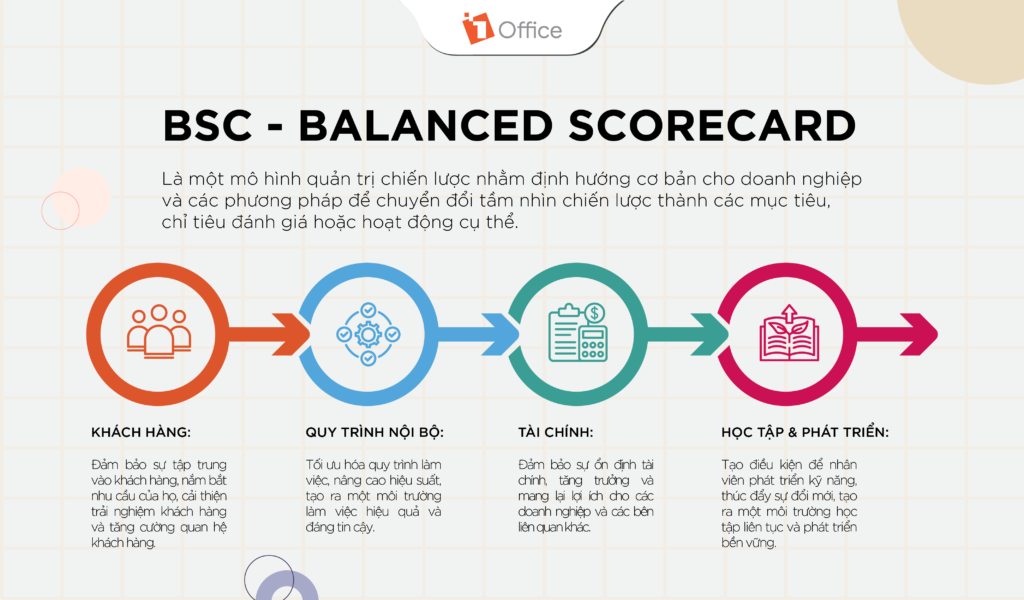
- Customer: BSC helps businesses evaluate and measure customer satisfaction through indicators such as customer loyalty rate, service cancellation rate, customer reviews, etc. This allows businesses to monitor and improve results to meet customer needs and expectations.
- Financial: BSC defines key financial indicators such as revenue, profit, profit margin, and ROI (Return on Investment). This helps businesses track and evaluate their financial performance while optimizing the resources needed to achieve financial goals.
- Internal Processes: BSC measures and tracks performance through internal business processes and activities. Indicators such as product/service quality, delivery time, error rate, etc., help businesses enhance efficiency and improve performance, thereby increasing customer satisfaction.
- Learning and Growth: BSC encourages businesses to define learning and growth indicators such as employee training rate, product innovation and development, new technology adoption rate, etc. This helps businesses formulate strategies for employee training and development, enhancing organizational capabilities and adaptability to environmental changes.
| >> Read more: What is BSC? How to build a successful strategy with the BSC model |
1.2 What is a KPI?
KPI stands for Key Performance Indicators, which are important metrics used to measure and evaluate the achievement of goals and the performance of an organization, project, or business process. KPIs are often selected based on critical factors that influence the organization’s success.
KPIs can be defined and applied in almost all different fields, including finance, sales, marketing, customer service, project management, quality, employee performance, and many other aspects. They are usually measured by specific numbers that help compare and evaluate the work efficiency of individuals, departments, and business units.
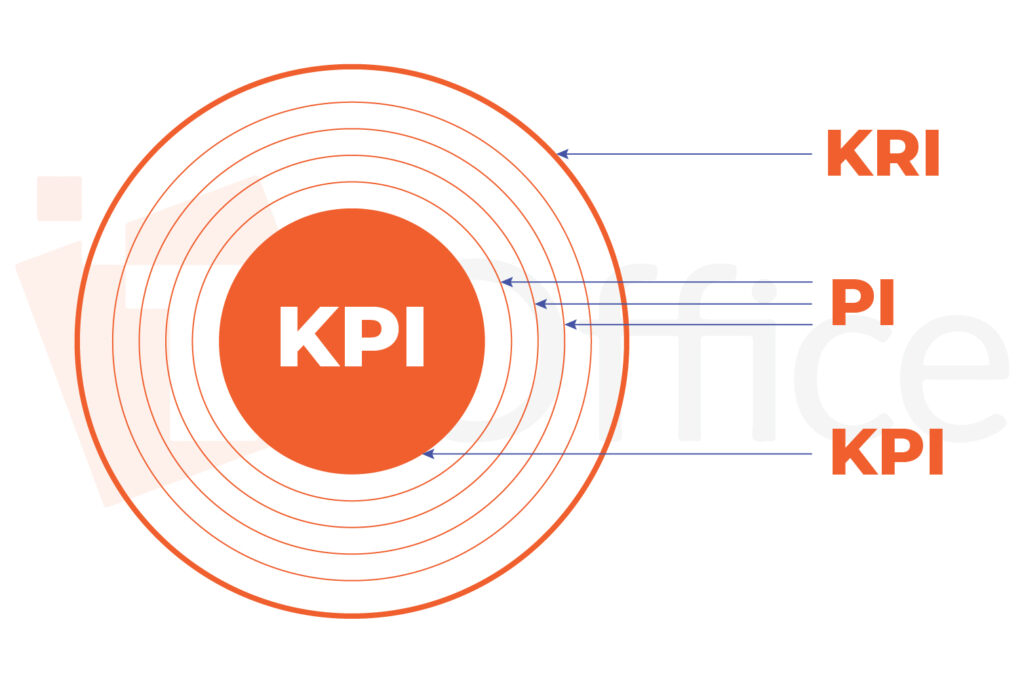
Specifically, KPIs impact many aspects of a business and can be divided into the following main groups:
- Financial: Measure the financial performance of the business, including revenue, profit, profit margin, gross margin, cash flow, and financial structure. Example: Achieve a net profit margin of 20% of revenue.
- Customer: Focus on measuring customer satisfaction and experience in aspects such as customer retention rate, number of new customers, number of loyal customers, etc. Example: Increase the number of new customers by 15% within the year.
- Production and Operations: Measure the performance and efficiency of production processes and business operations, such as output, quality, production costs, labor productivity, etc. Example: Increase labor productivity by 15% by improving the training process.
- Human Resources: Help managers measure and evaluate employee turnover rate, labor utilization rate, individual performance assessments, training rate, etc. Example: Reduce the employee turnover rate to below 10% in 2023.
- Marketing and Sales: Includes metrics on sales revenue, conversion rate, marketing costs, number of new customers, and number of sales opportunities. Example: Increase sales revenue by 10% compared to the same period last year.
- Research and Product Development: KPIs help managers measure the number of new products, research and development costs, and completion time. Example: Develop and launch at least 3 new products within the year.
| >> Read more: A Detailed Guide to Building a KPI System for Businesses from A-Z |
2. Comparing the differences between BSC and KPI
| Criteria | BSC (Balanced Scorecard) | KPI (Key Performance Indicator) |
| Scope | BSC aims to consider all important aspects of the business to ensure that strategic objectives are implemented simultaneously and in a balanced way. | KPI focuses on specific indicators and measures the performance of a particular aspect or activity within the business, not necessarily related to all aspects. |
| Objective | BSC has a macro-level scope, helping businesses create a comprehensive and balanced view of performance, thereby shaping and driving the overall strategy to achieve sustainable success. | KPI provides specific measurement indicators to track and evaluate the performance of a specific activity, process, department, or objective. |
| Vision | BSC focuses on the long-term vision of the business, aiming to ensure a balance between aspects to achieve sustainable development. | KPI focuses on the short-term vision to monitor and evaluate current results and performance indicators for adjustment and improvement. |
| Application | BSC is often used as an overall strategic management tool to shape, monitor, and balance the business’s performance across important aspects. | KPI is often used as a specific tool to measure, track, and manage the performance of specific activities and areas within the business. |
Comparison table of the differences between BSC and KPI
3. The Relationship Between BSC and KPI
BSC and KPI have a close and mutually supportive relationship. They create a bridge between the overall strategy and the detailed work of employees, thereby helping to guide business strategy and leadership within an enterprise.

Converting strategic goals into specific objectives:
BSC helps businesses define strategic goals and convert them into specific, measurable indicators applicable in various areas such as finance, customers, internal processes, etc. KPIs help measure performance, track important indicators, and reflect the strategic goals defined in the BSC. For example:
- BSC: The company’s strategic goal is to increase overall revenue.
- KPI: To measure this goal, a specific KPI is to increase annual revenue by 10%.
Managing performance and driving improvement:
BSC helps manage the overall performance of the business by considering and balancing indicators from multiple perspectives. Conversely, KPIs play a crucial role in measuring performance in each operational area, thereby creating motivation for improvement. For example:
- BSC: Track indicators for product quality, delivery time, and defect rates to ensure overall performance.
- KPI: A KPI in manufacturing could be to reduce the defect rate to below 1% during the production process.
Mutual support, synchronization, and ensuring consistency:
BSC and KPI support each other in ensuring consistency and building the company’s overall strategy. BSC helps synchronize goals and activities with the strategy, while KPIs provide directional information and measure results.
- BSC: Ensure that the goals and activities of the Marketing and Sales departments within the company are consistent and mutually supportive.
- KPI: A KPI for these departments could be to increase the conversion rate from potential customers to actual customers by 10% during an advertising campaign.
In summary, businesses should closely integrate the two tools, BSC and KPI, to ensure that the strategy is implemented effectively and the organization’s strategic goals are achieved.
| >> Read more: How to set feasible short-term and long-term goals for your business? |
4. Guide to Implementing KPIs using the BSC Format

Step 1: Provide knowledge about KPIs and BSC to all employees
- To implement KPIs using the BSC format, the first step is for the business to provide employees with basic and general knowledge about this method.
- Managers need to train their team members to ensure everyone understands and masters the related concepts and methods.
Step 2: Define and align on objectives and strategic perspectives
- The business needs to clearly define its strategic objectives, vision, and overall strategy. The objectives must align with the company’s mission, values, and goals.
- Next, leaders identify the crucial strategic perspectives necessary for the business’s growth, such as financial, customer, internal processes, and learning and growth.
- However, the business can adjust or add perspectives to suit its specific needs.
Step 3: Set objectives and KPI standards for each perspective
- Managers conduct surveys and review the operational process of this model across each department and division.
- At the same time, they establish KPI objectives and standards based on the overall strategic goals and the importance of each perspective.
- Define standards or metrics to measure performance in each perspective, including setting thresholds or levels that KPIs must meet to be considered successful.
Step 4: Implement and test KPIs within the business
- Support the establishment of work performance measures for departments based on implementation experience and the company’s actual situation.
- It is necessary to establish a process for data collection and KPI recording, ensuring the accuracy and consistency of the collected data.
Step 5: Evaluate, analyze KPIs, and propose improvement measures
- Compare the achieved results with the set standards and evaluate performance. Determine the extent to which objectives have been met and identify strengths, weaknesses, opportunities, and threats.
- Based on the analysis results, managers propose improvement and adjustment measures. These measures may include adjusting objectives, operational processes, resource allocation, employee training, and improving the management system.
- KPIs need to be evaluated and analyzed regularly—weekly, monthly, annually, etc.—to promptly address any errors discovered.
Step 6: Apply and promote within the business environment
- Ensure that objectives and KPIs are continuously implemented and monitored with the participation of all relevant employees.
- Create a dynamic environment that encourages collaboration and the sharing of information about KPIs and performance.
- Establish communication and feedback mechanisms so employees can discuss, contribute ideas, and drive continuous improvement.
5. Mistakes When Applying BSC and KPIs
Confusing KPIs with departmental business plans: KPIs are performance measurement indicators, while business plans are specific objectives and activities. It is necessary to clearly distinguish between these two concepts to ensure that KPIs meet and effectively measure the implementation of the business plan.
For example: A sales department sets a goal to increase sales revenue by 20% for the year, but the established KPI is to increase the customer conversion rate from 5% to 8%.
Implementing BSC and KPIs half-heartedly, incompletely, and without a comprehensive view: To achieve good results, leaders must implement BSC and KPIs comprehensively, aligning with the organization’s critical factors. A half-hearted implementation will lead to shortcomings and affect the effectiveness of the performance measurement and management process.
For example: A business only sets KPIs for the financial perspective while ignoring other aspects like customers, internal processes, and personnel. This leads to shortcomings and a lack of synchronization in performance measurement.
Failing to specify the business strategy in BSC and KPIs: The business strategy must be broken down into specific objectives and indicators for measurement and tracking. Without clarity and specificity, the implementation of BSC and KPIs will become vague, leading to shortcomings and an inability to achieve the desired results.
For example: A company has a strategic objective to improve product quality but does not define specific indicators to measure quality. This causes ambiguity and difficulty in measuring and evaluating performance related to quality.
Lacking a system for accurate monitoring and evaluation: This is because there is no reliable data or information to evaluate performance and progress toward goals. Businesses should establish a clear monitoring and evaluation system to ensure that data is used accurately.
For example: A business lacks an accurate monitoring and evaluation system to collect data and information related to KPIs. Therefore, measuring performance and evaluating progress toward goals will be baseless, relying on intuition, which leads to inaccurate decisions.
6. When to Apply BSC and KPIs
6.1 When should a business apply BSC?
BSC is applied when a business wants to innovate and use it as a strategic management system. This occurs when the business needs to focus on:
- Shaping vision, plans, goals, and strategy
- Linking strategic objectives and evaluation criteria
- Measuring performance and balancing important factors
- Promoting learning and feedback among members.
6.2 When should a business apply KPIs?
KPIs are applied when a business wants to ensure effective goal achievement and wants to measure and evaluate employee performance. KPIs are an effective tool for measuring progress and assessing performance in achieving the business’s goals and tasks.
In summary, a business needs to apply KPIs when:
- Achieving specific goals
- Tracking progress and timelines
- Evaluating work performance
7. Monitoring and Evaluating the Effectiveness of BSC and KPIs
After implementing the BSC (Balanced Scorecard) and KPI (Key Performance Indicators) systems, businesses need to regularly monitor and evaluate to ensure strategic objectives are on the right track. This is a crucial stage that helps leadership verify implementation effectiveness, detect deviations early, and make timely adjustments.
Objectives of Monitoring and Evaluation
-
Ensure that KPI metrics accurately reflect the actual work performance of each department and individual.
-
Determine the completion level of strategic objectives in the BSC, including the four perspectives: Financial, Customer, Internal Processes, and Learning & Growth.
-
Provide foundational data for review meetings, process improvements, and management decision-making.
How to Measure Progress and Effectiveness
-
Establish a clear KPI monitoring cycle:
For operational KPIs (short-term): monitor weekly or monthly.
For strategic KPIs (long-term): evaluate quarterly or semi-annually.
-
Compare actual results with targets:
Compare the achieved data against the set benchmark or KPI target.
Analyze deviations (if any) to find the root cause—it could stem from processes, resources, personnel capabilities, or market fluctuations.
-
Analyze performance trends and behaviors:
Use trend charts to detect signs of declining effectiveness or positive improvements over time. This analysis helps businesses proactively forecast issues and implement improvement measures before problems occur.
Reports, Dashboards, and Periodic Review Processes
-
KPI Dashboard:
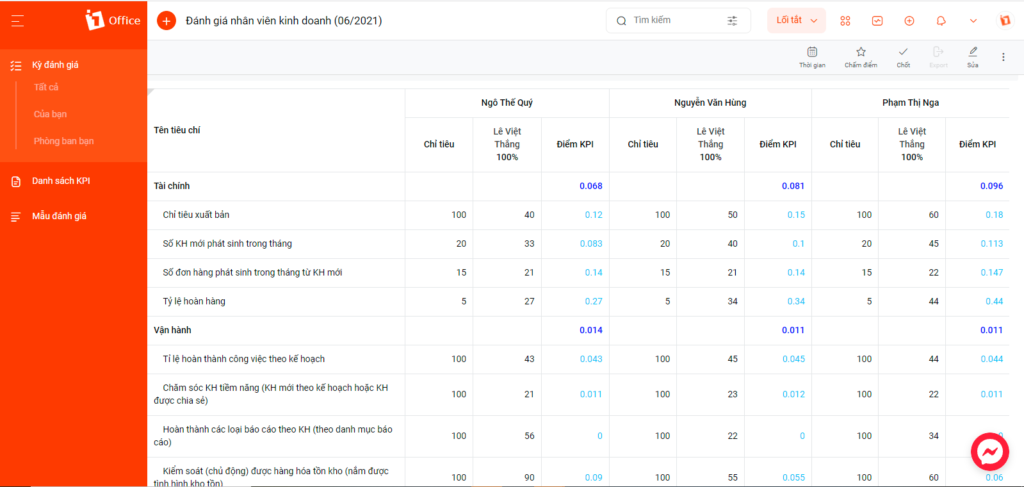
Businesses should use management systems like HRM, ERP, or BI (Business Intelligence) to visualize KPI data. A real-time dashboard helps leadership and employees track progress, compare results between departments, and creates motivation to improve performance.
-
Periodic Reports:
KPI reports should be compiled and presented in the form of comparison tables, trend charts, and root cause analysis to facilitate easy evaluation.
KPI review meetings should be held at least once a month, with the participation of department heads, management, and the HR department.
-
Multi-dimensional Evaluation:
In addition to quantitative data, businesses should incorporate qualitative feedback from employees, customers, and partners to gain a more comprehensive view of performance.

8. How to Adjust KPIs and BSC When Business Strategy Changes
Businesses operate in a constantly changing environment. When strategies, business models, or long-term goals change, the BSC and KPI system must also be flexibly updated to continue reflecting the organization’s new direction.
Why is it necessary to adjust BSC and KPIs?
-
Avoid measuring the wrong direction: Old KPIs may no longer be suitable for new goals, leading to a situation of “doing things right, but not doing the right things.”
-
Ensure strategic alignment: All metrics must support the company’s current vision and development plan.
-
Increase adaptability and competitiveness: A flexible KPI system helps businesses react quickly to changes in the market, technology, or customer needs.
The process of reviewing and updating KPIs
- Establish a regular review schedule:
The entire KPI system should be reviewed at least every 6 to 12 months.
In case of major strategic changes (entering a new market, restructuring, mergers…), a re-evaluation should be conducted immediately.
- Categorize KPIs to keep, modify, or eliminate:
Keep KPIs that are still relevant and provide value.
Modify KPIs that need adjustments to their targets, thresholds, or units of measurement.
Eliminate KPIs that are no longer related to the current strategy or are difficult to measure.
- Link new KPIs with the BSC and strategic goals:
Update KPIs according to the 4 perspectives of the BSC:
- Financial: measure profit, costs, and revenue from the new market.
- Customer: measure satisfaction levels, new customer rates, and customer retention.
- Internal Processes: measure speed, efficiency, and error rates in new processes.
- Learning & Growth: measure employee capabilities, training, and innovation.
Ensure KPIs adhere to the SMART principle – Specific, Measurable, Achievable, Relevant, and Time-bound.
- Update on the system and communicate internally:
After adjustment, the new KPIs need to be uploaded to the management system (like HRM or ERP) and clearly communicated to all employees. This helps staff understand the new direction and proactively act towards the right goals.
Illustrative Example
When a business expands into the international market, its core strategy shifts from “domestic growth” to “foreign market development.”
-
Before adjustment:
Financial KPIs focused on domestic revenue and production costs.
Customer KPIs focused on the satisfaction level of Vietnamese customers.
- After adjustment:
Financial KPI: Revenue from the new market ≥ 20% of total revenue.
Customer KPI: Customer satisfaction rate in the new market ≥ 90%.
Learning & Growth KPI: Percentage of staff trained in international communication skills ≥ 80%.
Thanks to this adjustment, the business can not only measure the effectiveness of the new market but also create a basis for making decisions on investment, expansion, and optimizing operational processes suitable for the next growth stage.
———————————————-
Through this article, we hope that leaders have gained a clearer understanding of the two terms BSC and KPI, as well as their differences, implementation methods, and common mistakes to avoid. If your business is looking for a KPI goal management software, please contact 1Office immediately via Hotline: 083 483 8888 for a consultation and a free trial of the feature.
Proud to be a partner to over 5,000 businesses & over 450,000 users. The software has helped thousands of businesses optimize their Human Resource Management processes.