


7 HRM Software for the Logistics Industry to Optimize Human Resource Management


Investing in specialized HRM software for the logistics industry is a key solution to automate operational processes. The need for this software arises because human resource management in the Logistics industry is a challenging problem, completely different from other sectors. This article by 1Office will help you evaluate in detail the top 7 solutions designed specifically for the transportation and warehousing industry.
Mục lục
1. 7 Specialized HRM Software Solutions for the Logistics Industry
Vietnam’s Logistics industry is projected to need 300,000 professional personnel by 2025. This figure indicates that the pressure on human resource management is immense. Transportation companies need professional HRM software for the logistics industry. Below are the top 7 solutions, designed for the industry’s complex processes.
Overall Comparison
| Software | Suitable Scale | Outstanding HRM Features |
| 1HRM | All scales |
|
| Lạc Việt SureHCS HRM | Medium, large enterprises, corporations |
|
| FPT.iHRP | Corporations, large enterprises with multiple branches |
|
| FTSHRM/TacaSoft | Enterprises with complex processes |
|
| Base HRM+ | All scales and industries |
|
| SAP SuccessFactors | Large global enterprises |
|
| VnResource HRM Pro | Medium, large enterprises |
|
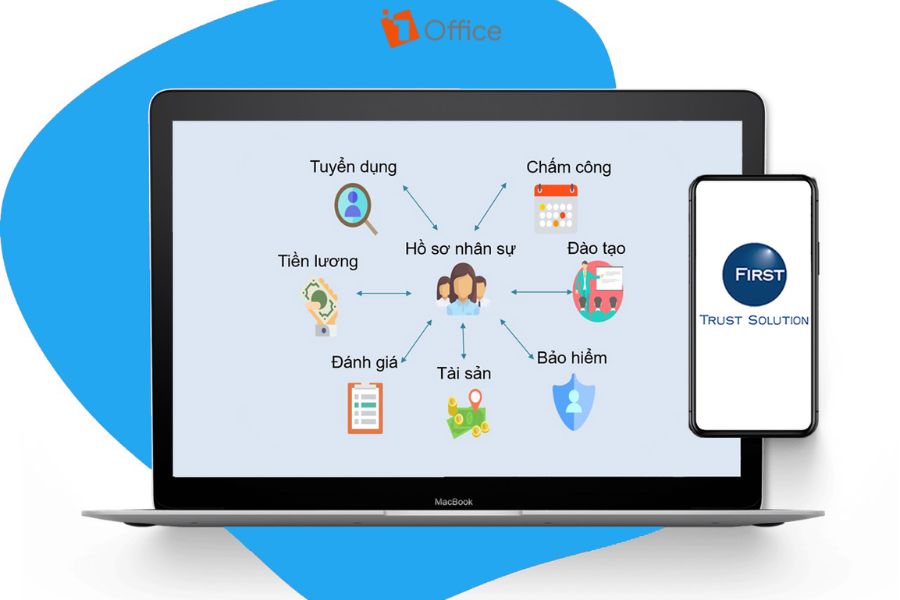
1.1. 1HRM
For the Logistics industry, the 1HRM tool from 1Office provides specialized solutions, especially the application of AI in operational risk management:
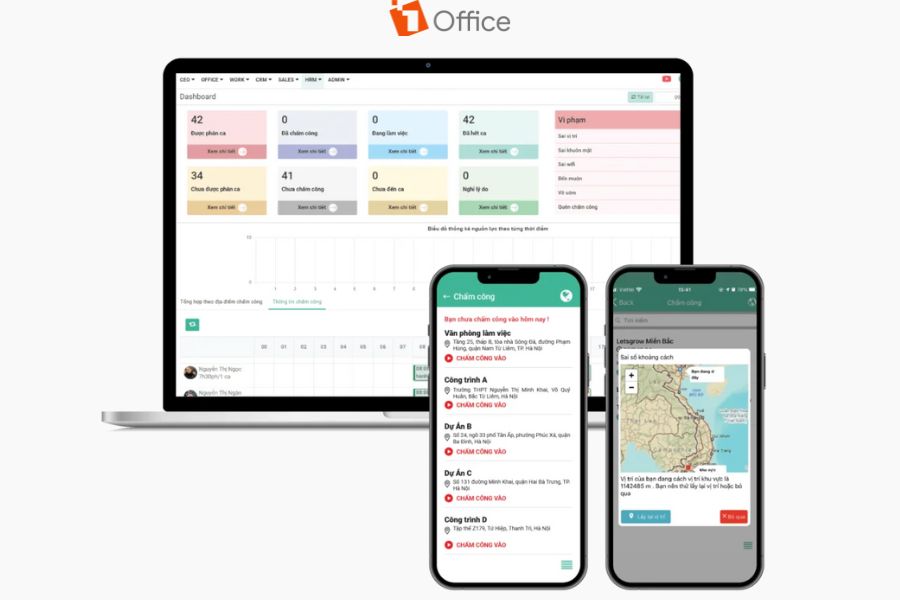
- Mobile timekeeping & shift management: 1HRM supports all timekeeping methods, allowing employees to clock in via a mobile app using GPS or WiFi. Data from warehouses and ports is automatically synchronized to a centralized management system, enabling flexible shift management.
- Complex payroll calculation (Piece-rate, KPI): The Payroll module of 1HRM supports multiple payroll calculation methods (Daily wage, Piece-rate wage, Production-based wage, KPI-based sales wage, revenue-based). The system automatically inherits data from timesheets and KPI results to calculate salaries, completely eliminating manual errors.
- AI in recruitment: The Logistics industry has a large and continuous demand for recruitment. 1Office’s AI supports automatic CV screening, analysis, and recommends the most suitable profiles for drivers and warehouse staff.
- Personnel training: The system integrates a Learning Management System (LMS) to organize professional training courses, mandatory occupational safety training, and track employee competencies.

1.2. VnResource HRM Pro
VnResource HRM Pro is a top choice for medium and large-sized enterprises in Vietnam, with experience in implementing for many complex industries.
Key features:
- The software provides a comprehensive human resource management solution, supporting very flexible timekeeping methods, including GPS, WiFi, and mobile clock-in, meeting the specific needs of the industry.
- VnResource has strong integration capabilities with ERP, SAP, and Oracle systems, helping to synchronize HR data with the company’s core operating system.
1.3. FPT.iHRP
FPT.iHRP is a powerful HRM solution, specially designed for large corporations and enterprises with multiple branches, making it highly suitable for the logistics industry model.
Key features:
- The software supports HR management in a multi-company, multi-branch, multi-language model, allowing for centralized data management from multiple warehouses and offices nationwide.
- Deep integration capabilities with complex core systems like ERP, SAP, and Oracle, which are very common in leading logistics companies.
1.4. FTSHRM/TacaSoft
This HRM software duo for the logistics industry targets businesses with complex HR processes that require high operational flexibility.
Key features:
- FTSHRM strongly supports GPS location-based timekeeping, allowing for the management of frequently moving employees. TacaSoft excels at creating flexible work shift schedules for warehouse staff and drivers.
- The system automates payroll calculation based on different types of labor contracts, a common practice in the logistics industry where various forms of labor are used.
- Helps to closely manage the history of employee records, contracts, and qualifications (such as driver’s licenses, operating certificates).
1.5. Lạc Việt SureHCS HRM
This is a comprehensive, end-to-end human resource management solution designed for large-scale enterprises and corporations with complex HR organizational structures.
Key features:
- Ability to customize the system according to the specific business processes of logistics companies.
- Integrates Business Intelligence (BI) tools and an AI Advisor, providing leadership with deep insights into HR data to support strategic decision-making.
- Manages the entire employee lifecycle, from recruitment and training to evaluation and retirement, suitable for large logistics corporations.
1.6. SAP SuccessFactors
SAP SuccessFactors is an international-standard HRM solution, a top choice for multinational logistics enterprises and corporations.
Key features:
- Provides a unified human resource management platform for corporations operating in multiple countries, helping to standardize processes.
- Integrates AI and powerful data analytics capabilities, not only for management but also for forecasting HR trends and supporting human resource strategy planning.
- Very strong in performance management, succession planning, and developing the next generation of leaders.
1.7. Base HRM+
Base HRM+ is a comprehensive HRM software for the logistics industry, built with a modular architecture that allows businesses to select and implement features according to their needs.
Key features:
- The platform focuses on automating core tasks, ensuring accurate timekeeping and payroll data, and minimizing manual errors.
- Performance management (KPI/OKR) for logistics businesses to measure the performance of drivers and warehouse staff based on specific metrics such as “on-time delivery” and “number of orders processed.”
2. Unique HR Management Challenges in the Logistics Industry
The Logistics industry is characterized by work distributed across multiple locations, along with rapid technological changes. This creates significant pressure and challenges for the HR department.
2.1. Difficulty in Managing Mobile Timekeeping
The main workforce in the Logistics industry, including drivers, delivery staff, and field employees, does not work in a fixed office. They frequently travel to ports, partner warehouses, or ships to handle their tasks. Controlling their timekeeping and actual working hours becomes extremely difficult.
2.2. Complex and Error-Prone Payroll Calculation
Each department in a logistics company often has a different way of calculating salaries. A driver’s salary might be calculated per trip, per kilometer, or as a fixed rate. A warehouse employee’s salary is calculated by shifts. The complexity of consolidating timekeeping data from multiple sources and locations makes payroll processing prone to delays and errors. This directly affects employee satisfaction and retention.
2.3. Manual Administrative Processes, Dispersed Data
Currently, many logistics HR departments are still wasting time on paperwork. They have to manually process leave requests, advances, and store employee records. HR data is scattered across various unlinked Excel files. When the board of directors needs a statistical report, HR has to spend a lot of time compiling it, and accuracy cannot be guaranteed.
2.4. Pressure to Train Employees to Adapt to New Technology
Technology is changing the face of the logistics industry every day. Automated warehouse management systems (WMS), IoT technology, and AI are being applied more and more. This requires the current workforce to be retrained to adapt to and operate new technologies. Businesses need a systematic training management mechanism and post-training effectiveness evaluation.

2.5. Lack of Reporting and Strategic Evaluation Tools
Creating manual HR reports is not only time-consuming but also prone to errors. More importantly, the board of directors lacks visual reporting tools (dashboards) to analyze and evaluate the situation. They cannot get an immediate overview of personnel performance, labor costs, or turnover rates, leading to strategic decisions based on intuition.
3. Core HRM Features a Must-Have for the Logistics Industry
To thoroughly address the 5 challenges above, an HRM software for the Logistics industry needs to be equipped with specialized features that cater to the specific needs of the sector.
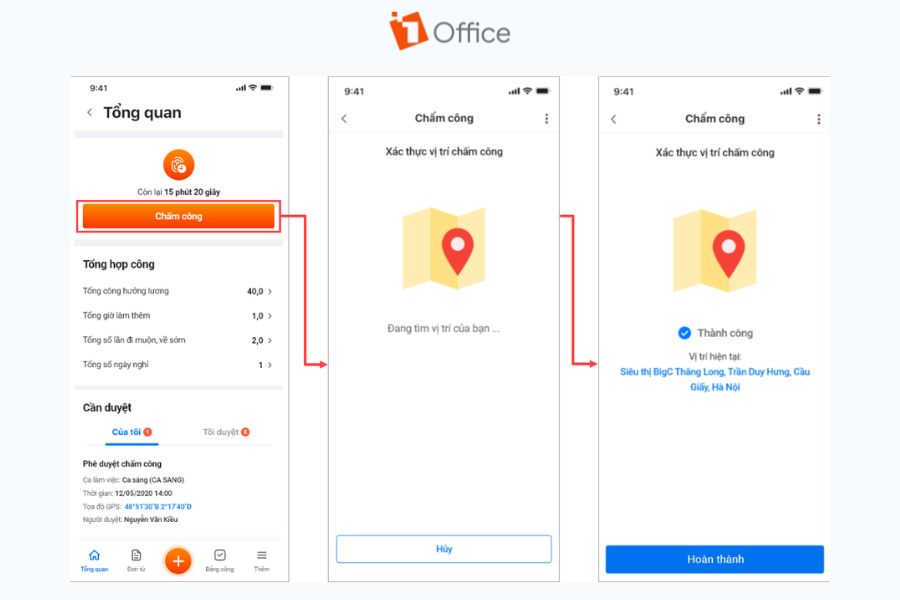
3.1. Timekeeping Management
An ideal HRM software must be able to connect with common types of time clocks. It needs to automatically extract and summarize total working hours, overtime hours, and minutes of lateness.
The most important and mandatory feature is GPS location-based timekeeping. This feature is specifically designed for employees who are constantly on the move, such as drivers, delivery staff, or employees working at construction sites or warehouses without time clocks. The system must also allow for the declaration and management of an unlimited number of complex work shifts.
3.2. Automated Payroll Calculation Based on Timesheets
HRM software for the logistics industry must be able to fully automate the payroll process. Payroll calculations need to be based on contract type and verified actual working hours data. Payroll data needs to be synchronized with absence time, working hours, and compensation and allowances.
Specifically, the software must allow the HR department to set up complex salary formulas (such as piece-rate pay, pay per km, pay per trip) and automatically generate monthly timesheets according to the company’s template.
3.3. Automating administrative processes for transportation companies
The software should help businesses automate manual tasks that currently consume a lot of HR’s time. The system needs to support the automation of the recruitment process, from posting jobs and screening candidates to sending interview invitations.
Internal processes such as leave registration and approval, and advance payment approval also need to be handled online via email, SMS, or Zalo. The Self-Service Portal feature allows employees to manage their personal data, view payslips, and submit requests.
3.4. Centralized storage of personnel records on a single platform
All employee data and records need to be managed centrally on a single platform. The software must be able to track the entire record history, contract progression, and salary history. Furthermore, it should allow for the attachment of original documents and certificates (such as contracts, degrees) to the employee’s electronic file.
3.5. Personnel performance management
To measure work efficiency, the system should allow businesses to set up evaluation criteria based on KPIs or OKRs. This helps managers assess employee capabilities objectively and accurately. These evaluation results will serve as crucial data for determining salaries and bonuses.
At the same time, the software must also support the management of the entire training process, tracking the plans, costs, and training results for each employee.

4. Core criteria for choosing HRM software for the Logistics industry
When selecting an HRM solution, logistics companies need to consider the following 5 key criteria to ensure the software correctly and thoroughly addresses the industry’s challenges.
4.1. Ability to automate mobile timekeeping and payroll
The primary and most important criterion is the GPS location-based timekeeping capability. The software must be able to track employee working hours based on their actual geographical location. Furthermore, it must have a fully functional mobile app or portal. This allows employees (drivers, delivery staff) to access, clock in, and submit requests anytime, anywhere.
4.2. Deep integration with business systems (ERP/TMS/WMS)
The ability to integrate with existing systems is a decisive factor when choosing HRM software for the logistics industry. It helps optimize information flow within the business and avoid data duplication. The Logistics industry has very high integration requirements with large systems like ERP. Specifically, the HRM must be able to connect with the Transportation Management System (TMS) and Warehouse Management System (WMS) to create a synchronized operational ecosystem.
4.3. Large-scale, multi-branch management
Logistics companies often have a large workforce and a distributed network of branches and warehouses. The chosen HRM software must have good scalability. It needs to easily support a multi-branch, multi-entity management model.
4.4. Performance evaluation and technology adaptation training
As technology in the logistics industry changes rapidly, HRM software is more than just an administrative tool. It must support the management of professional and new technology training programs. The system needs a mechanism to evaluate post-training effectiveness. This feature helps measure employees’ ability to adapt to technology and plan for succession.
4.5. The system must have high security
HRM software for the logistics industry will store extremely sensitive data. This includes personal information, addresses, and bank account details for thousands of employees. Therefore, the system must ensure the highest level of security. Encryption mechanisms, multi-factor authentication, and strict access permissions are mandatory.
Conclusion
Investing in HRM software for the logistics industry is a strategic decision that helps businesses automate, ensure compliance, and have data for decision-making. Is your business ready to automate GPS timekeeping and manage transportation risks with AI? Contact 1Office today for an in-depth consultation!




