


 10/05/2026
  10267 views
Piece-rate pay is a fairly common form of payment in many businesses, but not everyone clearly understands how to calculate it and when to apply it. If you want to know what piece-rate pay is, see some easy-to-understand examples, and learn how to calculate it, this article will help you quickly grasp the most important points.
Mục lục
- 1. What is piece-rate pay? The nature of the piece-rate pay system
- 2. Guide to the most accurate way to calculate piece-rate pay
- 3. Piece-work Contracts
- 4. Applying piece-rate pay in practice
- 5. Advantages and disadvantages of piece-rate pay
- 6. When Should Businesses Apply Piece-Rate Pay?
- 7. Comparing Piece-Rate Pay with Other Compensation Methods
- 8. Frequently Asked Questions about Piece-Rate Salary for Employees
1. What is piece-rate pay? The nature of the piece-rate pay system
Piece-rate pay is a form of payment based on the volume of work previously agreed upon between the employee and the employer. Piece-rate pay is a legal form of payment stipulated by law in:
- According to Clause 1, Article 96 of the 2019 Labor Code: The employee and the employer shall agree on the form of payment based on factors such as: by product, by time, or by contract (piece-rate).
- According to Point C, Clause 1, Article 54 of Decree 145/2020/ND-CP, which provides detailed guidance on the relationship between employees and employers as follows: Piece-rate wages are paid to the employee for a specific period as previously agreed upon, and are based on the volume, quality of work, and the time required for completion to determine whether the employee is entitled to the full salary stated in the contract.
Thus, in practice, there is currently no official definition of piece-rate pay, but this form is widely used, especially for seasonal jobs.
It can be understood that before starting the work, the employee and the employer will agree on the volume of work to be completed and the corresponding salary for 100% completion. Additionally, if the employee does not complete 100% of the work, they will receive a salary corresponding to the amount of work completed.
For example: Ms. X is contracted to make 100 ballpoint pens for a piece-rate salary of 4 million VND. However, by the deadline, she only completes 90 pens, so the amount Ms. X receives will be equivalent to 90% of the piece-rate salary = 3,600,000 VND.
Read more: What is 3P Salary? How to build an effective 3P salary system for businesses
2. Guide to the most accurate way to calculate piece-rate pay
To pay piece-rate wages fairly and transparently, businesses need to clearly understand how to determine the volume of work, unit price, and appropriate contract rate. This section will provide a detailed guide on the formula for calculating piece-rate pay, along with practical examples to help you easily apply it to different types of work.
2.1. Piece-rate pay formula
In practice, piece-rate pay is one of the basic salary calculation formulas commonly applied by businesses. The standard way to calculate piece-rate pay is based on the volume and quality of work completed by the employee.
Piece-rate pay formula:
Piece-rate pay = Agreed piece-rate salary * Percentage of work completion

Example of calculating piece-rate pay:
Ms. B is hired to make handmade bracelets. She must complete 1,000 bracelets within one month to receive 3,000,000 VND. However, during this period, Ms. B only makes 900 bracelets, achieving 90% of the assigned output as previously agreed, so the income she receives is:
3,000,000 * 90% = 2,700,000 VND
| >> Read more: What is Payroll? The Foundations for Building a Payroll System that HR Needs to Know |
2.2. Forms of piece-rate pay
To clearly understand what piece-rate pay is, let’s refer to the 2012 Labor Code and Article 54 of Decree 145/2020/NĐ-CP. After reviewing these two regulations, we have summarized the following key points for our readers:
Time-based piece-rate pay
The formula for calculating time-based wages will be specified in each individual’s labor contract and varies according to each company’s regulations. Typically, time-based labor contracts include the following:
- Weekly pay: This is the salary paid for one week of work. If the employment contract specifies a monthly piece-rate salary, the employee can calculate the weekly salary as follows:
Weekly salary = Monthly salary x 12 / 52
- Daily pay: The amount of salary an employee receives after one day of work. Employees can calculate this by dividing the monthly salary by the number of standard working days in a month as stipulated by the company.
- Hourly pay: The amount of money an employee receives for one hour of work. Typically, this hourly rate will have a minimum level as required by law. According to Official Dispatch 294/LĐLĐ Hanoi, the regional minimum hourly wage in Hanoi is 22,500/hour, and in Ho Chi Minh City, the regional minimum hourly wage is also 22,500/hour.
Product-based piece-rate pay
Product-based piece-rate pay is the salary paid based on the quantity of products an employee produces, provided they meet the quality standards required by the company.
Thus, there are two main forms of piece-rate pay, depending on each company’s regulations. In addition, each company will have different payment methods, such as via bank transfer or in cash.
| >> Read more: Standardize the payroll process in your business with 7 simple steps |
3. Piece-work Contracts
A piece-work contract is an important legal basis for clearly defining the rights and obligations of both parties in a piece-rate pay system. This section helps you understand the concept, the mandatory content required in the contract, and important notes to avoid the risk of disputes.
3.1. What is a piece-work contract?
A piece-work contract is a written agreement between an employee and an employer regarding factors such as the volume of work, the quality of work to be performed, etc. This contract requires the employee to complete a specific amount of work within a certain period.
After the work is completed and the manager has verified its quality, the employee will be paid the remuneration as stated in the contract, provided no issues arise. Piece-work contracts are often used for short-term, seasonal jobs.
3.2. Common types of piece-work contracts today
In the current job market, there are 2 common forms of piece-work contracts:
- Full piece-work contract: This contract stipulates that the hiring party will provide the entire cost (material costs, labor costs) to the hired party so they can complete the required volume of work as initially agreed.
- Partial piece-work contract: The hired party must provide their own work tools, etc., while the hiring party will pay the hired party an amount after the work is completed, which includes depreciation costs for the work tools.
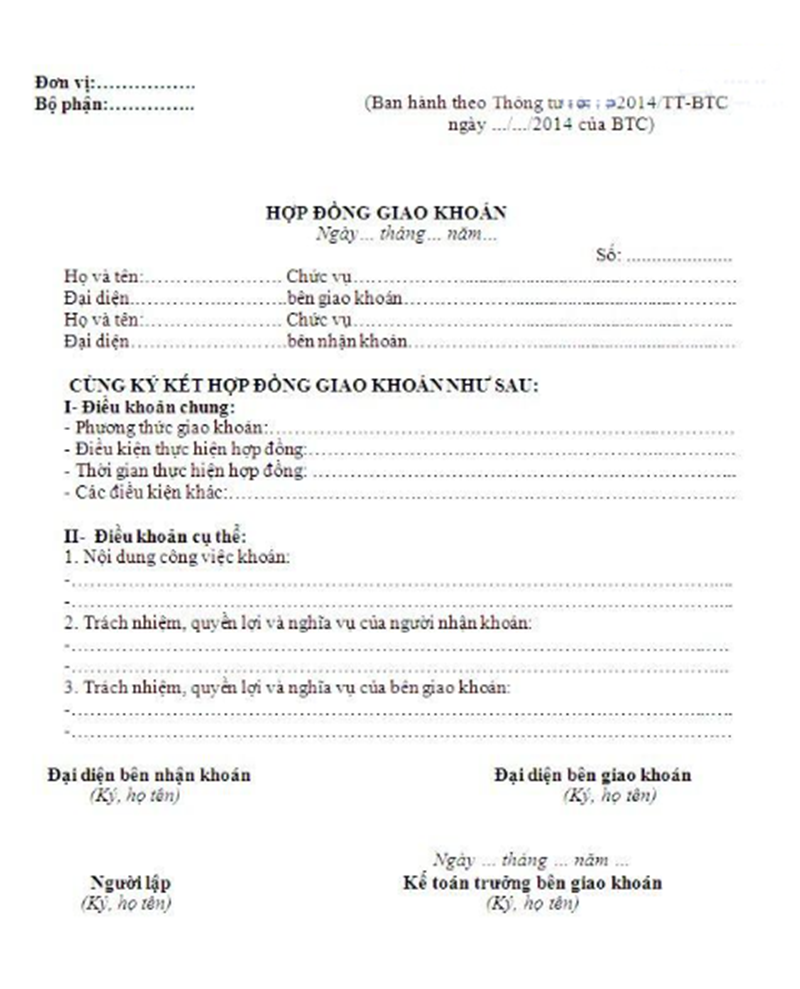
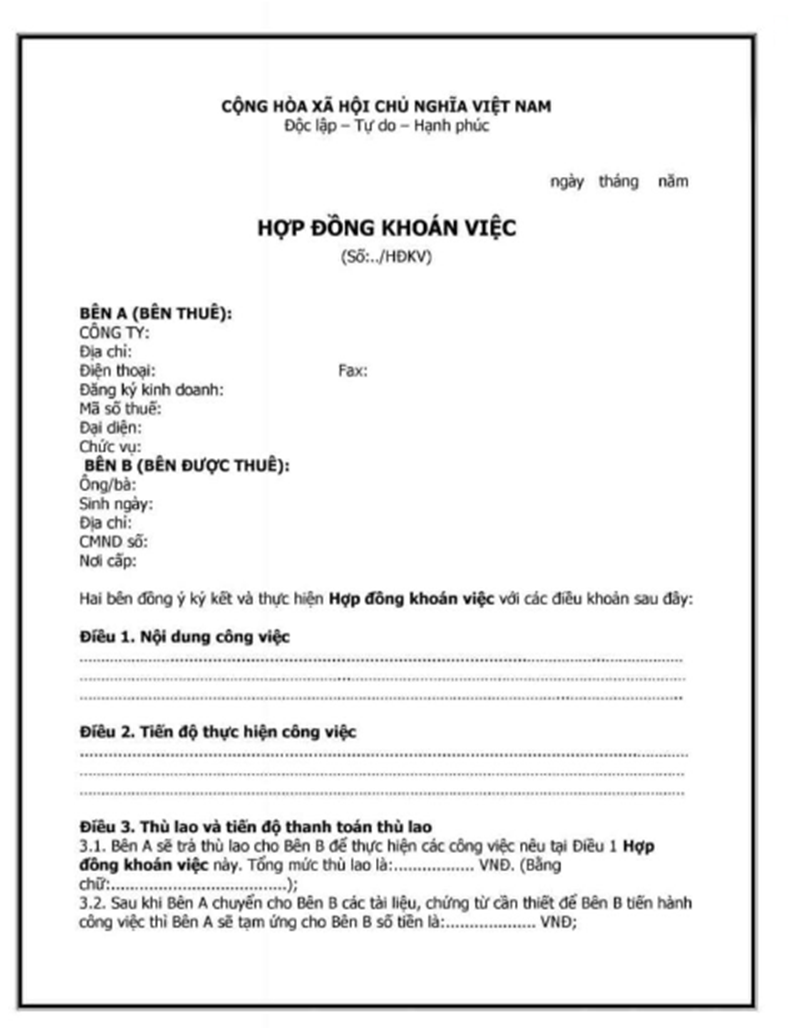
3.3. Piece-work contract templates
Below, we will provide readers with standard piece-work contract templates that comply with state regulations.
4. Applying piece-rate pay in practice
Not all jobs are suitable for piece-rate pay. This section will guide businesses on how to implement piece-rate pay effectively — from identifying applicable roles and establishing benchmarks to monitoring and evaluating actual work results.
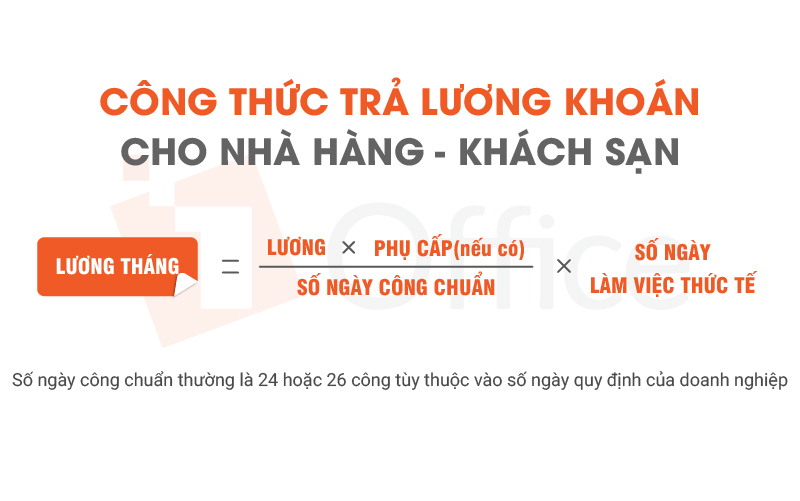
4.1. Piece-rate pay in the Restaurant – Hotel industry
This is an industry that frequently needs short-term labor due to its seasonal nature. During peak season, businesses often have to hire additional workers to meet the increased consumer demand. This is because if they hire many permanent employees, during periods of low customer demand and sudden business downturns, the organization would incur a large cost to pay their salaries. Below is a payment method used by many Restaurants and Hotels:
4.2. Piece-rate pay in construction companies
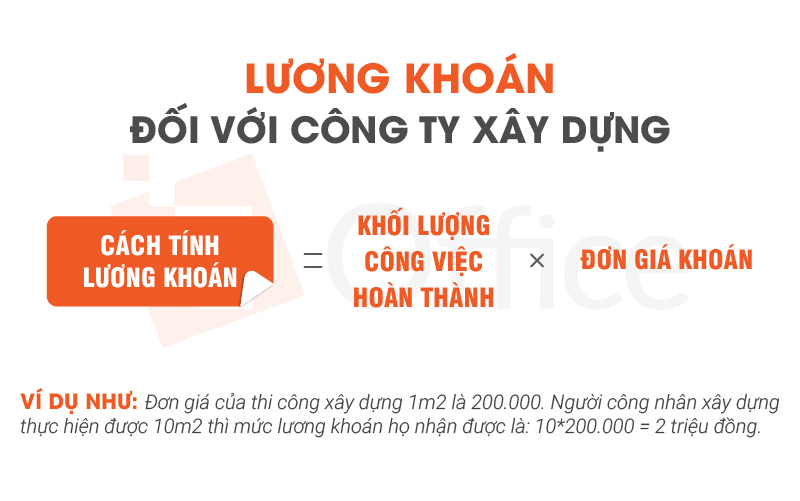
Construction is also a field that requires a lot of seasonal labor. In this industry, piece-rate payroll is often paid to workers based on the volume of work they have completed.
5. Advantages and disadvantages of piece-rate pay
Piece-rate pay is increasingly being adopted by many businesses due to its ability to link income directly to work performance. However, alongside its clear benefits, this method also has some risks if not designed and managed carefully.
5.1. What are the advantages of piece-rate pay?
Piece-rate pay provides a strong motivation for employees, especially in industries with measurable outputs such as construction, manufacturing, logistics, or sales.
-
Increases productivity and work efficiency: When income is tied to results, employees tend to be more proactive, responsible, and put in more effort to achieve their goals.
-
Better cost control: Businesses only have to pay based on the product or volume of work completed, which helps optimize the labor budget.
-
Encourages healthy competition: Teams and individuals strive to complete targets sooner and better, thereby improving the overall performance of the organization.
-
Suitable for clearly quantifiable work: For positions with specific outputs – for example, the number of orders processed, the number of products completed, or projects delivered – piece-rate pay helps ensure fair and transparent measurement.
5.2. Limitations and Risks of Piece-Rate Pay
Besides its advantages, without a standardized process, businesses can face many challenges:
-
Lack of fairness with non-transparent criteria: If targets, performance measurement methods, or piece rates are not clearly defined, disputes can easily arise between employees and management.
-
Difficult to apply to creative or teamwork-based jobs: Positions like marketing, design, and research often have outputs that are difficult to quantify, so piece-rate pay can create pressure and affect quality.
-
Legal risks if the contract is unclear: A piece-rate contract lacking specific provisions on volume, deadlines, and quality standards can lead to complaints or provide insufficient grounds for handling violations.
-
Impact on work quality: If employees focus solely on volume to meet the piece rate, they may work quickly but carelessly, leading to product defects.
6. When Should Businesses Apply Piece-Rate Pay?
Not all types of work are suitable for a piece-rate pay system. To achieve maximum effectiveness, businesses need to clearly understand the job characteristics, team capabilities, and management objectives before implementation.
Businesses should apply piece-rate pay when:
-
The work has clear products, targets, or volume: For example: manufacturing, construction, logistics, sales, or technical services – where the output can be specifically quantified and measured.
-
The team is highly self-disciplined: Piece-rate pay is suitable for individuals who work independently, are proactive, and do not require constant supervision.
-
The business wants to optimize personnel costs: The piece-rate system helps businesses pay only based on results, avoiding waste on inefficient work time.
-
Management objectives are focused on performance and results: For businesses transitioning from a time-based management model to a productivity-based one, piece-rate pay is a suitable step.
Conversely, if a business operates in creative services, strategic consulting, research, or senior management, where output is difficult to quantify, then time-based pay or KPI-based pay would be a more reasonable choice.
7. Comparing Piece-Rate Pay with Other Compensation Methods
To fully understand the nature of piece-rate pay, it’s necessary to compare it with other common compensation methods like time-based pay, product-based pay, and KPI-based pay. Each method has its own advantages and is suitable for different types of jobs.
| Criteria | Contract Salary | Time-based Salary | Piece-rate Salary | KPI-based Salary |
|---|---|---|---|---|
| Basis for Calculation | Volume or output results | Number of hours/days worked | Number of products meeting standards | Level of goal completion |
| Performance Measurement | Clear, quantitative | Difficult to assess productivity | Easy to measure, but only in quantity | Comprehensive (quantity + quality) |
| Suitable for | General labor, manufacturing | Administrative, office roles | Production lines | Sales staff, managers |
| Key Advantages | Links results to income | Stable, easy to manage | Encourages increased output | Comprehensive performance evaluation |
| Main Drawbacks | Prone to imbalance, legal risks | Lacks motivation to increase productivity | Easy to overlook quality | Difficult to set accurate targets |
8. Frequently Asked Questions about Piece-Rate Salary for Employees
Employees often wonder: “Is social insurance contribution required for piece-rate salary?”, “What happens if I don’t meet the quota?”… This section compiles and answers frequently asked questions, helping both businesses and employees clearly understand their rights and obligations under the piece-rate salary system.
YES. According to the provisions in Article 6 of the Social Insurance Collection Process and other types of insurance issued with Decision 595/QD-BHXH by Vietnam Social Security:
- From January 1, 2018, the monthly salary for compulsory social insurance contributions is based on the sum of the salary and salary allowances.
- According to Point a, Clause 3, Article 4 of Circular No. 47/2015/TT-BLDTBXH: the piece-rate salary stated in the labor contract between the employee and the enterprise is used as the basis for social insurance contributions.
- For employees contributing to Unemployment Insurance, the monthly salary basis is specified in Clause 2, Article 6. If the employee’s monthly salary is higher than 20 times the regional minimum wage, the monthly salary for unemployment insurance contribution will be 20 times the regional minimum wage. (Clause 2, Article 15)
- The monthly contribution rate is 4.5% of the monthly salary:
- The employer contributes 3%;
- The employee contributes 1.5%.
8.2. Do employees have to pay Personal Income Tax (PIT) with a piece-rate contract?
YES. In this case, PIT payment is divided into 2 scenarios:
Scenario 1: The enterprise signs a contract with an individual who does not have a business registration license
The enterprise is responsible for withholding PIT at a rate of 10% before paying the salary to that individual.
Scenario 2: In cases where the party is not an enterprise, a business household, or an individual not trading goods or services subject to VAT or not required to declare VAT, the tax authority will not issue an invoice.
With the advancement of science and technology, employee payroll software is increasingly being developed with diverse features. Payroll software applications allow managers to establish salary policies that meet the specific needs of the business. 1Office is an HR management solution trusted by over 5,000 businesses with 450,000 users. It is the solution that helps businesses automate HR management processes, improve operational efficiency, and save costs and time.
Through the article above, we have provided readers with the most specific and accurate information about what piece-rate salary is, how to calculate it, examples of piece-rate salary, and more. We hope the information we provide will be useful for your business. If you need any further information or consultation, please contact us for a free consultation with our specialists. Thank you very much!
Get a consultation & a free software trial
For more details, please see:
- Hotline: 083 483 8888
- Fanpage: https://www.facebook.com/1officevn/
- Youtube: https://www.youtube.com/channel/UCeTIRNqxaTwk0_kcTw6SxmA
















