


 11/05/2026
  161 views
Gross profit is a crucial indicator that helps businesses clearly see their core business efficiency before delving into other operating costs. But what is gross profit, how is it calculated, and what does this indicator reveal? This article will help you understand everything from the concept and formula to how to optimize Gross Profit in practice.
Mục lục
- 1. What is Gross Profit?
- 2. What Does Gross Profit Reflect About Business Performance?
- 3. Gross Profit Formula
- 4. Factors Affecting Gross Profit
- 5. How to Optimize Gross Profit in Business
- 6. The Relationship Between Gross Profit and Business Cash Flow
- 7. Gross Profit and Its Impact on Investors and Shareholders
- 8. What are the risks when a business focuses only on gross profit?
- 9. Frequently Asked Questions about Gross Profit
- 10. Conclusion
1. What is Gross Profit?
Gross Profit is the difference between a company’s revenue and its cost of producing and selling goods. It is the amount of money a business retains after deducting the direct costs associated with creating its products or services.
Gross profit is the profit that still includes the costs of producing or providing the company’s services. Therefore, it is not the net profit from business or sales operations.
2. What Does Gross Profit Reflect About Business Performance?
A high gross profit indicates that a business is operating efficiently, has good cost control, and is generating profit from its core business activities. The higher the gross profit, the more profit the business has to cover other expenses and reinvest in its operations.
Gross profit is the basis for calculating other profitability ratios such as gross profit margin, net profit margin, etc. These indicators help assess a company’s profitability and the efficiency of using capital to generate profit.
This indicator helps businesses make decisions about product pricing, production costs, business strategies, and more. Therefore, businesses need to monitor and analyze gross profit to make appropriate decisions to increase operational efficiency.
Additionally, the Gross Profit indicator also helps businesses compare their operational efficiency with other companies in the same industry. A business can use gross profit to assess its competitive position in the market.
3. Gross Profit Formula
Gross profit is calculated by taking net revenue and subtracting the cost of goods sold (COGS). This is a key financial metric that helps assess business performance, risk levels before making investment decisions, and the company’s profitability.
The formula for calculating gross profit is as follows:
| Gross Profit = Net Revenue – Cost of Goods Sold |
Where:
- Net revenue: Sales revenue minus deductions such as discounts, interest, allowances, etc. To calculate net revenue, businesses use the following formula: Net revenue = Revenue – Revenue deductions.
- Cost of goods sold (COGS): Direct costs related to producing and selling products/services, including raw materials, direct labor, general production costs, etc. COGS does not include general and administrative expenses or selling expenses.
Example: Company A sells a product for 100,000 VND/product. The cost of goods sold for the product is 60,000 VND/product. The company sells 100 products in a month.
- Company A’s net revenue for the month is: 100,000 * 100 = 10,000,000 VND
- Company A’s cost of goods sold for the month is: 60,000 * 100 = 6,000,000 VND
- Thus, Company A’s gross profit for the month is: 10,000,000 – 6,000,000 = 4,000,000 VND
4. Factors Affecting Gross Profit
Gross profit can be affected by many different factors, including:
- Selling price of products/services: The selling price of products/services is an important factor affecting a company’s gross profit. Managers need to consider the following factors when deciding on the selling price: production costs, market prices, customer demand, profit targets, etc.
- Cost of goods sold (COGS): The lower the COGS, the higher the gross profit. Businesses need to focus on controlling production costs, including raw material costs, labor, overhead, etc. Additionally, businesses can implement measures such as purchasing raw materials at good prices, optimizing production processes, and using advanced technology to reduce the cost of goods sold.
- Sales revenue: When sales revenue and volume increase, a company’s gross profit can increase if the cost of goods and services does not increase significantly or decreases. However, the extent of the gross profit increase will depend on the company’s gross profit margin.
- Production costs: Production costs include raw material costs, direct labor, overhead, etc. The lower the production costs, the higher the gross profit. Managers need to focus on optimizing production processes and using technology effectively to reduce production costs.
- Selling and administrative expenses: This includes advertising, marketing, and management costs. The lower the selling and administrative expenses, the higher the gross profit. Businesses need to focus on controlling these expenses to optimize profit.
- Other expenses: In addition to the factors above, other factors also affect gross profit, such as taxes, interest on loans, etc. Businesses need to pay attention to these factors to develop a suitable business strategy.
5. How to Optimize Gross Profit in Business
Optimizing gross profit is essential for businesses to increase profits, improve operational efficiency, enhance competitiveness, and achieve sustainable development. Here are some ways to optimize gross profit in business:

Increase sales revenue:
- Strengthen marketing and promotional activities to reach more potential customers.
- Enhance the customer experience to retain existing customers and attract new ones.
- Develop new products/services to meet the increasingly diverse needs of customers.
- Enter new markets to increase sales revenue.
Reduce the cost of goods sold:
- Optimize production processes, use advanced technology, automate production, and minimize waste.
- Find raw material suppliers with good prices by negotiating prices and buying in bulk for better rates.
- Control production costs and cut unnecessary expenses.
Manage costs effectively:
- Closely monitor selling and administrative expenses, and cut unnecessary costs.
- Use financial management software to help businesses track and manage costs more effectively.
Enhance management capabilities:
- Improve employees’ skills and knowledge to increase work efficiency.
- Build an effective management system to help the business control costs, increase revenue, and improve gross profit.
Analyze and monitor operational performance:
- Analyze the gross profit margin to evaluate business performance and devise appropriate strategies.
- Keep track of market fluctuations to adjust business strategies accordingly.
6. The Relationship Between Gross Profit and Business Cash Flow
Many businesses feel secure looking at high gross profit figures, but in reality, cash flow determines survival. A company with good gross profit but negative cash flow can still go bankrupt.
For example, a retailer records a large gross profit from selling many products but has to allow customers 90-day payment terms. Meanwhile, the business must pay its suppliers in cash immediately. The result: high gross profit but “depleted” cash flow.
Gross profit reflects business health, but cash flow reflects actual viability. Businesses need to analyze both in parallel to avoid falling into the “phantom profit trap”.
For investors and shareholders, gross profit is a crucial indicator for assessing a company’s competitive strength. A high gross profit margin indicates that the company can price its products well, effectively control production costs, and possesses a market advantage.
For example, technology companies like Apple often maintain a gross profit margin above 35% thanks to their strong brand and ability to sell high-priced products. This is a positive signal that builds investor confidence, leading to a higher stock price.
Conversely, if gross profit continuously declines, shareholders will become concerned about the company’s competitiveness, leading to a decrease in its market value.
Arguably, gross profit is a “measure of confidence” for investors and is one of the first financial indicators they consider when deciding to invest capital.
8. What are the risks when a business focuses only on gross profit?
Focusing solely on gross profit can easily lead a business into a situation of “fake profit, real loss” by overlooking hidden operating costs and weakening its market competitiveness. Specifically:
First, a business might overlook other expenses such as marketing, management, and operations. The gross profit may look good on reports, but after adding these costs, the net profit could be very low or even negative.
Second, if a business focuses too much on increasing gross profit by raising prices, it may drive customers away as its products become expensive compared to competitors.
For example, a home appliance manufacturer sharply increases prices to improve gross profit, but as a result, loses market share to cheaper brands.
Therefore, businesses need to strike a balance: gross profit must be accompanied by comprehensive cost management and a long-term market strategy.
9. Frequently Asked Questions about Gross Profit
What does the gross profit margin reflect about a company’s health?
This ratio (Gross Margin) indicates how much profit is generated for every dollar of revenue after subtracting the cost of goods sold. A higher ratio demonstrates that the product has a strong competitive advantage, an optimized production process, or the company holds a high market position allowing it to sell at a good price.
Formula for calculating gross profit margin:
| Gross Profit Margin = (Gross Profit / Sales Revenue) x 100% |
For example: Company A has a sales revenue of 100 million VND and a gross profit of 40 million VND. Thus, the company’s gross profit margin would be: (40 million VND / 100 million VND) x 100% = 40%
How to quickly distinguish between gross profit and net profit?
The difference lies in the scope of costs:
- Gross profit: Only subtracts the cost of goods sold (raw materials, direct labor).
- Net profit (bottom line): Subtracts all incurred expenses (marketing, administrative, financial, taxes). This is the actual amount the business owner can pocket or reinvest.
Why does gross profit decrease even when revenue is growing?
This phenomenon is often due to the cost of goods sold increasing faster than revenue (e.g., rising raw material prices) or the company is using a price reduction strategy to stimulate demand. This warns that the business needs to review its supply chain or the effectiveness of its promotional programs.
What is a safe gross profit margin for a business?
There is no single number for all industries. Service and software industries often have very high gross profit margins (over 50%), while retail or manufacturing industries may have lower ones (around 10% – 25%). Businesses should compare their metrics with the industry average to assess their competitiveness.
How to improve gross profit without increasing sales prices?
Businesses should focus on optimizing the cost of goods sold by:
- Renegotiating with suppliers for better raw material prices.
- Improving production processes to reduce waste and scrap rates.
Use a management platform like 1Office to control raw material and labor costs in real-time, helping to detect operational waste early.
10. Conclusion
Gross profit is a key financial indicator that helps businesses evaluate the efficiency of their core business operations and the profitability of their products/services. Tracking and analyzing the gross profit margin over time and comparing it with industry peers will help businesses make effective management decisions to improve operational efficiency and increase profits.
Furthermore, managing and analyzing the Gross Profit indicator in particular and other financial indicators in general will help businesses gain a comprehensive assessment of their financial situation and make effective management decisions.
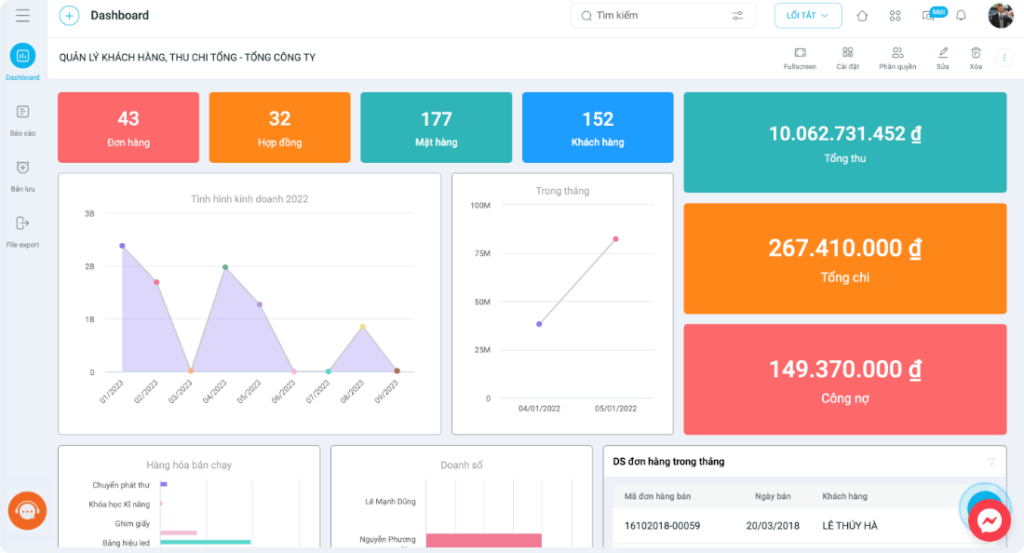
Check out the 1Office revenue and expenditure management software now – The platform trusted and effectively used by over 6,000 businesses:
- The reporting dashboard provides complete metrics on revenue and costs, helping businesses easily calculate gross profit and make effective production and business decisions.
- Provides detailed data and reports on spending for each item, helping managers easily grasp the business situation and create reasonable business plans.
- Easily track the company’s revenue and expenditure on various devices like mobile phones and laptops, anytime, anywhere, with just an internet connection.
Experience the free trial today!
We hope this article has given you a deeper understanding of “what is gross profit,” its formula, and the significance of this indicator. We wish your business success
















