


 11/05/2026
  902 views
Employee performance reviews are one of the most crucial stages in the human resource management of any business. How to evaluate and assess employees most fairly is always a concern for HR professionals. To solve this problem, 1Office suggests 80+ detailed and accurate employee performance review phrases in the article below.
Mục lục
- 1. What to Keep in Mind When Giving Employee Performance Reviews?
- 2. Aspects to Consider When Giving Employee Performance Reviews
- 3. Ways to Provide Appropriate Employee Feedback Based on Criteria
- 3.1. How to provide appropriate feedback on employee work performance
- 3.2. How to give appropriate employee feedback on work quality
- 3.3. How to give appropriate employee feedback on professional expertise
- 3.4. How to give appropriate employee feedback on attitude and work ethic
- 3.5. How to give appropriate employee feedback on soft skills
- 4. A Comprehensive List of 80+ Detailed Employee Evaluation Comments
- 5. Great Feedback for Leaders
- 6. Transparent and Accurate Employee Evaluation with 1Office HRM Module
- 7. Frequently Asked Questions
1. What to Keep in Mind When Giving Employee Performance Reviews?
Accurately Assess Employee Capabilities
Employee competency assessment is the basis for managers to make important decisions that directly affect employee benefits, such as salary increases, promotions, bonuses, or warnings and reprimands. Therefore, every employee wants their abilities to be recognized fairly and adequately, commensurate with their efforts and value.
To do this, managers need to keep “a cool head,” not be influenced by emotional factors (favoritism or prejudice), to provide the most objective employee performance review comments.
Base Evaluations on Factual Evidence
The employee review process must ensure transparency by being based on the employee’s actual work results with specific evidence.
Many businesses build a set of transparent and clear criteria to serve as a reference framework when evaluating employee performance. The evaluation criteria must be measurable and specific (e.g., KPIs, number of products, workload,…).

Balance Praise and Criticism
A performance review is an opportunity for employees to have their achievements and efforts recognized, while also helping them identify weaknesses to improve and develop themselves. Therefore, leaders should aim to evaluate employees comprehensively and provide two-way feedback.
Do Not Criticize Employees
Don’t turn the review session into a “nightmare” that no employee wants to attend. A harsh review can lead to a series of consequences, such as demoralizing employees, causing them to lose motivation, reducing productivity, and even leading to the decision to leave the company.

2. Aspects to Consider When Giving Employee Performance Reviews
Work Results
Work results are the outcomes of an employee’s work, primarily measured by quantitative indicators such as KPIs, sales figures, number of products, etc. This factor reflects the employee’s responsibility and performance, serving as a basis for evaluating achievements and implementing reward policies for personnel.
Competency and Skills
Competency and skills are the determining factors in an employee’s ability to perform and ensure the quality of their work. This aspect includes professional knowledge and the necessary skills for the job. It is one of the most important areas to focus on in the evaluation process to improve labor quality and develop human resources for the organization.
Work Attitude
Currently, many businesses prioritize “attitude over aptitude” when recruiting and training employees. This is because attitude is the key factor that determines how far an employee can go and how long they will stay with the company. An employee’s attitude and work ethic are evaluated based on factors such as discipline, honesty, cooperation, and willingness to learn.
See more: 7 Effective and Easy-to-Apply Employee Evaluation Methods
3. Ways to Provide Appropriate Employee Feedback Based on Criteria
3.1. How to provide appropriate feedback on employee work performance
Evaluating work performance goes beyond simply “meeting or not meeting KPIs”; it needs to be expressed in a way that is fair, specific, and constructive. When giving feedback, managers can follow these steps:
- Base it on specific data: Avoid general statements like “good job” or “not effective.” Instead, be specific with numbers, for example, “achieved 95% of the quarterly sales target” or “increased work productivity by 20% compared to the previous quarter.” This helps employees see clear evidence for the feedback.
- Praise strengths: Before offering suggestions for improvement, acknowledge positive contributions. For example: “You consistently complete assigned projects on time, demonstrating a high level of commitment and responsibility.”
- Point out areas for improvement constructively: Instead of direct criticism, suggest solutions. For example: “Your work performance could be further enhanced with better time management during the planning phase.”
- Connect to the employee’s development goals: Link the feedback to their career path to show that you care. For example: “If you improve your data analysis skills, your reporting will be faster and more accurate, which will support your goal of advancing to a senior specialist position.”
- Maintain an objective and encouraging tone: Feedback should be neutral, avoiding favoritism, while also motivating the employee to strive for more: “Your current results are good, but I believe you are fully capable of achieving even better results next quarter.”
3.2. How to give appropriate employee feedback on work quality
Evaluating work quality should focus on accuracy, creativity, and the ability to meet task standards. To provide appropriate feedback, managers can apply the following principles:
- Provide feedback based on clear standards: Work quality should be compared against established benchmarks. For example: “Your reports always adhere to requirements, have few spelling errors, are well-structured, and meet the department’s standards.”
- Acknowledge strengths in meticulousness and care: Praise helps employees see the value of their contributions. For example: “You handle tasks with great detail, which ensures consistently high accuracy in the results.”
- Emphasize creativity or process improvement: Work quality isn’t just about “meeting requirements” but also about the ability to innovate. For example: “You took the initiative to improve the process, helping the final result not only meet but exceed expectations.”
- Offer specific suggestions for improvement: If quality is lacking, provide clear solutions instead of general criticism. For example: “The content you created is quite comprehensive, but you need to double-check the data more carefully to avoid minor errors.”
- Encourage long-term capability development: Combine work quality assessment with career development guidance. For example: “If you continue to enhance your analytical skills, you will produce higher-quality work and have the opportunity to take on more complex projects.”
3.3. How to give appropriate employee feedback on professional expertise
Assessing professional expertise is not just about recognizing an employee’s current knowledge and skills, but also about identifying their future development potential. When giving feedback, managers can note the following points:
- Base it on the level of mastery of specialized knowledge: Feedback should reflect the ability to apply knowledge in practice. For example: “You have a strong professional foundation and apply it well to handle real-world situations.”
- Acknowledge proficiency in the job: If an employee demonstrates strong professional competence, emphasize it so they see their value. For example: “You are proficient in using data analysis tools, which helps improve the quality of reports.”
- Assess the ability to learn and update knowledge: Professional expertise is not static; it needs continuous enhancement. For example: “You proactively participate in courses, allowing you to quickly update your skills to match job requirements.”
- Provide feedback on areas for improvement: If there are limitations, state them specifically and suggest a path forward. For example: “You need to improve your skills in using project management software to coordinate better with the team.”
- Link encouragement to the development path: Feedback should provide clear direction for advancement. For example: “With your current professional foundation, you are fully capable of taking on a senior specialist role if you continue to hone your in-depth analytical skills.”
3.4. How to give appropriate employee feedback on attitude and work ethic
Attitude and work ethic are decisive factors for corporate culture, internal cohesion, and overall efficiency. When giving feedback, managers should focus on the following points:
- Acknowledge a positive attitude: For example: “You are always cooperative and supportive of your colleagues, creating a friendly work atmosphere.”
- Assess the sense of responsibility: Emphasize accountability and commitment. For example: “You proactively take on tasks and complete them on time, demonstrating a high sense of responsibility.”
- Comment on discipline and adherence to regulations: A professional attitude is shown through compliance with rules. For example: “You always adhere to work processes and schedules, contributing to maintaining professionalism.”
- Provide feedback on weaknesses: If there are issues, offer constructive suggestions. For example: “You need to improve your emotional control to maintain stability in high-pressure situations.”
- Guide long-term work ethic development: For example: “With your current positive attitude, you should leverage it to become a role model and inspire other team members.”
3.5. How to give appropriate employee feedback on soft skills
Soft skills play a crucial role in teamwork effectiveness, adaptability, and career development. When evaluating, managers should focus on specific factors rather than general comments.
- Assess communication skills: For example: “You present ideas clearly, listen actively, and provide positive feedback in meetings.”
- Comment on teamwork skills: For example: “You collaborate effectively with colleagues and are always willing to help achieve common goals.”
- Evaluate problem-solving abilities: For example: “You have good analytical thinking and quickly come up with solutions when faced with unexpected situations.”
- Provide feedback when skills are limited: For example: “You need to improve your time management skills to avoid work piling up at the end of a period.”
- Guide development: For example: “If you further practice your presentation skills, you will enhance your personal value and provide better support to the team.”
4. A Comprehensive List of 80+ Detailed Employee Evaluation Comments
Overall Assessment
Overall employee evaluation comments are used during performance reviews and end-of-period, month-end, or year-end summaries. During these sessions, managers and employees sit down together to comprehensively evaluate the work process from various perspectives. Here are some sample phrases that managers can use:
| Praise | Criticism |
| Convincingly demonstrates the value they bring to their work. | The employee has difficulty adapting to the work environment. |
| Consistently completes work excellently, exceeding expectations. | The employee has not yet met the expectations for their role and capabilities at work. |
| Has a professional work attitude, does not avoid responsibility, and is willing to help and share experiences with colleagues. | The employee has an unprofessional attitude at work, which affects the atmosphere and performance of the company/department. |
| Has the ability to handle pressure well and always ensures work progress. | Lacks skills in work and time management. Fails to ensure work progress. |
Performance-Based Employee Evaluation Comments
Employees must ensure they meet individual and departmental KPIs on a weekly and monthly basis. Therefore, organizing weekly performance reviews is essential to determine whether employees are fulfilling their responsibilities and meeting set targets, while also providing timely solutions to improve KPIs.
When evaluating employee performance based on job results, managers should consider the following two factors:
Comments on work quality
| Praise | Criticism |
| Always sets detailed directions and specific goals when performing tasks | Overestimates personal abilities, leading to setting unrealistic goals |
| Has a spirit of continuous learning. Always proactively seeks information and tools to complete work | Often makes poor decisions that affect work quality |
| Always ensures work quality, contributing to enhancing reputation and revenue for the company | Lacks self-discipline at work, unable to ensure work progresses on schedule |
| Increased work efficiency (Revenue) from …% to …% | Encounters problems in teamwork, lacks information exchange with team members |
>> Evaluate employee work quality easily and effectively with:
Feedback and evaluation on work performance
| Praise | Criticism |
| Capable of completing tasks with performance exceeding requirements | Does not meet the requirements of assigned tasks |
| Willing to take on tasks outside of their role when necessary. | Takes on too many tasks, reducing efficiency and quality |
| Contributes to increasing the productivity of the entire department | Negatively affects the work progress of the entire department |
| Has the ability to handle tasks quickly | Works with a perfunctory attitude, not truly focused on the job |
Download now: 6+ KPI employee evaluation templates for all departments, the most complete and detailed for 2022
Employee evaluation comments based on competency and qualifications
Employee evaluations based on job performance are commonly used during salary reviews. Competency and qualifications are the basis for managers to consider and set a commensurate salary for employees. Therefore, this aspect needs to be accurately assessed to build a fair and transparent salary and bonus policy within the organization.
Evaluation comments on knowledge and professional competence
| Praise | Criticism |
| Has extensive knowledge in professional fields. | Has difficulty resolving partner inquiries. |
| Proactively learns and updates information and tools relevant to the job. | Should participate in more professional courses to improve competency. |
| Is trusted with highly specialized tasks. | Work quality is often inconsistent. |
| Delivers work quality that exceeds expectations. | Uses outdated methods that are not suitable for current tasks. |
Assessment of creativity
| Praise | Criticism |
| Has a unique perspective and creative approach when solving problems | Overly rigid, follows outdated methods when handling tasks. |
| Has a flexible approach to new trends. | Is not receptive to new knowledge. |
| Is always a pioneer in adopting new knowledge and trends | Does not proactively offer personal opinions at work, only works according to a template |
| Does not shy away from change, always ready to embrace new opportunities at work. | Does not proactively pursue new opportunities due to an aversion to risk. |
Evaluation of communication skills
| Praise | Criticism |
| Always maintains good relationships with colleagues and partners | Lacks confidence when communicating with others |
| Expresses ideas fluently, clearly, and coherently. Ensures listeners can understand and keep up. | Shortcomings in expression skills cause misunderstandings |
| Verbal, written, and non-verbal communication skills are professional and highly effective. | Hesitates to ask for help from colleagues or partners when unable to complete a task |
| Explains complex topics in a simple and easy-to-understand manner for the audience. | Lacks written communication skills. |
Leadership Capability Assessment
| Praise | Criticism |
|---|---|
| Able to lead employees and connect the team. | Overly authoritarian, not receptive to employee feedback |
| Understands employees’ strengths and weaknesses to assign tasks appropriately | Disregards the legitimate rights of employees. |
| Listens to and respects opinions from employees | Lacks patience when guiding new members. |
| Willing to teach and share knowledge and experience with employees | Does not give proper recognition to employees |
Assessment of problem-solving skills
| Praise | Criticism |
| Shows quick thinking when faced with unexpected difficulties | Unwilling to listen to others’ opinions |
| Evaluates challenges from all angles before making decisions | Makes hasty decisions without thorough consideration |
| Does not panic when facing difficult problems, always maintains a professional and calm demeanor | Becomes flustered when faced with difficult problems. |
| Takes full responsibility for their own decisions. | Tends to shift responsibility when making wrong decisions |
Employee performance review comments based on work attitude
Feedback on teamwork
| Praise | Criticism |
| Good teamwork skills, always ready to cooperate and support team members | Unwilling to share information with team members |
| Listens to and respects the opinions of team members | Overly self-centered, lacks respect for colleagues |
| Contributes greatly to the team’s success | Unwilling to listen to and accept opinions from fellow team members |
| Prioritizes team success over individual success | Focuses only on personal gain. Willing to sacrifice the interests of the team or other members |
Feedback on work attitude
| Praise | Criticism |
| Always ensures commitments to partners and in work are met | Demonstrates a dishonest attitude at work |
| Always adheres to the company’s regulations and work principles | Often initiates or spreads rumors in the workplace |
| Respects the core values of partners and the company itself | Does not comply with company rules |
| Stays away from unnecessary rumors in the workplace | Often lets personal emotions affect work decisions |
Comments on attendance and punctuality
| Praise | Criticism |
| Has a good sense of time, always punctual. | Frequently delays work. |
| Always ensures work is completed on or before the deadline. | Often arrives late, which reduces work efficiency. |
| Always prepares in advance for work or meetings. | Frequently organizes meetings on short notice. |
| Rarely absent, but if so, completes and carefully hands over necessary tasks to colleagues. | Tends to spend too much time on personal matters during work hours. |
5. Great Feedback for Leaders
Below is a compilation of great comments and feedback for leaders – suitable for year-end reviews, thank-you letters, speeches, or social media posts. The sentences are categorized for easy selection based on context.
1. Feedback on Vision and Strategy
- “You are a visionary leader, always providing the right direction to help the team overcome every challenge and achieve seemingly impossible goals.”
- “Under your leadership, the company has not only grown in scale but also solidified its strong position in the market thanks to your wise and decisive strategy.”
- “You possess a rare foresight, turning big ideas into reality step-by-step in a methodical and effective manner.”
2. Feedback on Leadership Style and People Management
- “You are a shining example of a democratic leadership style, always listening to employee opinions and creating an open, cohesive work environment.”
- “Your leadership is based not only on expertise but also on the ability to inspire, making every team member feel like an important part of the collective.”
- “You always lead the team with fairness, transparency, and respect – a rare quality in a talented leader.”
3. Feedback on Employee Support and Development
- “You are not just a leader but also a dedicated mentor, always creating opportunities for employees to learn, develop, and reach their full potential.”
- “Thanks to your continuous guidance and support, my colleagues and I have grown tremendously in both professional and soft skills.”
- “You always place trust in the team, delegate appropriately, and are ready to stand by us – that is the greatest motivation for us to strive every day.”
4. General, Inspiring Feedback
- “You are an outstanding leader that any team would be fortunate to work with – talented, dedicated, and always putting the collective interest first.”
- “Having you as our leader is our pride – a leader who is not only professionally skilled but also humane and responsible.”
- “You are the ideal leadership model: decisive at work, approachable in life, and always inspiring the younger generation.”
Tips for Using Feedback
- Personalize: Add names and specific examples (successful projects, support situations) to make the feedback more sincere.
- Be concise when needed: Choose 1-2 sentences if writing on a greeting card.
- Formal: Use when writing a thank-you letter or a year-end review.
This feedback not only expresses gratitude but also contributes to building a culture of respect and recognition within the organization. Choose a suitable sentence and add a personal touch – it will surely leave a deep impression!

6. Transparent and Accurate Employee Evaluation with 1Office HRM Module
1Office is a comprehensive human resource management software with features for evaluating KPIs, ASKH, etc., according to standard competency frameworks, helping to manage employee performance comprehensively and effectively, suitable for businesses in the current 4.0 era. Forget traditional manual evaluation methods! 1Office will help you digitize the entire employee evaluation process scientifically and systematically with outstanding features:
- A multi-dimensional, intuitive Dashboard reporting system with smart filters helps to measure & evaluate employee competency and performance effectively
- Work completion percentage reports help to closely monitor employee work progress and track whether employees are missing deadlines
- Automatically aggregates data on KPIs and tasks for each specific employee
- Links KPI evaluations with tasks, salary, and bonuses, making it easy to make transparent decisions regarding personnel
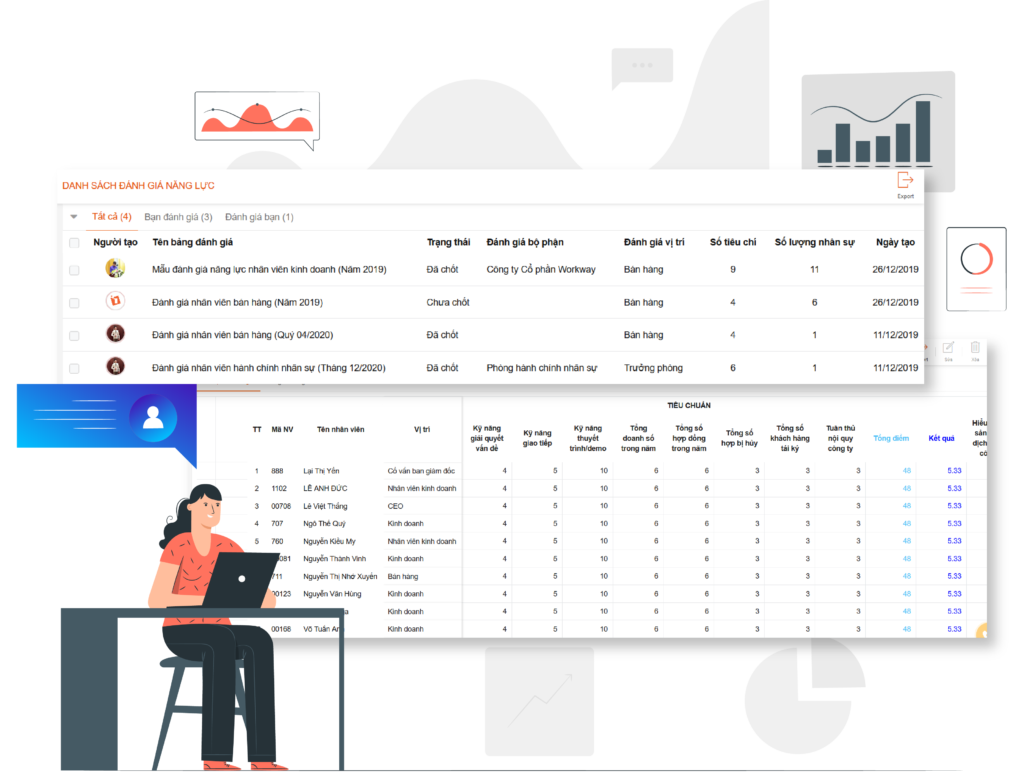
The above article from 1Office has provided you with professional and impartial employee evaluation feedback templates to enhance HR management efficiency and introduced a solution to digitize employee performance management with the 1Office HRM module. Register to experience 1Office HRM today!
7. Frequently Asked Questions
What is the difference between year-end employee reviews and periodic reviews?
Periodic reviews often focus on work results over a short period, such as a month or quarter, to monitor progress and make timely adjustments. In contrast, year-end reviews are more comprehensive, used to look back at the entire work process, the degree of goal completion, progress, and the employee’s development potential.
Does employee evaluation feedback need to be linked to KPIs or specific data?
Yes. If linked to KPIs, data, or specific results, the feedback will be clearer, more impartial, and more persuasive. Instead of just writing “completed work well,” you should specify what level the employee achieved, which goals were exceeded or not met, to make the evaluation more realistic.
What factors should be focused on when reviewing a new employee on probation?
For a new employee on probation, the focus should be on factors such as work attitude, learning ability, eagerness to learn, job suitability, and ability to collaborate with colleagues. These factors are more important than demanding high results in the initial stage.
What kind of feedback should be avoided when evaluating an employee?
You should avoid overly general, subjective, or reactive comments like “poor performance,” “irresponsible,” or “incompetent” without clear explanation. Instead, provide specific feedback on behavior, results, or areas for improvement so that the employee can understand and accept it more easily.
Is there any software that helps businesses digitize the employee evaluation process?
For more details, please contact:
Hotline: 083 483 8888
1Office Fanpage: https://www.facebook.com/1officevn
Youtube Channel: https://www.youtube.com/c/1OfficeNềntảngquảnlýtổngthểDoanhNghiệp
















