


 11/05/2026
  608 views
An interview evaluation form is an important tool in the recruitment process. It helps recruiters assess the abilities, skills, experience, and attitude of candidates during the interview. Based on this evaluation, recruiters can compare and select the most suitable candidate for the job position. So, let’s join 1Office in listing the TOP 5 most detailed and comprehensive interview evaluation forms in this article.
Mục lục
- 1. Framework for Building an Interview Evaluation Form
- 2. Guide to Building an Interview Evaluation Form for Any Job Position
- 3. What sets of questions should an interview evaluation form include?
- 4. Top 10 Most Comprehensive and Up-to-Date Interview Evaluation Form Templates
- 5. Common mistakes when evaluating candidates and how to avoid them
- 6. What is the most effective candidate evaluation solution on the market today?
- 7. Frequently Asked Questions
1. Framework for Building an Interview Evaluation Form
The candidate evaluation form for the interview round helps recruiters review the interview process. From there, they can obtain accurate information and an overview of the skills and competencies an employee needs to perform the job well. At the same time, this also helps recruiters design more suitable and effective tests, interviews, and assessments.

Therefore, building an interview evaluation form correctly will help make the organization’s recruitment and candidate assessment decisions more accurate and effective. According to a compilation from various businesses, a basic framework for an interview evaluation template includes the following sections:
- Candidate and Job Position Information: Includes the candidate’s name, applied position, department, interview date, interviewer’s name, and other relevant information.
- Competency and Experience Assessment Questions: Includes questions to assess professional skills, work experience, problem-solving ability, teamwork skills, and organizational and time management skills.
- Character and Ethics Assessment Questions: Includes questions to assess qualities such as ethics, honesty, integrity, prudence and respect, and the ability to work in and respect a diverse environment.
- Overall Assessment: Includes overall evaluation criteria such as ability and suitability for the job position, ability to work in the company environment, and potential for development and progress.
- Summary and Decision: Includes a summary section, overall assessment, and a decision on whether to accept or reject the candidate.
>> See more: What is MBTI? Applying the MBTI Personality Test to Evaluate Staff and Candidates
2. Guide to Building an Interview Evaluation Form for Any Job Position
Building an interview evaluation form is a crucial step in the recruitment process. To create a quality interview evaluation template, you can follow these steps:
Step 1: Define the evaluation criteria
You need to define the evaluation criteria based on the job requirements and the skills, experience, and abilities of a suitable candidate for the position. These criteria can include professional skills, soft skills, work ethics, contribution to the company, teamwork ability, problem-solving skills, etc.
Step 2: Create interview questions
Based on the defined evaluation criteria, you can create interview questions to assess the candidate. For example, if one of the criteria is problem-solving skills, a question could be: “Tell us about a time you faced a complex problem and how you solved it?”
Step 3: Determine the assessment method
You need to decide how to evaluate the candidate’s answers based on the defined criteria. This may involve using a scorecard or a rating system.

Step 4: Determine the weighting
You need to assign a weight to each evaluation criterion based on its importance for the job position. For example, if professional skills are the most critical factor, you can assign a higher weight to this criterion compared to others.
Step 5: Summarize the results
Finally, you need to summarize the evaluation results and make a hiring decision. You should store the interview evaluation form for each candidate and record their scores for each criterion. This record-keeping helps you compare different candidates and evaluate the criteria throughout the recruitment process.
Explore 1Office’s employee evaluation feature
3. What sets of questions should an interview evaluation form include?
To build an effective interview evaluation template, you should include specific and comprehensive questions to assess the candidate’s key attributes. Here are some questions you can use:
- What is the candidate’s work experience? What jobs has it been related to?
- What are your comments on the candidate’s educational background and professional expertise?
- Have you assessed the candidate’s ability to adapt and learn in a new work environment?
- What difficult situations or challenges has the candidate faced in their work? How did they resolve them?
- What are your comments on the candidate’s ability to work independently and manage their tasks?
- Please evaluate the candidate’s teamwork skills. Can they integrate into a new work environment?
- What are your comments on the candidate’s communication skills? Can they communicate effectively with colleagues and clients?
- Please evaluate the candidate’s time management and work prioritization skills.
- What are your comments on the candidate’s motivation and commitment to the job?
- What are your comments on the candidate’s creativity and ability to propose new solutions?
- Do you have any other assessments of the candidate?
Additionally, you can also add other questions that are suitable for the specific job requirements and company culture. Furthermore, ensure that the questions are arranged in a logical order to create a comprehensive picture of the candidate’s abilities and competencies.
4. Top 10 Most Comprehensive and Up-to-Date Interview Evaluation Form Templates
Dividing the candidate interview evaluation form by department and recruitment level is an effective way to assess and compare candidates within the same department or at the same recruitment level. This will help recruitment and HR managers easily evaluate and select the most suitable candidate for the job and department. Additionally, recruiters can also choose to use a rating scale evaluation form to assess candidates.
4.1 The Most Common Interview Evaluation Form
Candidate Overview:
Does the candidate appear confident and professional?
Does the candidate clearly and fully present their experience, skills, and achievements?
Does the candidate have the ability to work independently and as part of a team?
Does the candidate demonstrate interest in and research about the company?
Professional Skills:
Does the candidate have the professional knowledge and experience suitable for the applied position?
Can the candidate apply their professional knowledge to the job?
Soft Skills:
Does the candidate have the ability to communicate and work in a diverse environment?
Does the candidate have time management, logical thinking, and problem-solving skills?
Does the candidate have the ability to work under pressure and face challenges?
Summary:
Overall score.
Comments on the candidate’s abilities and skills.
Overall assessment and recommendation for the candidate.
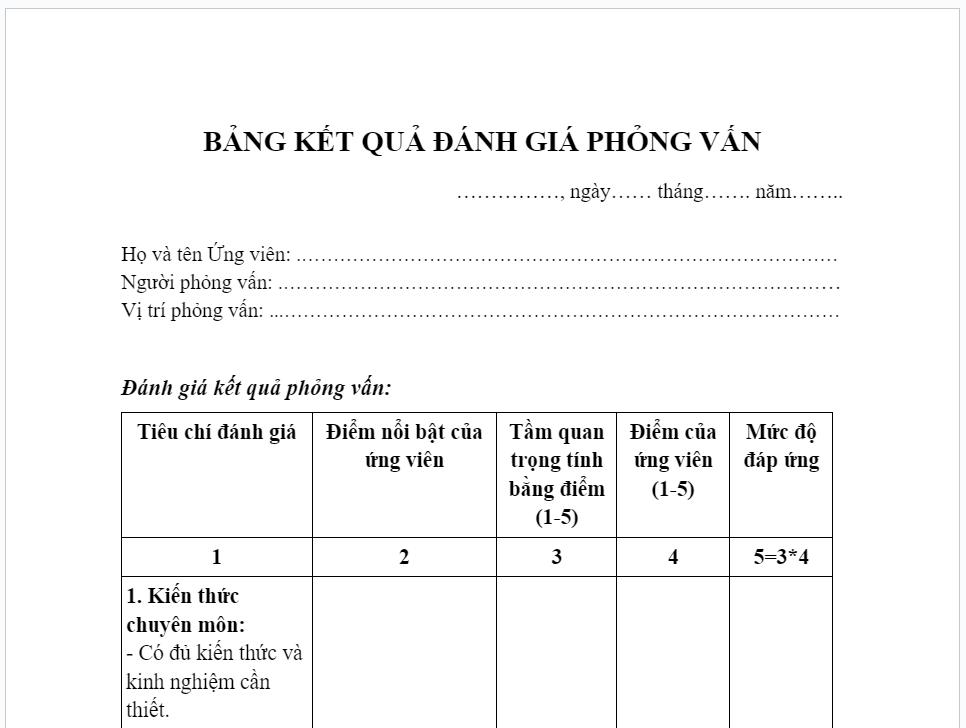
4.2 Interview Evaluation Forms by Department
When divided by department, the questions in the interview evaluation form will focus on the skills and experience related to the job in that department. This helps in assessing candidates based on the specific requirements of the job and department, thereby helping recruitment and HR managers select the most suitable candidate.
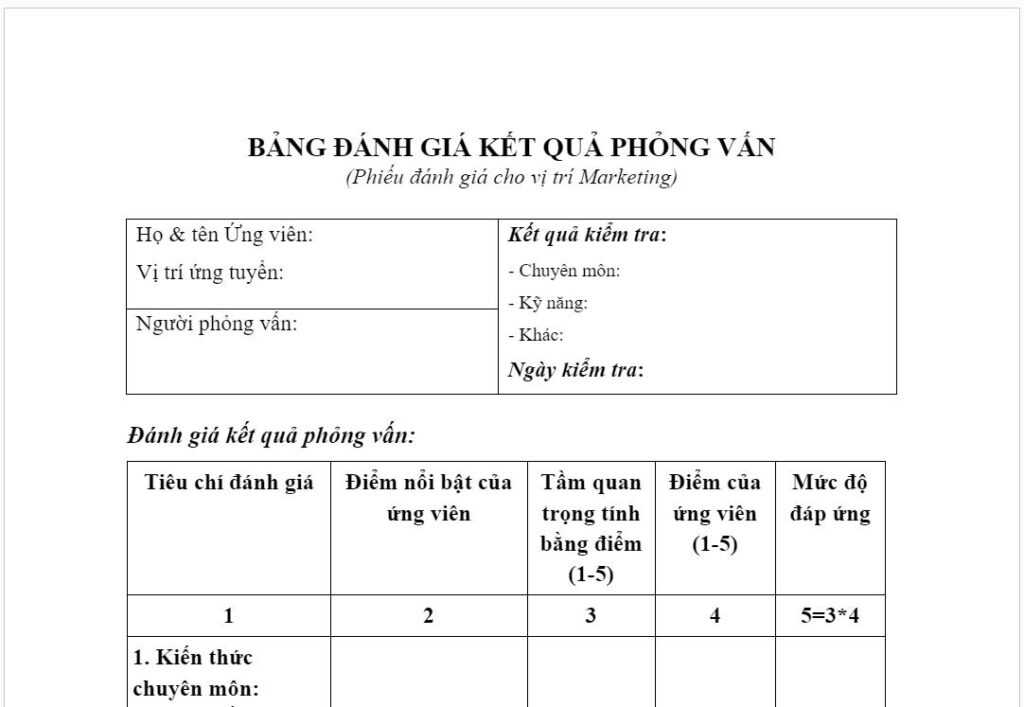
4.2.1 Human Resources Department
The interview evaluation form template for the HR department focuses on recruitment management skills, candidate sourcing ability, employee training, benefits policy management, and other HR-related activities.
Candidate sourcing ability:
Interviewing skills:
Ability to evaluate candidate profiles:
Ability to make accurate decisions during the recruitment process:
Employee training and development skills:
Ability to manage benefits and insurance policies:
Download the interview evaluation form for HR positions here
4.2.2 Sales Department
The evaluation form template for the sales department focuses on sales skills, customer management, negotiation, and other business-related activities.
Ability to build customer relationships:
Negotiation and persuasion skills:
Ability to handle difficult situations in the business process:
Planning and time management skills:
Communication and information-conveying skills:
Ability to provide solutions and make quick decisions:
Download the interview evaluation form for sales positions here
4.2.3 Accounting Department
The interview evaluation form template for the accounting department focuses on auditing skills, financial management, data analysis, and other accounting-related activities.
Ability to audit and analyze financial data:
Accounting and financial management skills:
Proficiency in using accounting software:
Skills in preparing financial reports and business plans:
Ability to resolve tax-related issues:
Download the interview evaluation form for accounting positions here
4.2.4 Production Department
The form for the production department typically focuses on production management skills, product quality control, production process management, and other production-related activities.
Production management and process management skills:
Ability to ensure product quality:
Ability to find solutions to increase production productivity:
Personnel management and employee training skills in the production department:
Ability to handle production-related incidents:
Production planning and time management skills:
Download the interview evaluation form for the production department here
4.2.5 Marketing Department
The candidate interview evaluation form for the Marketing department focuses on skills in Marketing planning, advertising activities, event management, strategy development, and other Marketing-related activities.
Marketing planning ability:
Event management and media preparation skills:
Ability to develop market-appropriate Marketing strategies:
Market analysis and evaluation skills:
Ability to propose solutions to increase sales:
Customer consulting and support skills:
Download the Marketing position interview evaluation form here
4.3 Interview evaluation form by job level in the company
Interview evaluation forms can also be categorized by job level, from senior management to junior staff positions. Below are some common interview evaluation form templates by job level.
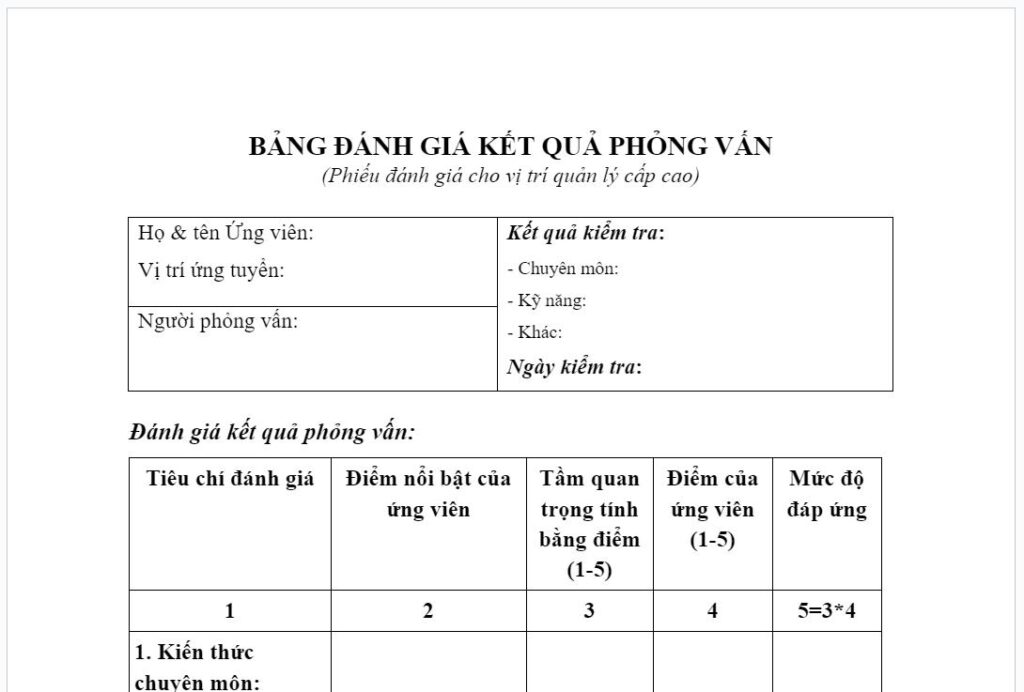
4.3.1 Interview evaluation form for senior management positions
The interview evaluation form for senior management positions focuses on leadership, strategic management, and business development skills.
Leadership and human resource management skills:
Ability to develop and execute strategic plans:
Financial and asset management skills:
Ability to find and develop new business opportunities:
Skill in handling complex issues and making sound decisions:
Ability to establish and maintain relationships with customers, partners, and the community:
Download the senior management position interview evaluation form here
4.3.2 Interview evaluation form for mid-level management positions
The interview evaluation form for mid-level management positions focuses on human resource management, planning, and project management skills.
Human resource management and employee training skills:
Planning and project management ability:
Interaction and communication skills with other departments in the company:
Ability to analyze and solve problems in the management process:
Skill in proposing solutions to improve departmental work efficiency:
Ability to monitor progress and ensure project quality:
Download the mid-level management position interview evaluation form here
4.3.3 Interview evaluation form for regular staff positions
The interview evaluation form for regular staff positions focuses on basic skills, diligence, and responsibility.
Ability to work diligently and meet job requirements:
Cooperation and teamwork skills:
Integrity and honesty in work:
Ability to adapt and learn quickly:
Sense of responsibility and willingness to take ownership of assigned tasks:
Skill in solving basic work-related problems:
4.4 Interview evaluation form by scoring scale
Using an interview evaluation form with a scoring scale depends on the purpose and nature of the job being recruited. If the job requires specific professional skills and abilities, using a scoring scale can be very beneficial in the evaluation process. However, when assessing soft skills and the candidate’s personality, other evaluation methods should be used to get a more comprehensive and accurate view.
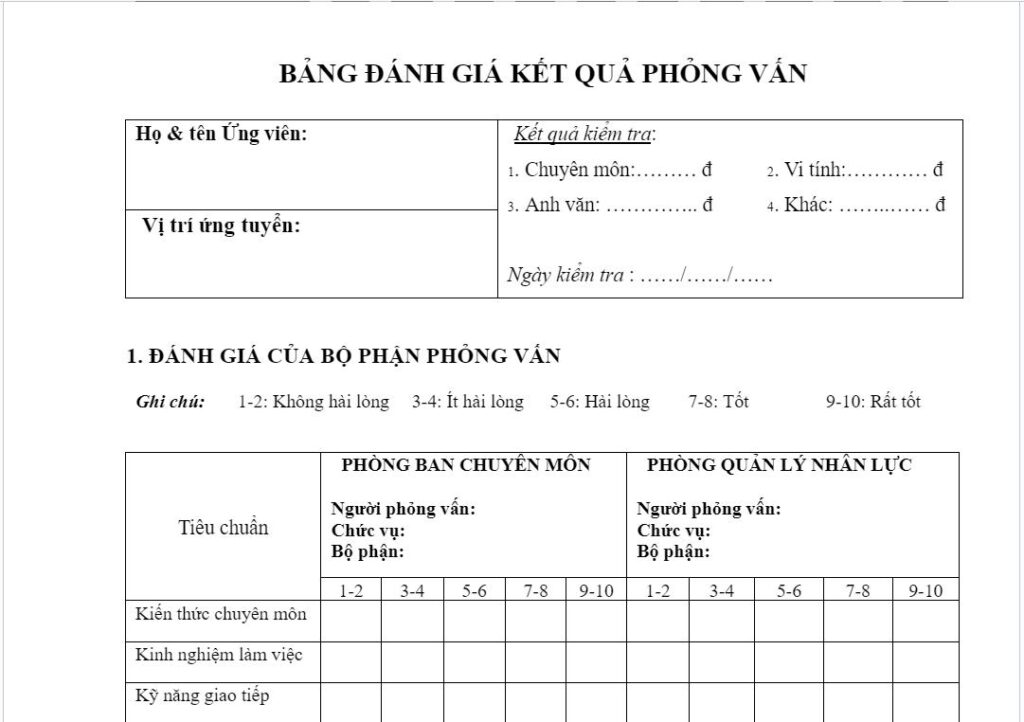
Download the interview evaluation form by scoring scale here
5. Common mistakes when evaluating candidates and how to avoid them
5.1 Judging based on first impressions
This is the most common mistake in the interview process. Many recruiters make a judgment within the first few minutes based on the candidate’s appearance, greeting, or demeanor. However, first impressions reflect only a very small part and are often subjective. Relying entirely on this factor can cause the company to miss out on talented candidates who haven’t had a chance to fully demonstrate their abilities.
- Solution: Always adhere to the evaluation form with specific criteria, scoring based on answers and behavior throughout the interview rather than on personal feelings.
5.2 Focusing only on professional skills, ignoring soft skills
A candidate with strong professional expertise may not be a good long-term fit for the company if they lack communication skills, a cooperative spirit, or problem-solving abilities. In the modern work environment, soft skills play an equally important role in ensuring teamwork effectiveness and integration.
- Solution: Develop an evaluation form that balances hard skills and soft skills. In addition to technical questions, include hypothetical situations or behavioral questions to assess their conduct, thinking, and work style.
5.3 Using criteria unsuitable for the job position
Many businesses use a single, generic evaluation form for all positions. This leads to inaccurate results that do not correctly reflect the job requirements. For example, a sales employee needs to be highly rated on negotiation skills, while a senior manager must demonstrate leadership and strategic thinking.
- Solution: Customize the evaluation form for each department and level. For each position, clearly define the core criteria to ensure the candidate meets the specific needs.
5.4 Lack of consensus in the interview panel
In many panel interviews, each member often has their own opinions and criteria, leading to inconsistent final results. This makes the hiring decision difficult and prone to disputes.
- Solution: Before the interview, the panel needs to agree on a common set of criteria, use the same evaluation form, and the same scoring scale. Additionally, after the interview, there should be a brief discussion to clarify any differences in assessment.
5.5 Skipping the detailed comments section
Only assigning scores without specific notes makes the evaluation data dry and lacks basis when it needs to be reviewed. In many cases, scores are the same, but the reasons differ, leading to inaccurate analysis and comparison of candidates.
- Solution: Besides scoring, the interviewer should write down brief comments or specific evidence from the candidate’s answers. This helps make the results transparent and supports the final overall evaluation process.
6. What is the most effective candidate evaluation solution on the market today?
Recruitment management software is the most effective candidate evaluation solution on the market today. With the application of artificial intelligence technology and data analysis tools, 1Office helps businesses evaluate candidates quickly, accurately, and objectively.
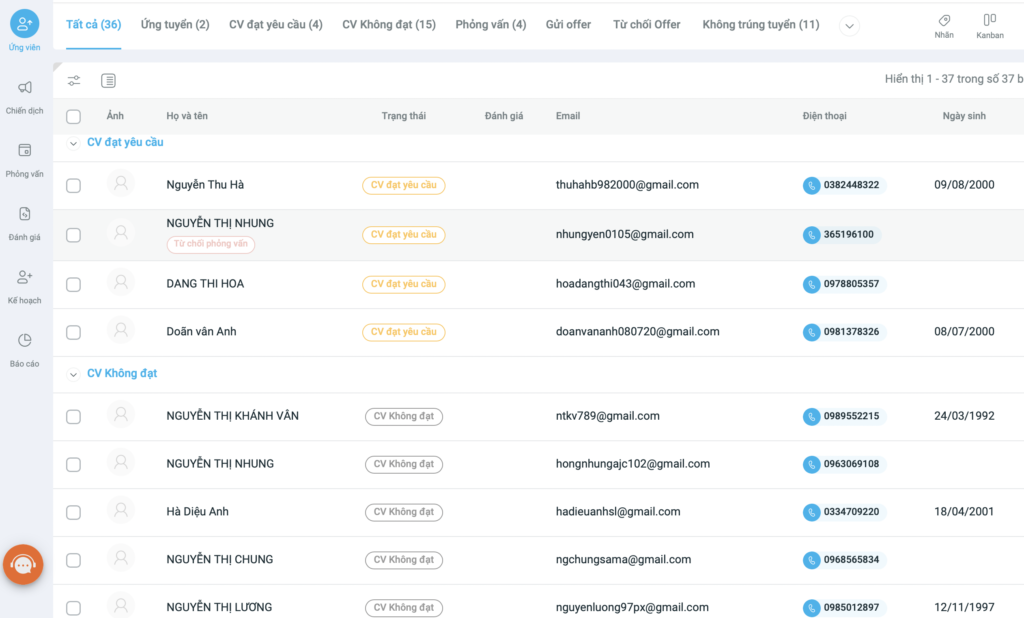
1Office provides various interview evaluation form templates, suitable for many different positions and industries. All these templates are designed based on the standards and professional requirements of each position, helping to evaluate candidates comprehensively and accurately.
In addition, 1Office also has a feature to automatically evaluate and rank candidates based on important criteria such as experience, skills, and qualifications. This helps businesses save time and effort in the candidate evaluation process.
Furthermore, 1Office also provides a data analysis feature to help businesses assess the effectiveness of their recruitment process and identify areas for improvement. This helps enhance recruitment quality and minimize errors in the candidate selection process.
Get a free consultation & software demo
With its powerful features and tools, 1Office is becoming the top choice for recruiting businesses worldwide. If your company is looking for an interview evaluation form template and the most effective candidate evaluation solution, please contact 1Office via email: support@1office.vn for a completely free consultation.
7. Frequently Asked Questions
How many evaluation criteria are sufficient for an interview?
Usually, 5–7 criteria are appropriate. This is enough to evaluate the candidate clearly while still allowing the interviewer to score quickly without getting confused.
How should you score a candidate with good professional skills but weak soft skills?
You should score each group of criteria separately instead of giving an overall assessment. This approach helps the company clearly see the candidate’s strengths and weaknesses and consider their suitability for the actual position.
Does an interview evaluation form need a detailed comments section?
Yes. The comments section helps explain why a candidate received a certain score and also makes it easier for HR and managers to discuss and compare multiple candidates.
How can you distinguish between a candidate giving a rehearsed answer and one with genuine experience?
You should ask more in-depth questions about the context, their approach, their specific role, and the final outcome. Candidates with real experience usually provide more detailed and consistent answers during follow-up questions.
Is there any software that helps HR save evaluation forms, score candidates, and track them in a more centralized way?
Yes. If your business wants to manage interview evaluation forms, score candidates, and track the recruitment process on a single system, you can check out 1Office’s recruitment software.
See more related articles:
















