Latest 2026 Standard Employee Training Policy Template for Businesses


Training is no longer a “benefit” – it’s a vital strategy to help businesses develop their teams and retain talent. However, without a well-structured Employee Training Policy Template, employees might “learn and forget,” budgets get wasted, and managers struggle to evaluate effectiveness. So, how can you build a standard training policy that is easy to apply and truly effective? In this article, 1Office will provide a standard employee training policy template to help businesses build a clear team development roadmap, measure effectiveness, and align with talent retention goals.
Mục lục
1. What is an Employee Training Policy?
An employee training policy is:
- A set of principles and regulations established by the company for employee training activities.
- Enhancing the knowledge and skills of employees.
- Meeting business requirements and developing employee capabilities, thereby meeting customer expectations.

A comprehensive human resource training policy is designed to ensure development plans for new employees and competency development for existing staff, especially core team members.
Read more: 5 steps to build an effective internal training process for businesses
2. The Importance of a Training Policy in a Business
In the context of increasingly fierce competition among Vietnamese businesses regarding organizational capacity and personnel quality, training is no longer a “benefit” – it has become a vital strategy for retaining talent, developing teams, and creating a long-term advantage.
However, in reality, many businesses implement training in a fragmented, directionless manner, lacking a clear policy framework to evaluate effectiveness. As a result, budgets are wasted, and employees “learn and forget,” unable to apply their new knowledge to their actual work.
A well-structured employee training policy with a clear framework will help a business:
-
Standardize the internal training process
-
Align training with HR strategy and organizational development
-
Improve the ability to measure the return on training investment
-
Reduce the risk of post-training turnover through legal commitments
3. Essential Elements of an Employee Training Policy Template
Managers need to remember the essential elements to include in an employee training policy template.
3.1 Scope of Application in the Employee Training Policy Template
The training for full-time employees will differ from that for part-time or seasonal employees. Additionally, based on the nature of the job, some positions may need to be managed separately from the company’s general training policy.
The company needs to clearly define the scope of the policy’s application to ensure that individuals understand and comply with the business’s training process.
3.2 Concepts Mentioned in the Employee Training Policy Template
The business needs to clarify the company’s definitions of:
- General training programs.
- Specific training programs for each department
- Individual training programs.
3.3 Responsibilities of Each Department/Individual
Responsibilities should be clearly divided among the HR Department, Department Directors, and individuals. Note, discuss employee obligations thoroughly with them.
There will be cases where the Company will recover 100% of the tuition fees by deducting from salary or severance pay for courses fully paid by the company, for the purpose of contributing to the business’s success, such as:
- The employee resigns during the training period or within 2 months after the training course ends.
- Failing the assessment test, if any, from the training provider…
Discussing/notifying employees in advance will help avoid future conflicts and questions, as well as wasted budget and human resources. Therefore, the company’s employee training policy must be transparent, ensuring that departments and individuals understand and fulfill their responsibilities.
3.4 Budget for Employee Training
The company needs to be certain whether it has sufficient funds to cover the training sessions proposed by the HR department and needs to clarify the responsibility for building and managing the budget of each department.

The HR Department is in charge of general training programs, departmental training programs, and individual training programs. Meanwhile, each department is responsible for its own internal training programs.
3.5 Detailed Training Process
The training process is like the clearest map for employees working in the business. You need to ensure the following content:
- Training needs and information.
- Internal training, external training.
- Storing training records.
You should anticipate and be flexible with information such as: Training session schedules; training room capacity. The training format, method of evaluating training results, etc., will depend on the specific training plans.
The “Workplace Learning Report 2018” conducted by LinkedIn revealed that 93% of employees stay longer with a company that has a strong training culture and a well-structured personnel development plan. A professional and systematic employee training policy not only helps the business enhance its resources but also helps employees shape a path for effort and skill improvement.
4. Objectives and Scope of Application
The employee training policy needs to be built with objectives that are clear – measurable – aligned with the human resource development strategy of each business.
Main Objectives
-
Enhance professional competence, soft skills, and mindset for all personnel
-
Ensure the team has sufficient capabilities to meet current and future job requirements
-
Contribute to building a culture of continuous learning within the company
-
Support the talent retention strategy with a clear development path
Scope of Application
-
All employees officially working at the company
-
Includes new employees, personnel in their probationary period, and management personnel
-
Applies to all training formats: internal, outsourced, in-person, online, workshops, 1:1 coaching, etc.
Classification of Subjects by Level
| Personnel Group | Main Training Objectives |
|---|---|
| New Employees | Quick integration, understanding company processes and culture |
| Specialized Staff | Update professional skills, improve work performance |
| Mid-level Managers | Develop leadership and team management skills |
| Senior Leadership | Strategy, change management, system operation |
5. SMEs and Corporations: Are Their Employee Training Policies the Same?
A common mistake when building an employee training policy is applying a single template to all types of businesses. In reality, there are many differences between a 50-employee company and a 500+ employee corporation: in terms of budget, implementation capacity, team development strategy, and level of specialization.
If the policy is not designed to fit the organization’s scale, the business can easily fall into a state of superficial training – wasted budget – difficult application – and unmeasurable effectiveness.
5.1. Training Policies for SMEs
SMEs (30–200 employees) often do not have a dedicated training department. The planning, implementation, and evaluation of training effectiveness are usually handled by the HR department or managed by individual departments. Therefore, they need policies that are:
-
Concise, clear, and easy to implement by each department
-
Focused on post-training job performance
-
Prioritizing flexible formats like e-learning, internal training, and coaching
-
Optimizing the budget to within 1–3% of the salary fund
-
Simple commitments (e.g., reimbursement agreements for early departure)
5.2. Training Policies for Large Corporations
In contrast, large corporations (500+ employees) often have in-depth competency development strategies. Training is organized into structured programs that can last for months, are tiered by level, and are linked to individual and organizational KPIs. They need policies that are:
-
Integrating multiple formats: outsourcing, coaching, seminars, international programs
-
Having a fixed annual budget, typically from 5–10% of the salary fund
-
Using specialized tools: LMS, competency assessment systems, AI for learning outcome analysis
-
Accompanied by training contracts, clear KPIs, and legally binding policies
| Criteria | SME Businesses | Large Corporations |
|---|---|---|
| Training Objectives | Increase performance, optimize practical work | Develop in-depth competencies, upgrade succession teams |
| Implementation Organization | HR holds multiple roles, by department | Dedicated Training Department, coordinates with partners |
| Training Budget | 1–3% of salary fund, optimized for each session | 5–10% of salary fund, with a long-term plan |
| Effectiveness Evaluation | Measured by work results, direct feedback | LMS, internal surveys, AI analysis |
| Post-Training Commitment | Agreement to reimburse fees if leaving early | Training contract, post-training KPIs |
| Supporting Tools | Google Sheets, basic HRM | LMS, competency assessment system, AI |
6. Employee Training Policy Template
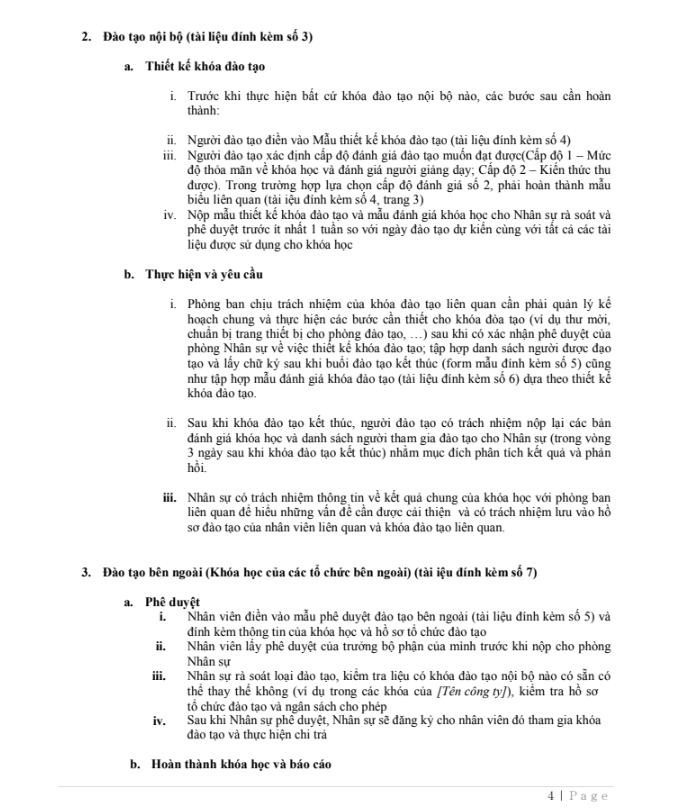
DOWNLOAD THE TRAINING POLICY TEMPLATE NOW WITH JUST 1 CLICK HERE