11/05/2026
  775 views
Human resource management is one of the most important activities for a business. To manage human resources effectively, businesses need to build a standardized human resource management process flowchart according to ISO standards. In the article below, let’s explore the human resource management process flowchart with 7 ISO-standard steps with 1Office.
Mục lục
- 1. What is a human resource management process flowchart?
- 2. Why do businesses need a human resource management process flowchart?
- 3. Standard human resource management process flowchart
- 4. 7 Steps to Standardize the ISO Human Resource Management Process
- Step 1: Analyze and Determine the Current State of the Human Resource Management Process in the Business
- Step 2: Establish a Quality Management Board
- Step 3: Develop Processes, a Documentation System, and Applicable Documents
- Step 4: Apply the Human Resource Management Process in Practice
- Step 5: Evaluate the ISO Standard Application Process
- Step 6: Register for ISO Standard Certification
- Step 7: Maintain ISO Standard Certification
- 5. ISO in the Human Resource Management Process: Key Changes After Standardization
- 6. 1Office HRM – An Effective HR Management Toolkit
- 7. Frequently Asked Questions about HR Management Process Flowcharts
- 8. Conclusion
1. What is a human resource management process flowchart?
A human resource management process is a collection of activities and tasks related to managing a company’s human resources. Human resource management activities include: recruitment, training, evaluation, development, compensation, and employee retention.
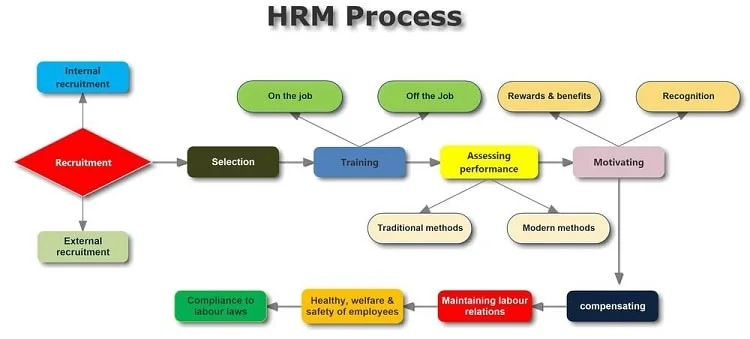
The human resource management process is established to optimize the effective use of human resources, benefiting both the business and its employees. By implementing smart and scientific steps to build a human resource management process, a business can effectively control its personnel situation, develop high-quality human resources, and foster employee engagement with the company’s overall goals.
2. Why do businesses need a human resource management process flowchart?
A human resource management process flowchart acts as a strategic operational blueprint, helping to standardize all activities from recruitment to training, aiming to optimize human resources and ensure consistency within the organizational structure.
Without a specific and clear process, a business is likely to face many unexpected problems and suffer consequences that can affect its operations. Management is always challenging, especially when it involves managing people. Therefore, having a logical human resource management process can directly impact the company’s development, including:
- Selecting the right employees and reducing recruitment costs: Helps the business find suitable candidates and avoid wasting resources during the hiring process.
- Assessing employee capabilities and professional development: Assists in evaluating employee performance and identifying appropriate ways to develop professional skills.
- Maintaining an effective work environment and promoting satisfaction: Creates positive working conditions, fostering an environment beneficial to both employees and the business.
- Handling internal conflicts and disputes: Provides a mechanism for resolving conflicts effectively, maintaining harmony within the organization.
- Maintaining cost-effective human resource management for the business: Optimizes resources and costs related to personnel management.
- A professional and systematic HR organizational structure.
In summary, with a complete human resource management process flowchart, all departments and individuals involved in HR management can simply look at the chart to understand:
- The entire human resource management process.
- Identify which step their tasks belong to and which departments are involved.
- Implement tight control over the human resource management process.
- Easily detect issues during implementation and quickly improve one or more steps in the process, ensuring adaptability to trends and avoiding system disruptions.
3. Standard human resource management process flowchart
A standard human resource management process flowchart is not just a description of basic operational steps within a business; it also serves as a “strategic map” to connect people, tasks, and development goals. With a clear process, the HR department can easily manage the entire employee lifecycle, from recruitment, training, and evaluation to development and talent retention. This is the foundation that helps the business operate stably, reduce management risks, and motivate the workforce to reach its full potential.
3.1. Stages in the human resource management process flowchart
A standard human resource management process consists of 4 stages: Recruit – Utilize – Retain – Release, with each stage having its own tasks and required conditions.
Stage 1: Recruitment
This is the first and most crucial step, aimed at finding and attracting qualified candidates. The HR department and leadership consider whether to hire new employees or appoint existing staff based on job requirements and expertise. When hiring new employees, the business needs to develop a recruitment plan, interview scripts, compensation and benefits packages, and onboarding training programs.
Basic sequence: Identify needs → Create a recruitment plan → Select recruitment channels → Source candidates → Interview and evaluate → Make a hiring decision → Onboarding training.
Stage 2: Training and utilization of personnel
During this stage, the business trains and develops employees, and assesses their performance and job skills. After training, new employees will be assigned suitable tasks to apply their knowledge and maximize work efficiency. Managers need to monitor, evaluate, and adjust assignments to ensure the highest productivity.
Phase 3: Employee Retention
Compensation and benefits policies are crucial factors for attracting and retaining talented employees, including: salary levels, performance-based bonuses, healthcare, paid leave, social insurance, and other benefits. A strong organizational culture, where employees clearly understand the company’s core values and mission, also contributes to maintaining long-term unity and dedication. The HR department plays a role in shaping and nurturing this culture through training, workshops, and internal activities.
Phase 4: Employee Offboarding
This is the process of terminating the employment relationship with unsuitable employees to maintain organizational performance and development.
Basic process:
-
Identify the reason: poor performance, policy violations, or changes in business needs.
-
Execute according to regulations: notification, contract termination, and ensuring employee rights.
-
Support departing employees: provide job counseling, severance information, and maintain respect and reputation.
-
Record and store related documents.
The offboarding phase must be carried out carefully, professionally, and in compliance with the law to ensure a smooth process for both the employee and the organization.
3.2. Sample Standard HR Management Process Diagram
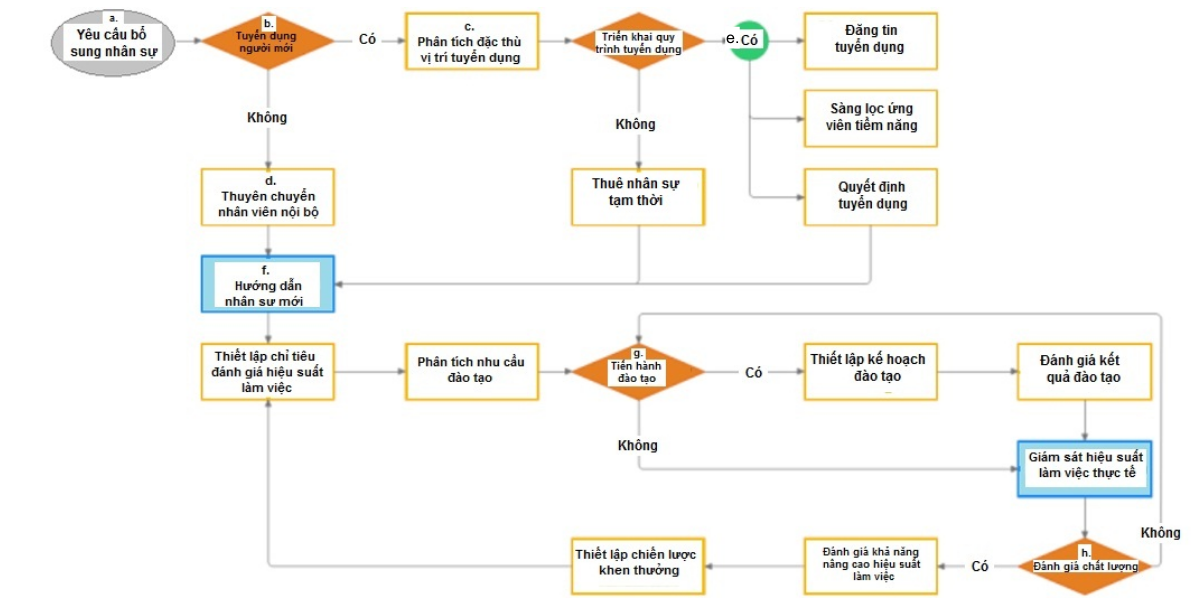
The HR management process diagram is explained in detail step-by-step in the following table:
|
Step |
Step Content |
|
a. Personnel Request |
The board of directors or department heads send requests for additional personnel to the HR department. |
|
b. Review Recruitment Plan |
The HR department assesses: should we recruit externally or transfer internal employees?
|
|
c. Job Analysis and Description |
Compile position requirements, analyze job specifics, and create a detailed job description. |
|
d. Internal Personnel Transfer |
Utilize current employees: promote or transfer them to fill the new position. |
|
e. Recruit New or Hire Temporary Staff |
|
|
f. Onboarding Training |
After selecting a candidate for the position, the company will conduct onboarding training, provide guidance, and hand over job responsibilities to the new employee.
At this step, the company needs to:
|
|
g. Conduct or Skip Training |
Based on the results of the work quality assessment, the company considers whether it is necessary to conduct training:
|
|
h. Evaluate Job Performance |
By monitoring the new employee’s work quality, the company will evaluate their job performance, contributions, and suitability for the assigned tasks.
|
4. 7 Steps to Standardize the ISO Human Resource Management Process

Step 1: Analyze and Determine the Current State of the Human Resource Management Process in the Business
To standardize the human resource management process, the business first needs to identify its current HR management organization and activities. Then, compare them with ISO standards. It is best to have this done by an ISO consulting unit to assess the current HR management situation, provide advice, and make recommendations for the successful application of ISO standards.
Once the context of the HR management issue is identified, the business will consider adjusting, improving, and supplementing the system to ensure its quality aligns with ISO standards.
Step 2: Establish a Quality Management Board
Applying ISO standards to the human resource management process is a major project that requires coordination among many departments within the business. Therefore, a project management board should be established, including managers at all levels and responsible employees with knowledge of the ISO Standard Set.
The management board will be responsible for analyzing and identifying the key clauses and standards the business will apply, as well as planning and organizing the implementation of the HR management system standardization process.
Step 3: Develop Processes, a Documentation System, and Applicable Documents
The core of managing human resources according to ISO standards is the systematization of current management processes within the business and charting them into regulatory documents and texts. This is considered the most crucial step in the ISO standard implementation process.
The processes that need to be standardized include:
- Recruitment process.
- Training and human resource development process.
- Personnel competency assessment process.
- Process for appointments, rewards, and discipline, etc.
Additionally, it is necessary to build a system of documents and texts including:
- Compensation and benefits policies.
- Internal rules and regulations of the business.
- Development and promotion paths for each position and title.
- Regulations related to discipline and the employee termination process.
- Regulations on rewards and personnel evaluation.
All of these elements support the building and maintenance of a standard human resource management system, helping to ensure consistency and compliance with ISO standards.
Step 4: Apply the Human Resource Management Process in Practice
Once the processes and system have been comprehensively developed, the management board will need to disseminate this information to the HR department and begin training and guiding employees on how to implement the processes. During this implementation, the management needs to ensure a clear and transparent assignment of authority and responsibilities for each individual.
Step 5: Evaluate the ISO Standard Application Process
To determine the level of suitability and compliance with ISO standards, the human resource management system must be continuously evaluated for effectiveness during implementation. This evaluation helps identify areas in the process that are not yet perfected for improvement and correction. The evaluation can be conducted by internal company staff or by a specialized ISO unit.
Step 6: Register for ISO Standard Certification
To be officially recognized for having an ISO-compliant human resource management process, the business must register for certification with authorized organizations. The business needs to choose a reputable place with full legal authority to register for certification.
Step 7: Maintain ISO Standard Certification
The ISO standard certification is valid for a maximum of 3 years from the date of registration. During this time, periodic surveillance and assessments will be conducted to ensure the business continues to comply with the requirements set by ISO. Therefore, the business needs to continuously improve and ensure the quality of its human resource management system.
See more: Which HR management software is popular in Vietnam in 2026?
5. ISO in the Human Resource Management Process: Key Changes After Standardization
The table below illustrates the clear differences in human resource management before and after standardizing according to ISO standards, from processes, documentation, recruitment, training, and evaluation, to rewards and continuous improvement. Through this, businesses can easily see the benefits of applying ISO in enhancing the efficiency and transparency of HR management.
| Criteria | Before ISO Standardization | After ISO Standardization |
|---|---|---|
| Management Process | Fragmented, inconsistent across departments | Standardized, all steps are clear and consistent according to ISO standards |
| Documents and Records | Inconsistent, incomplete, difficult to track | A complete system of documents, forms, and internal regulations that is easy to look up |
| Recruitment | No standards, each person acts based on experience | Transparent, clear recruitment process with standardized competency assessment |
| Training and Development | No specific plan, lacks effectiveness evaluation | Has a training plan, results evaluation, and competency development according to standards |
| Performance Appraisal | Inconsistent, subjective, lacks transparency | Objective, clear evaluation system with KPIs and quantitative indicators |
| Rewards and Discipline | Not transparent, at the discretion of each manager | Clear, transparent, fair regulations applied consistently |
| Legal and Regulatory Compliance | Prone to errors, legal risks | Full compliance with labor laws, insurance, and ISO requirements |
| Management Effectiveness | Difficult to measure, employees lack direction | Easy to measure, improves performance, employees clearly understand the process |
| Continuous Improvement | No mechanism for evaluation and improvement | Has a mechanism for periodic evaluation and continuous improvement according to PDCA |
6. 1Office HRM – An Effective HR Management Toolkit
1Office HRM – The Smart HR Management Solution
1Office HRM is the “golden key” that helps businesses optimize their HR management processes in the digital age. With in-depth features and a rich repository of tools and resources, 1Office HRM helps improve management efficiency while creating a competitive advantage in the market.
Key features:
- Comprehensive Recruitment Management – Create recruitment requests, manage and evaluate candidates from multiple channels, and quickly find suitable candidates.
- Employee Training and Development Management – Track the training process, assess competencies, and create personalized training plans.
- HR Profile Management – Digitize profiles, contracts, insurance, leave… Helps the HR and accounting departments optimize costs and procedures.
- Benefits and Reward-Penalty Policy Management – Automatically calculate KPIs, rewards, and penalties, update them directly to the payroll, and conduct effective performance evaluations.
7. Frequently Asked Questions about HR Management Process Flowcharts
Why do businesses need an ISO-standard HR process flowchart instead of a spontaneous one?
An ISO process helps standardize all activities in writing, eliminating dependence on individuals. This ensures continuity, minimizes operational errors, and creates a mechanism for continuous system improvement.
How can SMEs build a suitable HR process flowchart?
SMEs should focus on simplifying the flowchart into 3 core stages: Targeted Recruitment, Practical Training, and Flexible Salary and Bonus Policies. Using 1Office HRM helps quickly digitize these steps without needing a cumbersome apparatus.
Which step in the HR process flowchart determines the retention rate of new employees?
Onboarding training is the most crucial step. A standard process helps new employees quickly grasp the company culture and job expectations, thereby reducing the turnover rate during the probationary period.
Where should a business start standardizing when its HR system is chaotic?
You should start by analyzing the current situation and standardizing the system of forms and records. Businesses can apply 1Office‘s No-code technology to redesign approval flows according to their own specific characteristics.
How can the HR process flowchart be implemented in practice?
The most effective way is to integrate the flowchart into management software. When the process is set up as automated workflows (Workflow) on 1Office, every individual must follow the correct sequence to complete their tasks, which helps eliminate the “process on paper” situation.
8. Conclusion
We hope this article has provided you with useful information for building an ISO-standard HR management process flowchart for your business. We wish you success!
👉 [Register for a free 1Office HRM trial here] and experience the difference in your HR management process flowchart!