


 12/05/2026
  606 views
The BCG Matrix is a business model that helps companies identify which products to invest in, maintain, or cut. But what is the BCG Matrix, what are its categories, and how is it applied in practice? This article will help you quickly understand the concept, the 4-quadrant structure, and how to use the BCG Matrix in strategy formulation.
Mục lục
- 1. What is the BCG Matrix?
- 2. The Structure of a BCG Matrix
- 3. Example of the BCG Matrix in Business
- 4. Advantages and Disadvantages of Using the BCG Matrix
- 5. What are the steps in the BCG matrix analysis process?
- 6. How to Apply the BCG Matrix in Strategy Formulation
- 7. Considerations During BCG Matrix Analysis
- 8. Common Mistakes When Businesses Apply the BCG Matrix
- 9. Modern Trends in Using the BCG Matrix
- 10. Frequently Asked Questions about the BCG Matrix
- 11. Conclusion
1. What is the BCG Matrix?
The BCG (Boston Consulting Group) Matrix is a tool used to analyze business models, assess the competitive position, and evaluate the growth potential of a company’s product portfolio or business units. For this reason, the BCG Matrix is also known as the product portfolio matrix. This is a classic business model developed by the Boston Consulting Group in 1970.
This model is built on two factors: relative market share and market growth rate. Based on these two factors, the BCG Matrix divides a company’s business portfolio into 4 categories: Stars, Question Marks, Cash Cows, and Dogs.
Within a business, applying the BCG Matrix helps managers make decisions about resource allocation, investment projects, and product/service development strategies, based on an understanding of the position of each product or unit in this matrix.

2. The Structure of a BCG Matrix
The BCG Matrix is divided into two main axes representing the relative market share (horizontal axis) and the growth rate (vertical axis) of the product portfolio or business unit. Specifically:
- Horizontal Axis: Determines the relative market share of a product/service compared to the largest competitor’s product/service in the same industry. Relative market share is calculated by dividing the market share of the product/service being analyzed by the market share of the largest competitor in the same industry.
- Vertical Axis: Determines the growth rate of the market in which the product/service operates. The market growth rate is calculated by taking the percentage change in market size over a specific period.
Based on these two axes, the BCG Matrix is divided into 4 main quadrants, with each quadrant corresponding to a group of products/services with different characteristics and growth potential.

2.1. BCG Matrix: Dogs
These are products located in the “Dogs” quadrant, which has low relative market share and low market growth rate.
Products or services in the “Dogs” quadrant of the BCG Matrix typically have no growth potential and generate low profits for the company. Therefore, the company should consider divesting these categories to focus resources on other products/services with higher growth potential.
2.2. BCG Matrix: Question Marks
Categories in the “Question Marks” quadrant are products/services with low relative market share but a high market growth rate. In other words, these are products with high growth potential but require significant investment to compete effectively.
Typically in businesses, investments in “Question Marks” are funded by cash flow from “Cash Cows”. The company needs to carefully evaluate the potential of products/services in this section to decide whether to invest or divest.
2.3. BCG Matrix: Stars
In the Stars quadrant of the BCG Matrix, product categories hold a high relative market share in a high-growth market. These are market-leading products/services with strong growth potential that generate significant profits for the company. Therefore, businesses need to invest strategically to develop and expand the market share of these categories or units.
To generate significant cash flow for the business, “Stars” also consume a considerable amount of cash, accounting for a large portion of production costs. When the market matures and the product categories in the “Stars” quadrant remain successful, they will transition into “Cash Cows”.
2.4. BCG Matrix: Cash Cows
Products/services in the “Cash Cows” quadrant have a high relative market share but a low market growth rate. These are products/services that generate stable profits for the company but require little investment.
Although they do not require heavy investment, the profits and cash flow generated by “Cash Cows” are substantial, so they are often used to fund “Stars” and “Question Marks”. The company needs to maintain and optimize the operations of these products/services to maximize profits.
See more: The Eisenhower Matrix: An Effective Time Management Matrix
3. Example of the BCG Matrix in Business
3.1. Apple’s BCG Matrix
Below is an example of the BCG Matrix for the Apple brand:
| Product Name | Relative Market Share | Market Growth Rate | BCG Matrix |
| iPhone | 0.9 | 5% | Star |
| iPad | 0.8 | 3% | Question Mark |
| Mac | 0.6 | 2% | Cash Cow |
| iPod | 0.4 | 1% | Dog |
In this example, the iPhone is the product/service with the highest relative market share and the highest market growth rate, so it is classified as a Star. The iPad has a high relative market share, but its market growth rate is lower than the iPhone’s, so it is classified as a Question Mark. The Mac product line has a low relative market share but a stable market growth rate, so it is classified as a Cash Cow. The iPod has a low relative market share and a low market growth rate, so it is classified as a Dog.
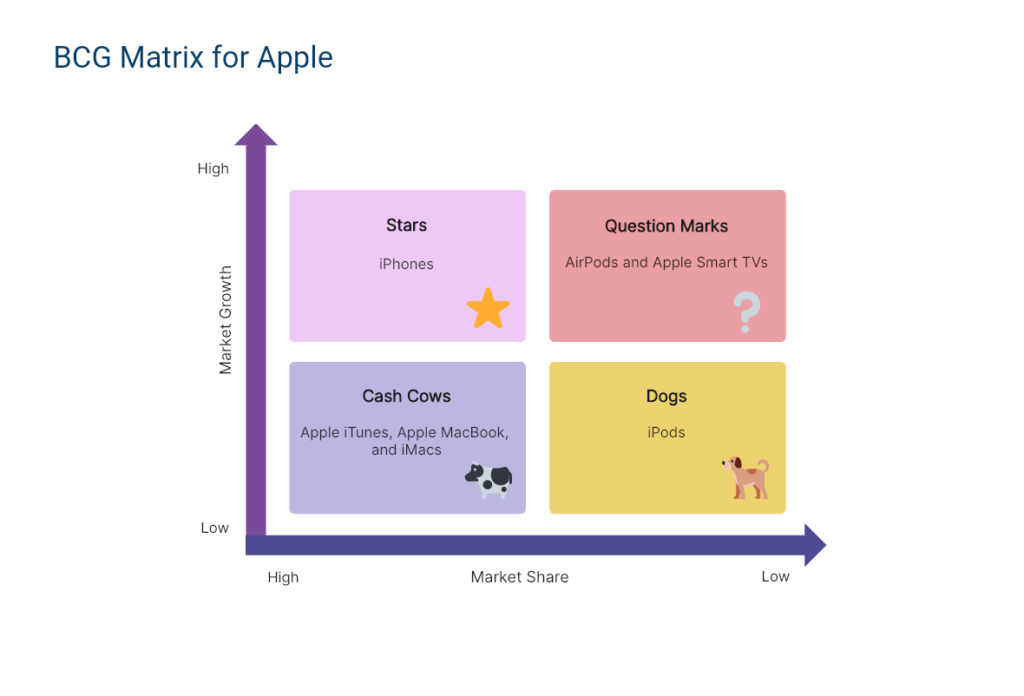
Based on the BCG matrix, the company can make the following strategic decisions:
- For the iPhone and iPad, the company needs to continue investing to develop and expand market share.
- For the Mac, the company needs to maintain and optimize operations to generate stable profits.
- For the iPod, the company should consider phasing it out to focus resources on products/services with higher growth potential.
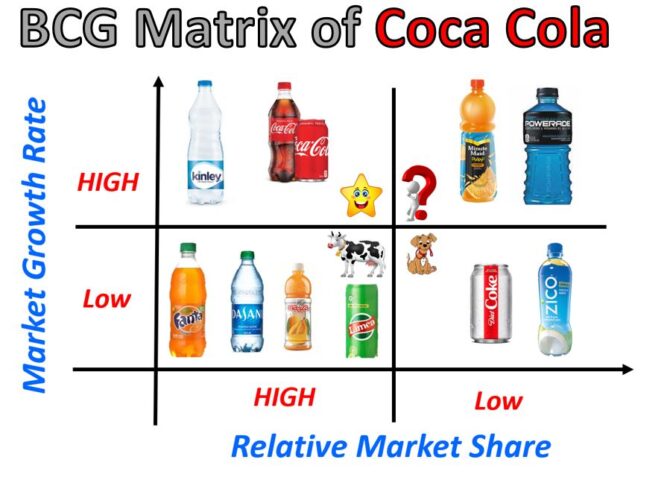
3.2. Coca-Cola’s BCG Matrix
- Cash Cow: Core products like Coca-Cola Original and Diet Coke – these are mature product lines in the market with a large market share, providing a stable cash flow, but their market growth rate is slow.
- Question Mark: New products like flavored water or other health-related products (e.g., low-sugar products) fall into this category because these product groups are in the process of building market share.
- Star: Product lines like Coca-Cola Zero Sugar and energy drinks (Powerade) belong to the Star category, with strong market share growth and high profit potential.
- Dog: Some secondary or less successful products, such as non-soda beverages that are not profitable and fail to generate market share.

Coca-Cola’s BCG matrix chart
Based on the BCG matrix, the company can make the following strategic decisions:
- Invest in Cash Cow products to maintain profitability and leverage cash flow, invest in Star products, and expand market share.
- Promote the development of healthy product lines like Diet Coke and Coca-Cola Zero Sugar to stay ahead of health trends in the market.
3.3. Honda’s BCG Matrix
- Cash Cow: Popular motorcycle models like the Honda Vision, Honda Lead, and Honda Wave, as well as the Honda City car. These are model lines with a large market share that bring stable profits to Honda.
- Star: Higher-end motorcycle models like the Honda SH and large-displacement motorcycles are growing strongly and have the potential to move into the Cash Cow category in the future.
- Question Mark: Honda’s new technology products or electric vehicles belong to this group, as the company is investing heavily in new products to capture market share.
- Dog: Some less successful model lines or those with declining revenue and market share, for example, older models that no longer suit current consumer tastes.
Based on the BCG matrix, the company can make the following strategic decisions:
- Leverage the Cash Cow model lines, such as popular motorcycles, while investing heavily in Star products like large-displacement motorcycles and electric vehicles.
- Consider phasing out model lines in the Dog category to optimize resources and cash flow.
4. Advantages and Disadvantages of Using the BCG Matrix
The BCG matrix is an effective business model widely used by companies worldwide. This model has several advantages:
- Easy to understand and use: The BCG matrix uses two main factors, relative market share and market growth rate, to assess the competitive position of a product/service. Therefore, the BCG matrix is easy to understand and use for both large and small businesses.
- Applicable to many industries: The BCG matrix can be applied to many different industries, from manufacturing to service sectors.
- Helps in making effective strategic decisions: The BCG matrix can help a business analyze and evaluate the competitive position of products/services in its portfolio. From there, the business can make appropriate strategic decisions to maximize profits.
Conversely, the BCG matrix also has some limitations:
- The BCG matrix relies only on two factors, relative market share and market growth rate, to assess the competitive position of a product/service. Therefore, it may not accurately reflect the development potential of the product/service.
- The BCG matrix does not consider other factors such as cost, profitability, competitive capabilities, etc. Therefore, businesses need to consider these factors when making strategic decisions based on the BCG matrix.
5. What are the steps in the BCG matrix analysis process?
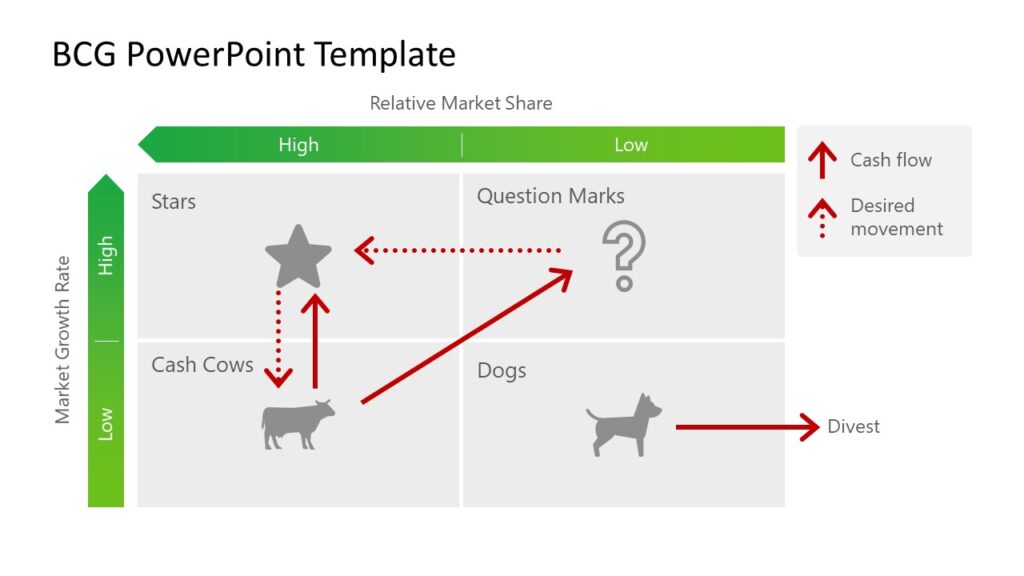
Step 1: Select the unit to be analyzed
Determining the specific unit you want to analyze using the BCG matrix is the first and most crucial step in the analysis process. The unit to be analyzed can be a strategic business unit (SBU), a brand, a product, or a service. The business needs to carefully select the right unit, as it will impact the entire analysis process.
Step 2: Determine the relative market share
Relative market share is the ratio of a product/service’s market share to that of the largest competitor in the same industry. To determine the relative market share, the business needs to know the market share of its chosen unit in the specific field of operation.
Relative market share is calculated by dividing the market share of the product/service being analyzed by the market share of the largest competitor in the same industry. In some cases, market share may also be calculated by the unit’s sales value or the number of products sold compared to the total market.
Step 3: Determine the market growth rate
The market growth rate is understood as the rate of change in the market size over a specific period. To calculate the market growth rate, managers need to collect information on the overall market growth in the business’s field of operation. This information may include sales growth rate, the number of new products on the market, or other related factors.
The formula for calculating market growth rate is the percentage change in market size over a specific period
Step 4: Classify according to the BCG model
After determining the relative market share and market growth rate, the business will proceed to classify the product/service according to the BCG matrix. This includes 4 categories: Cash Cows, Stars, Question Marks, and Dogs.
- Dogs: Products/services with low relative market share and low market growth rate. These are products/services that have no growth potential and bring low profits to the business.
- Question Marks: Products/services with low relative market share but high market growth rate. These are products/services with high growth potential but require significant investment to compete effectively.
- Stars: Products/services with high relative market share and high market growth rate. These are products/services with high growth potential that bring large profits to the business.
- Cash Cows: Products/services with high relative market share but low market growth rate. These are products/services that bring stable profits to the business but require little investment.
Step 5: Make a decision
After you have classified the units in the BCG matrix, you can make decisions on the corresponding strategy for each category. Specifically:
- For products/services in the star and question mark groups, the business needs to invest to develop and expand market share.
- For products/services in the cash cow group, the business needs to maintain and optimize operations to generate stable profits.
- For products/services in the dog group, the business should consider divesting to focus resources on products/services with higher growth potential.
The final decision will depend on the specific goals and situation of your business.
6. How to Apply the BCG Matrix in Strategy Formulation
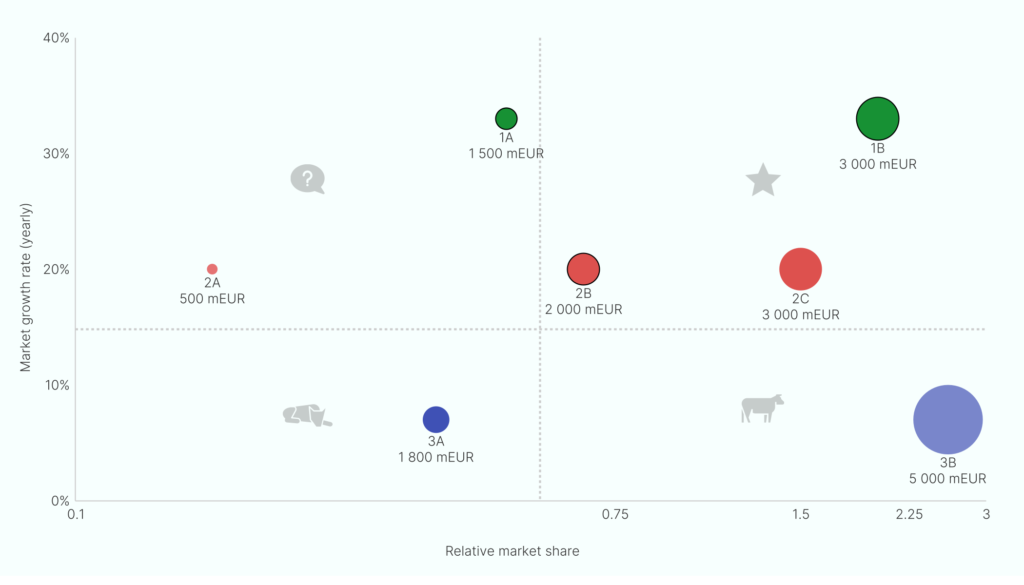
The BCG matrix can be applied in a company’s strategy formulation in the following ways:
Resource Allocation
The BCG matrix can be used to allocate resources to products/services in a company’s business portfolio. Based on the BCG model’s classification, the company can make decisions to invest, maintain, or divest products/services.
Defining Development Strategy
The BCG matrix can be used to define the development strategy for products/services in a company’s business portfolio. Based on the BCG matrix’s classification, the company can devise suitable development strategies for each product/service.
Monitoring Strategy Effectiveness
The BCG matrix can be used to monitor the effectiveness of a company’s business strategy. Based on the BCG model’s classification, the company can evaluate the effectiveness of its implemented business strategy.
- If products/services in the Star and Question Mark categories show growth in relative market share and market growth rate, it indicates that the company’s business strategy is effective.
- If products/services in the Cash Cow category show stable profitability, this also indicates that the company’s business strategy is effective.
- If products/services in the Dog category show a decline in relative market share and market growth rate, it indicates that the company’s business strategy needs adjustment.
7. Considerations During BCG Matrix Analysis

During the BCG matrix analysis process, you will need to note several points such as:
- Correctly Understand Market Share and Growth Rate: To classify product lines into appropriate groups, accurately determining relative market share and market growth rate is crucial. If the assessment is inaccurate or lacks a solid basis, the business and its managers may make inappropriate investment decisions.
- Avoid a One-Dimensional Assessment of Products and Markets: The BCG matrix is based on only two factors (market share and growth). Therefore, to gain a comprehensive view and make accurate decisions, you need to consider and analyze other factors such as: profit margins, competition, external environmental factors, and apply other analysis models like PESTEL, SWOT, etc.
- The Dynamic Nature of the Market: Growth rate and market share can change over time, so the classification of products in the BCG matrix is only a snapshot in time. Managers need to closely monitor market changes to make timely and appropriate strategic adjustments.
- Do Not Eliminate Products in the Dogs Category Prematurely: Although products in the “Dog” category do not generate high profits, some of them may play a strategic role in maintaining brand image or serving certain market segments.
- Investment Resources for the Question Mark Group: Businesses need to be cautious when investing in product groups in this category because their development potential is unclear, and they risk becoming Dogs.
8. Common Mistakes When Businesses Apply the BCG Matrix
Although the BCG matrix is a popular tool in strategic management, many businesses still “apply it incorrectly,” leading to inaccurate analysis results. The first mistake is using outdated data or subjective estimates to create the matrix. When the market changes rapidly, even a few months’ delay in updating data can cause a product’s position in the matrix to be completely wrong.
The second mistake is applying the BCG matrix mechanically. Many businesses assume that “Stars” must be invested in and “Dogs” should be eliminated. In reality, some products in the “Dog” quadrant play a strategic role in customer retention or brand image building. If eliminated hastily, the business could lose a long-term advantage.
Another mistake is ignoring factors outside the matrix. The BCG focuses only on market share and market growth but does not reflect changes in technology, consumer behavior, or brand strength. Relying solely on the BCG can give a business a one-sided view and lead to poorly considered decisions.
9. Modern Trends in Using the BCG Matrix
In the context of digital business and the data explosion, the BCG matrix has been “upgraded” to fit the new era. One of the prominent trends is combining the BCG with Big Data and Artificial Intelligence (AI). By analyzing real-time data, businesses can accurately determine a product’s position on the matrix and quickly adjust their strategies.
The second trend is integrating the BCG with other strategic models. Instead of using it in isolation, businesses combine the BCG with SWOT, PESTEL, or Ansoff to gain a more comprehensive perspective, understanding both product positioning, the macroeconomic context, and internal capabilities.
Additionally, more and more global companies are using the BCG in a dynamic rather than static way. Instead of analyzing it once and “setting it in stone,” they continuously update data, creating a living BCG matrix that accurately reflects market developments quarterly or annually.
For example, large tech corporations like Google or Amazon regularly adjust their product portfolios based on the BCG combined with customer behavior data, helping them allocate resources flexibly and maintain a competitive edge.
10. Frequently Asked Questions about the BCG Matrix
Is the BCG matrix suitable for all businesses?
The BCG matrix is not suitable for all businesses because:
- More suitable for large enterprises: The BCG matrix is primarily designed for large enterprises with multiple products or Strategic Business Units (SBUs). Meanwhile, small businesses often have fewer products, so analysis using this matrix may not be highly effective due to a lack of diversity for resource allocation.
- Not suitable for stable or saturated markets: The BCG matrix is based on market growth rate. For industries that are saturated or stable, the growth rate is low or constant, which reduces the effectiveness of the analysis and makes it difficult to accurately determine product positioning.
When should a business use the BCG matrix?
Businesses should use this model when they need to evaluate their investment portfolio’s performance to identify which products are highly profitable or underperforming. Additionally, it is a powerful tool for long-term strategic planning to allocate budgets focused on groups with high growth potential.
What strategies are applied based on the BCG matrix analysis?
There are 4 core strategies:
- Build (invest in the Question Marks group).
- Hold (reinvest in the Stars group).
- Harvest (maximize profits from the Cash Cows group).
- Divest (eliminate the Dogs group).
The choice of strategy depends on the product’s position and the organization’s cash flow objectives.
Why shouldn’t a product in the “Dogs” category always be eliminated immediately?
Despite low market share and growth, some “Dogs” products play a strategic role, such as completing an ecosystem, blocking competitors, or maintaining brand image. A business should only divest when these products no longer provide supplementary value and cause a waste of financial resources.
How can we make accurate strategic decisions and limit data discrepancies?
Businesses should digitize data on the 1Office all-in-one management platform. Operating on a single platform helps businesses connect data seamlessly across work, HR, and sales, creating a clear competitive advantage. 1Office also integrates the 1AI Dashboard to turn data into an effective decision-making tool:
- Aggregates data from multiple sources and displays it visually in real-time
- AI quickly summarizes key insights for managers
- Detects anomalies and “bottlenecks” in operations
- Recommends strategies based on real data
This enables businesses to make more accurate decisions, operate more leanly, and minimize risks.
Register for a free feature Demo!
11. Conclusion
The BCG Matrix is a fairly common business model used in corporate strategy formulation. However, businesses need to be aware of the limitations of the BCG matrix to make accurate strategic decisions. We wish your business success
















