


 12/05/2026
  484 views
The turnover rate is a crucial metric for businesses, especially in today’s highly volatile labor market. So, what exactly is the turnover rate? Why does it play such an important role in a business? And how is this metric calculated? Let’s find out in the following article with 1Office!
Mục lục
1. What is turnover rate?
Turnover rate is the employee resignation rate (employee turnover rate) that reflects the proportion of employees who leave compared to the average number of employees over a specific period, such as a month, quarter, or year. From this, businesses can determine the rate of personnel change and develop strategies to retain employees.

2. Why is the turnover rate metric especially important?
The turnover rate not only reflects the fluctuation of a company’s personnel but also symbolizes the organization’s “health.” A higher employee resignation rate indicates that the company’s work environment is facing many problems. The issues could lie in relationships between colleagues, with superiors; compensation and benefits policies, or corporate culture.

A large number of employees resigning costs the company a significant amount of money. These costs include recruitment and new training expenses, and also impact organizational performance while these changes are still stabilizing.
When the number of employees leaving increases, it is a signal for leaders to review compensation policies, individual workloads, and propose reasonable adjustments.
On the other hand, in today’s changing labor market, attracting and retaining talent is a difficult process. Businesses need to monitor their turnover rate to remain competitive in the market.
3. Formula for calculating turnover rate
You can calculate your company’s resignation rate using the following formula.
Calculation formula:
| Turnover Rate = (Number of employees who left) / (Average number of employees) x 100 |
Specifically:
- Number of employees who left: The number of employees who resigned during the period for which you want to calculate the turnover rate.
- Average number of employees: The average of the number of employees on the first day and the last day of the period.
Example: To calculate the turnover rate for Company A in 2023. On 01/01/2023, the company had 70 employees, and on 01/01/2024, it had 82 employees. The number of employees who left in 2023 was 15.
Average number of employees in 2023 = (70+82) / 2 = 152 / 2 = 76 people
Now, we have enough information to calculate the turnover rate:
Turnover Rate = 15 / 76 × 100% ≈ 19.74%
Thus, Company A’s employee turnover rate in 2023 is approximately 19.74%.

3. What is a good/bad turnover rate?
A company’s turnover rate reflects its overall “health.” So, how can you evaluate these metrics?
According to Dr. John Sullivan, a leading expert in human resource management solutions, the specific assessments for this metric are as follows:
| Turnover rate | Assessment |
| < 3% | The company’s personnel situation is stable. Employee departures are mainly due to objective factors. |
| 3% – 5% | The business can still control the turnover rate, and it does not have a significant impact on the company. The main causes may be related to compensation and management style. |
| 5% – 8% | This rate reflects the personnel difficulties the company is facing. Besides issues with the salary system and management, the work environment may not be suitable for employee development. The training and resource development system needs to be reviewed. |
| 8% – 10% | This is an alarming figure indicating workforce instability. In addition to potential issues with management, salary, environment, or development opportunities, the corporate culture also needs to be re-examined. |
| > 10% | Leadership needs to conduct a comprehensive review of all the issues mentioned above. The business can consult with other companies in the same industry to identify its current human resource management challenges. From there, specific solutions can be developed. |
A turnover rate maintained at 4% – 6% is considered ideal for a business. However, this figure cannot be applied to all industries because the characteristics of each industry are different.
Some industries with high turnover rates include: Restaurants and food services; Retail; Real estate; Insurance; Customer service; etc.
4. 5 main causes affecting your business’s turnover rate
The Salary and Labor Market Report 2024 (Talent Guide 2024) published by Navigos Search has identified 5 reasons why employees leave a company.

Ranking first at 70.1%, salary is considered the most powerful factor influencing an employee’s decision to leave their current job. They feel the company’s compensation does not match their job position and workload.
Company culture (accounting for 35.7%) and opportunities for career advancement (accounting for 35.5%) hold the second and third positions, respectively. Additionally, work-life balance ranks fourth (at 35.4%), and leaving due to a direct manager is the fifth reason (with 35.2%).
Thus, it is clear that besides the desire to meet material needs, employees are increasingly prioritizing values related to health and well-being. This is the factor that motivates them to leave and seek more suitable job opportunities.
5. 5 methods to improve employee turnover rate
Understanding the concerns and worries surrounding HR issues in general and a company’s turnover rate in particular, we share with you 5 methods to improve employee turnover.
5.1 Regularly listen to the employee experience
As a first step, businesses can conduct anonymous surveys to listen to and understand the employees currently working at the company.

The HR department can learn about employees’ satisfaction levels as well as what they are dissatisfied with during their time at the company. From there, leadership can adjust some management policies to retain the workforce.
In particular, during the recruitment process, the company needs to clarify certain information with candidates during discussions. This information includes opportunities for development and promotion within the company and the compensation and benefits the company offers its employees.
In addition, businesses should also pay attention to and propose training courses to develop employees’ professional capabilities. Nowadays, employees highly value opportunities to learn and develop their professional skills. Therefore, they appreciate the learning opportunities provided by the company. As a result, the employee retention rate improves.
5.2 Survey departing employees
The company can also improve its turnover rate by conducting surveys with employees who are resigning.

Through surveys, the business can identify the underlying reasons why employees choose to leave. You will have the opportunity to listen to and understand employees’ feelings during their employment, their thoughts on company culture, and management style.
This allows for corrective measures and timely handling if the fault lies with the company, preventing similar departures.
5.3 Be meticulous from the candidate recruitment stage
One of the most practical solutions to reduce the turnover rate is to be meticulous right from the recruitment stage.

During the interview process, HR should not only focus on attitude and work experience. It is necessary to use interviewing techniques and ask questions to understand deeper personal information such as desires, goals, and intentions.
This way, the company can not only screen for candidates who fit the job requirements more thoroughly but also select potential candidates who are willing to commit to the company long-term.
5.4 Provide employees with suitable benefits
Employee benefits are one of the most important factors in retaining staff and attracting potential candidates.
Benefits are not just about salary or the work environment, but also include flexible leave days, health insurance, free lunches, and more.
Although these may seem like small things, they show that your company is willing to pay a competitive salary along with a range of attractive benefits to foster employee loyalty.
5.5 Improve the quality of human resource management with 1HRM
As you know, one of the top 5 reasons employees choose to leave their jobs is due to leadership and management issues.
Therefore, leaders must first focus on self-development, enhancing their human resource management skills to gain a deeper understanding. From there, you can broaden your vision, improve the work environment, and pay more attention to your employees’ well-being.
However, as a leader of a growing or organizationally unstable business, you might feel ‘drowned’ by a mountain of miscellaneous tasks. Even time for family becomes increasingly scarce.
The question arises, “How can I focus on self-development when I don’t even have time for family and work?” Understanding this, 1HRM was created with the mission to support businesses and reduce the burden of human resource management.
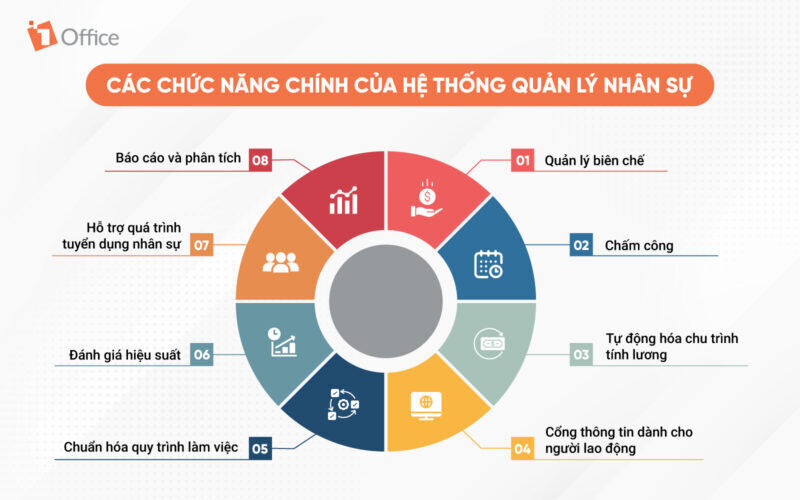
Known as the best human resource management tool on the market today, 1HRM possesses many smart features to quickly solve challenges in recruitment, personnel management, competency assessment, timekeeping, and payroll.
Not only does it help businesses eliminate cumbersome manual administrative procedures, but your company can also easily inform employees about promotion opportunities, make decisions on individual salaries and bonuses, and ensure evaluations are transparent and fair. With 1HRM, leaders are at ease, and employees are happy.
6. Conclusion
In the article above, we have provided you with information about turnover rate. In addition to the concept, 1Office offers a formula to accurately calculate the employee turnover rate and suggests some measures to address this situation. We hope your business can retain its employees and continue to grow.
















