


 12/05/2026
  270 views
High revenue but low profit is a problem that many businesses face. One of the reasons for this situation is that managers have not effectively utilized revenue deductions – one of the effective tools that help businesses reduce their tax burden and increase profits. In this article, let’s explore the concept, classification, and accounting methods for these revenue deductions with 1Office.
Mục lục
1. What are revenue deductions?
According to Article 81 of Circular 200/2014/TT-BTC, the concept of revenue deductions is defined as follows:
Revenue deductions are all amounts adjusted to reduce the sales and service revenue generated during a period and are recorded in Account 521. This account does not reflect taxes deducted from revenue, such as output VAT payable calculated using the direct method.
The accounting and adjustment must comply with the provisions of the Law on Corporate Income Tax and related guiding documents. Businesses need to ensure complete and accurate recording of all documents related to deductions to ensure legality and transparency in their business operations.
2. Classification of revenue deductions
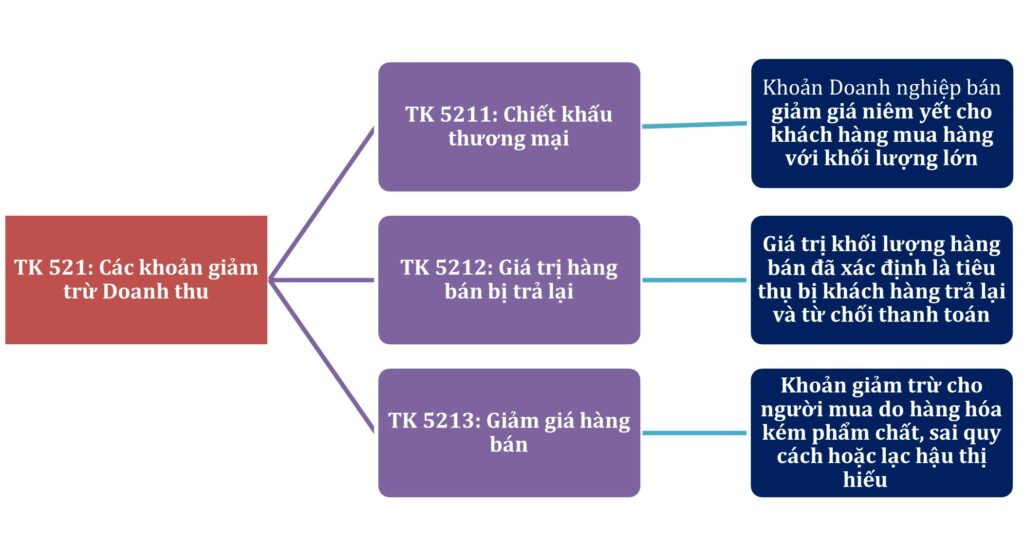
Revenue deductions include 3 types:
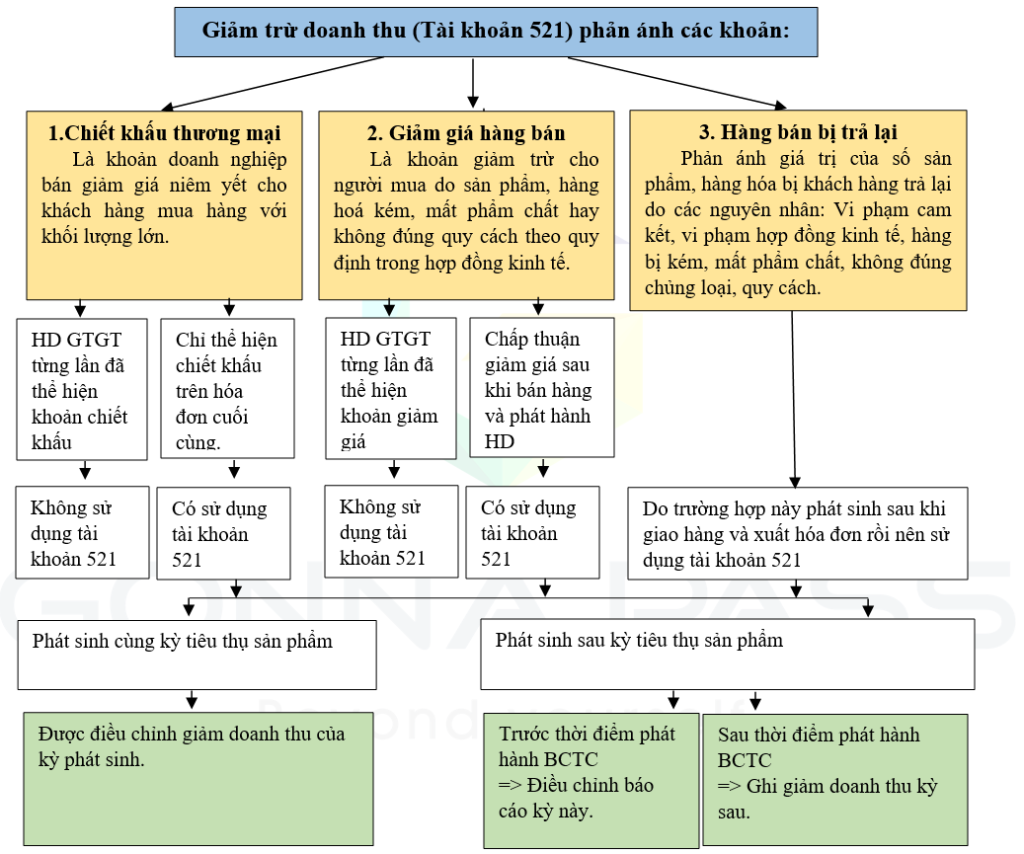
- Trade discounts: This is a price reduction that a business offers to customers when they purchase goods in large quantities. Trade discounts are considered a tool to encourage customers to buy in bulk, thereby helping the business increase revenue and improve cash flow effectively.
- Sales allowances: This is a deduction for products or goods that are damaged, obsolete, or not of the quality committed. The purpose of sales allowances is to sell off inventory and minimize losses for the business.
- Sales returns: This is a refund given to customers when they return purchased goods for reasons such as dissatisfaction, defective products, contract violations, etc. Businesses need to have a reasonable return policy to protect customer rights and maintain brand reputation.
Example of revenue deductions: A customer receives a 10% trade discount for buying in large quantities. The business agrees to a return/exchange according to its policy and gives the customer a 5 million VND allowance, or agrees to let the customer return the goods and receive a full refund of the amount paid.
3. Formula for calculating revenue deductions
According to Circular 200/2014/TT-BTC, Account 521 – Revenue Deductions has no ending balance, as follows:
Account 521 has 3 sub-accounts, including:
- Account 5211 – Trade Discounts: Reflects trade discounts granted to buyers for purchasing in large volumes, which were not reflected on the invoice at the time of selling products/goods or providing services during the period.
- Account 5212 – Sales Returns: Reflects the revenue from products, goods, and services returned by buyers during the period.
- Account 5213 – Sales Allowances: Reflects sales allowances granted to buyers because the provided products, goods, or services did not meet specifications, which were not reflected on the invoice at the time of sale during the period.
Structure of Account 521 – Revenue Deductions:
Debit side:
- The amount of trade discounts accepted for payment to customers;
- The amount of sales allowances approved for buyers;
- Revenue from returned goods for which money has been refunded to the buyer or deducted from the customer’s accounts receivable for the sold products/goods.
Credit side:
- At the end of the accounting period, the total amount of trade discounts, sales allowances, and revenue from returned goods is transferred to Account 511 – Sales and Service Revenue to determine the net revenue for the reporting period.
4. Accounting for revenue deductions
If applying the accounting regime under Circular 200, revenue deductions will be recorded in Account 521. If the business applies the accounting regime under Circular 133, managers will record them in Account 511. Therefore, businesses need to identify which accounting regime they are following and choose the correct account for revenue deductions.
4.1. Revenue deductions according to Circular 200
Circular 200/2014/TT-BTC, issued by the Ministry of Finance, regulates the Chart of Accounts for entities and organizations involved in production, business, and service activities. According to this circular, deductions are accounted for as follows:
4.1.1. Accounting for Trade Discounts
| Case | Calculating VAT using the deduction method | Calculating VAT using the direct method |
| Debit Side | Acc 5211: Trade discount (CKTM) for customers
Acc 3331: VAT reduction |
Acc 521: Sales discount for customers |
| Credit Side | Acc 111, 112, 131: Total discount value for the buyer | Acc 111, 112, 131: Total discount value for the buyer |
4.1.2. Accounting for the Value of Sales Returns
| Case | Calculating VAT using the deduction method | Calculating VAT using the direct method |
| Debit Side | Account 5212: Revenue from returned goods recorded as a decrease
Account 3331: VAT recorded as a decrease |
Account 5212: Revenue from returned goods recorded as a decrease |
| Credit Side | Accounts 111, 112, 131: Total revenue including tax recorded as a decrease | Accounts 111, 112, 131: Total revenue including tax recorded as a decrease |
4.1.3. Accounting for Sales Discounts
| Case | Calculating VAT using the deduction method | Calculating VAT using the direct method |
| Debit Side | TK 5213: Value of goods discounted for the buyer
TK 3331: VAT recorded as a reduction |
TK 5213: Value of goods discounted for the buyer |
| Credit Side | TK 111, 112, 131: Total value of goods discounted for the buyer | TK 111, 112, 131: Total discounted value for the buyer |
4.2. Revenue deductions according to Circular 133
4.2.1. Calculating VAT using the deduction method
| Case | Debit Side | Credit Side |
| Trade Discount | Acc 511: Discount for customers, excluding VAT.
Acc 333: VAT on the discounted value for customers. |
Acc 131: Total discount value for customers. |
| Sales Allowance | Acc 511: Value of sales allowance for customers, excluding VAT.
Acc 333: VAT on the value of the sales allowance. |
Acc 131: Total value of the sales allowance. |
| Sales Returns | Acc 511: Value of returned goods, excluding VAT.
Acc 333: VAT on the returned goods. |
Acc 131: Total value of returned goods. |
4.2.2. VAT Calculation Using the Direct Method
| Case | Debit | Credit |
| Trade Discount | Acc 511: Discount for customers, excluding value-added tax. | Acc 131: Total discount value for customers. |
| Sales Allowance | Acc 511: Value of sales allowance for customers, excluding value-added tax. | Acc 131: Total value of sales allowance. |
| Sales Returns | Acc 511: Value of returned goods, excluding value-added tax. | Acc 131: Total value of returned goods. |
5. Conclusion
Revenue deductions play a crucial role in determining a business’s actual revenue. Understanding the regulations for accounting for revenue deductions is extremely important to ensure legality and transparency in business operations. This helps reduce the tax burden and increase profits in their business activities.
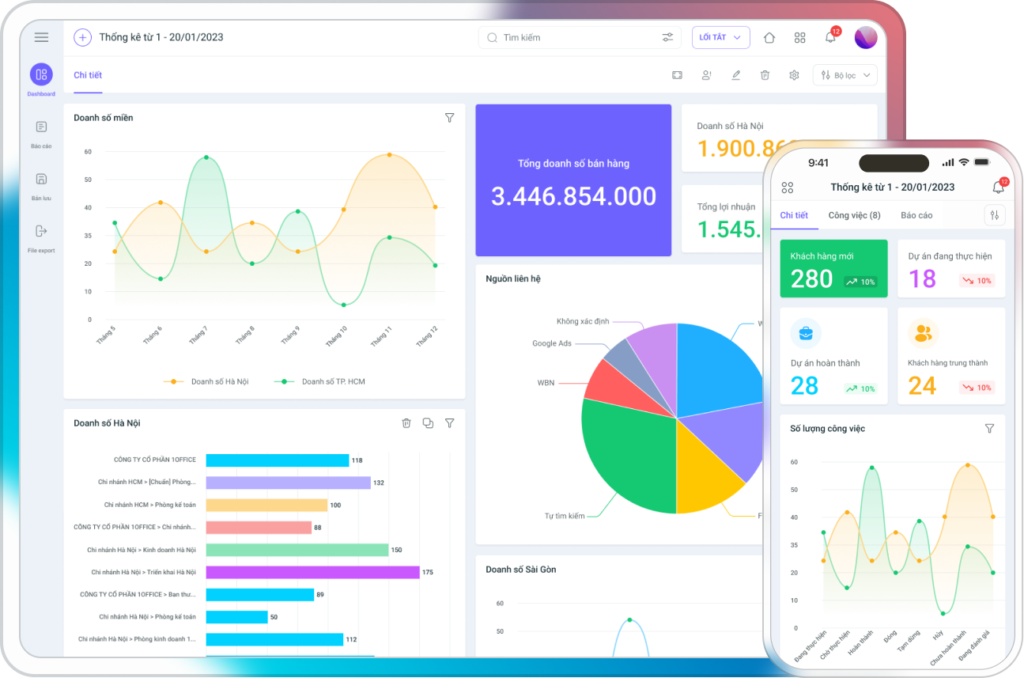
1Office revenue and expenditure management software helps businesses automate the accounting of revenue deductions, ensuring accuracy and legality. 1Office provides the following functions:
- Sales Management: Record sales revenue, trade discounts, sales allowances, and sales returns.
- VAT Accounting: Calculate value-added tax using the deduction method and the direct method.
- Financial Reporting: Automatically generate VAT reports, income statements, and balance sheets.
With 1Office, businesses can completely save time and effort in revenue accounting, ensuring the accuracy and legality of tax data while improving financial management efficiency.
Experience a free trial today!
For a free consultation, please contact us via:
- Hotline: 083 483 8888
- Facebook: https://www.facebook.com/1officevn/
- Youtube: https://www.youtube.com/@1office-chuyendoisodn
















